VOOZH about

URL: https://www.amazon.com/dp/0310330297?&linkCode=sl1&tag=gotquestion09-20&linkId=71a2ad4f5f01e0648ca1931fe895a309&language=en_US&ref_=as_li_ss_tl

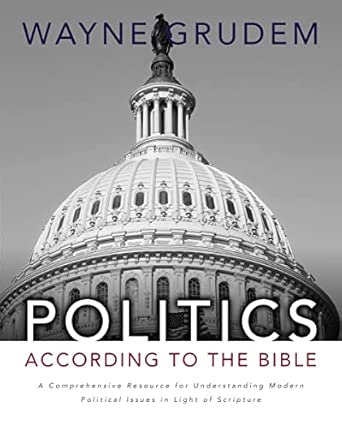
⇱ Politics - According to the Bible: A Comprehensive Resource for Understanding Modern Political Issues in Light of Scripture: Grudem, Wayne A.: 9780310330295: Amazon.com: Books


πŸ‘ Image
πŸ‘ Image
Enjoy fast, free delivery, exclusive deals, and award-winning movies & TV shows.
Buy New
-46% $27.06$27.06
FREE delivery Monday, April 13 on orders shipped by Amazon over $35
Ships from: Amazon.com
Sold by: Amazon.com

Download the free Kindle app and start reading Kindle books instantly on your smartphone, tablet, or computer - no Kindle device required.

Read instantly on your browser with Kindle for Web.


Using your mobile phone camera - scan the code below and download the Kindle app.

πŸ‘ QR code to download the Kindle App

πŸ‘ Play
Audible sample

Follow the author

Get new release updates & improved recommendations
Something went wrong. Please try your request again later.

OK

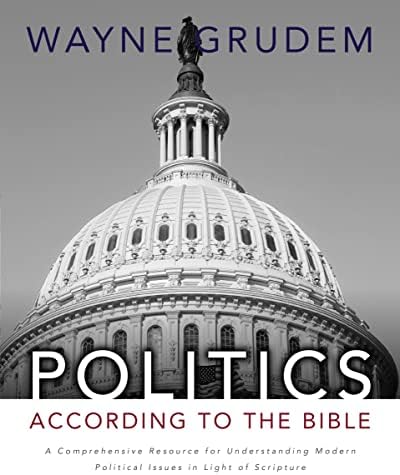
Politics - According to the Bible: A Comprehensive Resource for Understanding Modern Political Issues in Light of Scripture Hardcover – September 3, 2010


{"desktop_buybox_group_1":[{"displayPrice":"$27.06","priceAmount":27.06,"currencySymbol":"$","integerValue":"27","decimalSeparator":".","fractionalValue":"06","symbolPosition":"left","hasSpace":false,"showFractionalPartIfEmpty":true,"offerListingId":"5FD2XM91J9gxUya0%2Bi%2FDW9pXrp88DBXw9sYm8D1dssyBng1FWWPMPBZfckM2EWwjgMDS%2FCi62NcaFU2rH%2BGZyZsZliHZ4WtmuREcgSbe75Zwyn6tj2YIu9aCFJDtvTLgcFDj2JOLNUc%3D","locale":"en-US","buyingOptionType":"NEW","aapiBuyingOptionIndex":0}, {"displayPrice":"$15.35","priceAmount":15.35,"currencySymbol":"$","integerValue":"15","decimalSeparator":".","fractionalValue":"35","symbolPosition":"left","hasSpace":false,"showFractionalPartIfEmpty":true,"offerListingId":"5FD2XM91J9gxUya0%2Bi%2FDW9pXrp88DBXwHaoavoZi5XKSy7LP7PHEQiDw01d1MNIbUQF7%2BVnb0%2BglgTu3LwX5Bozyu0rAhJyFdEiLglGO9MteWo60B%2Be79FmhjOlFXHXF8g1teR%2BsFXk3iUFetrFsMcKnQ1XDF961DkFbppt27OJuF7Vm%2FuHGHDUoBcC3E9UB","locale":"en-US","buyingOptionType":"USED","aapiBuyingOptionIndex":1}]}

Purchase options and add-ons


Should Christians be involved in political issues?

This comprehensive and readable book presents a political philosophy from the perspective that the Gospel pertains to all of life, including politics. Politicsβ€”According to the Bible is an in-depth analysis of conservative and liberal plans to do good for the nation, evaluated in light of the Bible and common sense.

Evangelical Bible professor, and author of the bestselling book Systematic Theology, Wayne Grudem unpacks and rejects five common views about Christian influence on politics:

  1. "compel religion,"
  2. "exclude religion,"
  3. "all government is demonic,"
  4. "do evangelism, not politics," and
  5. "do politics, not evangelism."

Instead, he defends a position of "significant Christian influence on government" and explains the Bible's teachings about the purpose of civil government and the characteristics of good or bad governments. Grudem provides a thoughtful analysis of over fifty specific and current political issues dealing with:

  • The protection of life.
  • Marriage, the family, and children.
  • Economic issues and taxation.
  • The environment.
  • National defense
  • Relationships to other nations.
  • Freedom of speech and religion.
  • Quotas.
  • And special interests.

Throughout this book, he makes frequent application to the current policies of the Democratic and Republican parties in the United States, but the principles discussed here are relevant for any nation.


The Amazon Book Review
Book recommendations, author interviews, editors' picks, and more. Read it now.

Frequently bought together

This item: Politics - According to the Bible: A Comprehensive Resource for Understanding Modern Political Issues in Light of Scripture
$27.06$27.06
Get it as soon as Monday, Apr 13
In Stock
Ships from and sold by Amazon.com.
Total price: $00$00
To see our price, add these items to your cart.
Try again!
Details
Added to Cart
Choose items to buy together.

Customers who viewed this item also viewed

Page 1 of 1 Start over

Customers also bought or read

Page 1 of 1Start over
Loading...

From the brand

Editorial Reviews

Review

"There are sections of this book that are uncannily timely . . . This can be a wonderful resource as we face growing tensions from an ever more powerful state."
--Chuck Colson, Founder, Prison Fellowship

"a sweeping, and inspiring, guide to politics and government .... [this book] will be on the desk next to the microphone in my radio studio" --Hugh Hewitt, professor of law and radio talk show host

"[Grudem's] biblically-based good sense overwhelms the nostrums of . . . the evangelical left." --Marvin Olasky, editor, World magazine

Conservative and hard-hitting both biblically and culturally, . . . [it covers] the whole waterfront of America's political debate with shrewd insight and strong argument . . . . An outstanding achievement! --J I Packer, Regent College, Vancouver,

"The fuzzy thinking . . . of many evangelicals is corrected in Wayne Grudem's biblical and irenic assessment of contemporary politics." --Paige Patterson, president, Southwestern Baptist Seminary

From the Back Cover

"Precisely and exactly the call the rising generation needs to hear"
-- Timothy Goeglein, Vice President, External Relations, Focus on the Family

Written by the author of the bestselling theology text in the world, this book not only considers today's most pressing issues, but also details the purpose of civil government and how Christians might best influence government.
Politics -- According to the Bible may be the most important book you can read on how the Bible supports conservative political positions.

About the Author

Wayne Grudem is Research Professor of Theology and Biblical Studies at Phoenix Seminary in Phoenix, Arizona. He previously taught for twenty years at Trinity Evangelical Divinity School, Deerfield, Illinois. He holds degrees from Harvard (BA), Westminster Seminary (MDiv), and Cambridge (PhD). He is the author of a number of books, including the bestselling Systematic Theology,  and the editor of Are Miraculous Gifts for Today. He is a former president of the Evangelical Theological Society.

Excerpt. Β© Reprinted by permission. All rights reserved.

Politics-According to the Bible

A comprehensive resource for understanding modern political issues in light of scriptureBy Wayne Grudem

Zondervan

Copyright Β© 2010Wayne A. Grudem
All right reserved.

ISBN: 978-0-310-33029-5

Contents

Preface....................................................................................................13Introduction...............................................................................................17Chapter 1: Five Wrong Views about Christians and Government................................................23Chapter 2: A Better Solution: Significant Christian Influence on Government................................55Chapter 3: Biblical Principles Concerning Government.......................................................77Chapter 4: A Biblical Worldview............................................................................116Chapter 5: The Courts and the Question of Ultimate Power in a Nation.......................................124Chapter 6: The Protection of Life..........................................................................157Chapter 8: The Family......................................................................................245Chapter 9: Economics.......................................................................................261Chapter 10: The Environment................................................................................320Chapter 11: National Defense...............................................................................387Chapter 12: Foreign policy.................................................................................436Chapter 13: Freedom of Speech..............................................................................484Chapter 14: Freedom of Religion............................................................................499Chapter 15: Special Groups.................................................................................513Chapter 16: The Problem of Media Bias: When the Watchdogs Fall Asleep......................................555Chapter 17: Application to Democratic and Republican Policies Today........................................572Chapter 18: Faith and Works, and Trusting God While Working in Politics and Government.....................591Scripture Index............................................................................................602Index of Names.............................................................................................608Subject Index..............................................................................................615

Chapter One

FIVE WRONG VIEWS ABOUT CHRISTIANS AND GOVERNMENT

Before explaining my own understanding of the proper role of Christians in politics, I need to examine what I think are five wrong views on this question-sadly mistaken views that have been propagated by many writers throughout history. Then in the following chapter I propose what I think is a better, more balanced solution.

A. GOVERNMENT SHOULD COMPEL RELIGION

The first wrong view (according to my judgment) is the idea that civil government should compel people to support or follow one particular religion.

Tragically, this "compel religion" view was held by many Christians in previous centuries. This view played a large role in the Thirty Years' War (1618-48) that began as a conflict between Protestants and Roman Catholics over control of various territories, especially in Germany. There were many other "wars of religion" in Europe, particularly between Catholics and Protestants, in the sixteenth and seventeenth centuries. Also in the sixteenth century, the Reformed and Lutheran Protestants persecuted and killed thousands from the Anabaptist groups in Switzerland and Germany who sought to have churches for "believers only" and practiced baptism by immersion for those who made a personal profession of faith.

Over the course of time, more and more Christians realized that this "compel religion" view is inconsistent with the teachings of Jesus and inconsistent with the nature of faith itself (see discussion below). Today I am not aware of any major Christian group that still holds to the view that government should try to compel people to follow the Christian faith.

But other religions still promote government enforcement of their religion. This is seen in countries such as Saudi Arabia, which enforces laws compelling people to follow Islam and where those who fail to comply can face severe penalties from the religious police. The law prohibits any public practice of any religion other than Islam and prohibits Saudis from converting to other religions. Islamic advocate Bilal Cleland writes at the pro-Islamic web site Islam for Today, "Legislation contained in the Quran becomes the basic law of the state."

The "compel religion" view is also used by violent groups around the world to justify persecution of Christians, such as the burning by Muslims of an entire Christian village in Pakistan, killing six Christians in early August 2009, or the warfare waged by Islamic militant groups against Christians in Nigeria, Sudan, and other sub-Saharan African countries. The "compel religion" view has also led to the violent persecution of Christians by some Hindu groups in India. In 1999 it was reported that fifty-one Christian churches and prayer halls were burned to the ground in the western state of Gujarat. An Australian missionary, Graham Staines, and his two young sons were burned to death in their jeep by a Hindu mob in Orissa state on the eastern coast of India. In 2007 it was reported by the Associated Press that Hindu extremists set fire to nearly a dozen churches.

But it must be noted that other Muslims and other Hindus also favor democracy and allowing varying degrees of freedom of religion.

In the early years of the United States, support for freedom of religion in the American colonies increased both because of a need to form a united country with people from various religious backgrounds (such as Congregational, Episcopalian, Presbyterian, Quaker, Baptist, Roman Catholic, and Jewish) and because many of the colonists had fled from religious persecution in their home countries. For example, the New England Pilgrims had fled from England where they had faced fines and imprisonment for failing to attend services in the Church of England and for conducting their own church services.

In 1779, just three years after the Declaration of Independence, Thomas Jefferson drafted the Virginia Act for Establishing Religious Freedom, which demonstrated the increasing support for religious freedom in the United States. Jefferson wrote:

Be it therefore enacted by the General Assembly, That no man shall be compelled to frequent or support any religious worship, place, or ministry whatsoever, nor shall be enforced, restrained, molested, or burdened in his body or goods, nor shall otherwise suffer on account of his religious opinions or belief; but that all men shall be free to profess, and by argument to maintain, their opinions in matters of religion, and that the same shall in nowise diminish, enlarge, or affect their civil capacities.

Several teachings of the Bible show that "government should compel religion" is an incorrect view, one that is contrary to the teachings of the Bible itself.

1. Jesus distinguished the realms of God and of Caesar

The first biblical argument against the "compel religion" view comes from Jesus' teachings in Matthew 22. Jesus' Jewish opponents were trying to trap him with the question, "Is it lawful to pay taxes to Caesar, or not?" (Matt. 22:18). To say "yes" to Roman taxes ran the risk of appearing to support the hated Roman government. To say "no" to Roman taxes would make Jesus sound like a dangerous revolutionary against Rome's power. Taking his opponents by surprise, Jesus said, "Show me the coin for the tax," and "they brought him a denarius" (v. 19). After that, here is how the teaching unfolded:

And Jesus said to them, "Whose likeness and inscription is this?" They said, "Caesar's." Then he said to them, "Therefore render to Caesar the things that are Caesar's, and to God the things that are God's" (Matt. 22:20-21).

This is a remarkable statement because Jesus shows that there are to be two different spheres of influence, one for the government and one for the religious life of the people of God. Some things, such as taxes, belong to the civil government ("the things that are Caesar's"), and this implies that the church should not try to control these things. On the other hand, some things belong to people's religious life ("the things that are God's"), and this implies that the civil government should not try to control those things.

Jesus did not specify any list of things that belong to each category, but the mere distinction of these two categories had monumental significance for the history of the world. It signaled the endorsement of a different system from the laws for the nation of Israel in the Old Testament. With regard to Old Testament Israel, the whole nation was a "theocracy" in that God was the ruler of the people, the laws were directly given to Israel by God (rather than being decided upon by the people or a human king), and the whole nation was considered "God's people." Therefore everyone in the nation was expected to worship God, and the laws of Israel covered not only what we today would consider "secular matters" such as murder and theft, but also "religious matters" such as animal sacrifices and punishments for worshiping other gods (see Lev. 21-23; Deut. 13:6-11).

In Jesus' statement about God and Caesar, he established the broad outlines of a new order in which "the things that are God's" are not to be under the control of the civil government (or "Caesar"). Such a system is far different from the Old Testament theocracy that was used for the people of Israel. Jesus' new teaching implies that all civil governments-even today-should give people freedom regarding the religious faith they follow or choose not to follow and regarding the religious doctrines they hold and how they worship God. "Caesar" should not control such things, for they are "the things that are God's."

2. Jesus refused to try to compel people to believe in him

Another incident in Jesus' life also shows how he opposed the "compel religion" view, for he rebuked his disciples when they wanted instant punishment to come to people who rejected him:

And he sent messengers ahead of him, who went and entered a village of the Samaritans, to make preparations for him. But the people did not receive him, because his face was set toward Jerusalem. And when his disciples James and John saw it, they said, "Lord, do you want us to tell fire to come down from heaven and consume them?" (Luke 9:52-54).

The disciples apparently thought they had an excellent way to convince people to come to hear Jesus in the next village. If fire came down from heaven and wiped out the Samaritan village that had rejected Jesus, then word would get around and Jesus and the disciples would have 100% attendance in the next village. What a persuasive method to "compel religion"!

But Jesus would have nothing to do with this idea. The next verse says, "But he turned and rebuked them" (Luke 9:55). Jesus directly refused any attempt to try to force people to believe in him or follow him.

3. Genuine faith cannot be forced

The nature of genuine faith fits with Jesus' condemnation of any request for "fire from heaven" to compel people to follow him. The underlying reason is that true faith in God must be voluntary. If faith is to be genuine, it can never be compelled by force. This provides another reason why governments should never try to compel adherence to any particular religion.

A clear respect for people's individual will and voluntary decisions is seen throughout the ministry of Jesus and the apostles. They always taught people and reasoned with them and then appealed to them to make a personal decision to follow Jesus as the true Messiah (see Matt. 11:28-30; Acts 28:23; Rom. 10:9-10; Rev. 22:17).

Genuine religious belief cannot be compelled by force, whether by fire from heaven or by the force of civil government, and Christians should have no part in any attempt to use government power to compel people to support or follow Christianity or any other religion.

But what about the laws God gave to Israel in the Old Testament, especially in the books of Exodus, Leviticus, Numbers, and Deuteronomy? Those laws required people to give tithe money to support the Jewish priesthood and temple services, and they required people to make certain specified sacrifices to the Lord every year (see Lev. 23). They even ordered severe punishments for anyone who tried to teach another religion (see Deut. 13:6-11). But these laws were only for the nation of Israel for that particular time. They were never imposed on any of the surrounding nations. They were part of the Old Testament system that came to an end when Jesus established a "new covenant" for God's people in the New Testament. Such a system was ended by Jesus' teaching that some areas of life were "things that belong to Caesar" and some areas of life were "things that belong to God." Such Old Testament laws enforcing religion were never intended for people after Jesus established his "new covenant," or for any time after that.

4. Not a worldly kingdom

In another incident, just after Jesus had been captured by Roman soldiers near the end of his life, he told the Roman governor, Pontius Pilate,

"My kingdom is not of this world. If my kingdom were of this world, my servants would have been fighting, that I might not be delivered over to the Jews. But my kingdom is not from the world" (John 18:36).

Jesus refused to have his disciples fight with swords and military power, because he was not attempting to establish an earthly kingdom like the Roman Empire or the various other nations in the history of the world. Earthly kingdoms are established by armies and military power, but Jesus' kingdom would be established by the power of the Gospel changing people's hearts, bringing people to trust in him and obey him.

This does not mean that Jesus' kingdom has no effect on the world. Indeed, it transforms and overcomes the world (1 John 3:8; 5:4-5), but it does so by changing people's hearts and their deep convictions, not by military power. The power of government should never be used to compel a certain kind of religious belief or adherence to any specific religion, whether the Christian faith or any other faith.

In summary, the "compel religion" view is contrary to the Bible, and it is simply wrong.

5. Practical implications of rejecting the "compel religion" view

What are the practical implications of rejecting the "compel religion" view? One implication is that governments should never attempt to force people to follow or believe in one specific religion, but should guarantee freedom of religion for followers of all religions within the nation.

Another implication is that Christians in every nation should support freedom of religion and oppose any attempt by government to compel any single religion. In fact, complete freedom of religion should be the first principle advocated and defended by Christians who seek to influence government.

Sometimes non-Christians express a fear that if Christians get too much power in government, they will try to force Christianity on everyone. This is a common argument made by groups such as Americans United for Separation of Church and State, the Center for American Progress, and the Freedom from Religion Foundation. Some critics even suggest that right-wing Christians are trying to establish a theocracy in the United States by incremental means. Michelle Goldberg writes, "The Christian nation is both the goal of the religious right and its fundamental ideology, the justification for its attempt to overthrow the doctrine of separation of church and state.... Right now ... is high tide for theocratic fervor." To counter this kind of false accusation, it is important for Christians involved in politics to affirm again and again their commitment to complete religious freedom in America (and in every other country).

A third implication has to do with governments giving direct financial support to one church as an established "state church." Such government support is a more benign form of the "compel religion" view, but it is still one that I do not think is right. This support occurs in some countries where the civil government uses tax money and privileged status to support one single religion or denomination as the "state church." Such action was prohibited to the US government by the First Amendment-"Government shall make no law respecting an establishment of religion"-where an "establishment of religion" meant giving governmental support for only one church, the "established church."

An established church does still exist in some countries. For example, in the United Kingdom today the Church of England is still the state church; in Scandinavian countries such as Norway and Sweden the Lutheran Church is the state church; and in many countries with a highly Catholic populace such as Spain, the Roman Catholic Church is the state-supported church. In Germany, church taxes are accessed on Catholic, Protestant, and Jewish wage-earners, up to 8 or 9% of their total income. The state then disperses these funds to the churches to be used for social services.

I recognize that some Christians in these countries argue that the benefits that come from having such a state church outweigh the negative effects, but I still cannot see sufficient warrant for it in the New Testament. I see no evidence that government tax money, rather than the donations of individual Christians, should be used to support the religious activities of a church. In addition, the historical pattern seems to be that direct government support weakens a church rather than strengthening it. (Notice the extremely low church attendance at state-sponsored Lutheran churches in Germany or Sweden, for example.)

6. What about giving some tax benefits to churches?

If the government gives some tax benefits to religious organizations, is that another example of the "compel religion" view? For example, in the United States, churches do not pay property taxes on the land and buildings they own, and individuals do not have to pay income taxes on the amount of their income that they donate to churches or other charities.

(Continues...)


Excerpted from Politics-According to the Bibleby Wayne Grudem Copyright Β© 2010 by Wayne A. Grudem. Excerpted by permission.
All rights reserved. No part of this excerpt may be reproduced or reprinted without permission in writing from the publisher.
Excerpts are provided by Dial-A-Book Inc. solely for the personal use of visitors to this web site.


Product details

Brief content visible, double tap to read full content.
Full content visible, double tap to read brief content.

Product Videos

πŸ‘ Image
Customer ReviewSee examples of the inside See Full Review

About the author

Follow authors to get new release updates, plus improved recommendations.
Brief content visible, double tap to read full content.
Full content visible, double tap to read brief content.

Wayne Grudem (PhD, University of Cambridge; DD, Westminster Theological Seminary) is distinguished research professor of theology and biblical studies at Phoenix Seminary, having previously taught for 20 years at Trinity Evangelical Divinity School. He is a former president of the Evangelical Theological Society, a member of the Translation Oversight Committee for the English Standard Version of the Bible, the general editor of the ESV Study Bible, and has published over 20 books.


Customer reviews

4.6 out of 5 stars
376 global ratings
How customer reviews and ratings work

Customer Reviews, including Product Star Ratings help customers to learn more about the product and decide whether it is the right product for them.

To calculate the overall star rating and percentage breakdown by star, we don’t use a simple average. Instead, our system considers things like how recent a review is and if the reviewer bought the item on Amazon. It also analyzed reviews to verify trustworthiness.

Learn more how customers reviews work on Amazon



Customers say

Customers find this book informative and well-referenced, with one review noting it explains topics rationally. Moreover, the book receives praise for its comprehensive analysis and depth of reference, making it an excellent personal study resource. Additionally, customers appreciate its conservative Christian perspective and clear writing style. They value its political insights, with one review describing it as a candid expose of political complexities, while another highlights its focus on good citizenship.
AI Generated from the text of customer reviewsπŸ‘ Image
Generated from the text of customer reviews

Select to learn more

49 customers mention informative, 47 positive, 2 negative49 customers mention "Informative"47 positive2 negative
Customers find the book informative and well-referenced, describing it as a scholarly work that provides great insight on current issues.
"Just what I expected and great resource. No complaints!"Read more
"Easy to understand and very informative. Sounds scripture basis as well. Would recommend highly to anyone who wants to understand politics!"Read more
"This is truly a scholarly work. It would make a great textbook for a full semester course in the subject...."Read more
"...debate and discuss what the bible is telling us, and this is a fantastic reference...."Read more
48 customers mention content, 46 positive, 2 negative48 customers mention "Content"46 positive2 negative
Customers find the book to be an outstanding resource for personal study and recommend it to Christians, describing it as one of the best books on politics.
"This is an excellent book and should be found in all High School and College Libraries. If it were, America would not be in the mess were in."Read more
"This is a great book! You'll be amazed that the Bible does speak to so many Political issues...."Read more
"...This is a good read, and is worth keeping on a reference shelf...."Read more
"Excellent, thought provoking book. This have helped me understand the history of our nation in light of scripture. A great resource."Read more
28 customers mention christian content, 24 positive, 4 negative28 customers mention "Christian content"24 positive4 negative
Customers appreciate the Christian content of the book, which provides a comprehensive review of Biblical principles and helps readers live out a Biblical worldview from a conservative Christian perspective.
"The book is good for a general Christian audience, helping Christians to be discerning about the political context in which they live...."Read more
"...into three parts and eighteen chapters plus three indices -- a scripture index, an index of names, and a subject index...."Read more
"...If you believe the Bible is the inspired, infallible word of God, this book is for you."Read more
"...Perfect for Christians who want to know what our role should be in this political world."Read more
19 customers mention comprehensive, 14 positive, 5 negative19 customers mention "Comprehensive"14 positive5 negative
Customers find the book comprehensive, praising its depth of analysis and reference, with one customer noting its extensive footnotes.
"...It's full of footnotes to back up everything the author says...."Read more
"truly comprehensive"Read more
"Shallow analysis. Several substantial stretches. Here's a couple examples: 1. The subchapter on the F-22 raptor was borderline absurd...."Read more
"Dr. Grudem's book on politics and religion is a very comprehensive and well thought out topic...."Read more
14 customers mention readability, 13 positive, 1 negative14 customers mention "Readability"13 positive1 negative
Customers find the book easy to read as a reference, with one customer noting that Wayne writes very clearly.
"...Don't let the size of the volume deter you from purchase. It's an easy read. Every Christian should read this book...."Read more
"...the content is well-written, the arguments are well-supported and clear, and the style is accessible...."Read more
"...He explains EVERY topic in a rational, easy-to-understand fashion, while providing one or all of the three things stated above (i.e. scrpiture)...."Read more
"One of the most cherished books I own. Written in an easy to read way without the dry academic tone that can often be found in both political and..."Read more
11 customers mention political clarity, 8 positive, 3 negative11 customers mention "Political clarity"8 positive3 negative
Customers appreciate the political clarity of the book, with one customer describing it as a candid expose of political thickets, and another noting its conservative perspective.
"Amazing work. Very truthful."Read more
"...thoughts on our leaders... So its not like he's hiding an agenda, he's honest and we need more of that."Read more
"Unfortunately this book is very biased and one sided with much information regarding current events left out. Had to read it for school...."Read more
"Amazing good book, quite conservative without the mindless conservatism"Read more
7 customers mention citizenship, 5 positive, 2 negative7 customers mention "Citizenship"5 positive2 negative
Customers appreciate the book's approach to citizenship, with one customer highlighting its discussion on protecting national borders, while another notes its preference for Republicans over Democrats.
"...It advocates things as being active, being a good citizen, and regardless of country finding the positive within it."Read more
"...regulation, less government spending, limited government, protecting our country's borders, etc: something the Republicans have been talking about..."Read more
"...Deficit spending, yielding American sovereignty, sodomy allowed in military ranks, abortion, moral relativism, forced charity through welfare..."Read more
"...Generally speaking, it favors Republicans over Democrats though not for light or transient reasons...."Read more

Amazon Customer
5 out of 5 stars
Great resource
I have bought 5 of these books in the last 3 years as gifts for people. Well done research and well grounded on biblical principals. Not hard to read but a wealth of information
Thank you for your feedback
Sorry, there was an error
Sorry we couldn't load the review

Top reviews from the United States

There was a problem filtering reviews. Please reload the page.

  • Reviewed in the United States on March 16, 2013
    Format: KindleVerified Purchase
    I'm honestly sickened by the highly inaccurate and demonizing reveiws that I've read on this book. I LOVED this book! Reveiws where people say that Grudem is promoting a "right-wing" agenda through his "so-called scripture", are very mislead. The truth is it IS a right wing book BECAUSE the conservative veiw is for the most part biblically based, and Grudem proves it in this book!! Grudem, in each chapter, presents 3 things to support his position on each and every topic which he flat-out says in the preface!!! They are; Scripture, Scientific data/statistics, and his opinion (which are based off the first two).

    He explains EVERY topic in a rational, easy-to-understand fashion, while providing one or all of the three things stated above (i.e. scrpiture). Most of the negative reveiws are obviously based off a liberal biased veiw. If you notice, that in their reveiw (at least most of them) they can't give any secific reference to what they believe to be false. One thing Grudem touches up on is gay rights/marriage. He gives irrefutable logic (while I don't remember him giving scrpiture, though there is PLENTY) on why we shouldn't endorse it and its dangers. He does this with global warming, guns, women in the military, seperation of church and state, ect... And I agree with him on 99.9% of it (there were one or two things I was a little curious about, but nothing too serious). I was already of the same mindset which Grudem seems to portray in this book, it just helped me put it into words better. Contrary to the absurd reveiws, he DOES give lots of proof for his position, both scriptural and scientific, you just have to read for yourself. PLEASE read this, at least rent it from your local library. Oh, and for those of you who claim to be liberal... How about YOU have an "open-mind" as to not be so hypocritical and read this book to give it some thought, since that's what I hear all the time from your side. At least read the preface which amazon will allow you and it will tell you Grudems honest position and what he believes and what the book is about. He even tells the reader his political veiw point and his thoughts on our leaders... So its not like he's hiding an agenda, he's honest and we need more of that.
    23 people found this helpful
    Report
  • Reviewed in the United States on November 11, 2025
    Format: HardcoverVerified Purchase
    If you are familiar with Wayne Grudem, you know that he is a student of the Word and does a great job of pulling together lots of Scripture into a cohesive system. He did that again with this book, in the readable style that he does so well.

    I've been looking for a resource that pulls together biblical teachings on how the government should be formed, its proper scope and role, etc, and this book fit the bill. In American culture today, there is quite a bit of discussion and gnashing of teeth on our government. This book helps to address much of what we need to be thinking about right now.
    2 people found this helpful
    Report
  • Joseph Colannino
    Reviewed in the United States on December 3, 2012
    Format: HardcoverVerified Purchase
    Wayne Grudem is a first rate theologian and scholar. He teaches at Arizona's Phoenix Seminary. Grudem received his undergraduate degree from Harvard, his Master's in Divinity from Westminster Theological seminary and his doctorate from the University of Cambridge. He has the distinction of writing what I consider to be the finest systematic theology in print and being the general editor of the biblical translation I favor -- the English Standard Version (ESV). Indeed, those interested should note that reviews of both the ESV and Systematic Theology are contained in these book review pages.

    Grudem's most recent book, Politics According to the Bible, is simply without equal in its depth and breadth of treatment. I have never read anything like it.

    The book is organized into three parts and eighteen chapters plus three indices -- a scripture index, an index of names, and a subject index. Part 1, Basic Principles, comprises five chapters: 1.) Five Wrong Views about Christians and Government, 2.) A Better Solution: Significant Christian Influence on Government, 3.) Biblical Principles Concerning Government, 4.) A Biblical Worldview, and 5.) The Courts and the Question of Ultimate Power in a Nation.

    Part 2 (Chapters 6 - 15) contains the most controversial material: Chapter 6, The Protection of Life, tackles abortion, euthanasia, capital punishment, and gun ownership. Chapter 7, Marriage, speaks to marriage, incest, adultery, homosexuality, polygamy, divorce, pornography, and related doctrines both legal and scriptural. Chapter 8, Family, discusses child rearing, parental authority, school vouchers, and corporal punishment. Chapter 9, Economics, treats private property, economic development, the money supply, free markets, rich and poor, government and business, taxes, social security, health care, and proper response to recessions. Chapter 10, The Environment, opens with a Biblical framework, and assesses earth's resources (including energy, global warming, carbon fuels, CAFE standards) and cap and trade. Chapter 11, National Defense, covers Just War Theory, pacifism, defense policy, Islamic jihadism, the wars in Iraq and Afghanistan, nuclear weapons, the CIA, coercive interrogation, homosexuals in the military, and women in combat. Chapter 12, Foreign Policy, treats policies regarding the UN, foreign aid, Israel, and Immigration. Chapter 13, Freedom of Speech, discusses the U.S. Constitution, free-speech, campaign finance, hate speech, and the fairness doctrine. Chapter 14, Freedom of Religion, discusses religious expression, faith-based programs, and political advocacy by churches. Part 2 concludes with Chapter 15, Special Groups -- regulators, earmarks, Affirmative Action, gender-based quotas, farm subsidies, tariffs, tort law, medical malpractice, the National Education Association, Native Americans, and Gambling.

    Part 3, Concluding Observations, has three chapters: Chapter 16, The Problem of Media Bias: When the Watchdogs Fall Asleep; Chapter 17, Application to Democratic and Republican Policies Today; and Chapter 18, Faith and Works, and Trusting God While Working in Politics and Government.

    This is one book that can be judged by its cover, or at least its title. Generally speaking, it favors Republicans over Democrats though not for light or transient reasons. Considering the author's background, that is not so surprising. What is remarkable is the clarity of the writing and the depth of analysis and reference; the many citations (both secular and non-secular) distance this book from others. (There have been several books claiming Biblical support for liberal positions; for those interested, see for example The Myth of a Christian Nation by Greg Boyd, and the book by Jim Wallis -- God's Politics, Why the Right Gets It Wrong and The Left Doesn't Get It. Notwithstanding, Grudem gives the most comprehensive, coherent, and compact Biblical and secular apologetic to be found.
    18 people found this helpful
    Report

Top reviews from other countries

  • Richard Dunning
    5.0 out of 5 stars Introduction
    Reviewed in the United Kingdom on November 1, 2010
    Format: HardcoverVerified Purchase
    This tome is a thorough introduction to Biblical politics. With sections on the framework of understanding politics in light of the Bible's teaching and on specific topics this book acts as both a good Biblical politics 101 and a reference guide for engaging in contemporary issues at the heart of western democracy.
  • David Haitel
    5.0 out of 5 stars This book presents a solid Christian perspective on politics and ...
    Reviewed in Canada on February 5, 2016
    Format: HardcoverVerified Purchase
    This book presents a solid Christian perspective on politics and covers a wide range of issues being discussed in our society today.
  • Nigel Tomes
    1.0 out of 5 stars The Bible according to Right-Wing US Politics
    Reviewed in Canada on January 1, 2013
    Format: HardcoverVerified Purchase
    Wayne Grudem's latest book is called "POLITICS According to the Bible." It ought to be titled, "The Bible according to Right-Wing US Politics" or "Theology according to the Tea Party." Here's why:

    Dr. Wayne Grudem is a respected theologian; he's Professor of Theology & Biblical Studies at Phoenix Seminary in Arizona, USA and General Editor of the ESV Study Bible. Dr. Grudem is author of the best-selling US theology textbook, Systematic Theology (1994) which sold over 350,000 copies in 8 languages. Here we review his book entitled "POLITICS According to the Bible" (2010).

    Rather than "POLITICS According to the Bible," this volume ought to be titled, "The Bible according to Right-Wing US Politics" or "Theology according to the Tea Party." That's my frank appraisal of this book which purports to provide Scriptural support for American-style democracy, free enterprise capitalism, private property, small government, gun ownership rights, and a host of other right-wing policies.

    A US Patriot
    No doubt Prof. Grudem is sincere when he asserts, "I see these positions as flowing out of the Bible's teachings rather than positions that I hold prior to, or independently of, those biblical teaching." (p. 13) He honestly feels his views arise from examining "Political issues in the light of Scripture." Yet Wayne Grudem is also a self-confessed American patriot, who (coincidentally?) finds "biblical support for the idea of patriotism" (p. 109). This is evident from his admission, "I focus primarily on the US, because that is the country I know best, the country I am proud to be a citizen of, and the country I deeply love" (p. 16). Perhaps this helps explain why, when Prof. Grudem addresses political questions in the context of Scripture, the Bible invariably produces conservative answers. Let's examine a few examples:

    Bible Backs Private Property
    Grudem asserts that Scripture supports personal ownership of private property. Property rights are a fundamental assumption of the Bible, he says, "The Bible regularly assumes and reinforces a system in which property belongs to individuals..." (p. 262). The commandments not to steal or covet your neighbor's possessions imply "these things belong to my neighbor." Based on this, Grudem rejects communist and socialist notions of collective ownership.

    Grudem also warns against, "the regular tendency of human governments is to seek to take control of more and more of the property of a nation that God intends to be owned and controlled by private individuals." (p. 263) In his view, the Bible echoes US conservatives' fear of a government tyranny encroaching on the rights of individuals. Gurdem quotes the prophet Samuel's warning to Israel that a king will tax, take, and enslave them (1 Sam. 8); he interprets this as biblical endorsement of the notion that big government is evil. But that is a peculiar American notion which Grudem inserts into Scripture. Read in context, Samuel warned Israel of the downside of a monarchy as opposed to a theocracy--direct government by God. It's quite a stretch to read this as advocating small government versus large government.

    Grudem also warns against the "erosion of the right to private property" due to US government actions. He asserts that "threats to private ownership of property are increasing at the highest level of government" (p. 265) Examples are government bailouts of banks and auto makers (GM & Chrysler), plus "excessive environmental regulations" (p. 268). It seems Grudem opposes (almost) every restriction on private property rights. But is this consistent with the Bible?

    Inalienable Land in the Jubilee
    Scripture does not endorse unrestricted private ownership of all property. For ancient Israel, land was a notable exception. Contrary to current practice, land couldn't be permanently sold; it was inalienable. In Leviticus God says "The land shall not be sold in perpetuity, for the land is mine ...In all the country you possess, you shall allow a redemption of the land. If your brother becomes poor and sells part of his property, then his nearest relative shall redeem it." (25:23-25) If the original owner found the means, he could also repossess his land. If not, "In the [50th] jubilee year the land shall be released, and he shall return to his property." (Lev. 25:28)

    No Unrestricted Property Ownership
    These provisions were important in Israel's largely agricultural society. Individual's property rights were restricted in ways they aren't in the US. In Israel there was no unrestricted individual property ownership of land; it was owned by the family line. This meant that one generation couldn't sell off this family asset to the detriment of their descendents (children, grandchildren, etc.). The Jubilee provision also implied that inequality wouldn't continually increase; every 50 years the "reset button was pressed," land reverted back to its original owners. Clearly the Bible supports some restrictions on property ownership rights. Yet Grudem ignores these biblical statutes and their implications for society. If the US retro-actively recognized land as an inalienable asset, Native Americans would go from the bottom to the top wealth quartile. But that's a possibility Dr. Grudem isn't willing to contemplate!

    Grudem's God is a Republican
    Grudem quotes the slogan, 'God is not a Republican or a Democrat.' But, based on his analysis, it seems his God is a Republican. He concludes that "the policies endorsed by ...the Republican Party are much more consistent with biblical teachings." (p. 573). He also thinks "that the teachings of the Bible ...mostly support the current policies of the Republicans." (pp. 573-4) In my view this is largely because Dr. Grudem reads conservative values into Scripture. Take free market capitalism as an example.

    Bible Backs Free Market Capitalism
    Grudem alleges that Scripture backs free market capitalism. He states that "several principles from the Bible ...indicate that the free market is a much better solution than government control." (p. 278) These include "The Bible's emphasis on the value of human liberty... argues for a free market system" (p. 276). Plus "the Bible's teaching that... government is to punish evil and reward those who do good and enforce order in society. It is not to own the property or businesses of a nation," (p. 275) supports this notion, Grudem says.

    Free Market Capitalism--"God-given"
    Grudem views the market system as "God-given," saying "Here is what I mean by a free market: A wonderful God-given process in human societies through which the goods & services that are produced by a society (supply) continually adjust to exactly match the goods & services that are wanted by the society (demand) at each period of time, and through which the society assigns a measureable value... through the free choices of every individual in that society rather than though government control." (p. 276)

    This description belongs in an Economics 101 class and dates back to Adam Smith's Wealth of Nations (1776). But neither Adam Smith, nor today's economists, claim divine-endorsement for the capitalist system; Grudem does! He repeats Adam Smith's version of the free market's "invisible hand" by which self-seeking individuals (inadvertently) end up producing what's best for society. As Grudem says, "They seek their own self-interests, but in a free market that is achieved by best providing for the interests of others." (p. 278) So, free market capitalism gives us the best of all worlds!

    Government Health Care System Fails
    Based on this wholesale endorsement of "God-given" free market capitalism Grudem opposes virtually all restrictions on private companies; he opposes government interference in markets--for e.g., in the US health system (p. 278). He opposes the "Obama-care" health reforms (pp. 313-5). Scripture never addresses this issue; nevertheless Grudem asserts that "a government-controlled health care system would fail to provide enough of the services that people want, leading to the rationing of health care...leading also to long waits for certain services (as seen in...Canada or England for e.g." (p. 278).

    Dr. Grudem fails to point out however that life expectancy--a good measure of overall health--is higher in both Canada and the UK than in the US. In 2010 life expectancy was 80.7 years in Canada, 80.1 in the UK, but only 78.2 years in the US. Hence people can expect to live (on average) 2.5 extra years in Canada. Plus, the Canada-US gap has been growing. Despite the criticism of Grudem and his peers, Canada seems to be doing something right!

    Free Markets Not Always Best
    Unrestricted free market capitalism produces society's best outcome only under restrictive conditions. For e.g. all the costs of production must be borne by producers. "Externalities" such as air or water pollution mean that producers underestimate the real costs of production to society as a whole. Hence their products tend to be under-priced and over-produced. Likewise if additional costs are imposed on others by the purchaser of a product (e.g. cancer-causing, 2nd-hand smoke) government regulation can be beneficial. Grudem fails to acknowledge such real-life situations. In fact he's critical of US government actions to safeguard rivers and wilderness areas (p, 268). But these are cases where private ownership probably doesn't reflect all the costs or benefits to society, both presently and in future generations. Hence unrestricted free markets outcomes are unlikely to match society's best interests in these cases. Ignoring these possibilities, Grudem gives a cavalier, across-the-board endorsement to capitalism's free market system.

    Grudem's Bible is an American Book
    Grudem says, "I am well aware that the Bible is not an American book" (p. 16). Yet, in his hands, the Bible becomes a very American book; it endorses an exclusively American view. It is "America first" and everyone else a distant second. This is evident when immigration is analyzed. Grudem argues that the Bible enjoins governments "to seek the good of these they rule...This means that the immigration policies of a nation should be designed to bring benefit to that specific nation" (p. 471). This statement is not innocuous; it means the benefit to existing US citizens ought to decide which immigrants are accepted into the US. Under this criterion, the benefits to the immigrants themselves are irrelevant. This is an Ameri-centric view; it's not a biblical view.

    The Bible says God loves the world (Jn. 3:16). That means people from all nations, not just US citizens! Grudem applies his Ameri-centric criterion to call for tough immigration measures. He would require "immigrants from every nation to learn English well." The fact that 20% of the US residents don't speak English at home is viewed as a problem; out of "care for the future of Spanish-speaking people" Grudem asserts, "we should require that they [US Hispanics] speak English" (p. 477). His view is "Anglo-centric" as well as "Ameri-centric."

    A Global View of Migration
    I contend that a biblical view of immigration would consider its effects on all nations of the world (Jn. 3:16). Jesus commended the attitude, "I was a stranger and you welcomed me" (Matt. 25:35). This is not inconsistent with Grudem's emphasis on the superiority of free market outcomes; let's take that as given. When analyzing global trade Grudem calls for the elimination of tariffs (taxes) on exports & imports (pp. 535-6). This is the standard free market prescription for removing barriers to international trade in goods & services. The same free market economics advocates removing restrictions on the movement of "factors of production"--capital and labor (skilled & unskilled workers).

    Greatest Global Economic Distortion
    Consider the current global situation: Less developed countries have millions of workers (many skilled & educated), but lack the capital (financial & physical) to enable their workers to be productive enough to escape poverty. Meanwhile developed nations have abundant capital, but are often short of certain types of worker. There's an economic imbalance here. Economic studies show that the economic costs of global restrictions on workers' migration are huge. Michael Clements summarizes this research, saying, "Large numbers of people born in poor countries would like to leave those countries, but barriers prevent their emigration. Those barriers, according to economists' best estimates to date, cost the world economy much more than all remaining barriers to the international movement of goods." [Michael A. Clemens, Economics & Emigration, Center for Global Development, Working Paper #264, Aug. 2011] Research finds that the greatest single distortion in the global economy is the binding constraint on emigration from poor countries. The estimated gains from eliminating these mobility barriers range from 50 percent to 150 percent of total world production (GDP). That's $30 to $ 90 trillion US dollars [Clemens, Table 1]. These are potential gains from allowing free markets to work--the system Grudem endorses as "God-given."

    "Give me your tired, your poor..."
    This is a case where a global view contradicts Grudem's Ameri-centric view which is anti-immigration. I contend that a biblical view would reflect God's concern for the whole world, not just the welfare of today's US citizens. Accepting the free market view and applying it on a global scale, Grudem ought to endorse the elimination of restrictions on global migration. Of course enacting this would lead to huge people flows out of poor countries (e.g. Africa) and into developed countries, including the US & Canada. But the willingness to receive a huge influx is an important part of US heritage embodied in the Statue of Liberty (1903):
    "Give me your tired, your poor,
    Your huddled masses yearning to breathe free,
    The wretched refuse of your teeming shore.
    Send these, the homeless, tempest-tossed to me..."
    I believe this attitude reflects a more biblical view than the Ameri-centric attitude of Wayne Grudem's, "POLITICS According to the Bible."
    Conclusion
    Grudem's POLITICS according to the Bible is a terrible book. Terrible because, rather than addressing US "political issues in the light of Scripture" (as the cover claims,) this book reads Right-Wing Republican values into the Bible. It ought to be called, "Theology according to the Tea Party." The author selects a few Bible verses and, based upon them, interprets Scripture as endorsing conservative policy prescriptions. I consider it unfortunate that this volume will be used as a textbook to teach seminary & Bible college students. To the extent they are influenced, these future pastors and ministers of US churches will propagate the mistaken view that the Bible endorses Right-wing conservative values. This will inhibit the cause of the gospel, since it reinforces the popular mis-perception that in order to become a Christian, one has to endorse right-wing political, economic & social views.
    Nigel Tomes, Toronto, CANADA
  • P. Jackson
    4.0 out of 5 stars A good effort, but Grudem tries to cover a lot ...
    Reviewed in the United Kingdom on August 14, 2015
    Format: KindleVerified Purchase
    A good effort, but Grudem tries to cover a lot of ground in a short space.

    To those who have been somewhat critical in this review section, I think Wayne makes it very clear at the start that his opinions vary in how important they are from a theological, common sense and (sometimes) his own personal perspective, based on the former two ideas, of course.

    I don't mind the fact that he has Republican views; he's thought each issue through and therefore his political position makes sense.