There are four models worth arguing about in mid-2026, and only one of them ships with open weights. That one is GLM-5.2. Z.ai’s ~753B-parameter mixture-of-experts model walked into the frontier conversation by edging GPT-5.5 on SWE-bench Pro, drawing level with Claude Opus 4.8 on agentic tool-use, and doing it at roughly a sixth of the cost (per VentureBeat). The other three (GPT-5.5, Claude Opus 4.8, and Gemini 3.1 Pro) are closed, metered, and excellent.
So the real question for 2026 is not “which model is smartest.” It’s “where does an open-weights challenger actually catch the closed frontier, and where does the gap still hold?” This is the GLM-5.2 vs GPT-5.5 vs Claude Opus 4.8 comparison, with Gemini 3.1 Pro in the mix, scored across coding, agentic work, reasoning, context, openness, and price.
If you want the full historical context, the GLM-5.1 four-way LLM comparison and the Claude Opus 4.8 vs GPT-5.5 vs Gemini 3.5 breakdown cover the closed-model matchup in depth. This piece keeps GLM-5.2 as the subject throughout.
The contenders at a glance
| Dimension | GLM-5.2 | GPT-5.5 | Claude Opus 4.8 | Gemini 3.1 Pro |
|---|---|---|---|---|
| Weights | Open (MIT) | Closed | Closed | Closed |
| Architecture | ~753B MoE, BF16 | Undisclosed | Undisclosed | Undisclosed |
| Context window | 1M tokens | Large (undisclosed) | Large (undisclosed) | Very large |
| API input price | $1.40 / 1M | Higher | Higher | Higher |
| API output price | $4.40 / 1M | Higher | Higher | Higher |
| SWE-bench Pro | 62.1 | 58.6 | n/a | n/a |
| MCP-Atlas (agentic) | 77.0 | 75.3 | 77.8 | n/a |
| Self-host | Yes | No | No | No |
Prices for the closed three move and vary by tier, so the table marks them “Higher” rather than pinning numbers that drift. GLM-5.2’s API rates are confirmed: $1.40 per million input tokens and $4.40 per million output tokens (per OpenRouter), with cached input around $0.26 per million (VentureBeat, attributed). Benchmark cells left blank reflect figures Z.ai published for its own head-to-heads; not every model reports every test.
Coding: where GLM-5.2 actually wins
Lead with the headline, because it’s the strongest part of GLM-5.2’s case. On SWE-bench Pro, Z.ai’s published results put GLM-5.2 at 62.1, ahead of GPT-5.5 at 58.6 and its own predecessor GLM-5.1 at 58.4. That’s a real, repeatable software-engineering benchmark, and an open-weights model topping a closed frontier model on it is the news.
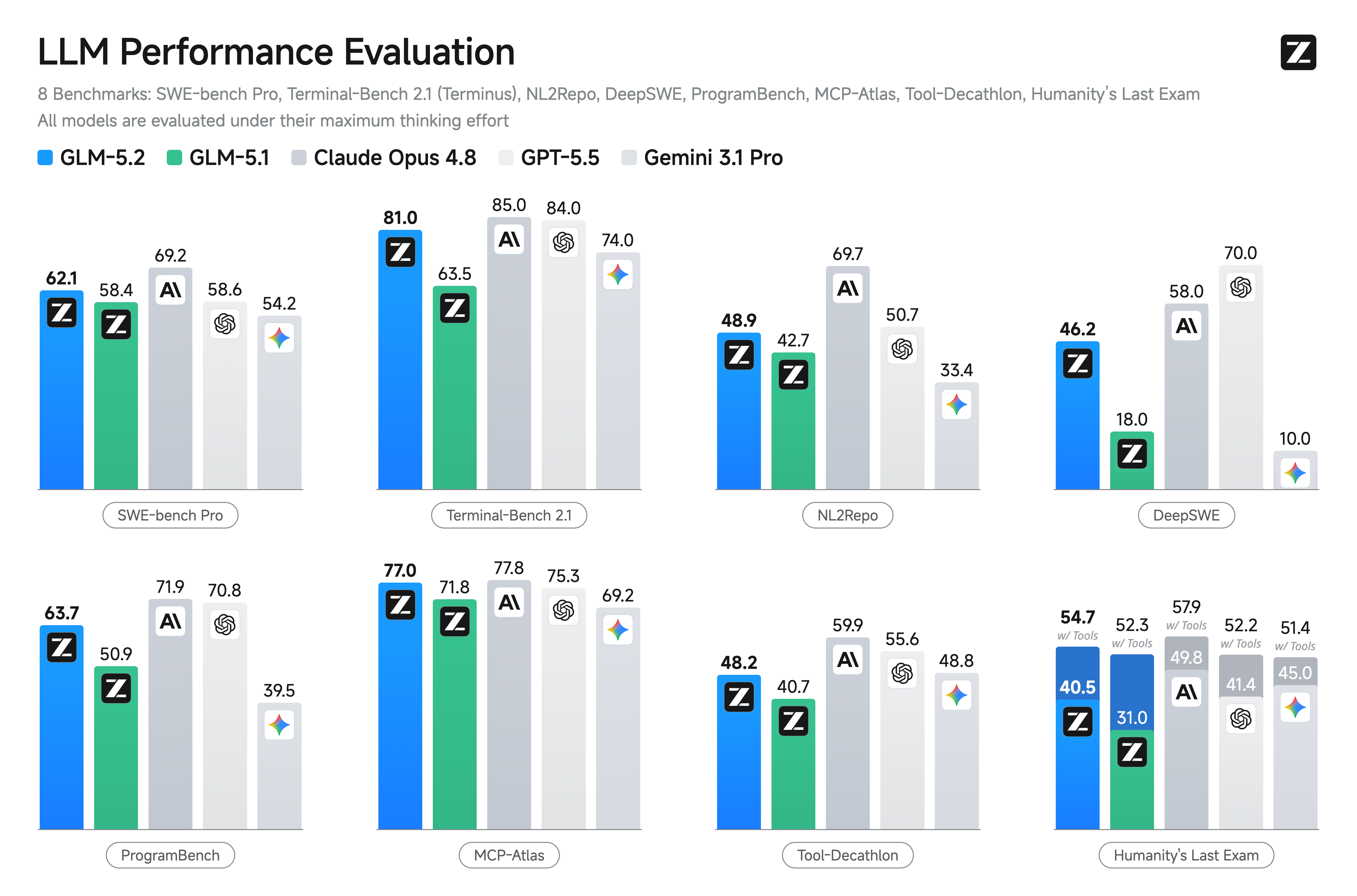
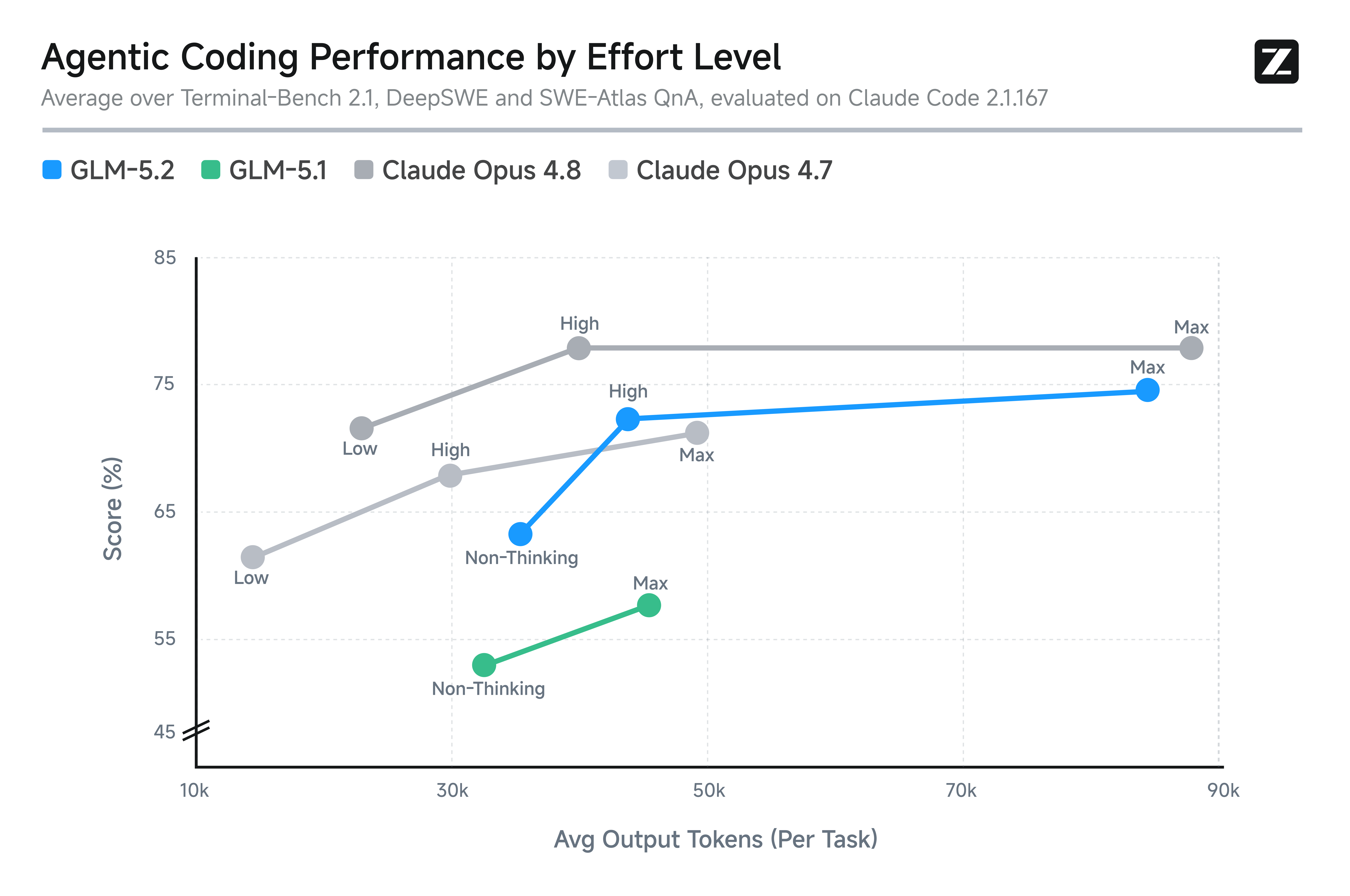
The Terminal-Bench 2.1 jump is the one that made people look twice. GLM-5.2 scores 81.0, up from GLM-5.1’s 62.0. A ~19-point generational leap on terminal-style agentic coding is the hero stat of this release, and it tracks with how the model behaves in practice: it’s coding-first, with two thinking-effort levels (High and Max). Z.ai recommends Max for coding work.
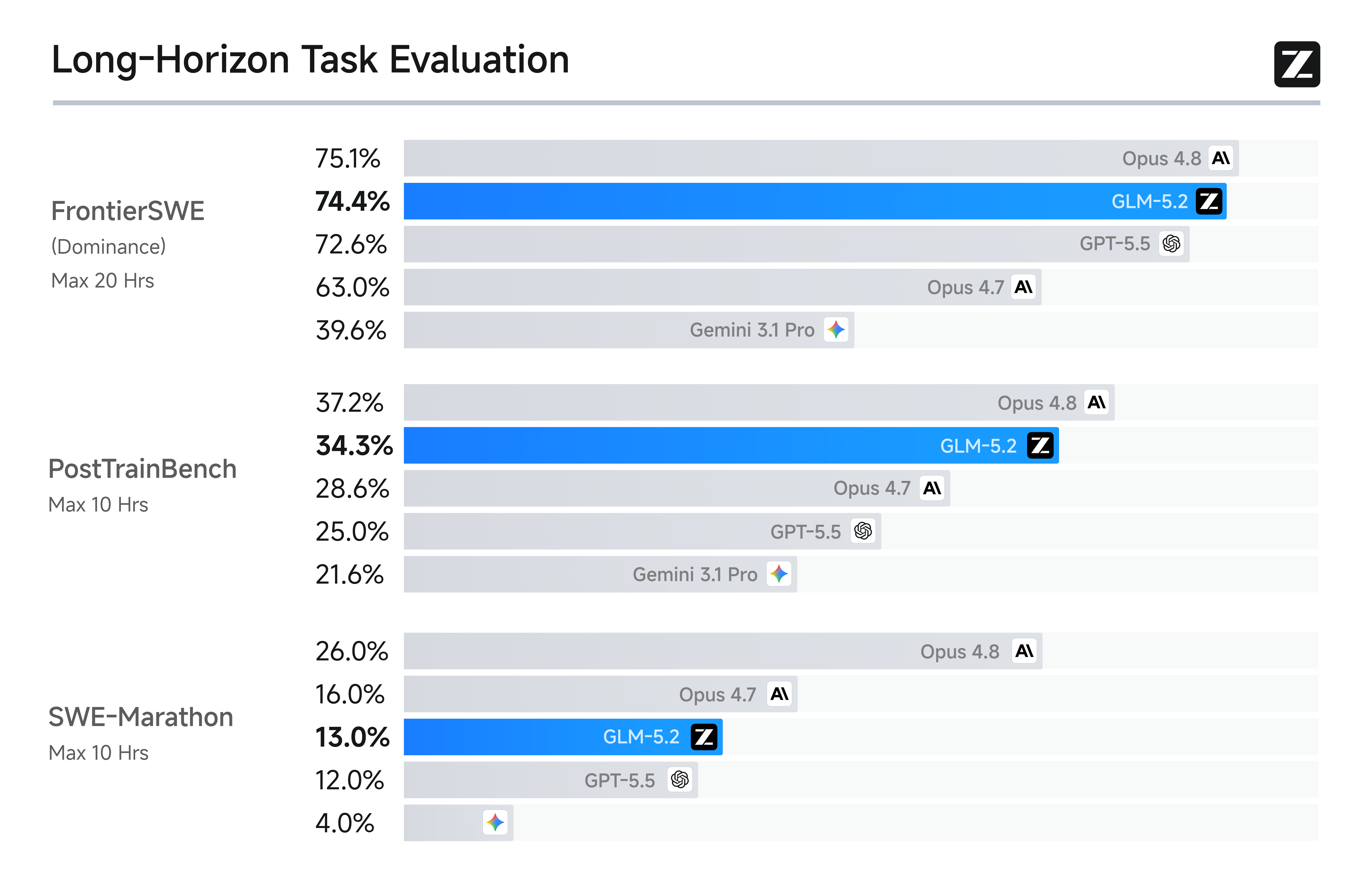
Z.ai also reports GLM-5.2 as the highest open-source model on FrontierSWE, PostTrainBench, and SWE-Marathon. For the “best coding model 2026” search that everyone is running right now, the honest answer is split: closed models still take some quality crowns, but GLM-5.2 is the model that wins on coding-per-dollar and is the only one you can run on your own hardware.
GPT-5.5 remains a formidable generalist coder and pairs tightly with the OpenAI tooling ecosystem. Claude Opus 4.8 is the one many engineers still reach for on gnarly multi-file refactors and long agentic sessions where judgment matters more than raw benchmark points. Gemini 3.1 Pro leans on its enormous context for whole-repo reasoning. None of that changes the SWE-bench Pro line. On that test, GLM-5.2 vs GPT-5.5 goes to GLM-5.2.
Agentic and tool-use: level with the best
This is the surprising one. On MCP-Atlas, which measures Model Context Protocol tool orchestration, GLM-5.2 lands at 77.0. GPT-5.5 sits at 75.3. Claude Opus 4.8 leads at 77.8. So GLM-5.2 vs Claude Opus 4.8 on agentic tool-use is a near tie, with Opus ahead by less than a point, and GLM-5.2 ahead of GPT-5.5.
GLM-5.2 backs this with OpenAI-compatible function and tool calling, plus an Anthropic-compatible coding endpoint so it can drop into agent harnesses built for Claude. On Humanity’s Last Exam with tools, Z.ai reports 54.7 against GPT-5.5’s 52.2, another agentic-reasoning edge.
The architecture helps the agentic story too. GLM-5.2’s “IndexShare” sparse attention reuses one indexer across every four sparse-attention layers, which cuts attention cost at long context. For agents that accumulate huge tool-call histories, cheaper long-context attention is a structural advantage, not just a benchmark line. If you’re wiring GLM-5.2 into an agent stack, the GLM-5.2 with Claude Code, Cline and Cursor guide walks through the harness setup, and the GLM-5.2 API guide covers the tool-calling parameters.
Reasoning and math: top tier, with caveats
On pure reasoning, the four converge near the ceiling. Z.ai reports GLM-5.2 at AIME 2026 99.2 and GPQA-Diamond 91.2, both elite. These are Z.ai’s published numbers, so treat them as launch claims pending broad third-party replication rather than settled fact.
GLM-5.2 exposes reasoning control directly. You set reasoning_effort: "max" and thinking: {type: "enabled"} for hard problems, or disable thinking for fast, cheap responses. That dial is something the closed models expose less granularly. GPT-5.5, Claude Opus 4.8, and Gemini 3.1 Pro all reason superbly, and on the hardest open-ended judgment tasks (the kind benchmarks struggle to capture) the closed frontier still feels a notch more polished to many users. On scored math and science benchmarks, GLM-5.2 is right there.
Context and openness: the open-weights trump card
GLM-5.2 ships a 1M-token context window (1,048,576 tokens). Max output is listed as up to 128K per z.ai docs, though that number isn’t echoed everywhere, so verify it live before you design around it rather than asserting one unqualified figure.
Gemini 3.1 Pro is the other model famous for very large context, and it’s the closest competitor on the long-document axis. GPT-5.5 and Claude Opus 4.8 both offer large windows too. Where GLM-5.2 stands alone is openness. It’s released under an MIT license, with no regional restrictions, and it’s available as zai-org/GLM-5.2 on Hugging Face and glm-5.2 in Ollama. You can download the weights, run them air-gapped, fine-tune them, and deploy with zero per-token vendor fees.
For teams with data-residency rules or a hard “no third-party API” policy, that’s not a tiebreaker. It’s the whole decision. The other three cannot be self-hosted at any price. If running it yourself is the goal, run GLM-5.2 locally for free and the older run GLM-5 locally guide cover the hardware and quantization paths.
Price: the ~1/6 line
Here’s the economic argument, and it’s blunt. GLM-5.2 costs $1.40 per million input tokens and $4.40 per million output tokens via API. VentureBeat’s framing is that GLM-5.2 “beats GPT-5.5 on long-horizon coding at ~1/6 the cost” (attributed to VentureBeat). Cached input drops to around $0.26 per million (VentureBeat).
| Cost factor | GLM-5.2 | Closed frontier (GPT-5.5 / Opus 4.8 / Gemini 3.1 Pro) |
|---|---|---|
| API input (per 1M) | $1.40 | Materially higher |
| API output (per 1M) | $4.40 | Materially higher |
| Cached input | ~$0.26 | Varies |
| Self-host option | Yes (no per-token fee) | None |
| OpenRouter free tier | No | No |
To be clear about what GLM-5.2 does not have: there is no free OpenRouter lane for it. If you see one advertised, it isn’t the official model. For the full pricing picture including the GLM Coding Plan tiers (Lite, Pro, Max, and Team, with figures that secondary sources still disagree on as of June 2026, so verify current pricing at z.ai), see the dedicated GLM-5.2 pricing breakdown. You can also route it through OpenRouter as z-ai/glm-5.2 if you’d rather not manage a key directly.
For day-to-day cost math, the GLM-5 vs DeepSeek vs GPT-5 speed and cost piece is a useful companion, even though it predates this generation.
Verdict: pick by constraint, not by hype
There’s no single winner, and pretending otherwise would be dishonest. Each model wins a different argument.
- Choose GLM-5.2 if you want the best coding-per-dollar, open weights you can self-host, competitive agentic tool-use, and a 1M-token window. It’s the value and control pick, and it genuinely beats GPT-5.5 on SWE-bench Pro.
- Choose GPT-5.5 if you live in the OpenAI ecosystem and want a polished, broadly capable generalist with deep tooling support.
- Choose Claude Opus 4.8 if your work is long, agentic, and judgment-heavy. It still leads MCP-Atlas (77.8) and remains many engineers’ default for hard refactors.
- Choose Gemini 3.1 Pro if very large context and tight Google integration drive your stack.
The honest summary of GLM-5.2 vs Gemini 3.1 Pro, GPT-5.5, and Opus 4.8: the closed frontier still wins some quality and polish on the hardest open-ended tasks. GLM-5.2 wins price, openness, self-hosting, and competitive-to-leading coding. For a large slice of real engineering work in 2026, that combination is enough to make it the default.
If you’re choosing for an agent or API-heavy workload, you’ll want to validate behavior against your own endpoints before committing. Apidog lets you design, debug, mock, and test the API calls behind any of these models in one place, so you can compare real latency and tool-call behavior on your own traffic instead of trusting a launch chart. Download Apidog and point it at the z.ai endpoint to start.
How GLM-5.2 compares to its own predecessor
Worth a quick note since it frames the generational story. The model-to-model jump is covered in full in the GLM-5.2 vs GLM-5.1 comparison, and the GLM-5.2 benchmarks deep-dive lays out every scored test. If you’re new to the lineage, start with what GLM-5.2 is. For the prior generation’s API surface, the GLM-5.1 reference and how to use the GLM-5.1 API still apply with minor changes. Official release notes live on Z.ai’s blog and the GLM-5.2 docs, with independent context in VentureBeat’s coverage.
FAQ
Is GLM-5.2 really better than GPT-5.5 at coding?
On SWE-bench Pro it scores higher: 62.1 versus 58.6, per Z.ai’s published results. That’s one strong, well-known software-engineering benchmark. GPT-5.5 still wins some other tasks and has a deeper tooling ecosystem, so “better at coding” depends on the workload. For benchmark-measured SWE work and cost, GLM-5.2 leads.
How close is GLM-5.2 to Claude Opus 4.8 on agentic tasks?
Very close. On MCP-Atlas, GLM-5.2 scores 77.0 against Opus 4.8’s 77.8, a sub-one-point gap, and GLM-5.2 leads GPT-5.5’s 75.3. For tool-use and agent orchestration, treat GLM-5.2 and Opus 4.8 as effectively peers.
Why does GLM-5.2 cost so much less?
It’s open-weights and priced aggressively at $1.40 input and $4.40 output per million tokens. VentureBeat frames it as roughly one-sixth the cost of GPT-5.5 on long-horizon coding. You can also self-host the weights and pay zero per-token fees.
Does GLM-5.2 have a vision model?
No confirmed vision variant exists as of June 2026. It’s a text-in, text-out model per the API docs. Don’t assume a “GLM-5.2V” until Z.ai ships one.
Can I run GLM-5.2 with Claude Code?
Yes. It exposes an Anthropic-compatible coding endpoint, so you can set ANTHROPIC_BASE_URL and a GLM Coding Plan key, then point Claude Code at the glm-5.2[1m] variant for the 1M-context model. The GLM-5.2 with Claude Code, Cline and Cursor guide has the full env setup.
The frontier isn’t one ladder anymore. It’s a set of tradeoffs, and for the first time an open-weights model is a serious answer to “which one should I build on.” GLM-5.2 doesn’t beat the closed three on everything. It doesn’t need to. It wins enough, costs a fraction, and hands you the weights.