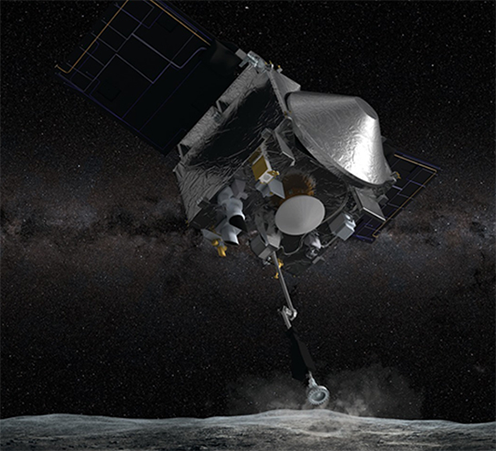
OSIRIS-REx (Origins-Spectral Interpretation-Resource Identification-Security-Regolith
Explorer) was selected as the third mission of NASA's New Frontiers Program.
OSIRIS-REx (Origins-Spectral Interpretation-Resource Identification-Security-Regolith
Explorer) was selected as the third mission of NASA's New Frontiers Program.
The Origins-Spectral Interpretation-Resource Identification-Security-Regolith
Explorer (OSIRIS-REx) was selected as the third mission of NASA's New Frontiers Program.
The robotic spacecraft launched in 2016 and will rendezvous with the near-Earth asteroid
1999 RQ36, renamed as Asteroid Bennu, in 2020. A robotic arm will collect at least 60 grams
of material from the surface of the asteroid to be returned to Earth in 2023 for worldwide
distribution by the NASA Astromaterials Curation Facility at JSC.
The target asteroid is believed to be a primitive type that is rich in organic matter. Such
primitive asteroids contains original material from the cloud of dust and gas that gave rise
to our solar system more than 4.5 billion years ago and could yield important clues about its
formation.
The ARES curation group will be involved in several different aspects of the mission. Because the
target asteroid is potentially carbon-rich, great care will be taken to ensure a contamination-free
environment, part of which means monitoring all materials that go into the design and construction
of the touch-and-go sample acquisition mechanism (TAGSAM) and the sample return capsule (SRC).
Several years before the return of the sample to Earth, a curation laboratory dedicated to the
OSIRIS-REx samples will be constructed. During sample recovery operations at the Utah Test and
Training Range, a portable clean room will be established for the initial arrival of samples and
preparation for transport to Johnson Space Center, Houston, Texas.
Finally, the curation group will oversee the initial characterization, cataloging and distribution
of samples to the science team and a large group of international scientists. In addition to collecting
samples, OSIRIS-REx will gather data to help scientists better understand the physical characteristics
of potentially hazardous asteroids. Data collected on its surface properties, internal structure and
orbital dynamics can be used to help develop hazard mitigation strategies for deflecting asteroids that
approach Earth in the future.
Asteroid Bennu is also a type of near-Earth asteroid that NASA is considering for human exploration
missions as early as 2025. Information that OSIRIS-REx collects from Asteroid Bennu will help formulate
the types of operations and identify the mission activities that astronauts will perform during their
expeditions to these asteroids. Such information is crucial in preparing for humanity's next steps beyond
low Earth orbit and on to deep space destinations.
The ARES OSIRIS-REx Team
ARES curates seven different types of astromaterials, beginning with the 1969 return
of lunar rocks from the Apollo missions. Lessons learned from that mission and numerous
others have advanced the science behind sample protection, contingency planning and
contamination control.