|
VOOZH | about |
|
VOOZH | about |
Editor’s note: This article was last updated by Eze Sunday on 4 June 2024 to include both languages’ memory management, including Rust’s borrow checker and Zig’s manual memory management, as well as to expand on the pros and cons of each language.
👁 Comparing Rust vs. Zig: Performance, safety, and moreWhen you consider Rust and Zig, they make for a fascinating comparison. Both languages promote efficient, performant code, but they do so in different ways. They also both compile to a native binary that your system can execute directly.
These languages run on entirely different concepts and philosophies, affecting how developers code with them. With that in mind, let’s take a look at how well they measure up against each other.
The Replay is a weekly newsletter for dev and engineering leaders.
Delivered once a week, it's your curated guide to the most important conversations around frontend dev, emerging AI tools, and the state of modern software.
Rust is a general-purpose programming language that prioritizes efficiency, performance, and memory safety. It introduces a new way of programming that still allows developers to use some object-oriented and functional paradigms.
Coding with Rust requires an entirely different way of thinking centered around the ownership and borrowing rules that govern the language. While this way of thinking allows developers to write memory-safe and efficient code, it has a steep initial learning curve.
Let’s look at an example of Rust code:
fn main() {
 println!("Hello world");
}
In Rust, every executable starts from the main function, which is similar to other compiled programming languages. If you run the example above, you’ll get “Hello, World!” in your terminal.
Like any programming language, Rust has its strengths and weaknesses. In this section, we’ll first explore the advantages that Rust offers to developers, followed by a discussion of the challenges and potential drawbacks.
Some benefits of Rust include:
Some drawbacks of Rust include:
Rust has reigned as the most desired programming language in Stack Overflow’s annual developer survey for 8 years in a row at the time of this writing.
Now that you’ve seen what Rust can do, let’s take a look at places where it is already being used.
In systems programming, Rust is useful for tasks like building operating systems (support for Rust Linux kernel was merged in version 6.1 of the Linux kernel), device drivers, and embedded systems.
Both backend and frontend web developers also use Rust with popular frameworks like Rocket or Actix for backend development and Leptos, Dioxus, and Tauri for frontend development.
Rust is also used in networking like network protocols, proxies, load balancers, VPN software, and more.
Some more niche use cases for Rust include:
If you are looking to start using Rust right away, you can check out our guide to getting up to speed with Rust.
Zig is a general-purpose, statically typed, and imperative, compiled system programming language. Zig was designed by Andrew Kelley to be a better version of C and the ability to interact with C code was an important consideration. Like Rust, Zig focuses on giving you the ability to write memory-safe, efficient, and fast software.
Let’s take a look at a hello world example written in Zig:
const std = @import("std");

pub fn main() void {
 std.debug.print("Hello, world", .{});
}
Also, like Rust, C, and C++, Zig doesn’t use a garbage collector. To achieve memory safety, Zig comes with mechanisms that promote memory safety, such as:
Error typesNext, we’ll look at Zig’s pros and cons, as well as its use cases.
Some of the benefits Zig offers to developers include:
defer statements, and the use of optional types help prevent common errors and improve code reliability by managing memory and ensuring safety without a garbage collectorSome of the drawbacks of Zig include:
Zig has a wide array of use cases from system programming, web development, and embedded system programming.
One popular framework using Zig right now is the Bun runtime. According to the Bun website:
Bun is an all-in-one JavaScript runtime and toolkit designed for speed, complete with a bundler, test runner, and Node.js-compatible package manager.
Another use case is the Zig Language Server — a language server for Zig, which provides IDE features such as code completion and error checking, showcasing Zig’s utility in developing tools to enhance the development experience.
Like Rust, Zig also has a few more niche use cases:
If you’re interested in using Zig in your next project, take a look at our guide on getting started with Zig.
In this section, we’ll discuss memory management patterns for both Rust and Zig.
Zig uses a manual memory management mechanism. It allows you the responsibility to allocate and deallocate memory safely and efficiently — with great power comes great responsibility. You have to be careful or, you might introduce a memory leak.
Here is a simple example of how the Zig memory allocator pattern works:
const std = @import("std");

pub fn main() !void {
 const allocator = std.heap.page_allocator;
 const buffer = try allocator.alloc(u8, 100); // Allocate 100 bytes
 defer allocator.free(buffer); // Ensure deallocation

 // Use the buffer
 buffer[0] = 42;
 std.debug.print("Buffer[0]: {}\n", .{buffer[0]});
}
In the above code, we initialize an allocator from the standard library’s heap module using page_allocator, which allocates memory in page-sized chunks. Then we went ahead to allocate 100 bytes to a buffer variable of u8 and also used the defer keyword to ensure that the allocated memory is deallocated when it goes out of its scope.
After allocating the memory, we then assign 42 to the first item in the buffer at index 0.
The language provides a variety of allocators and deallocators, which gives you the flexibility to manage memory according to the needs of your application.
Memory management in Rust is handled by the borrow checker and the compiler, making it almost impossible to introduce memory leaks or use-after-free memory issues.
Here is a simple example to illustrate how the borrow checker works in Rust to help memory management:
fn main() {
 let mut vec = Vec::new(); // Create a new vector
 vec.push(42); // Push a value onto the vector

 // Borrowing the vector
 let first = &vec[0];
 println!("First element: {}", first);

 // Ownership and scope
 {
 let vec2 = vec; // Move ownership to vec2
 // vec can no longer be used here
 }
 // vec is now out of scope and deallocated
}
In the above code, we created an empty vector, pushed 42 into it, and then moved the vector to a new scope — literally transferring ownership to the new scope. As a result, we can’t use that vector again because it’s deallocated. The memory is tracked until it goes out of scope, at which point the memory is freed.
Now that we’ve looked at Rust and Zig individually, it’s time to put them together for comparison. It’s always interesting to compare different programming languages, especially when they have similar targets.
Let’s start with what they have in common:
Use the comparison table below to understand the differences between Rust and Zig:
| Feature | Rust | Zig |
|---|---|---|
| Memory safety | Rust uses its strict ownership and borrowing rules to ensure that any code a developer writes is safe and the chance of memory leak is reduced. | Zig allows the developer the responsibility of allocating and deallocating memory properly. This method is prone to errors as the compiler won’t complain if you don’t deallocate memory. |
| Syntax | Rust has an expressive syntax that borrows similarities from several languages and it also introduces a lot of it’s own domain specific syntax like how it handles lifetimes and borrowing | Zig uses a simple and approachable language syntax. You’ll likely understand what is going on by just looking at the code even if you are new — at least that was how it was for me. |
| Ecosystem | Rust offers a robust ecosystem, including libraries, tools, and community support | Zig is a newer language, and while it doesn’t have a large ecosystem of tools, its toolchain is solid. |
| Interoperability | Rust has decent FFI compatibility. It works well calling Rust functions from C but it can be challenging to call C functions from Rust. | Zig has a superior FFI. It works well calling C functions from Zig and calling Zig functions from C. |
| Error handling | Rust uses Result and Option types for explicit error handling | Zig uses error types, error unions, and deferred statements for error handling. |
| Package manager | Rut uses cargo package manager for handling packages and dependencies. | Zig uses its built-in package manager for handling packages and dependencies. |
Besides their similarities and differences, we can compare Rust and Zig in three other ways: performance, popularity, and how much their programmers are paid. Let’s take a closer look.
Objectively, between Rust and Zig, there is no absolutely better-performing language. Rust may outshine Zig in certain areas, while Zig outperforms Rust in others.
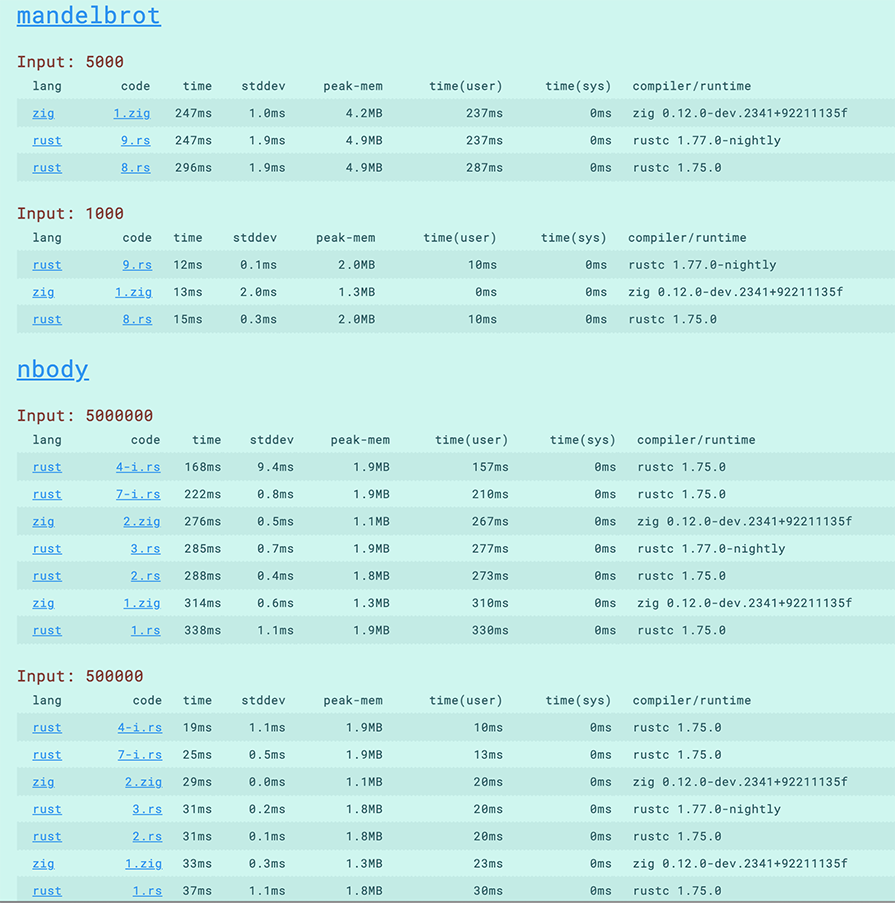
Let’s closely examine each performance with a comparison from the programming languages and compiler benchmarks:
This benchmark project contains programs written in several programming languages that run simultaneously. The outcomes from their runs are then measured and presented in a tabular form for you to see how each programming language performs in the task.
In the image above, we have the mandelbrot and nbody programs, both written using Rust and Zig. The measurements in the comparison tables are arranged from more performant to less performant.
You’ll notice that in some cases, Zig performs better than Rust, and in others, Rust performs better than Zig. Both are highly performant languages, so either option should serve you well in your projects.
When picking a programming language to learn, popularity can be a significant factor to consider. Choosing a popular language not only increases your chances of finding resources and support but also means you’ll have a higher chance of finding developers to collaborate with.
Stack Overflow’s latest developer survey provides some interesting insights. As mentioned earlier, Rust has been the most admired language for 8 years in a row including 2023, with over 84 percent of respondents saying they want to use it again compared to Zig’s 71 percent.
Rust is also 14th on the list of popular languages, while Zig is farther behind at number 41 out of 51 total languages listed.
Zig’s lower popularity in both cases may be because it’s still in its early stages. Either way, it’s crucial to consider the popularity of the language you choose to work with.
The Stack Overflow developer survey also contains information about the top-paying technologies as reported by the respondents. You may find this chart helpful, especially if you’re considering learning either Rust or Zig.
Interestingly, despite being a new addition, Zig is actually the highest-paid language to know in 2023 survey, while Rust is 14th on the list:
While the chart is a good starting point, there are other factors to consider when determining how much a developer gets paid, such as their experience level and the company they work for.
Regarding Rust and Zig, it’s hard to say which is the clear winner. Each language has strengths and weaknesses that make them fair competitors. I hope this article was useful in helping decide which language to use for your project.
Thanks for taking the time to read! If you have any questions about either language, feel free to comment below.
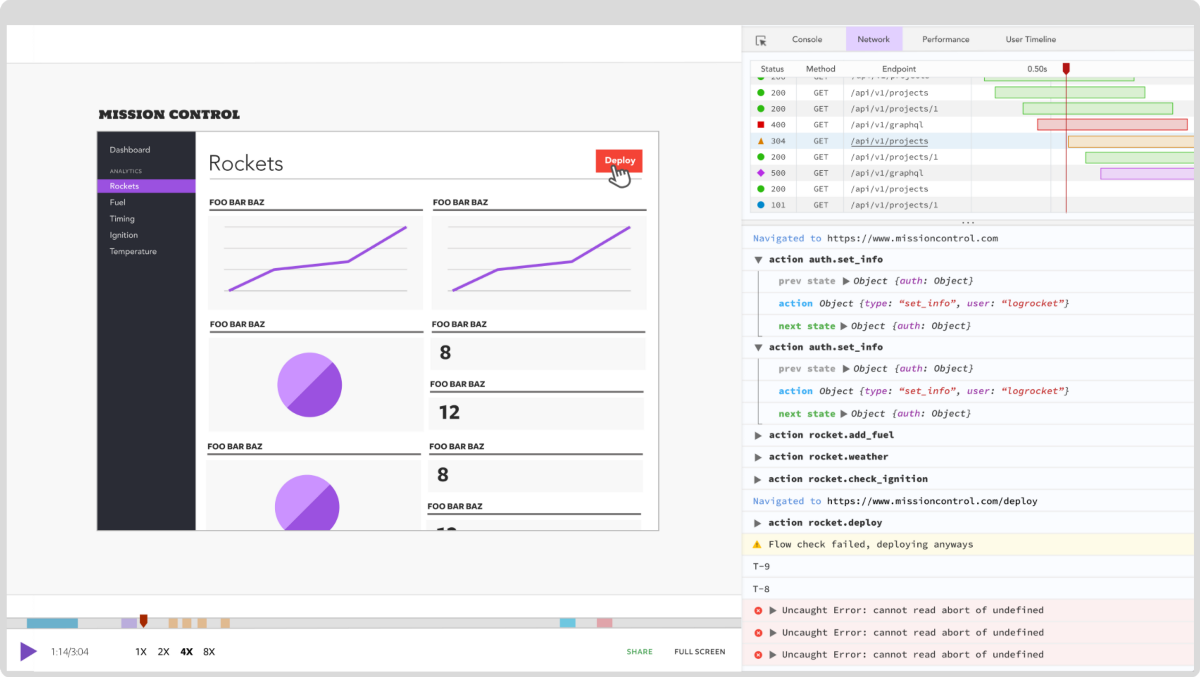
Debugging Rust applications can be difficult, especially when users experience issues that are hard to reproduce. If you’re interested in monitoring and tracking the performance of your Rust apps, automatically surfacing errors, and tracking slow network requests and load time, try LogRocket.
LogRocket lets you replay user sessions, eliminating guesswork around why bugs happen by showing exactly what users experienced. It captures console logs, errors, network requests, and pixel-perfect DOM recordings — compatible with all frameworks.
LogRocket's Galileo AI watches sessions for you, instantly identifying and explaining user struggles with automated monitoring of your entire product experience.
👁 LogRocket Dashboard Free Trial BannerModernize how you debug your Rust apps — start monitoring for free.
Learn how to build a full React Native auth system using Better Auth and Expo — with email/password login, Google OAuth, session persistence, and protected routes.
Compare the top AI development tools and models of June 2026. View updated rankings, feature breakdowns, and find the best fit for you.
Learn how Bloom filters reduce database lookups for username availability checks while preserving correctness at scale.
Learn how to test Nuxt apps with Vitest, @nuxt/test-utils, runtime mocks, server route mocks, and Playwright e2e tests.
Would you be interested in joining LogRocket's developer community?
Join LogRocket’s Content Advisory Board. You’ll help inform the type of content we create and get access to exclusive meetups, social accreditation, and swag.
Sign up now