|
VOOZH | about |
|
VOOZH | about |
The SOLID principles (single responsibility, open/closed, Liskov substitution, interface segregation, and dependency inversion) are essential for writing maintainable, scalable, and flexible software. While many developers are familiar with these principles, fully grasping their application can be challenging.
👁 dependency inversion principleBy the end of this guide, you will have a clear understanding of the dependency inversion principle (DIP), its importance, and how to implement it across multiple programming languages, including TypeScript, Python, Java, C#, and more.
This post was updated by Oyinkansola Awosan in February 2025 to explain DIP more conceptually with broader applications, including expanding the scope of the article beyond TypeScript to Java, Python, and C#.
The Replay is a weekly newsletter for dev and engineering leaders.
Delivered once a week, it's your curated guide to the most important conversations around frontend dev, emerging AI tools, and the state of modern software.
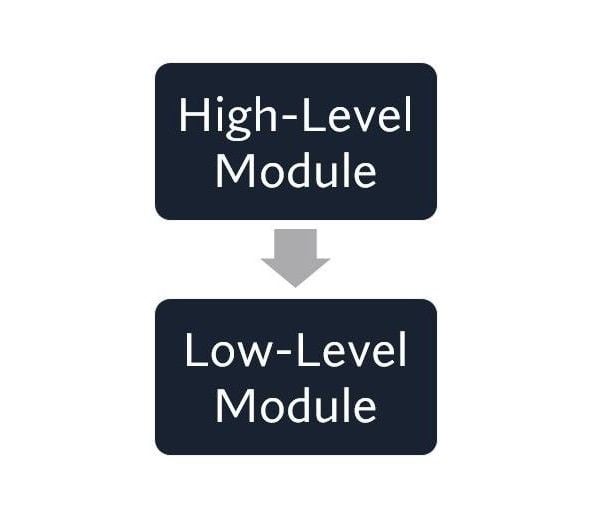
The dependency inversion principle states that high-level modules should not depend on low-level modules. Instead, both should depend on abstractions. This principle ensures that software components remain loosely coupled, making them easier to modify and maintain.
👁 high level vs low level module
In the context of the dependency inversion principle, the high-level module or component provides a high-level abstraction over the tiny implementation details and general functionalities of the system. High-level modules achieve this level of abstraction by not directly communicating with low-level modules. In other words, high-level modules are set up to talk to an interface to interact with the low-level modules to perform specific tasks.
On the other hand, low-level modules are set up to handle the underlying logic in a system architecture. They are also set up to conform to the interface, which is simply the method or properties a low-level component must have. Therefore, low-level modules depend heavily on interfaces to be useful.
Abstractions in DIP play a significant role in ensuring that high-level and low-level modules are decoupled, making the codebase highly flexible, maintainable, and testable.
What does it mean to say decoupled? In the context of the dependency inversion principle, low-level modules and high-level modules are never supposed to depend entirely on each other, but the interface, particularly when reusability is of paramount concern.
Potential issues can arise when low-level and high-level modules are tightly coupled. For example, a change in the former must cause the latter to be updated to effect the change. Furthermore, it becomes problematic if the high-level modules fail to incorporate well with other low-level modules’ implementation details.
To write high-quality code, you must understand the dependency inversion principle and dependency injection. So, what is the difference between the two? Let’s find out.
First, when we talk about dependency and object-oriented programming, we usually refer to an object type, a class that has a direct relationship with it. You can also say this direct dependency means that the class and object type are coupled. For instance, a class could depend on another class because it has an attribute of that type, or an object of that type is passed as a parameter to a method, or because the class inherits from the other class.
Dependency injection is a design pattern. The idea of the pattern is that if a class uses an object of a certain type, we do not also make that class responsible for creating that object. Dependency injection design shifts the creation responsibility to another class. This design is, therefore, an inversion of control techniques and makes code testing relatively easier.
Dependency inversion, on the other hand, is a principle that aims to decouple concrete classes using abstractions, abstract classes, interfaces, etc. Dependency inversion is only possible if you separate creation from use. In other words, without dependency injection, there is no dependency inversion.
DIP employs a concept that uses high-level modules and low-level modules, where the former contains the business rules that solve the business problem. Clearly, these high-level modules contain most of the business value of the software application. Below are some of the benefits of DIP:
Coupling means how closely two parts of your system depend on or interact with each other. In one sense, it is how much the logic and implementation details of these two parts begin to blend. When two pieces of code are interdependent this way, they are said to be tightly coupled.
Loose coupling, on the other hand, is if two pieces of code are highly independent and isolated from each other. Loose coupling promotes code maintainability because you will find that all the code related to a particular concern is colocated together.
Furthermore, loose coupling provides more flexibility, allowing you to change the internals of one part of your system without those changes spilling over into the other parts. You could even easily swap out one part entirely, and the other part would not be aware of that.
Writing good code lets other people understand it. If you have encountered a codebase that looks poorly written or structured, it is difficult to create a mental model of the code.
The dependency inversion principle helps to ease updating, fixing, or improving a system since the high-level and low-level modules are loosely coupled, and both only rely on abstractions.
Test-driven development is proven to reduce bugs, errors, and defects while improving the maintainability of a codebase It also requires some additional effort. Testing can be done in two ways: manually or automated.
Manual testing involves a human clicking on every button and filling out every form that assigns Jira tickets so the developers can backlog them. This manual testing is not very efficient for large-scale projects, and that is where automated testing comes into play.
Automated testing is a better approach where developers use testing tools to write code for the sole purpose of testing the main application code in the codebase. In a decoupled architecture, like the one provided by the dependency inversion principle, automated unit testing is relatively easier and faster.
Decoupled architecture ensures that real implementations can be swapped with fake or mock objects since the high-level and low-level modules are decoupled.
Scalability is one of the most important key concepts for any system design. It defines how a particular system can handle increased load efficiently without any issues and with zero negative impact on the end users.
So, how does the dependency inversion principle support easy scalability? This principle’s components are loosely coupled, which means that further implementation details can be added to the codebase without modifying the high-level logic.
Assuming a system was initially built to process payment transactions using only one payment gateway, the dependency inversion principle allows you to add more payment methods without breaking the existing functionality.
Reusable components have been discussed since the early days of computers. New software development approaches like module-based development mean that component construction and reuse are back in play.
Reusability simply refers to the ability to use the same piece of code or component, in some cases, without duplication. The dependency inversion principle ensures that both the high-level and low-level components do not directly depend on each other but on abstraction, thereby giving developers a shot at reusability. This means that the same high-level logic can be used with different low-level implementations with no issues.
To put this into context, there can be a high-level logic that implements notification, while the low-level implementation details may be for SMS, email, push notification, or anything else. DIP ensures that there is no need to write notification logic every time; it is as easy as simply swapping low-level implementations.
To demonstrate DIP in practice, we will cover implementations in various languages:
Use abstract base classes (ABC) to define abstractions:
from abc import ABC, abstractmethod

class Database(ABC):
 @abstractmethod
 def query(self, sql: str):
 pass
Implement low-level modules:
class MySQLDatabase(Database):
 def query(self, sql: str):
 print(f"Executing MySQL Query: {sql}")

class MongoDBDatabase(Database):
 def query(self, sql: str):
 print(f"Executing MongoDB Query: {sql}")
Create a high-level module:
class UserService:
 def __init__(self, db: Database):
 self.db = db

 def get_user(self, id: int):
 self.db.query(f"SELECT * FROM users WHERE id = {id}")
Define an interface:
interface Database {
 void query(String sql);
}
Implement low-level modules:
class MySQLDatabase implements Database {
 public void query(String sql) {
 System.out.println("Executing MySQL Query: " + sql);
 }
}
Create a high-level module:
class UserService {
 private Database db;
 public UserService(Database db) {
 this.db = db;
 }
 public void getUser(int id) {
 db.query("SELECT * FROM users WHERE id = " + id);
 }
}
Define an interface:
interface Database {
 query(sql: string): void;
}
Implement low-level modules:
class MySQLDatabase implements Database {
 query(sql: string): void {
 console.log(`Executing MySQL Query: ${sql}`);
 }
}
Create a high-level module:
class UserService {
 private db: Database;
 constructor(db: Database) {
 this.db = db;
 }
 getUser(id: number): void {
 this.db.query(`SELECT * FROM users WHERE id = ${id}`);
 }
}
Spring’s Inversion of Control (IoC) container helps achieve DIP by injecting dependencies at runtime:
import org.springframework.stereotype.Service;
import org.springframework.beans.factory.annotation.Autowired;
import org.springframework.context.annotation.ComponentScan;
import org.springframework.context.annotation.Configuration;
import org.springframework.context.annotation.AnnotationConfigApplicationContext;

interface Logger {
 void log(String message);
}

@Service
class ConsoleLogger implements Logger {
 public void log(String message) {
 System.out.println(message);
 }
}

@Service
class Application {
 private final Logger logger;

 @Autowired
 public Application(Logger logger) {
 this.logger = logger;
 }

 public void run() {
 logger.log("Application started");
 }
}

@Configuration
@ComponentScan("com.example")
class AppConfig {}

public class Main {
 public static void main(String[] args) {
 var context = new AnnotationConfigApplicationContext(AppConfig.class);
 Application app = context.getBean(Application.class);
 app.run();
 }
}
In .NET Core, the built-in dependency injection (DI) container makes it easy to implement DIP:
public interface ILoggerService {
 void Log(string message);
}

public class ConsoleLogger : ILoggerService {
 public void Log(string message) {
 Console.WriteLine(message);
 }
}

public class Application {
 private readonly ILoggerService _logger;

 public Application(ILoggerService logger) {
 _logger = logger;
 }

 public void Run() {
 _logger.Log("Application started");
 }
}
.NET Core’s built-in DI container ensures that the Application class depends only on the abstraction ILoggerService, making the code modular and testable:
var builder = WebApplication.CreateBuilder(args);
builder.Services.AddSingleton<ILoggerService, ConsoleLogger>();
builder.Services.AddSingleton<Application>();
var app = builder.Build();
var application = app.Services.GetRequiredService<Application>();
application.Run();
The dependency inversion principle has many use cases in different areas of software development. This section will explore several practical use cases and break down the benefits of DIP in each case:
While DIP offers significant advantages, misusing it can lead to issues. Here are some common pitfalls and solutions:
Developers often struggle to decide when to use DIP and when to simply use direct dependencies. Not every class requires an interface.
As essential as the dependency inversion principle is in software development, misusing it can create unnecessary complexity. DIP is not always necessary when the variation of services is minimal or implementations do not frequently change, as in a simple payment processing system.
Use DIP when:
Use direct dependencies when:
These tactics will help you take full advantage of DIP:
The dependency inversion principle is a powerful concept in software design that enhances flexibility, scalability, and maintainability. By decoupling business logic from implementation details through abstractions, DIP enables testable, reusable, and understandable code. However, like any design principle, its misuse can introduce unnecessary complexity.
In this guide, we have explored the essentials of the dependency inversion principle, its real-world applications, best practices, and practical implementation across different programming languages. With this knowledge, you are now well-equipped to leverage DIP effectively in your software development projects.
TSRX adds first-class control flow, conditional hooks, and scoped styles to React via a TypeScript compiler extension — no new framework required.
Learn how to build a full React Native auth system using Better Auth and Expo — with email/password login, Google OAuth, session persistence, and protected routes.
Compare the top AI development tools and models of June 2026. View updated rankings, feature breakdowns, and find the best fit for you.
Learn how Bloom filters reduce database lookups for username availability checks while preserving correctness at scale.
Hey there, want to help make our blog better?
Join LogRocket’s Content Advisory Board. You’ll help inform the type of content we create and get access to exclusive meetups, social accreditation, and swag.
Sign up now