|
VOOZH | about |
|
VOOZH | about |
Most of the product and engineering teams I talk to are building and deploying AI agents, but these agents are blind to how customers are actually experiencing your product.
This is why I’m excited to announce that the LogRocket MCP is now available to everyone.
Let’s suppose your conversion rate dropped last week. You ask Claude or Cursor what went wrong, but find nothing obviously amiss.
When you enable the LogRocket MCP, you and your agents can watch thousands of session replays in minutes.
So now if conversion rate dips, the LogRocket MCP identifies the problem immediately: on mobile Chrome, autofill triggers a spinner that never resolves. This context, and a suggested fix, is delivered wherever you need it: Claude, Cursor, or right to your agent.
Let’s dive into how the MCP is changing the way our customers monitor their products.
The LogRocket MCP connects your agents directly to LogRocket’s Galileo AI, which is already watching session replays, listening to customer calls, reading support tickets, and tracking product changes.
Galileo detects issues, diagnoses root causes, quantifies user impact, and suggests fixes. Via the MCP, it sends this context to your agent, without anyone on your team needing to pull up LogRocket:👁 gif of LogRocket MCP agent watching real user sessions
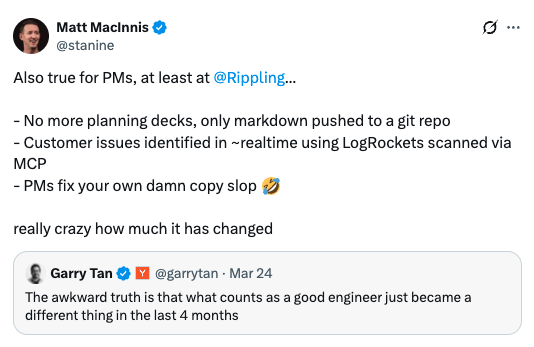
Rippling, the HR, payroll, and IT software provider, is using the MCP to identify customer issues in near-realtime.
Matt MacInnis, Rippling’s President and Chief Product Officer, posted about it on X:👁 rippling tweets about using LogRocket MCP
Nick Ciubotariu, CTO at ShipStation Global, the shopping and logistics provider behind products like ShipStation and Stamps.com, shared how his team is connecting its coding agents to the MCP to generate PRs to fix user issues.
“We’re using the LogRocket MCP to feed real user session data directly to our AI agents,” Nick said. “When an issue surfaces, the agent doesn’t wait for us to investigate; it pulls the sessions, diagnoses the root cause, and opens a pull request automatically. That’s an amazing advantage, and it’s a great accelerator for our engineering teams and a huge benefit to our customers.”
The pattern we’re seeing across early customers: their agents flag issues faster, which means they ship fixes faster.
Three examples of agents real LogRocket customers are building:
And that’s just a sampling. What agents will your team build?
When we founded LogRocket in 2016, the goal was to give teams a complete understanding of how users experience their product, without consuming all of their time.
Ask Galileo took us a big step forward. Teams could answer almost any question about their product experience in seconds.
The MCP takes it another step.
Galileo’s intelligence stops being something your team has to go look at. Now it helps you surface issues, resolve tickets, and propose fixes on its own.
The blindfold is off. We’re one step closer to software that fixes itself.
The LogRocket MCP Server is available now.
Existing LogRocket customers can connect via the hosted server at mcp.logrocket.com/mcp: no local setup required, OAuth authentication, works with Cursor, Claude Desktop, Claude Code, Codex, and any MCP-compatible client.
If you’re new to LogRocket, you can learn more by checking out our docs or trying it for yourself at logrocket.com.
Audit freemium conversion points by use case to cut clutter, improve UX, and protect long-term revenue from upgrade fatigue.
PMs often misread acquisition spikes as growth. Learn which retention and activation signals show whether users actually find value.
PMs don’t need fake authority to lead well. Learn how shared context, clearer trade-offs, and better decision-making build stronger teams.
Learn how PMs can spot novelty effects in A/B tests, validate wins over time, and avoid mistaking short-term lifts for impact.