|
VOOZH | about |
|
VOOZH | about |
TypeScript is no longer optional or experimental. It has become a core foundation of modern JavaScript systems. Today, it powers large-scale frontend applications, Node.js services, edge runtimes, shared packages, and even internal tooling.
👁 ImageThe question in 2026 is no longer “Should we use TypeScript?” Instead, it’s “How do we operate TypeScript effectively at scale?”
In this article, we’ll explore the practices senior engineers use to run TypeScript in large systems, from designing domain types and enforcing strictness to managing contracts across teams and platforms.
The Replay is a weekly newsletter for dev and engineering leaders.
Delivered once a week, it's your curated guide to the most important conversations around frontend dev, emerging AI tools, and the state of modern software.
In small applications, types simply describe shapes while larger systems define contracts between teams. That distinction changes everything.
At scale, your job isn’t to mirror backend payloads or auto-generate interfaces and call it done. It’s to model domain concepts intentionally in a way that protects the business from accidental complexity and future change.
That means:
any implicit escape hatches that silently weaken guaranteesWhen frontend, backend, and platform teams depend on shared packages, your types become infrastructure. A careless export becomes technical debt for five squads.
At scale, clean boundaries matter more than clever types
// Directly reusing backend DTO everywhere
type User = {
 id: string;
 created_at: string;
 is_active: boolean;
};
// Transport layer (API response)
type UserDTO = {
 id: string;
 created_at: string;
 is_active: boolean;
};

// Domain model
type User = {
 id: string;
 createdAt: Date;
 isActive: boolean;
};

function mapUser(dto: UserDTO): User {
 return {
 id: dto.id,
 createdAt: new Date(dto.created_at),
 isActive: dto.is_active,
 };
}
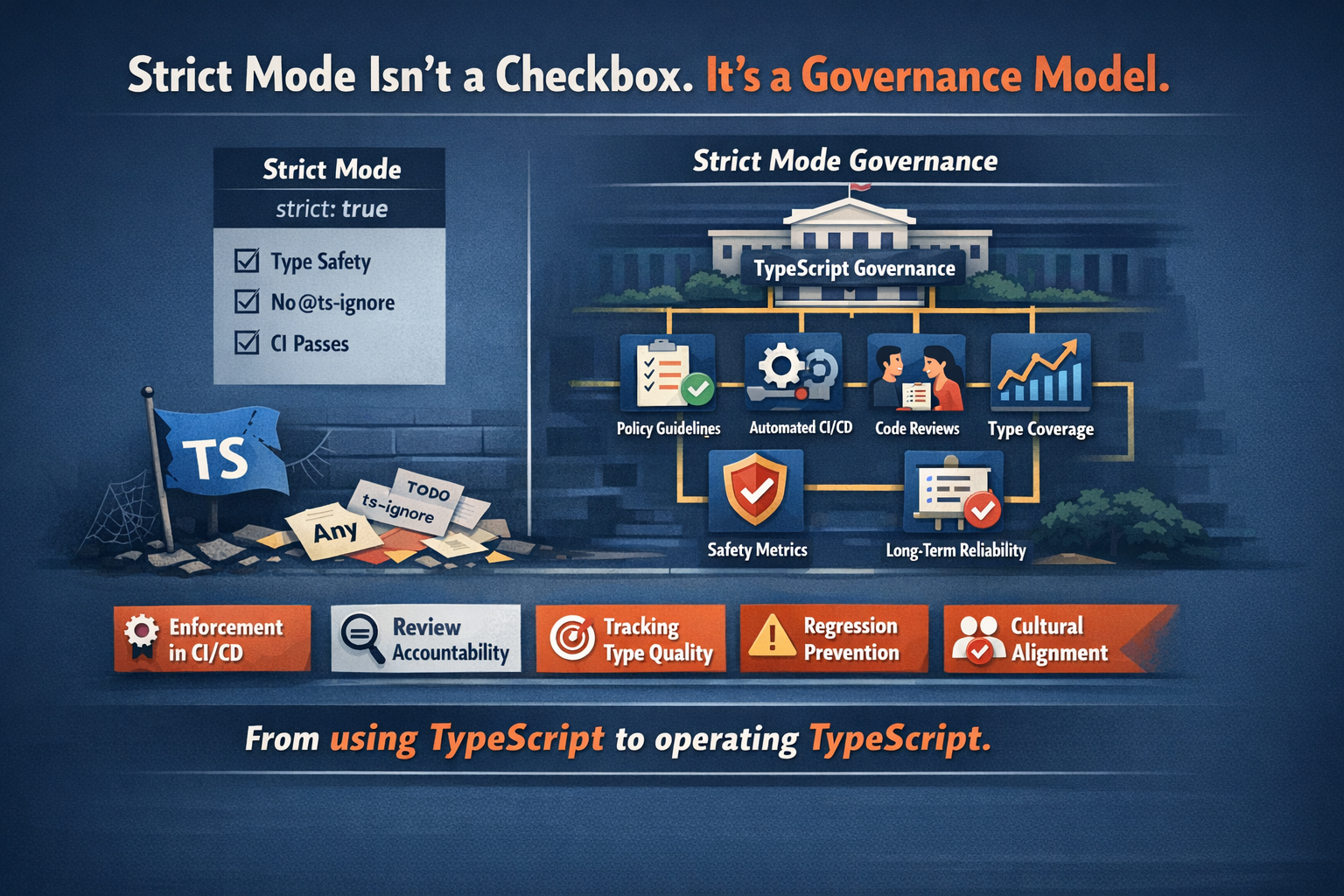
Turning on "strict": true in a greenfield project is easy, but maintaining it across a 200k+ LOC codebase with multiple contributors, legacy modules, and shifting deadlines is not.
At scale, strictness is no longer a compiler setting; it becomes an operational decision. Therefore, Senior engineers must answer the following uncomfortable but necessary questions:
@ts-ignore and @ts-expect-error?Type safety isn’t binary; it’s a spectrum, and where you sit on that spectrum directly affects velocity, onboarding friction, refactor confidence, and long-term system reliability. In large codebases, strictness is less about checkbox or compiler flags and more about organisational discipline.
Mid-level teams treat strictness as configuration, while Senior teams treat strictness as policy.
You’re not just configuring a compiler; rather, you’re defining how much risk the organisation is willing to tolerate.
"strict": true as the default baselineany usage (make it measurable)@ts-ignore and require justification in code review@ts-expect-error over @ts-ignore so ignored errors don’t silently disappearAt scale, consistency beats perfection, and guardrails beat heroics
{
 "compilerOptions": {
 "strict": true,
 "noUncheckedIndexedAccess": true,
 "exactOptionalPropertyTypes": true
 }
}
tsc --noEmit
Make type regressions visible in CI. Don’t rely on “we’ll fix it later.”
In large repositories, types are no longer local annotations; they become a dependency graph.
Every shared interface is a structural decision, and every cross-package import is an architectural statement. And if you don’t intentionally design those boundaries, your type system will silently erode them.
When multiple apps, services, and libraries coexist in a monorepo, unmanaged type sharing quickly leads to:
At scale, modularising types is not optional. It is how you preserve architectural integrity.
@org/contracts (or similar) package for shared domain contracts../../other-package/src/internal)packages/ contracts/ web-app/ api/
{
 "references": [
 { "path": "../contracts" }
 ]
}
// contracts/user.ts
export interface PublicUser {
 id: string;
 email: string;
}
If everything imports everything, your architecture is already broken.
TypeScript disappears after compilation.
Note that TypeScript ≠ runtime safety. That distinction becomes critical at scale, and the compiler can guarantee internal correctness, but it cannot protect you from:
If data crosses a network boundary, it is untrusted regardless of how strong your types are.
Senior teams understand this and design accordingly.
import { z } from "zod";

const UserSchema = z.object({
 id: z.string(),
 email: z.string().email(),
});

type User = z.infer<typeof UserSchema>;

function parseUser(data: unknown): User {
 return UserSchema.parse(data);
}
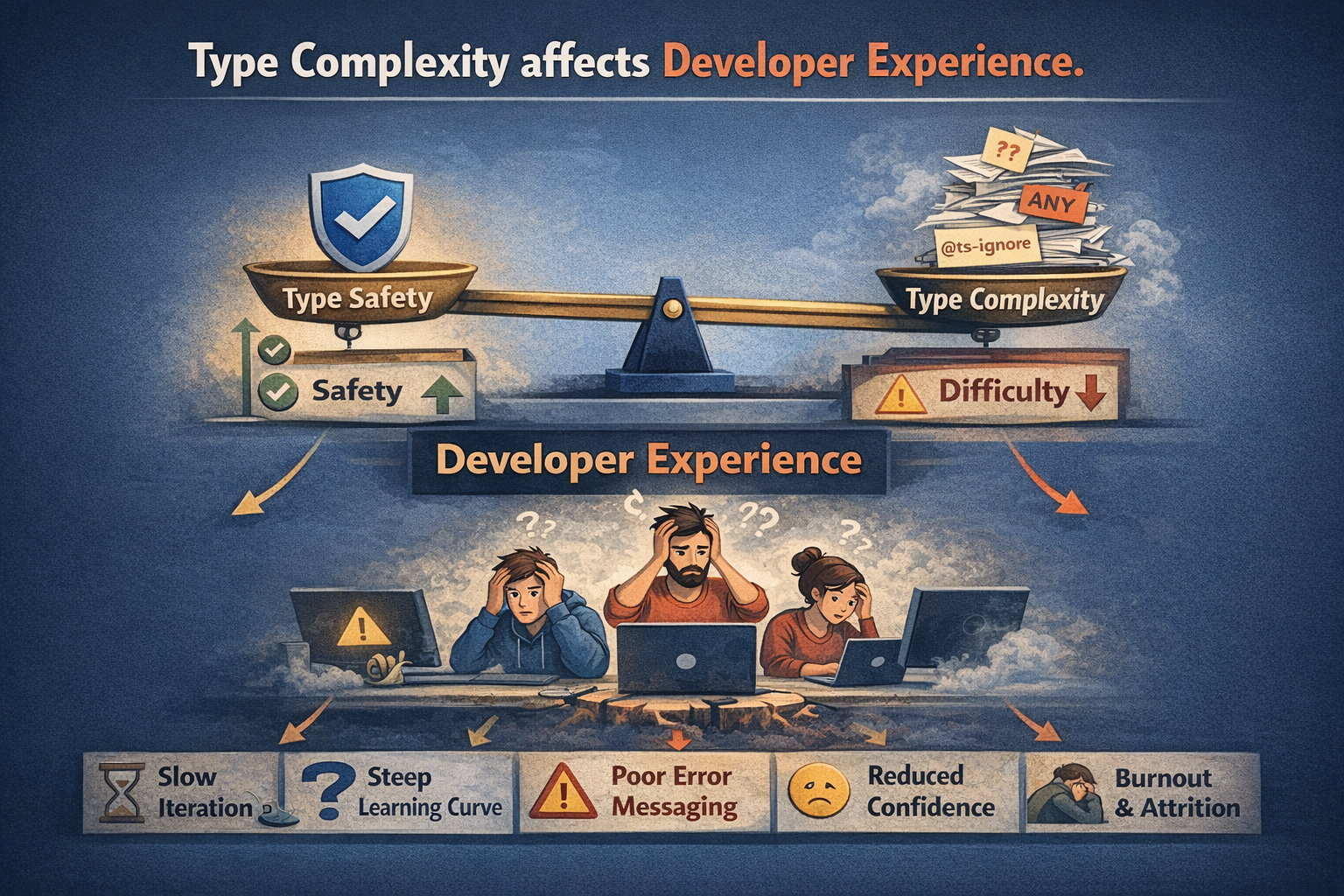
It’s easy to create “clever” generic abstractions, but it’s much harder to maintain them.
At scale, overly complex type logic can:
TypeScript’s type system is powerful enough to simulate parts of a functional programming language, but that doesn’t mean you should.
Before introducing advanced generics, mapped types, or deeply nested conditional types, senior engineers ask:
Types are for humans first, compilers second. If your team can’t confidently modify a type, it has already become technical debt.
type DeepReadonlyExcept<T, K extends keyof T> =
 { readonly [P in Exclude<keyof T, K>]: T[P] } &
 { [P in K]: T[P] };
This may be clever. But is it necessary?
Will someone confidently refactor it six months from now?
type User = Readonly<{
 id: string;
 email: string;
}> & {
 isAdmin: boolean;
};
This is more explicit, understandable and maintainable. In large systems, clarity compounds but cleverness accumulates cost.
Types are documentation. If they confuse humans, they’re failing.
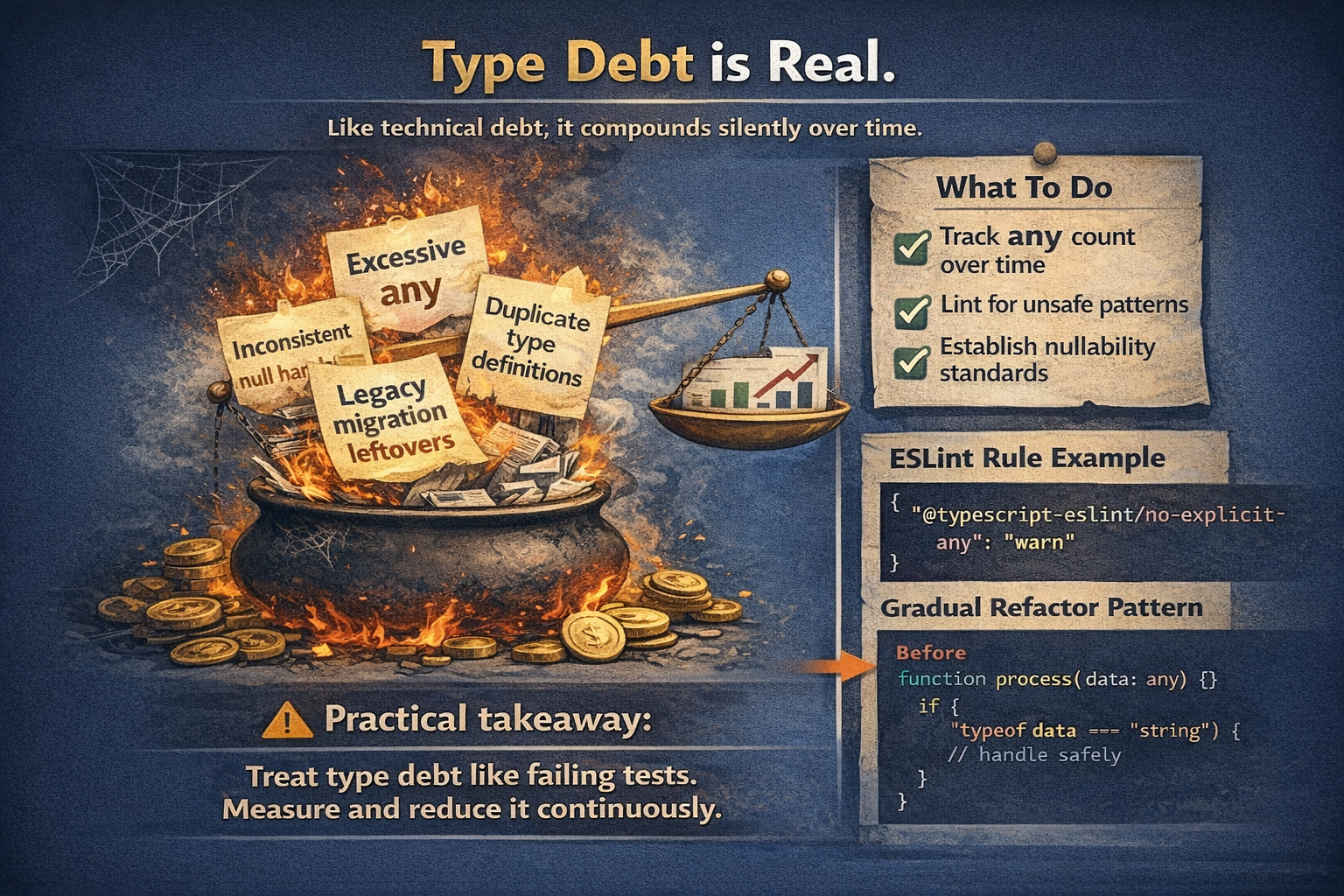
We talk about technical debt. We rarely talk about type debt.
It accumulates silently and shows up as: Excessive any, Inconsistent null handling, Duplicate type definitions and Legacy migration leftovers
Like other forms of debt, type debt compounds. And cleaning it up later is expensive.
any count over time{
"@typescript-eslint/no-explicit-any": "warn"
}
// Before
function process(data: any) {}

// After
function process(data: unknown) {
 if (typeof data === "string") {
 // handle safely
 }
}
Treat type debt like failing tests. Measure and reduce it continuously.
TypeScript is no longer “frontend only.” It now spans:
The question shifts from “How do we type this component?” to: “How do we ensure this contract holds across systems?”
Once types move across platforms, coordination matters more than syntax.
A change in one place can ripple across web apps, APIs, background workers, and mobile clients. At that point, types are no longer implementation details; they are cross-system agreements.
Version 1
// contracts/v1/user.ts
export interface UserV1 {
 id: string;
 name: string;
}
Version 2 (Breaking Change)
// contracts/v2/user.ts
export interface UserV2 {
 id: string;
 fullName: string;
}
Instead of silently mutating UserV1, you introduce UserV2.
Consumers can migrate intentionally. Nothing breaks unexpectedly.
Types that cross system boundaries are not just annotations, but rather they’re agreements between teams, services, and sometimes companies. Hence the need to:
TypeScript is here to stay, and it’s becoming more central to system architecture every year; shaping how teams design APIs, structure monorepos, enforce boundaries, and evolve systems safely. At scale, success isn’t about:
It’s about:
The teams that succeed with TypeScript in 2026 aren’t the ones writing the cleverest types.
They’re the ones operating TypeScript with discipline, because at scale, TypeScript isn’t just a language, it’s infrastructure, and infrastructure rewards clarity, consistency, and intentional design.
Happy Coding!!
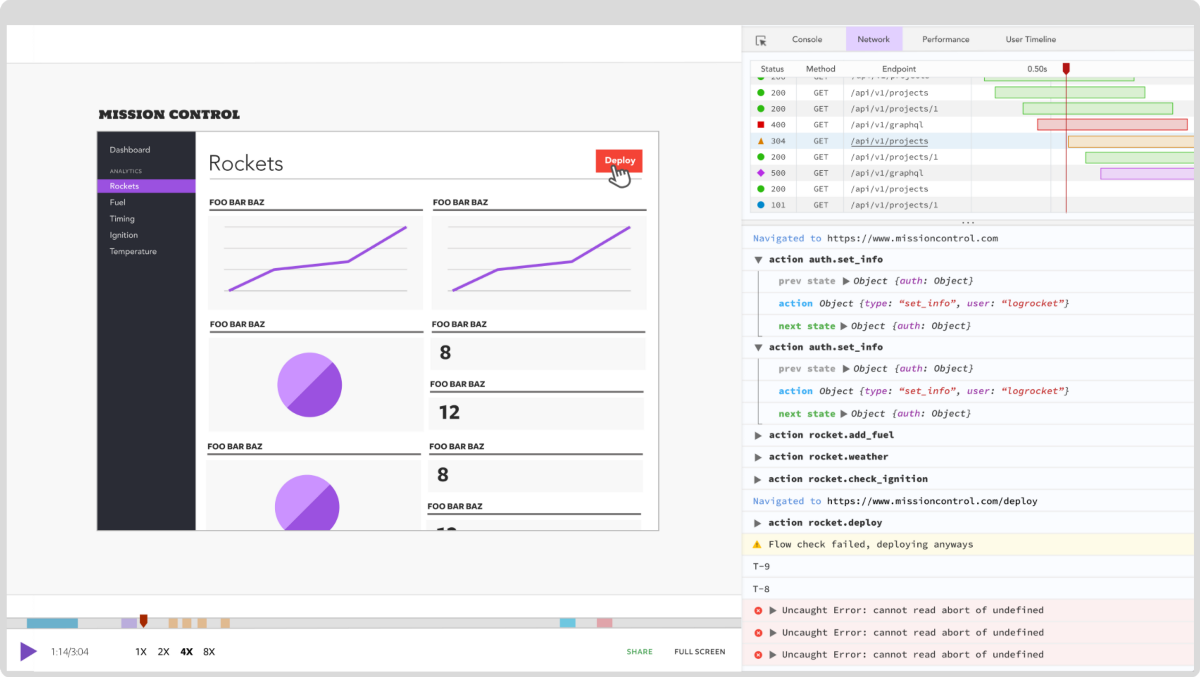
LogRocket lets you replay user sessions, eliminating guesswork by showing exactly what users experienced. It captures console logs, errors, network requests, and pixel-perfect DOM recordings — compatible with all frameworks, and with plugins to log additional context from Redux, Vuex, and @ngrx/store.
With Galileo AI, you can instantly identify and explain user struggles with automated monitoring of your entire product experience.
Modernize how you understand your web and mobile apps — start monitoring for free.
Learn how to build a full React Native auth system using Better Auth and Expo — with email/password login, Google OAuth, session persistence, and protected routes.
Compare the top AI development tools and models of June 2026. View updated rankings, feature breakdowns, and find the best fit for you.
Learn how Bloom filters reduce database lookups for username availability checks while preserving correctness at scale.
Learn how to test Nuxt apps with Vitest, @nuxt/test-utils, runtime mocks, server route mocks, and Playwright e2e tests.
Would you be interested in joining LogRocket's developer community?
Join LogRocket’s Content Advisory Board. You’ll help inform the type of content we create and get access to exclusive meetups, social accreditation, and swag.
Sign up now