VOOZH about

URL: https://brilliant.org/about/

⇱ About | Brilliant


Our Mission

Making a world of great problem solvers

We help people excel in STEM, in less time, with more purpose and joy

What we do

At Brilliant, we help our learners achieve much higher levels of ability in STEM, in less time, with more purpose and joy.

We do this by designing an optimized learning experience that’s interactive, adaptive, and fun — at scale.

Our focus is on mathematical and quantitative problem solving and computer science.

Our approach

What’s the best way to teach variables to a beginner? This is the kind of question that everyone at Brilliant – from math PhDs to engineers and designers – obsesses over.

We read every piece of feedback. We measure everything. Knowing how many users practice every day, and whether people solve problems of increasing difficulty over time, allows us to get the learning experience just right.

This is what’s driving our exponential growth. With millions of problem tries every day, we’re rapidly increasing the pace at which we’re able to test our pedagogical ideas.

Our learners

We believe that realizing your mind’s potential is a satisfying pursuit in itself. As an ethos, we teach people who take pride in having a well-trained mind. This includes a broad range of users – students seeking to excel in STEM, homeschools seeking an engaging curriculum, professionals learning new skills or refreshing dormant ones, and lifelong learners staying sharp.

While the skills you learn on Brilliant can be used in the real world, we don’t see this as the core purpose of learning. Problem solving, like play, is a natural instinct. Humans love to figure things out. We aim to feed this intrinsic motivation by making learning fun and creating a lifelong habit of self-challenge.

We’ve grown on the strength of being so good that you’ll voluntarily learn each day. This is very hard to do for math. But we’re demonstrating that it’s possible.

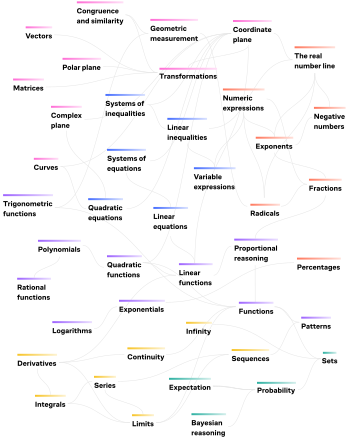
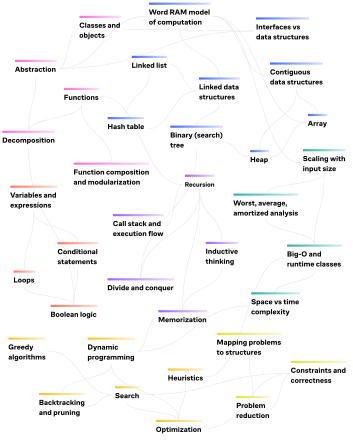
What we teach

After covering all concepts of Algebra, we’ll turn to building out our coverage of Geometry, Probability, Calculus, and beyond in 2026.

👁 WASC Accredited

Supplementary Education Program:

Fully accredited by the Accrediting Commission for Schools, Western Association of Schools and Colleges

Our method

Every lesson has associated practice sets. These practice sets are designed to feel like low-stakes quizzes. The frequency, timing, and composition of practice sets are an area of active experimentation, to maximize effective retrieval and automaticity.

In practice sets, the scaffolding falls away — you’re being tested on your independent ability to answer the questions, so there are no more visual aids or hints.

In some courses, we’re testing (with positive results) changing problem framing. So, for example, in our introductory Statistics course the lesson asks you to find the mean of a quantity of cupcakes sold. Then the associated practice asks you to find the mean of the sale price of a drink.

For constructing personalized practice, we predict the optimal next problem X to ask, so that you are adequately prepared to answer a future question Y. This is also a generalized testing umbrella within which we test spaced repetition (especially in weak areas), mixing practice problems from different concepts (so that the learner must identify what approach to use to solve each problem, rather than just applying the same procedure to every problem), determining level of effective automaticity (fast solving speed with no mistakes), and optimal length and difficulty per set.

Review sets that combine problems from preceding lessons are currently being rolled out on a course-by-course basis (we human-review everything, which is why this has a gradual rollout).

In 2026, we’ll also experiment with assessments that more closely mimic higher-stakes situations.
To learn math well requires many, many reps. The precise amount required varies among individuals, but everyone needs practice. We design a variety of mechanisms to make it fun to practice, and satisfying to progress to more challenging sets.

Our gamification layer provides scaffolding for motivation and habit formation. This provides another tool to help learners stick with learning even in the absence of tutors or parents who help foster motivation.

On Brilliant, the content itself is designed to feel fun — from the pedagogical design of the interactives and problem progression, to the types of sounds, feedback, and haptics we provide as you interact.

Most of the increase in usage and learner retention has come from excellent content delivery, but gamification helps. We avoid packing too many game incentives into the product to keep the focus on the learning content, but aim to execute well on a few core habit formation loops. These include Streaks and Leagues.

Learners progress through levels of progressively more difficult problem solving in a topic. The leveling system intentionally displays a more reductive view of concept connections and prerequisites than the underlying reality. It is focused on providing learners with clear and satisfying milestones to work toward.

Progress is also gamified — including in how we structure XP and pass/fail feedback and routing. Currently, we’re working on testing various mechanics to extend your learning session, i.e., motivate learners to continue with the next appropriate practice, review, or lesson.

Overall, approaches to building both intrinsic and extrinsic motivation are an area of active investigation and testing.
Our lessons prioritize visual representations and active learning.

Each lesson focuses on a single concept and has a mix of direct instruction and blocked problem solving (i.e., practicing similar problems).

We first build intuition with visual explanations, hands-on manipulation, and concrete computation. We start with the simplest version of an idea, minimizing cognitive load. Each interactive problem gives instant, custom feedback based on your answer.

As concepts build on one another, we challenge learners to try more advanced computations and combine ideas to solve problems.

We don’t teach how to do something before asking questions. Instead, we pretest on the material, letting the learner try to find a solution before learning the procedure. Based on our testing to date, we believe this is the optimal approach.
Brilliant is available on four platforms: desktop web, mobile web, iOS, and Android.

We sweat the details of removing as much from the interface as we can (including killing features that test only incrementally better), and making every UI element, interaction, and feedback obvious without needing a tutorial.

Every 30 ms we shave off of our loading and feedback times makes a difference in how much people learn, and to our personal satisfaction with the performance and craft in our engineering. For mature features, we routinely revisit how close we are to the limits of performance, and will rewrite everything if necessary to get closer.

It’s a core part of our business model today to allow everyone to learn something every day, for free. As we continue to build more features into our learning product, our aim is to make the free tier more generous, with various subscription tiers offering additional learning features.
Alongside adaptive practice delivery, ‘true’ personalization at the level of a 1:1 human tutor is an area we are actively user testing.

AI models bring us much closer to being able to have a multi-modal conversation in real-time with the material, but there are several important problems to solve:

User knowledge modeling. Teaching well requires having an understanding of what the learner does and doesn’t know. We’re combining techniques from intelligent tutoring systems, classic ML recommender systems, and natural language conversations to identify exactly where a learner’s misconception lies.

On-the-fly visual and interactive generation. Learners get lost in a wall of text. They want a visual or a manipulable interactive, problems that exactly match the question they have, and the ability to practice on near-neighbor problems just like it. Our content has been built over many years to enable precisely this functionality.

Interface. What should it look like, and more importantly feel like, to have a conversation with a human tutor? We know what it shouldn’t look like: the tutor giving you three paragraphs of text to read, just giving you the answer, or offering hints so easily that it becomes a crutch. We’re charging toward the future of what this should look like. If you’re a UI/HCI designer and this sounds exciting to you, please reach out!

More reading

Great minds think here

Come work alongside a team of diverse talents – multiple IMO medalists, ex-Editor-in-Chief at The Onion, Cannes Lion winner, knitwear designer for Marvel, an Amazon top 50 book of the year writer, and PhDs and dropouts from MIT, Caltech, Stanford, and Harvard to name a few.

See Brilliant careers
👁 Image

© 2026 Brilliant Worldwide, Inc., Brilliant and the Brilliant Logo are trademarks of Brilliant Worldwide, Inc.