



CXC Home | Search | Help | Image Use Policy | Latest Images | Privacy | Accessibility | Glossary | Q&A
 |
VOOZH | about |
|
VOOZH | about |
The evidence for cosmic acceleration and by implication, dark energy, comes from observations of distant Type Ia supernovas, X-ray observations of the gas content and growth of clusters of galaxies, the cosmic microwave background radiation, the large-scale distribution of galaxies on the sky, and the gravitational bending of light from distant galaxies by intervening matter.
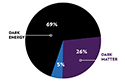
A broad suite of astronomical observations has led to a consistent picture in which 4.9 to 5% of the mass-energy budget of the Universe is normal (baryonic) matter such as protons and neutrons, 26 to 26.8% is dark matter, and 68 to 69% is attributed to dark energy.
The two basic models for dark energy are that it is either energy associated with empty space (vacuum energy) and is constant throughout space and time —the so-called "cosmological constant," or it is an energy field that varies over space and time — called a "scalar field," or "quintessence." Coming up with a theory to explain how this works has proved elusive in both cases.
Cosmic acceleration could be a sign that the theory of gravity needs to be modified for extremely large distance scales, or that we live in a very large region of space that just happens to have a much lower density than the rest of space. Models based on these explanations have had difficulty explaining all the data on cosmic acceleration.