Meet the winners of our Claude Opus 4.8 Build Day hackathon
From reconstructing Tang Dynasty architecture to polling a synthetic San Francisco, see what the winners of our latest hackathon built with Claude Opus 4.8 in a day.
On June 13, we brought more than 300 founders and builders to San Francisco for a 12-hour hackathon with Claude Opus 4.8. More than 1,500 people had applied; 310 took part, many traveling from around the world, each with $500 in credits and one day to turn an idea into a working demo.
We caught up with the three winning teams about what they built and how they used Claude to do it.
Congratulations to the winners and everyone who took part. We hope their projects give you a few ideas of your own.
First place: Tekton, Holly Tang and Austin Burgess
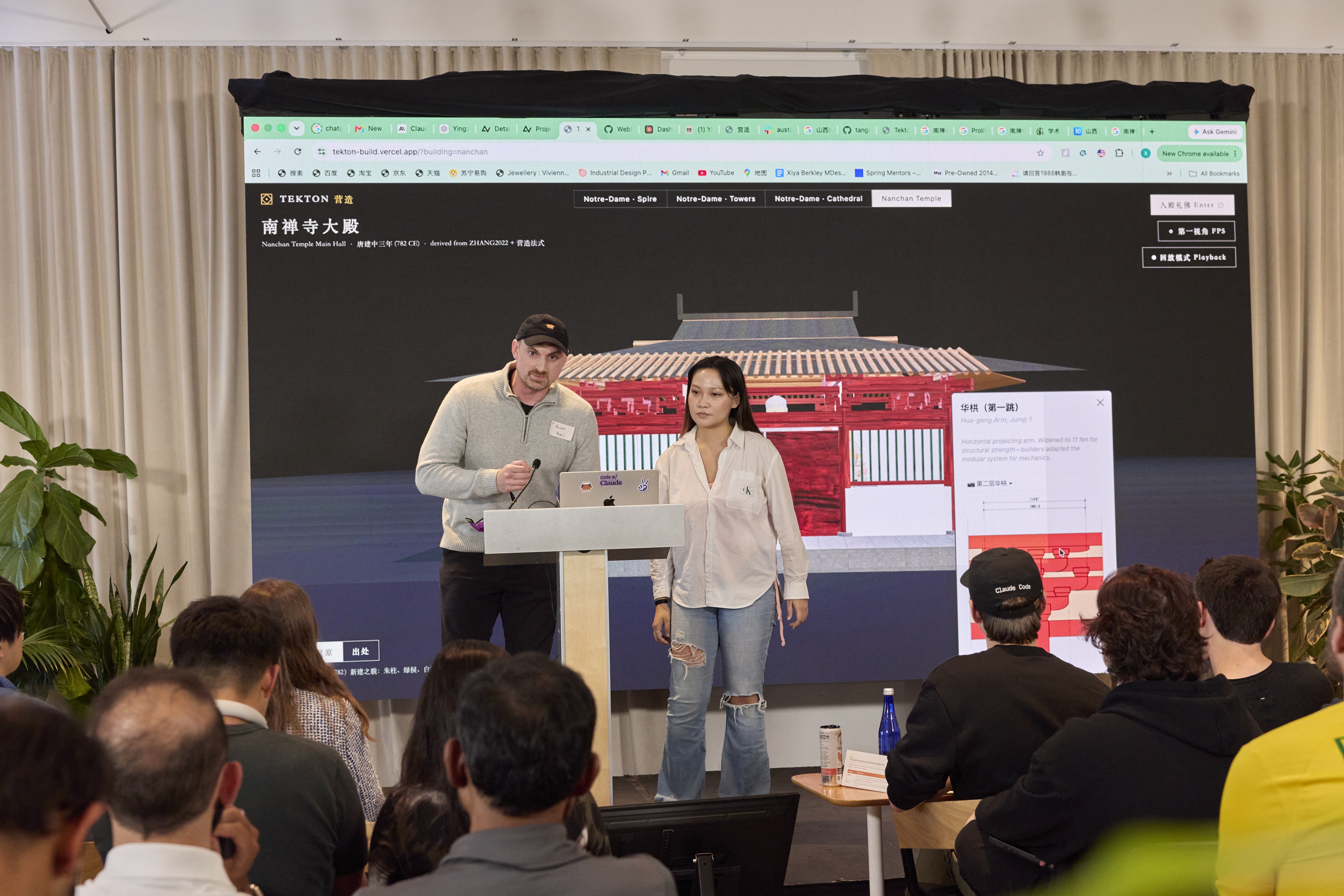
Holly Tang and Austin Burgess built Tekton, a 3D reconstruction platform that brings Tang Dynasty architecture back to life, with every component traceable to its historical source.
When a historic wooden building burns, centuries of craftsmanship can disappear with it. Tekton reconstructs those buildings in 3D and traces every piece back to a documented source.
Give Tekton a historical building and Claude researches it, pulling together schematics, construction documents, photographs, and diagrams, then assembles a 3D model across 339 incremental construction states. When you click any component in the model, Tekton shows where the detail came from and why it was placed there. The team calls this an evidence chain, running from source material to verified model. They built it for academic validation, restoration work, and cultural preservation, starting with Tang Dynasty architecture and the spire of Notre-Dame.
The verification ran entirely on Opus 4.8. Independent verifier sub-agents graded each reconstruction in isolated context windows, and self-correction loops rechecked component placement until all 20 tests passed. Every build was measured against the historical record and its citations, so the finished model follows the documented rules of how the structure was originally built.
Holly Tang and Austin Burgess met a month earlier, in line for coffee at a Code with Claude event. Holly, a designer, has been helping with Austin's startup. "I love watching documentaries, and it always upset me to see beautiful buildings lost to fire," Holly says. She had prototyped a single reconstruction on her own; Austin's contribution was scaling it to work on any building, end to end.
To build Tekton, the two worked in stages: they got the spire of Notre-Dame rendering at scale first, then added finer detail, then expanded toward the rest of the structure. Time ran out before the full cathedral was done. Even so, several hackathon attendees asked about it or offered to help make it more accurate. Holly and Austin want to make Tekton open source, so museums, historians, nonprofits, and governments can build on it.
Advice to other builders: Map the whole project before you build any of it.
"We built an entire PRD and a Notion board with around 50 tickets, one for each specific task," Austin says. "It was almost like, here's the complete project end to end, and this is exactly what we want for each step." With the plan set, he broke the build into separate workflows and ran them in parallel.
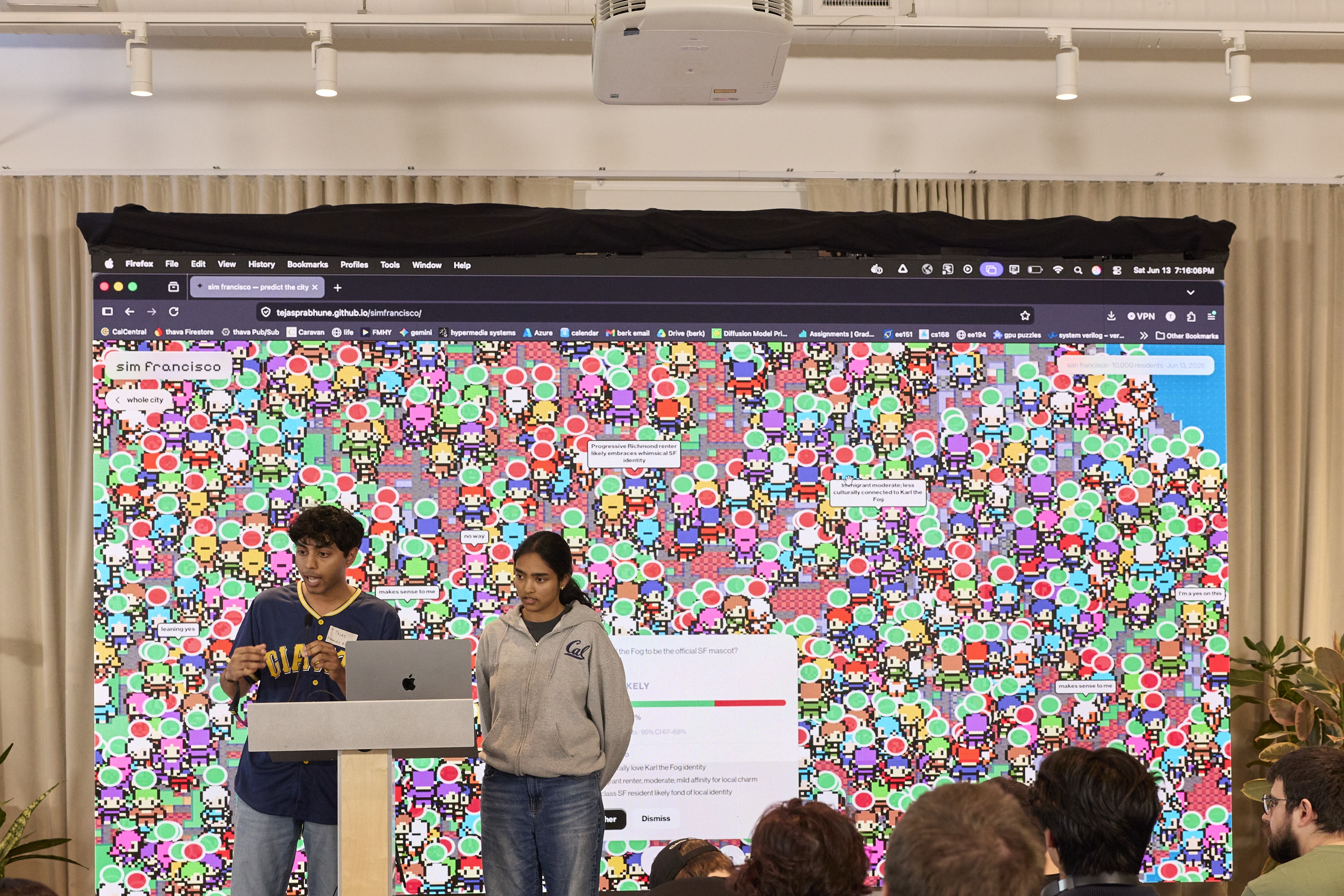
Tanmayi Priya Dasari and Tejas Prabhune built Sim Francisco, a Census-seeded digital twin of San Francisco's population that can poll a synthetic city in seconds and forecast real-world outcomes.
Sim Francisco is a working model of San Francisco's population. It has 10,000 synthetic residents drawn from US Census data, each with their own demographics, personal history, and worldview, placed on a map of the city and reacting to the news in real time.
Ask the city a question and it polls the entire synthetic electorate, neighborhood by neighborhood. Running on models with an October 2023 knowledge cutoff, it forecast the 2024 presidential vote at 81.3% Democratic against an actual 83.8%, and San Francisco's March 2024 Prop A at 70% against an actual 70.38%. It tracks prediction markets like Kalshi and Polymarket within a couple of points.*
Opus 4.8 wrote the entire front and back end and verified the backend's behavior end to end. To verify the model’s work, the team had Claude work alongside a verifier and an adversarial agent to build a backend that reproduced the city's real demographic distributions.
Tanmayi Priya Dasari and Tejas Prabhune are electrical engineering and computer science majors at UC Berkeley who met through the Machine Learning club on campus. For Tejas, Sim Francisco doubles as a test for the post-training company he's building, where he's working out whether simulated personas can stay consistent enough to train models on long-horizon tasks.
Advice to other builders: Don't settle for the first approach that works, especially when it's expensive.
The team's first version made a separate inference call for each of the 10,000 residents, which got costly. "Over time, Claude ran an evolutionary clustering algorithm it created itself," Tejas says, batching residents into about 300 representative personas. The grouped version held the same accuracy against Kalshi, Polymarket, and historical results while cutting inference cost by 10 to 100 times.
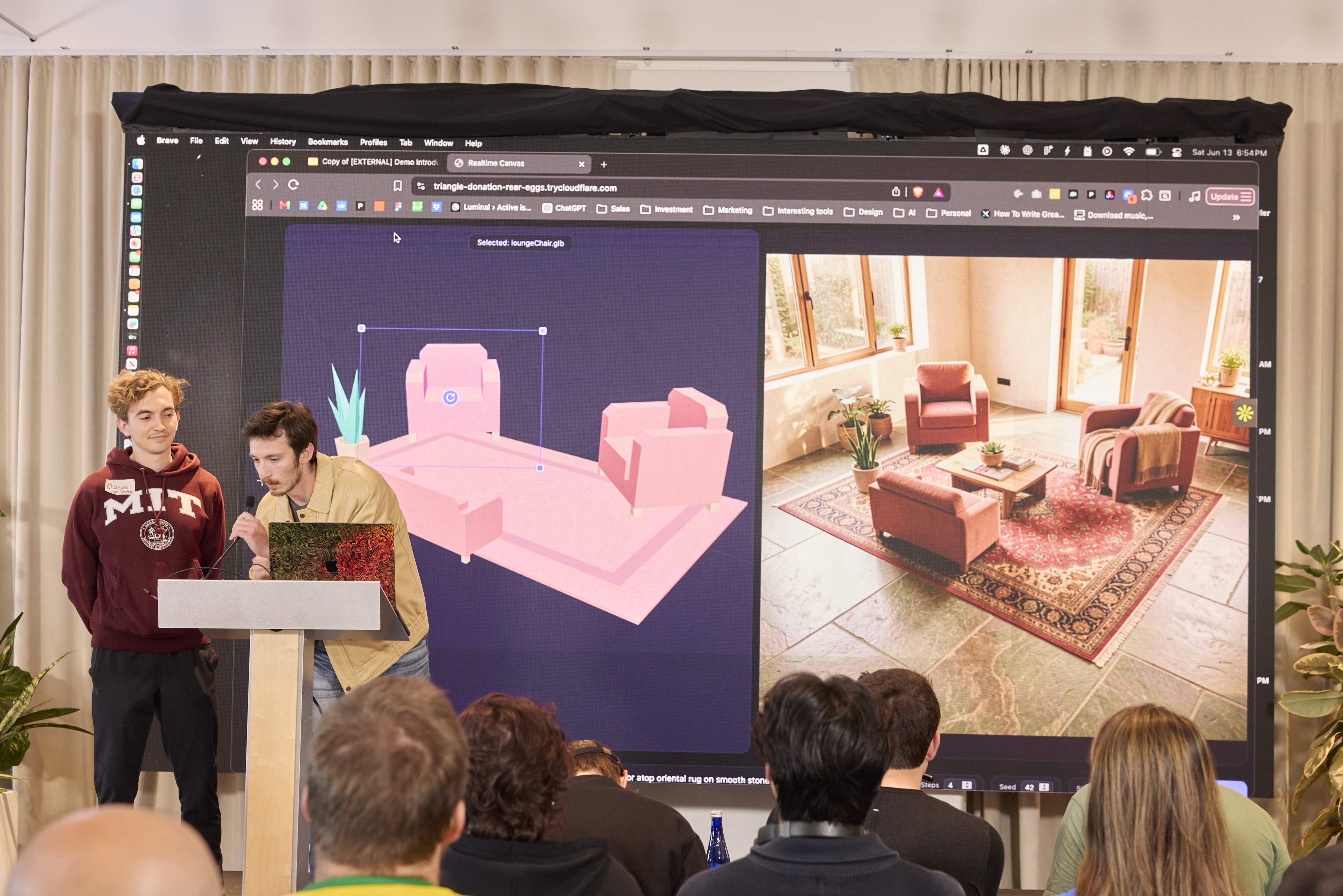
Jake Stevens and Mauricio Pereira built Custom Universe, a real-time engine that turns a single phone photo into a fully editable, photorealistic 3D scene.
Snap a phone photo of a chair, and Custom Universe turns it into a 3D object you can drop into a scene, restyle with a text prompt, and move around while the rendered image updates in real time.
The project is aimed at robotics labs, which need large volumes of synthetic data to train robots for specific tasks and settings. A lab can scan a machine from a factory floor, drop it into a scene, and generate data to fine-tune a robotics model for that exact environment. Building that kind of setup usually means hiring physicists and engineers to handle the physics and collision geometry. Custom Universe lets you arrange a scene by dragging objects around instead, and the team plans to add precise placement, like nudging an object 30 centimeters across a kitchen counter.
Opus 4.8 built the project end to end and operated the remote NVIDIA H100 that ran the model throughout the hackathon. The team also used Claude to work out which models produced the right output and to build the pipeline that brings phone-scanned objects, captured with Apple's RealityKit, into the web app.
Jake Stevens and Mauricio Pereira met at the event. Jake is a Rochester Institute of Technology (RIT) computer-vision graduate who runs Luminal, a startup focused on speeding up AI models; the scene builder started as a side project he had wanted to try. Mauricio, an MIT robotics graduate who runs Coat Robotics, brought the problem he knew firsthand: robotics still lacks training data, and building synthetic environments is hard. Custom Universe relies on open-source models and algorithms and is free to use; the team says users can run it on their own GPUs.
Advice to other builders: Use Claude to choose your tools, not just to write the code.
"A lot of the iteration was looking at which model was giving us the right output, so we used Claude to do a lot of the research," Mauricio says. The team also handed Claude unfamiliar technologies to integrate. "For example, Apple RealityKit, and how we were going to make sure people can input their scanned objects to our website. We asked Claude: add this to the pipeline."
Learn about our Claude Community programs, including meetups, hackathons, and more.
*Sim Francisco is an independent hackathon project that uses forecasting election outcomes as an example. This does not represent an Anthropic endorsement of using AI-simulated election predictions as a use case.
Hi Claude! Could you help me develop a unique voice for an audience? If you need more information from me, ask me 1-2 key questions right away. If you think I should upload any documents that would help you do a better job, let me know. You can use the tools you have access to— like Google Drive, web search, etc.—if they’ll help you better accomplish this task. Do not use analysis tool. Please keep your responses friendly, brief and conversational.
Please execute the task as soon as you can—an artifact would be great if it makes sense. If using an artifact, consider what kind of artifact (interactive, visual, checklist, etc.) might be most helpful for this specific task. Thanks for your help!
Improve my writing style
Hi Claude! Could you improve my writing style? If you need more information from me, ask me 1-2 key questions right away. If you think I should upload any documents that would help you do a better job, let me know. You can use the tools you have access to— like Google Drive, web search, etc.—if they’ll help you better accomplish this task. Do not use analysis tool. Please keep your responses friendly, brief and conversational.
Please execute the task as soon as you can—an artifact would be great if it makes sense. If using an artifact, consider what kind of artifact (interactive, visual, checklist, etc.) might be most helpful for this specific task. Thanks for your help!
Brainstorm creative ideas
Hi Claude! Could you brainstorm creative ideas? If you need more information from me, ask me 1-2 key questions right away. If you think I should upload any documents that would help you do a better job, let me know. You can use the tools you have access to— like Google Drive, web search, etc.—if they’ll help you better accomplish this task. Do not use analysis tool. Please keep your responses friendly, brief and conversational.
Please execute the task as soon as you can—an artifact would be great if it makes sense. If using an artifact, consider what kind of artifact (interactive, visual, checklist, etc.) might be most helpful for this specific task. Thanks for your help!
Learn
Explain a complex topic simply
Hi Claude! Could you explain a complex topic simply? If you need more information from me, ask me 1-2 key questions right away. If you think I should upload any documents that would help you do a better job, let me know. You can use the tools you have access to— like Google Drive, web search, etc.—if they’ll help you better accomplish this task. Do not use analysis tool. Please keep your responses friendly, brief and conversational.
Please execute the task as soon as you can—an artifact would be great if it makes sense. If using an artifact, consider what kind of artifact (interactive, visual, checklist, etc.) might be most helpful for this specific task. Thanks for your help!
Help me make sense of these ideas
Hi Claude! Could you help me make sense of these ideas? If you need more information from me, ask me 1-2 key questions right away. If you think I should upload any documents that would help you do a better job, let me know. You can use the tools you have access to— like Google Drive, web search, etc.—if they’ll help you better accomplish this task. Do not use analysis tool. Please keep your responses friendly, brief and conversational.
Please execute the task as soon as you can—an artifact would be great if it makes sense. If using an artifact, consider what kind of artifact (interactive, visual, checklist, etc.) might be most helpful for this specific task. Thanks for your help!
Prepare for an exam or interview
Hi Claude! Could you prepare for an exam or interview? If you need more information from me, ask me 1-2 key questions right away. If you think I should upload any documents that would help you do a better job, let me know. You can use the tools you have access to— like Google Drive, web search, etc.—if they’ll help you better accomplish this task. Do not use analysis tool. Please keep your responses friendly, brief and conversational.
Please execute the task as soon as you can—an artifact would be great if it makes sense. If using an artifact, consider what kind of artifact (interactive, visual, checklist, etc.) might be most helpful for this specific task. Thanks for your help!
Code
Explain a programming concept
Hi Claude! Could you explain a programming concept? If you need more information from me, ask me 1-2 key questions right away. If you think I should upload any documents that would help you do a better job, let me know. You can use the tools you have access to— like Google Drive, web search, etc.—if they’ll help you better accomplish this task. Do not use analysis tool. Please keep your responses friendly, brief and conversational.
Please execute the task as soon as you can—an artifact would be great if it makes sense. If using an artifact, consider what kind of artifact (interactive, visual, checklist, etc.) might be most helpful for this specific task. Thanks for your help!
Look over my code and give me tips
Hi Claude! Could you look over my code and give me tips? If you need more information from me, ask me 1-2 key questions right away. If you think I should upload any documents that would help you do a better job, let me know. You can use the tools you have access to— like Google Drive, web search, etc.—if they’ll help you better accomplish this task. Do not use analysis tool. Please keep your responses friendly, brief and conversational.
Please execute the task as soon as you can—an artifact would be great if it makes sense. If using an artifact, consider what kind of artifact (interactive, visual, checklist, etc.) might be most helpful for this specific task. Thanks for your help!
Vibe code with me
Hi Claude! Could you vibe code with me? If you need more information from me, ask me 1-2 key questions right away. If you think I should upload any documents that would help you do a better job, let me know. You can use the tools you have access to— like Google Drive, web search, etc.—if they’ll help you better accomplish this task. Do not use analysis tool. Please keep your responses friendly, brief and conversational.
Please execute the task as soon as you can—an artifact would be great if it makes sense. If using an artifact, consider what kind of artifact (interactive, visual, checklist, etc.) might be most helpful for this specific task. Thanks for your help!
More
Write case studies
This is another test
Write grant proposals
Hi Claude! Could you write grant proposals? If you need more information from me, ask me 1-2 key questions right away. If you think I should upload any documents that would help you do a better job, let me know. You can use the tools you have access to — like Google Drive, web search, etc. — if they’ll help you better accomplish this task. Do not use analysis tool. Please keep your responses friendly, brief and conversational.
Please execute the task as soon as you can - an artifact would be great if it makes sense. If using an artifact, consider what kind of artifact (interactive, visual, checklist, etc.) might be most helpful for this specific task. Thanks for your help!