Your GET /api/movies endpoint returns every single record in the database. That works fine when you have 10 movies. But what happens when you have 10,000? Or 100,000? The API response becomes painfully slow, the database is under unnecessary load, and your front-end developers are not going to be happy.
Pagination, sorting, and searching are the three pillars of any production-ready list endpoint. Every public API you’ve used (GitHub, Stripe, Twitter) implements all three. Trust me, I’ve seen production APIs that returned entire tables in a single call. The database went down during a demo. Don’t be that developer.
In this article, I’ll walk you through adding these capabilities to the Movie API from the previous lesson using Entity Framework Core (EF Core) 10, turning a basic GetAll endpoint into something you’d actually ship to production.
By the end of this guide, you’ll have a single endpoint that supports queries like:
GET /api/movies?pageNumber=2&pageSize=5&sortBy=rating desc&search=sci-fiReusable extension methods, a clean response wrapper, and a solid understanding of when to use offset pagination vs keyset (cursor) pagination. Let’s get into it.
Prerequisites
This article builds directly on the CRUD API from the previous lesson. Make sure you have:
- .NET 10 SDK installed - Download here
- The Movie API project from the previous lesson up and running
- PostgreSQL running via Docker (as set up in the CRUD lesson)
- Docker Desktop installed - Download here
If you haven’t completed the CRUD lesson yet, start there first. You’ll be extending the exact same Movie entity, MovieDbContext, and MovieService from that project.
Start Here: Build the CRUD API First
This article builds on the Movie API from the CRUD with EF Core lesson. Set up the project, entities, DbContext, and endpoints before continuing.
The complete source code for this article is available on my GitHub repository.
What is Pagination and Why Your API Needs It
Pagination is a technique where the API returns data in chunks (pages) instead of all at once. The client specifies which page they want and how many records per page, and the server returns only that subset. In .NET 10 with EF Core 10, pagination is implemented using Skip() and Take() LINQ operators, which translate directly to SQL OFFSET and LIMIT clauses.
There are two main approaches to pagination:
- Offset pagination - Uses page number and page size. The database skips N rows and returns the next batch. Simple to implement, supports jumping to any page. This is what most APIs use.
- Keyset (cursor) pagination - Uses a value from the last returned record to fetch the next batch. More performant for large datasets but doesn’t support random page access.
Without pagination, a single request could return millions of rows, overloading your database, saturating network bandwidth, and potentially crashing the client’s browser. Always paginate list endpoints. It’s not optional for production APIs.
RESTful API Best Practices
Pagination is a core REST principle. Learn the full set of best practices for designing clean, predictable APIs.
Seeding Sample Data for Testing
The CRUD lesson seeded a single movie. That’s not enough to see pagination in action. Let’s update the MovieDbContext to seed 20 movies across different genres, ratings, and release dates.
Open your MovieDbContext.cs and update the OnConfiguring method:
protectedoverridevoidOnConfiguring(DbContextOptionsBuilderoptionsBuilder){optionsBuilder.UseAsyncSeeding(async (context, _, cancellationToken) =>{if (!awaitcontext.Set<Movie>().AnyAsync(cancellationToken)){varmovies=GetSeedMovies();awaitcontext.Set<Movie>().AddRangeAsync(movies, cancellationToken);awaitcontext.SaveChangesAsync(cancellationToken);}}).UseSeeding((context, _) =>{if (!context.Set<Movie>().Any()){varmovies=GetSeedMovies();context.Set<Movie>().AddRange(movies);context.SaveChanges();}});}privatestaticList<Movie> GetSeedMovies() =>[Movie.Create("The Shawshank Redemption", "Drama", newDateTimeOffset(1994, 9, 23, 0, 0, 0, TimeSpan.Zero), 9.3),Movie.Create("The Godfather", "Crime", newDateTimeOffset(1972, 3, 24, 0, 0, 0, TimeSpan.Zero), 9.2),Movie.Create("The Dark Knight", "Action", newDateTimeOffset(2008, 7, 18, 0, 0, 0, TimeSpan.Zero), 9.0),Movie.Create("The Lord of the Rings: The Return of the King", "Fantasy", newDateTimeOffset(2003, 12, 17, 0, 0, 0, TimeSpan.Zero), 9.0),Movie.Create("Pulp Fiction", "Crime", newDateTimeOffset(1994, 10, 14, 0, 0, 0, TimeSpan.Zero), 8.9),Movie.Create("Forrest Gump", "Drama", newDateTimeOffset(1994, 7, 6, 0, 0, 0, TimeSpan.Zero), 8.8),Movie.Create("Inception", "Sci-Fi", newDateTimeOffset(2010, 7, 16, 0, 0, 0, TimeSpan.Zero), 8.8),Movie.Create("Fight Club", "Drama", newDateTimeOffset(1999, 10, 15, 0, 0, 0, TimeSpan.Zero), 8.8),Movie.Create("The Matrix", "Sci-Fi", newDateTimeOffset(1999, 3, 31, 0, 0, 0, TimeSpan.Zero), 8.7),Movie.Create("Interstellar", "Sci-Fi", newDateTimeOffset(2014, 11, 7, 0, 0, 0, TimeSpan.Zero), 8.7),Movie.Create("Dune: Part Two", "Sci-Fi", newDateTimeOffset(2024, 3, 1, 0, 0, 0, TimeSpan.Zero), 8.6),Movie.Create("Gladiator", "Action", newDateTimeOffset(2000, 5, 5, 0, 0, 0, TimeSpan.Zero), 8.5),Movie.Create("The Lion King", "Animation", newDateTimeOffset(1994, 6, 24, 0, 0, 0, TimeSpan.Zero), 8.5),Movie.Create("Oppenheimer", "Drama", newDateTimeOffset(2023, 7, 21, 0, 0, 0, TimeSpan.Zero), 8.5),Movie.Create("Parasite", "Thriller", newDateTimeOffset(2019, 5, 30, 0, 0, 0, TimeSpan.Zero), 8.5),Movie.Create("Jurassic Park", "Sci-Fi", newDateTimeOffset(1993, 6, 11, 0, 0, 0, TimeSpan.Zero), 8.2),Movie.Create("Spider-Man: No Way Home", "Action", newDateTimeOffset(2021, 12, 17, 0, 0, 0, TimeSpan.Zero), 8.2),Movie.Create("The Avengers", "Action", newDateTimeOffset(2012, 5, 4, 0, 0, 0, TimeSpan.Zero), 8.0),Movie.Create("Titanic", "Romance", newDateTimeOffset(1997, 12, 19, 0, 0, 0, TimeSpan.Zero), 7.9),Movie.Create("Everything Everywhere All at Once", "Sci-Fi", newDateTimeOffset(2022, 3, 25, 0, 0, 0, TimeSpan.Zero), 7.8),];The code uses AnyAsync() to check if data already exists before seeding, preventing duplicate inserts on subsequent runs. With 20 movies spanning multiple genres and ratings, there’s enough data to properly test pagination (2 pages at pageSize=10), sorting (by rating, title, release date), and searching (by title or genre).
Note: If you already have data from the previous lesson, drop and recreate the database:
dotnet ef database dropfollowed bydotnet ef database update, or simply delete the existing movies via the API.
Building the Paged Response Wrapper
Before implementing pagination logic, you need a response wrapper that tells the client everything about the current page: total records, total pages, and whether next/previous pages exist. This metadata goes in the response body, not in HTTP headers. The header-based approach (like X-Pagination) was popular years ago, but modern APIs return pagination metadata alongside the data for better developer experience.
Create a new folder named Common and add a PagedResponse.cs class:
namespaceMovies.Api.Common;publicclassPagedResponse<T>{publicIReadOnlyList<T> Data { get; init; } = [];publicintPageNumber { get; init; }publicintPageSize { get; init; }publicintTotalPages { get; init; }publicintTotalRecords { get; init; }publicboolHasNextPage=>PageNumber<TotalPages;publicboolHasPreviousPage=>PageNumber>1;}The PagedResponse<T> wraps any list response with pagination metadata. HasNextPage and HasPreviousPage are computed properties, so the client doesn’t need to calculate these. The Data property uses IReadOnlyList<T> to signal that this is an immutable collection.
HTTP Status Codes for API Responses
Your paginated endpoint should return 200 OK for successful responses and 400 Bad Request for invalid pagination parameters.
Creating the Query Filter
Next, you need a class that captures all the query parameters: page number, page size, sort expression, and search term. Create a MovieQueryFilter.cs file inside the Common folder:
namespaceMovies.Api.Common;publicclassMovieQueryFilter{publicintPageNumber { get; set; } =1;publicintPageSize { get; set; } =10;publicstring? SortBy { get; set; }publicstring? Search { get; set; }}This class works directly with ASP.NET Core’s Minimal API parameter binding via [AsParameters]. Each property maps to a query string parameter automatically: ?pageNumber=2&pageSize=5&sortBy=rating desc&search=action. I use default values so clients don’t have to pass every parameter on every request.
Building the IQueryable Extension Methods
Here’s where the real magic happens. Instead of cramming pagination, sorting, and search logic into the service method, I’ll build reusable extension methods on IQueryable<T>. This keeps the code clean, testable, and reusable across any entity, not just movies.
Create a new file called QueryableExtensions.cs inside the Common folder.
The Pagination Extension
usingSystem.Linq.Dynamic.Core;usingSystem.Reflection;namespaceMovies.Api.Common;publicstaticclassQueryableExtensions{publicstaticIQueryable<T> ApplyPagination<T>(thisIQueryable<T> query, intpageNumber, intpageSize){returnquery.Skip((pageNumber-1) *pageSize).Take(pageSize);}}Skip() skips over the records from previous pages, and Take() limits the result to the requested page size. EF Core translates this directly to SQL OFFSET and LIMIT, so the filtering happens at the database level, not in memory. Get the point?
The Dynamic Sorting Extension
For sorting, you need the ability to sort by any column and any direction based on query parameters. Hardcoding OrderBy(m => m.Title) doesn’t cut it when the client wants to sort by rating or release date.
First, install the System.Linq.Dynamic.Core package:
Install-PackageSystem.Linq.Dynamic.Core-Version1.7.1This library lets you build OrderBy expressions from strings at runtime. It’s the most popular dynamic LINQ library in the .NET ecosystem with over 100 million NuGet downloads. Now add the sorting extension to the same QueryableExtensions class:
publicstaticIQueryable<T> ApplySort<T>(thisIQueryable<T> query, string? sortBy) whereT : class{if (string.IsNullOrWhiteSpace(sortBy))returnquery;varallowedProperties=typeof(T).GetProperties(BindingFlags.Public|BindingFlags.Instance).Select(p=>p.Name).ToHashSet(StringComparer.OrdinalIgnoreCase);varsortExpressions=newList<string>();foreach (varpartinsortBy.Split(',', StringSplitOptions.RemoveEmptyEntries|StringSplitOptions.TrimEntries)){vartokens=part.Split(' ', StringSplitOptions.RemoveEmptyEntries);if (tokens.Length==0||!allowedProperties.Contains(tokens[0]))continue;vardirection=tokens.Length>1&&tokens[1].Equals("desc", StringComparison.OrdinalIgnoreCase)?"descending":"ascending";sortExpressions.Add($"{tokens[0]}{direction}");}returnsortExpressions.Count>0?query.OrderBy(string.Join(", ", sortExpressions)):query;}Let me walk through what this does:
- Validation first - It extracts all public property names from the entity type and checks each requested sort column against this whitelist. This prevents clients from passing invalid or malicious property names.
- Parse the expression - The client sends
?sortBy=rating desc,title asc. The method splits by comma, then splits each part into the property name and direction. - Build the sort string - Valid properties are assembled into a
System.Linq.Dynamic.Corecompatible expression like"Rating descending, Title ascending". - Apply via Dynamic LINQ - The
OrderBy()extension fromSystem.Linq.Dynamic.Corehandles the rest, translating it to proper SQLORDER BYclauses.
This supports multi-column sorting out of the box: ?sortBy=genre asc,rating desc sorts by genre first, then by rating within each genre.
The Search Extension
For searching, the goal is to find movies where the search term appears in the title or genre. Since the project uses PostgreSQL, I leverage EF.Functions.ILike() for case-insensitive pattern matching. This translates directly to PostgreSQL’s ILIKE operator.
Add the search extension to the same class:
publicstaticIQueryable<Movie> ApplySearch(thisIQueryable<Movie> query, string? search){if (string.IsNullOrWhiteSpace(search))returnquery;returnquery.Where(m=>EF.Functions.ILike(m.Title, $"%{search}%") ||EF.Functions.ILike(m.Genre, $"%{search}%"));}Note:
EF.Functions.ILikeis PostgreSQL-specific via the Npgsql provider. If you’re using SQL Server, useEF.Functions.Like()instead (which is case-insensitive by default on most SQL Server collations). The search parameter is parameterized by EF Core, so SQL injection is not a concern here.
Notice this extension is on IQueryable<Movie> rather than IQueryable<T> because it references specific properties (Title, Genre). In a production app with many entities, you could create a generic version using expression trees or an interface like ISearchable, but for this use case it’s clean and explicit.
LeftJoin and RightJoin in .NET 10 with EF Core 10
Need to join data across tables while paginating? Learn how EF Core 10 handles LINQ join operations natively.
Updating the Movie Service
Now let’s wire everything together. Open IMovieService.cs and update the GetAllMoviesAsync method signature:
Task<PagedResponse<MovieDto>> GetAllMoviesAsync(MovieQueryFilterfilter, CancellationTokencancellationToken=default);Then update the implementation in MovieService.cs:
publicasyncTask<PagedResponse<MovieDto>> GetAllMoviesAsync(MovieQueryFilterfilter, CancellationTokencancellationToken=default){varpageNumber=Math.Max(1, filter.PageNumber);varpageSize=Math.Clamp(filter.PageSize, 1, 50);varquery=_dbContext.Movies.AsNoTracking().AsQueryable();// 1. Apply search filter (reduces the dataset)query=query.ApplySearch(filter.Search);// 2. Count total records AFTER filtering, BEFORE paginationvartotalRecords=awaitquery.CountAsync(cancellationToken);// 3. Apply sorting (default to Title if not specified)query=query.ApplySort(string.IsNullOrWhiteSpace(filter.SortBy) ?"Title":filter.SortBy);// 4. Apply pagination and project to DTOsvarmovies=awaitquery.ApplyPagination(pageNumber, pageSize).Select(m=>newMovieDto(m.Id, m.Title, m.Genre, m.ReleaseDate, m.Rating)).ToListAsync(cancellationToken);returnnewPagedResponse<MovieDto>{Data=movies,PageNumber=pageNumber,PageSize=pageSize,TotalRecords=totalRecords,TotalPages= (int)Math.Ceiling(totalRecords/ (double)pageSize)};}The order of operations matters here:
- Search first - Filters out non-matching rows, reducing the dataset.
- Count after search -
TotalRecordsreflects the filtered count, not the entire table. - Sort after count - Sorting doesn’t change the count, but must happen before pagination.
- Paginate last -
SkipandTakeoperate on the sorted, filtered dataset.
The code also guards against invalid input: Math.Max(1, ...) ensures the page number is at least 1, and Math.Clamp(..., 1, 50) restricts page size between 1 and 50 to prevent clients from requesting absurdly large pages.
EF Core 10 composes the entire chain into optimized SQL queries (a COUNT query for total records, then a filtered + sorted + paginated SELECT), so the search, sort, count, and pagination all execute on the database, not in memory. You can verify this by enabling EF Core logging to see the generated SQL.
Interview Questions PDF
100 real interview questions across 9 categories, junior to senior
Wiring Up the Paginated Endpoint
Open your MovieEndpoints.cs and update the GET / route to accept the query filter using [AsParameters]:
usingMicrosoft.AspNetCore.Http.HttpResults;usingMovies.Api.Common;// ... inside MapMovieEndpointsmovieApi.MapGet("/", async ([AsParameters] MovieQueryFilterfilter,IMovieServiceservice,CancellationTokencancellationToken) =>{varresult=awaitservice.GetAllMoviesAsync(filter, cancellationToken);returnTypedResults.Ok(result);});The [AsParameters] attribute tells ASP.NET Core to bind individual properties of MovieQueryFilter from the query string. Each property name maps directly to a query parameter: pageNumber, pageSize, sortBy, and search.
Isn’t that clean? One attribute handles all the parameter binding. No manual parsing needed.
Minimal APIs in ASP.NET Core
Want a deeper understanding of how Minimal API parameter binding, route groups, and typed results work? Read the full guide.
Testing with Scalar
Build and run the application, then open Scalar UI at /scalar/v1. Let’s test each feature.
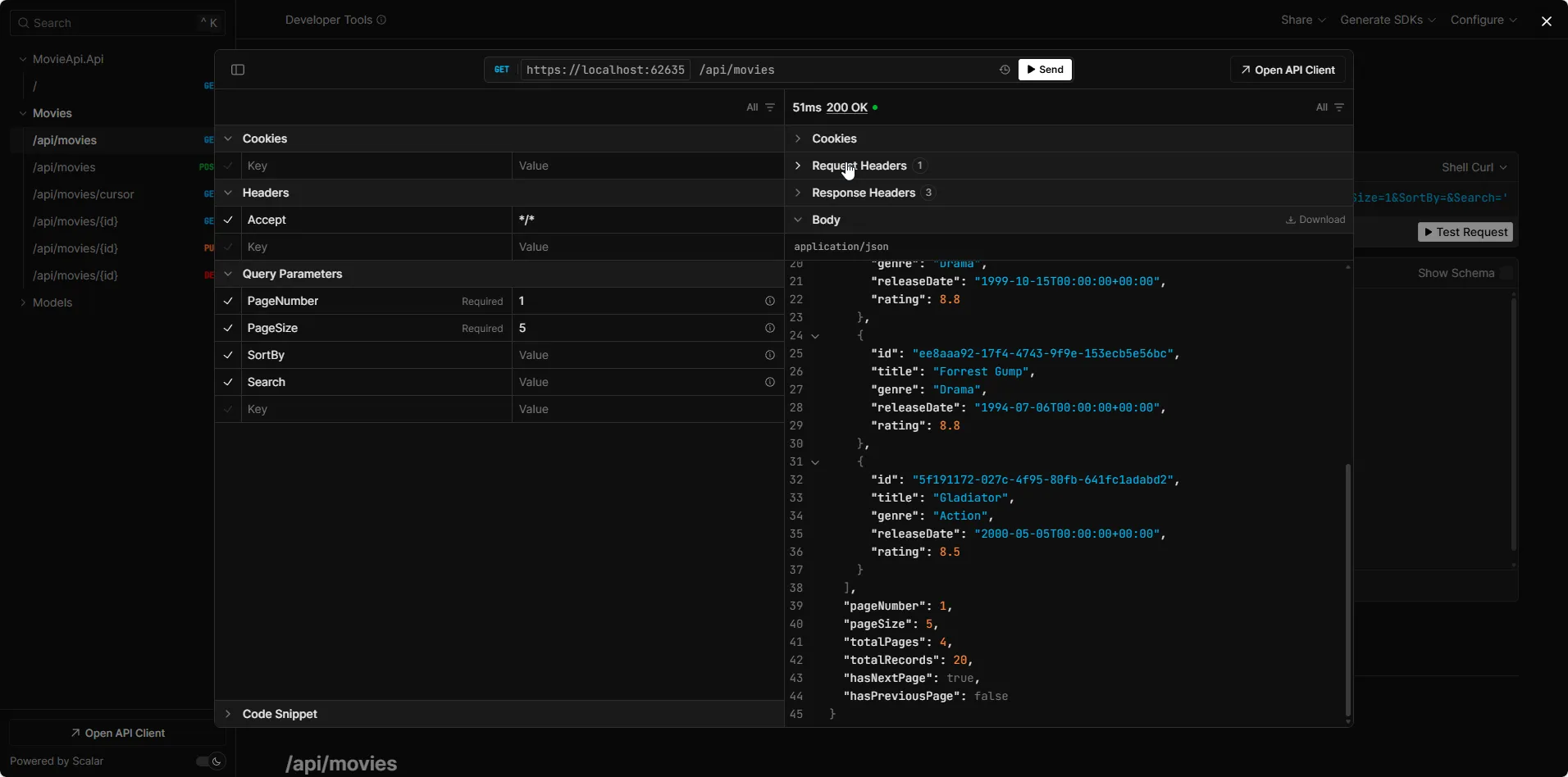
Pagination Only
GET /api/movies?pageNumber=1&pageSize=5This returns the first 5 movies with pagination metadata showing totalRecords: 20, totalPages: 4, and hasNextPage: true.
👁 Paginated Response - Page 1 of 4 with 5 Movies Per Page
Pagination + Sorting
GET /api/movies?pageNumber=1&pageSize=5&sortBy=rating descReturns the top 5 highest-rated movies. The Shawshank Redemption (9.3) comes first, followed by The Godfather (9.2).
You can also sort by multiple columns:
GET /api/movies?pageNumber=1&pageSize=10&sortBy=genre asc,rating descThis groups movies by genre alphabetically, with the highest-rated movie first within each genre.
Pagination + Sorting + Searching
GET /api/movies?pageNumber=1&pageSize=5&sortBy=rating desc&search=sci-fiThis searches for movies with “sci-fi” in the title or genre, sorts by rating descending, and returns the first page. You should see Inception (8.8), The Matrix (8.7), Interstellar (8.7), and other sci-fi films.
👁 Combined Search, Sort & Pagination - Sci-Fi Movies by Rating
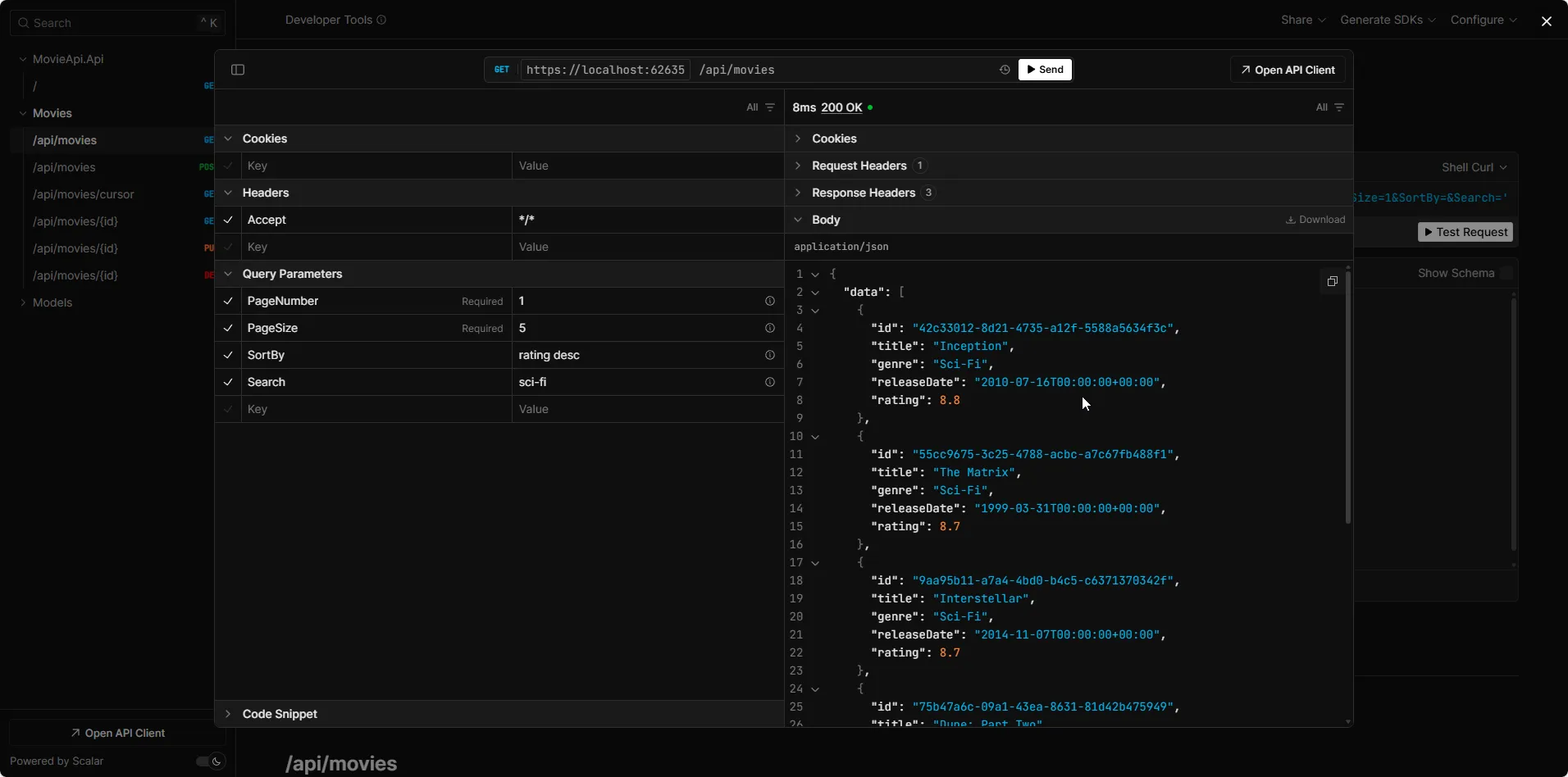
All three features compose seamlessly. The query goes to PostgreSQL as a single optimized SQL statement: search with ILIKE, sort with ORDER BY, paginate with OFFSET and LIMIT.
Keyset Pagination: The Faster Alternative for Large Datasets
The offset pagination I implemented above works great for most APIs. But it has a performance weakness: as the page number increases, the database still has to scan and skip all previous rows. Requesting page 1,000 with a page size of 10 means the database processes 10,000 rows and discards 9,990 of them.
Keyset pagination (also called cursor-based pagination) avoids this problem entirely. Instead of using OFFSET, it uses a WHERE clause to start after the last record from the previous page. According to Microsoft’s EF Core pagination documentation, keyset pagination is the recommended alternative for large datasets.
How It Works
Instead of “skip 100 rows, take 10”, keyset pagination says “give me the next 10 rows after this specific value”:
// Offset pagination - gets slower as offset growsvarpage=awaitcontext.Movies.OrderBy(m=>m.Title).Skip(1000).Take(10).ToListAsync();// Keyset pagination - constant speed regardless of positionvarpage=awaitcontext.Movies.OrderBy(m=>m.Title).Where(m=>string.Compare(m.Title, lastTitle) >0).Take(10).ToListAsync();The keyset approach is efficient because an index on Title lets the database jump directly to the right position without scanning previous rows.
Implementation
Here’s how you’d add a keyset-paginated endpoint to the Movie API. I’ll use the Created timestamp from EntityBase as the cursor, ordering newest first:
// In MovieEndpoints.csmovieApi.MapGet("/cursor", async (MovieDbContextdb,DateTimeOffset?after,intpageSize=10,CancellationTokencancellationToken=default) =>{pageSize=Math.Clamp(pageSize, 1, 50);varquery=db.Movies.AsNoTracking().OrderByDescending(m=>m.Created).AsQueryable();if (after.HasValue){query=query.Where(m=>m.Created<after.Value);}varitems=awaitquery.Take(pageSize+1).Select(m=>newMovieDto(m.Id, m.Title, m.Genre, m.ReleaseDate, m.Rating)).ToListAsync(cancellationToken);varhasMore=items.Count>pageSize;vardata=hasMore?items[..pageSize] :items;returnTypedResults.Ok(new{Data=data,HasNextPage=hasMore});});The trick is fetching pageSize + 1 records. If the result contains more than requested, there’s a next page. The client passes the Created value of the last returned item as the after cursor on the next request.
Offset vs Keyset: When to Use Which
| Aspect | Offset Pagination | Keyset Pagination |
|---|---|---|
| Implementation | Simple - Skip() + Take() | Moderate - requires cursor tracking |
| Jump to page | Yes - request any page number | No - sequential navigation only |
| Performance at depth | Degrades with large offsets | Constant - always fast |
| Concurrent data changes | May skip or duplicate rows | Stable - no missed records |
| Best for | Admin dashboards, tables with page numbers | Infinite scroll, feeds, mobile apps |
| Database requirement | None special | Index on cursor column(s) |
The recommendation: Use offset pagination for most APIs, especially those with traditional page-number navigation. Switch to keyset pagination when you’re dealing with very large datasets (100K+ rows), real-time feeds, or infinite scroll interfaces where users never jump to a specific page.
Performance Tips for Pagination at Scale
Add Indexes for Sorted and Searched Columns
Pagination without proper indexes is like searching a phone book page by page instead of using the alphabetical tabs. If you’re sorting by Rating or searching by Title, those columns need indexes.
Update your MovieConfiguration.cs to include additional indexes:
// Add inside the Configure methodbuilder.HasIndex(m=>m.Genre);builder.HasIndex(m=>m.Rating);builder.HasIndex(m=>m.Created);Then create and apply the migration:
dotnetefmigrationsaddAddPaginationIndexesdotnetefdatabaseupdateFor composite sorts like genre asc, rating desc, a composite index provides the best performance:
builder.HasIndex(m=>new { m.Genre, m.Rating });Fluent API Entity Configuration in EF Core
Learn the full set of Fluent API configuration options including indexes, constraints, and relationships.
Always Use AsNoTracking for Read Queries
I’m already using AsNoTracking() in the service, and it’s critical for paginated endpoints. Change tracking adds memory overhead for every entity EF Core loads. When you’re returning paginated data, you’re never going to modify those entities, so skip the tracking.
Enforce a Maximum Page Size
I’m using Math.Clamp(filter.PageSize, 1, 50) to cap page size at 50. Without this guard, a client could request ?pageSize=1000000 and nuke your database. Always set an upper bound.
Project Before Materializing
Notice the code applies .Select(m => new MovieDto(...)) before .ToListAsync(). This tells EF Core to only fetch the columns you need from the database (the DTO fields), rather than loading every column of the Movie entity and mapping in memory. This reduces both database I/O and memory allocation.
In-Memory Caching in ASP.NET Core
For endpoints that are hit frequently with the same parameters, consider adding a caching layer on top of pagination.
Key Takeaways
- Always paginate list endpoints - returning unbounded datasets is a performance and security risk.
- Return pagination metadata in the response body -
totalRecords,totalPages,hasNextPage, andhasPreviousPagegive clients everything they need. - Use
IQueryable<T>extension methods -ApplyPagination,ApplySort, andApplySearchkeep your service layer clean and your logic reusable. - Validate sort properties against the entity’s actual properties to prevent invalid column errors.
- Use offset pagination for most APIs and keyset pagination for large datasets or infinite scroll scenarios.
- Add database indexes on columns used for sorting and searching. This is the single biggest performance improvement.
Common Issues & Troubleshooting
System.Linq.Dynamic.Core throws ParseException on sort
Symptom: The API returns a 500 error with ParseException: No property or field 'xyz' exists in type 'Movie'.
Root Cause: The client passed a sort column name that doesn’t exist on the entity.
Fix: The ApplySort extension validates property names before passing them to Dynamic LINQ. If you see this error, make sure you’re using the extension method (not calling OrderBy() directly with user input). Valid sort columns for the Movie entity are: Title, Genre, ReleaseDate, Rating, Id, Created, LastModified.
EF.Functions.ILike not found
Symptom: Compiler error: 'DbFunctions' does not contain a definition for 'ILike'.
Root Cause: ILike is PostgreSQL-specific and comes from the Npgsql provider.
Fix: Make sure you have the Npgsql.EntityFrameworkCore.PostgreSQL package installed (version 10.0.0 for .NET 10). If you’re using SQL Server, replace ILike with Like: EF.Functions.Like(m.Title, $"%{search}%").
Pagination returns empty data but TotalRecords is correct
Symptom: The API returns data: [] with totalRecords: 20 and totalPages: 2.
Root Cause: The requested page number exceeds the total pages. For example, ?pageNumber=5&pageSize=10 with 20 records only has 2 pages.
Fix: The client should check hasNextPage before requesting the next page. Optionally, you can add a guard in the service that clamps pageNumber to the valid range: pageNumber = Math.Min(pageNumber, totalPages).
Sort by related entity property fails
Symptom: Sorting by a property from a related entity (e.g., ?sortBy=director.name) throws an error.
Root Cause: The ApplySort method validates against direct properties of the entity only. Nested property paths aren’t supported by the current implementation.
Fix: For sorting by related entity properties, you would need to include navigation properties in your IQueryable (via .Include()) and extend the validation logic to support dot-notation property paths. This is an advanced scenario. For most APIs, sorting by direct properties is sufficient.
Global Exception Handling in ASP.NET Core
Catch and transform all unhandled exceptions (including pagination errors) into consistent ProblemDetails responses.
ProblemDetails in ASP.NET Core
Return standardized RFC 7807 error responses when pagination parameters are invalid.
Summary
I took the basic GetAll endpoint and transformed it into a production-ready, queryable endpoint that supports pagination, dynamic multi-column sorting, and case-insensitive searching, all composing into optimized SQL queries via EF Core 10.
The key pattern is building reusable IQueryable<T> extension methods that you can apply to any entity in your application. This keeps your service methods clean and your query logic testable.
I also explored keyset pagination as a high-performance alternative for large datasets and covered essential performance tips including database indexes, AsNoTracking(), and page size guards.
The complete source code is available on GitHub. Feel free to clone it and experiment!
Structured Logging with Serilog
Add query logging to see exactly what SQL EF Core generates for your paginated queries, invaluable for debugging performance.
EF Core Relationships
Need to paginate data across related entities? Learn how to configure one-to-one, one-to-many, and many-to-many relationships first.
20+ Tips from a Senior .NET Developer
More best practices for writing clean, maintainable .NET code, including query optimization patterns.
If you found this guide helpful, share it with your colleagues. What other features should I add to this Movie API next? Drop a comment and let me know.
Happy Coding :)