|
VOOZH | about |
|
VOOZH | about |
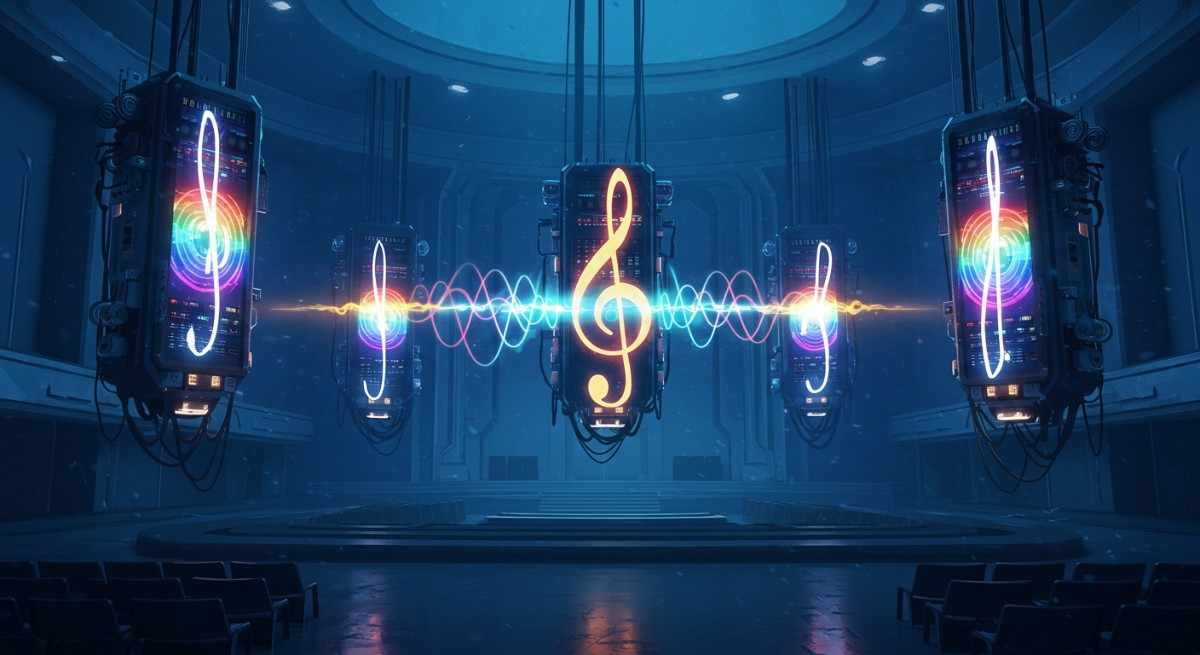
Artificial intelligence (AI) has infiltrated every field of life, creating new avenues of development and creativity. Amongst these advancements is AI music generation. It refers to the use of AI tools and models to create melodious notes.
However, it is a complex process as generating music is challenging and requires modeling long-range sequences. Unlike speech, music requires the full frequency spectrum [Müller, 2015]. That means sampling the signal at a higher rate, i.e., the standard sampling rates of music recordings are 44.1 kHz or 48 kHz vs. 16 kHz for speech.
Moreover, the music contains harmonies and melodies from different instruments, creating complex structures. Since human listeners are highly sensitive to disharmony [Fedorenko et al., 2012; Norman-Haignere et al., 2019], generating music does not leave much room for making melodic errors.
Hence, the ability to control the generation process in a diverse set of methods, e.g., key, instruments, melody, genre, etc. is essential for music creators. Today, music generation models powered by AI are designed to cater to these complexities and promote creativity.
In this blog, we will explore the 5 leading AI music generation models and their role in revamping the music industry. Before we navigate the music generation models, let’s dig deeper into the idea of AI generated music and what it actually means.
It is the process of using AI to generate music. It can range from composing entire pieces to assisting with specific elements like melodies or rhythms. AI analyzes large datasets of music, from catchy pop tunes to timeless symphonies, to learn the basics of music generation.
This knowledge lets it create new pieces based on your preferences. You can tell the AI what kind of music you want (think rock ballad or funky disco) and even provide starting ideas. Using its knowledge base and your input, AI generates melodies, harmonies, and rhythms. Some tools even allow you to edit the outputs as needed.
As a result, the music generation process has become more interesting and engaging. Some benefits of AI generated music include:
Explore the top 7 AI Music Generators
AI tools empower musicians to experiment with different styles and rhythms. It also results in the streamlining of the song production process, allowing for quick experimentation with new sounds and ideas.
This allows for the creation of personalized music based on individual preferences and moods can revolutionize how we listen to music. This capability enables the generation of unique soundtracks tailored to daily activities or specific emotional states.
AI music generation tools make music creation accessible to everyone, regardless of their musical background or technical expertise. These tools enable users to compose music through text input, democratizing music production.
Moreover, in educational settings, AI tools introduce students to the fundamentals of music composition, allowing them to learn and create music in an engaging way. This practical approach helps cultivate musical skills from a young age.
AI music tools simplify the music-making process, allowing users to quickly craft complete songs without compromising quality. This efficiency is particularly beneficial for professional musicians and production teams.
Plus, AI platforms ensure that the songs produced are of professional-grade audio quality. This high level of sound clarity and richness ensures that AI-generated music captures and holds the listener’s attention.
Learn about AI tools for code generation
These tools also significantly reduce the costs associated with traditional music production, including studio time and hiring session musicians. This makes it an attractive option for indie artists and small production houses. Hence, music can be generated quickly and at lower costs.
These are some of the most common advantages of utilizing AI in music generation. While we understand the benefits, let’s take a closer look at the models involved in the process.
Also learn about AI tools that could revolutionize your daily routine
There are two main types of music generation models utilized to create AI music.
These models are a fundamental approach in AI music generation, where they predict future elements of a sequence based on past elements. They generate data points in a sequence one at a time, using previous data points to inform the next.
In the context of music generation, this means predicting the next note or sound based on the preceding ones. The model is trained to understand the sequence patterns and dependencies in the musical data. This makes them particularly effective for tasks involving sequence generation like music.
Thus, autoregressive models can generate high-quality, coherent musical compositions that align well with provided text descriptions or melodies. However, they are computationally complex, making their cost a challenge as each token prediction depends on all previous tokens, leading to higher inference times for long sequences.
They are an emerging class of generative models that have shown promising results in various forms of data generation, including music. These models work by reversing a diffusion process, which gradually adds noise to the data, and then learning to reverse this process to generate new data.
Diffusion models can be applied to generate music by treating audio signals as the data to be diffused and denoised. Here’s how they are typically employed:
Thus, diffusion models can generate high-quality audio with fine details. They are flexible as they can handle various conditioning inputs, such as text descriptions or reference audio, making them versatile for different music generation tasks. However, they also pose the challenge of high computational costs.
Use GenAI for art generation too
Now that we understand the basic models used in AI music generation, it is time we explore the 5 leading music generation models in the market nowadays.
👁 Top 5 Music Generation Models
MusicLM is an AI music system developed by Google to create music based on textual prompts. It allows users to specify the genre, mood, instruments, and overall feeling of the desired music through words. Once a user inputs their prompt, the tool will generate multiple versions of the request.
Moreover, the tool allows the users to refine the outputs by specifying instruments and the desired effect or emotion. Google also published an academic paper to highlight the different aspects of its AI tool for music generation.
While you can explore the paper at leisure, here is a breakdown of how MusicLM works:
MusicLM is a significant advancement in AI-driven music generation. It is available in the AI Test Kitchen app on the web, Android, or iOS, where users can generate music based on their text inputs. To avoid legal challenges, Google has restricted this available version, preventing it from generating music with specific artists or vocals.
👁 How generative AI and LLMs work
MusicGen by Meta is an advanced AI model designed for music generation based on text descriptions or existing melodies. It is built on a robust transformer model and employs various techniques to ensure high-quality music generation.
This is similar to how language models predict the next words in a sentence. The model employs an audio tokenizer called EnCodec to break down audio data into smaller parts for easier processing.
Some key components and aspects of MusicGen are as follows:
Hence, MusicGen offers a blend of creativity and technical precision within the world of music generation. Its ability to use both text and melody prompts, coupled with its open-source nature, makes it a valuable tool for researchers, musicians, and AI enthusiasts alike.
Also learn how to use AI image generation tools
Suno AI is an innovative AI-powered tool designed to democratize music creation by enabling users to compose music through text input. It leverages AI to translate users’ ideas into musical outputs. Users can input information in the textual data, including the mood of your song or the lyrics you have written.
The algorithms craft melodies and harmonies that align with the users’ input information. It results in structured and engaging melodious outputs. The AI refines every detail of the output song, from lyrics to rhythm, resulting in high-quality music tracks that capture your creative spark.
Moreover, the partnership with Microsoft Copilot enhances Suno AI’s capabilities, broadening creative horizons and transforming musical concepts into reality. It is a user-friendly platform with a simplified music-making process, ensuring enhanced accessibility and efficiency.
Some top features of Suno AI are listed below.
Users can start using Suno AI by signing up for the platform, providing text input, and letting Suno AI generate a unique composition based on their input. The platform offers a straightforward and enjoyable music creation experience.
Project Music GenAI Control by Adobe is an innovative tool designed to revolutionize the creation and editing of custom audio and music. It allows users to share textual prompts to generate music pieces. Once generated, it provides users fine-grained control to edit the audio to their needs.
The editing options include:
These capabilities allow users to transform generated audio based on reference melodies and make detailed adjustments directly within their workflow. The user interface also assists in the process by simplified and automated creation and editing.
The automated workflow efficiency allows users to produce exactly the audio pieces they need with minimal manual intervention, streamlining the entire process.
It provides a level of control over music creation akin to what Photoshop offers for image editing. This “pixel-level control” for music enables creatives to shape, tweak, and edit their audio in highly detailed ways, providing deep control over the final output.
With its automation and fine-grained control, Project Music GenAI Control by Adobe stands out as a valuable tool in the creative industry.
Stable Audio 2.0 by Stability AI has set new standards in the field of AI music generation as the model is designed to generate high-quality audio tracks and sound effects using both text and audio inputs. It can produce full tracks with coherent musical structures up to three minutes long at 44.1kHz stereo from a single natural language prompt.
Moreover, its audio-to-audio generation capability enables users to upload audio samples and transform them using textual prompts. It enhances the flexibility and creativity of the tool. Alongside this, Stable Audio 2.0 offers amplified sound and audio effects to create diverse sounds.
Its style transfer feature allows for the seamless modification of newly generated or uploaded audio to align with a project’s specific style and tone. It enhances the customization options available to users.
Some additional aspects of the model include:
Stable Audio 2.0 offers high-quality audio production, extensive sound effect generation, and flexible style transfer capabilities. It is available for free on the Stable Audio website, and it will soon be accessible via the Stable Audio API.
Hence, AI music generation has witnessed significant advancements through various models, each contributing uniquely to the field. Each of these models pushes the boundaries of what AI can achieve in music generation, offering various tools and functionalities for creators and enthusiasts alike.
While we understand the transformative impact of AI music generation models, they present their own set of limitations and challenges. It is important to understand these limitations to navigate through the available options appropriately and use these tools efficiently.
Read more about 6 AI Tools for Data Analysis
Some prominent concerns associated with AI music generation can be categorized as follows.
AI models like MusicLM and MusicGen often train on extensive musical datasets, which can include copyrighted material. This raises the risk of generated compositions bearing similarities to existing works, potentially infringing on copyright laws. Proper attribution and respect for original artists’ rights are vital to upholding fair practices.
The ethical use of training data is another critical issue. AI models “learn” from existing music to produce similar effects, which not all artists or users are comfortable with. This includes concerns over using artists’ work without their knowledge or consent, as highlighted by several ongoing lawsuits.
The advent of AI-generated music could disrupt the music industry, posing challenges for musicians seeking recognition in an environment flooded with AI compositions. There’s a need to balance utilizing AI as a creative tool while safeguarding the artistic individuality and livelihoods of human musicians.
Here’s a list of 5 Most Useful AI Translation Tools
AI-generated music can exhibit biases or specific patterns based on the training dataset. If the dataset is biased, the generated music might also reflect these biases, limiting its originality and potentially perpetuating existing biases in music styles and genres.
Companies like Meta claim that all music used to train their models, such as MusicGen, was covered by legal agreements with the right holders. However, the continuous evolution of licensing agreements and the legal landscape around AI-generated music remains uncertain.
👁 Explore a hands-on curriculum that helps you build custom LLM applications!
AI has revolutionized music creation, leading to a new level of creativity and innovation for musicians. However, it is a complex process that requires the handling of intricate details and harmonies. Plus, AI music needs to be adjustable across genre, melody, and other aspects to avoid sounding off-putting.
Today’s AI music generators, like Google’s MusicLM, are tackling these challenges. These models are designed to give creators more control over the music generation process and enhance their creative workflow.
As AI generated music continues to evolve, it’s important to use these technologies responsibly, ensuring AI serves as a tool that empowers human creativity rather than replaces it.
Monthly curated AI content, Data Science Dojo updates, and more.