|
VOOZH | about |
|
VOOZH | about |
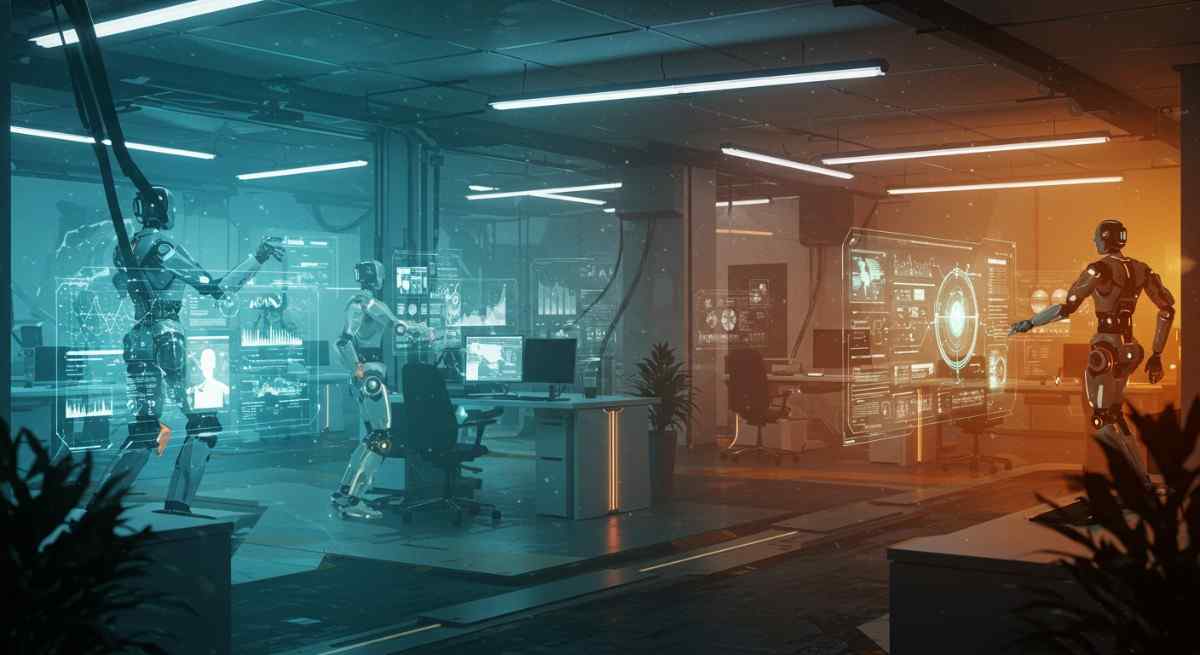
Generative AI is a rapidly emerging field of artificial intelligence capable of creating new content, such as text, images, and music. This technology has the potential to revolutionize many industries and professions, and it is already starting to significantly impact the future of work.
In this blog, we will explore multiple aspects of a workplace and its employees that are impacted by AI. We will also navigate through a list of 7 new AI jobs introduced in the market, owing to the use of artificial intelligence at work.
In the business world, generative AI is being used to automate tasks, improve efficiency, and generate new ideas. For example, generative AI can be used to generate marketing copy, create product designs, and write code. This can free up employees to focus on more strategic and creative work and help businesses save time and money.
Generative AI is also having a significant impact on the way we work. In the past, employees were often required to have specialized skills and knowledge.
However, generative AI is making it possible for anyone to learn new skills and knowledge quickly and easily. This is creating new opportunities for people to upskill and reskill, and it is making the workforce more adaptable and resilient.
As generative AI continues to develop, it is likely to have an even greater impact on the future of work. This technology has the potential to transform the way we work, and it is essential that businesses and individuals start to prepare for the changes that are to come.
AI foundation models are a type of generative AI that is trained on massive datasets of unlabeled data. This allows them to learn general patterns in data, which can then be used to generate new content.
Foundation models are often used to create new products and services, such as chatbots, virtual assistants, and image-generation tools.
Some of the most popular AI foundation models include:
These foundation models are still under development, but they have the potential to revolutionize many industries. For example, they could be used to create more realistic chatbots, generate more creative content, and improve the accuracy of machine translation.
👁 How generative AI and LLMs work
There are three main types of AI enablement:
Know more about —> The Top 7 Generative AI courses offered online
AI enablement is essential for businesses that want to succeed in the age of AI. By providing employees with the right tools, resources, and support, businesses can empower their employees to use AI to their full potential.
An AI-enabled employee is someone who can use AI tools and technologies to their advantage. They understand the potential benefits of AI and are able to use AI to improve their work.
AI-enabled employees can do things like:
AI-enabled employees are essential for businesses that want to succeed in the age of AI. By empowering their employees to use AI, businesses can gain a competitive advantage.
While generative AI has enhanced workplaces and employees alike, the introduction of AI-powered tools has also led to the introduction of new roles. These AI jobs are focused on improving the work environment and improve employee efficiency.
Let’s explore a list of these roles and their responsibilities.
These are specialist roles that prepare data and design training programs to keep the AI running smoothly. They train AI models on domain-specific data and oversee their operations to ensure effectiveness and accuracy. Hence, forming a bridge between humans and AI, ensuring the technology delivers its intended benefits.
These are professionals who use AI to interpret and predict consumer behavior by analyzing sentiments in large data sets. They categorize this tone as positive, negative, or neutral. This helps businesses understand customer sentiment towards their products or brands, allowing them to improve customer satisfaction and make data-driven decisions.
👁 Explore a hands-on curriculum that helps you build custom LLM applications!
These are creatives in the workplace who leverage AI tools to generate innovative content, including text, images, and videos. They craft engaging and informative content. Moreover, their duties can include editing, graphic design, or even video production.
These individuals are responsible for reviewing and ensuring the quality and integrity of AI-generated content and data. They look for issues like factual inconsistencies, stylistic inconsistencies, or even potential biases in language. Hence, refining AI responses for accuracy, clarity, and inclusivity.
This role is for experts who design prompts to guide generative AI models in producing desired outcomes in various fields. Hence, forming a link between human intent and what the AI can actually do.
As the name suggests, these individuals are managers of the machines running the AI system. They maintain the operation of AI systems, ensuring they function properly, deliver expected results, and adhere to ethical guidelines. This could involve tasks like monitoring performance, troubleshooting issues, and coordinating with AI specialists.
They are the caretakers of AI systems that examine them for biases, accuracy, and security issues. They ensure AI technologies are ethical, transparent, and aligned with human values, while also managing AI product development and deployment.
Hence, the role of AI has restructured the workspace for both the employer and the employees. It is crucial for both to integrate AI-powered tools into their infrastructure to yield maximum benefits.
Learn more about ways to execute AI automation at your workplace – Join our upcoming LLM Bootcamp today!
It is appropriate to say that generative AI is transforming the way we work. With automation, improved accuracy, and enhanced creativity, AI tools have created more innovative and exciting workspaces. However, it is important to understand that this does not mean that AI will replace human workers.
Instead, AI creates a collaborative environment that facilitates and empowers employees to excel at their jobs. Beyond the scope of new tools and processes, AI has also led to the emergence of new roles within the work environment, requiring a blend of technical skills and human expertise.
As AI continues to evolve, one thing remains clear: the future of work is a partnership between humans and machines. By embracing AI and fostering a culture of continuous learning, businesses and individuals can unlock the immense potential of this technology and thrive in the years to come.
Monthly curated AI content, Data Science Dojo updates, and more.