
AI-Generated Summary
Like
Dislike
- AI model cards are documents that provide detailed information about machine learning models, including metadata, performance measures, and training methodology, to promote transparency and accountability in AI development.
- NVIDIA is enhancing model cards with Model Card++, which incorporates additional information such as bias mitigation, explainability, privacy, safety, and security, to improve model trustworthiness.
- Model Card++ will be rolled out by NVIDIA by the end of 2024, with the goal of making AI models more transparent and trustworthy across various industries and use cases.
AI-generated content may summarize information incompletely. Verify important information. Learn more
An AI model card is a document that details how machine learning (ML) models work. Model cards provide detailed information about the ML model’s metadata, including the datasets it is based on, performance measures it was trained on, and the deep learning training methodology itself. This post walks you through the current practice for AI model cards and how NVIDIA is advancing Model Card++, the enhanced AI model card.
In their 2019 paper Model Cards for Model Reporting, a group of data scientists including Margaret Mitchell, Timnit Gebru, Parker Barnes, and Lucy Vasserman, sought to create a documentation standard for AI models. Their primary motivation was to promote transparency and accountability into the AI model development process by disclosing essential information about an AI model.
This information includes who developed the model, intended use cases and out-of-scope applications, expected users, how the model performs with different demographic groups, information about the data used to train and verify the model, limitations, and ethical considerations.
Until the development of the first AI model card, little information was shared about a particular AI model to help determine whether the model was suitable for a particular organization’s purpose.
This becomes problematic if the output of a model could have an adverse impact on a particular group of people. For example, the 2019 university-led study, Discrimination through Optimization: How Facebook’s Ad Delivery Can Lead to Skewed Outcomes revealed that algorithms for delivering ads on social media resulted in discriminatory ad delivery despite the use of neutral parameters for targeting the ads.
Why are AI model cards important?
AI model cards play a critical role in AI transparency. They provide both developers and downstream users and beneficiaries with a clear understanding of an AI model’s capabilities in a clear and concise format.
Model cards are a best practice, encouraging developers to engage with the people who will ultimately be impacted by the model’s output. They are built to communicate to nontechnical stakeholders, customers using the software, and even students. In addition, model cards educate policymakers who are drafting regulations and legislation governing AI models and systems.
While model cards are designed to encourage model transparency and trustworthiness, they are also used by stakeholders to improve developer understanding, evaluate model fitness for use, and standardize decision making processes.
Model cards are structured and organized in schema and can communicate a common software quality expectation. They concisely report information on different factors like demographics, environmental conditions, quantitative evaluation metrics, and, where provided, ethical considerations.
Model cards can also record model version, type, date, license restrictions, information about the publishing organization, and other qualitative information. Model cards are designed to educate and allow an informed comparison of measures and benchmarks, enabling developers to compare their results to those of similar models, and even pave the way for innovation. Figure 1 shows the NVIDIA Nemotron Nano 9b v2 model card.
Model cards are like open-source fact sheets. Unless you are the developer of the model itself, you would likely not know much about the AI model itself without model cards. Model cards provide the most comprehensive understanding of a model’s details and considerations individuals should take into account for its application.
For instance, a smartphone might have a face detection system that allows the user to unlock it based on recognition. Without model cards, model developers might not realize how a model will behave until it is deployed. This is what happened when Dr. Joy Buolamwini tried to use a face detection system as part of her graduate work at MIT.
Why is AI model card accessibility important?
AI model cards should not just be built for developers. Companies should also build model cards that are accessible to nontechnical individuals and technical experts alike.
Model cards are not restricted to a given industry or domain. They can be used for computer vision, speech, recommender systems, and other AI workflows. In addition to having active use in higher education and research and high performance computing spaces, model cards have utility across multiple industries including automotive, healthcare, and robotics applications. Model cards can:
- Teach students and help them understand real-world use cases
- Inform policymakers and clarify intended use for non-model developers
- Educate those interested in seeking the benefits of AI
Mobilizing AI through model cards is a decisive and transparent step that companies can take toward the advancement of trustworthy AI.
Improving and enhancing model cards
We conducted market research to inform the improvements to existing model cards. While 90% of respondents in the developer sample agreed that model cards are important and 70% would recommend them as is, there is room for improvement to drive their adoption, use, and impact.
Based on our research, existing model cards should be enhanced in two primary areas: accessibility and content quality. Model card users need model cards to be easily accessible and understandable.
Accessibility
Discovery was noted as one area of improvement. This pertains to the idea that AI developers should be able to find and then promote model cards alongside their work. This is true of models introduced in research papers as well as models deployed for commercial use.
Secondly, model cards need to be located where interested individuals can reference them. One of the ways NVIDIA promotes model cards is through NVIDIA and partner platforms. Models and model cards are located side-by-side in this same repository.
Content quality
After a model card has been located, the next challenge for the user is understanding the information contained in it. This is particularly critical in the model evaluation stage before selection. Not understanding the information contained in the model card leads to the same outcome as not knowing the information exists: model card users cannot make informed decisions.
To address this, NVIDIA encourages using a consistent organizational structure, simple format, and clear language for model cards. Adding filterable and searchable fields is also recommended. When individuals can find the information contained in model cards, they are more likely to understand the software. According to our research, respondents relied on the information contained in the model card when it was easily accessible and understandable.
In fact, performance and licensing information were the two most important areas respondents wanted to see in model cards. Figure 2 shows how the Nemotron Nano v2 model card devotes separate sections to performance and licensing.
After performance and licensing information, respondents felt that the section on ethical considerations was the most important category of information to include in model selection criteria. Respondents shared that they wanted more information about the datasets used to train and validate the model—particularly details regarding unwanted bias—as well as information about safety and security.
What is Model Card++?
Model Card++ is the improved model card that NVIDIA developed in 2020. In addition to the typical information provided in the Overview section of a model card, Model Card++ incorporates:
- The ++ Promise, which describes the NVIDIA software development approach to model development.
- Four subsections detailing model-specific information concerning Bias, Explainability, Privacy, and Safety and Security.
Figure 3 shows the ++ Promise, which is embedded in every Model Card++.
The ++ Promise describes the steps NVIDIA takes to demonstrate the trustworthiness of our work embedded in design. The four subcards outline:
- Steps taken to mitigate unwanted bias
- Provenance of training datasets, including what type of data was collected and how it was collected
- Key disclosures related to privacy and personal data use
- Technical limitations, known risks, and potential safety impacts
- Key performance indicators
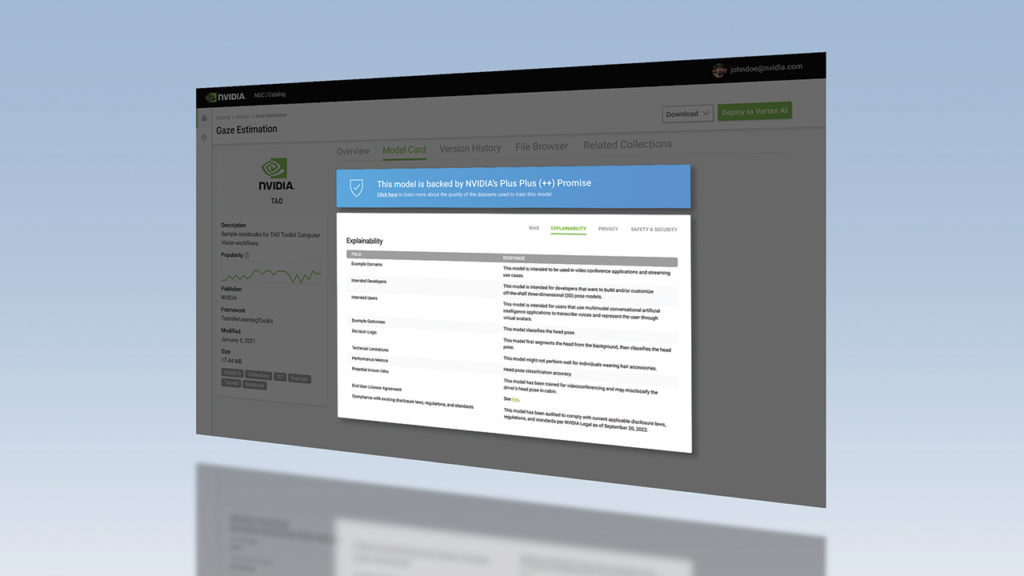
While this is not an exhaustive list, it does demonstrate the intent by design and commitment to standards and protections that value individuals, the data, and NVIDIA’s contribution to AI. This applies to every model, across domains and use cases. Figure 4 shows an example of the Explainability subcard. Each Model Card++ will include a dedicated section of fields and responses for each of the subsections. What is shown in the response section for each field is not meant to represent a real-world model, but to illustrate what will be provided based on current understanding and the latest research.
The Explainability subcard provides information about example domains for an AI model, intended users, decision logic, and compliance review. NVIDIA model cards aim to present AI models using clear, consistent, and concise language.
How was Model Card++ built?
Model Card++ is the result of a disciplined, cross-functional approach in partnership with engineering, product, research, product security, and legal teams. Building on existing NGC model cards, we reviewed model cards from other organizations and templates, including GitHub and Hugging Face, to find out what other information could be provided consistently.
We worked with engineering to pilot what could be consistently provided in addition to information that is currently provided. We discovered that although our model cards have a section for ethical considerations, more could be provided, including measures taken to mitigate unwanted bias. We also found we could describe dataset provenance and traceability, dataset storage, and quality validation.
This highlighted the importance of disclosing key details regarding dataset demographic make-up, performance metrics for different demographic groups, and specific mitigation efforts we have taken to address unwanted bias. We also worked with an algorithmic bias consultant to develop a process for assessing unwanted bias that is compliant with data privacy laws and coupled that with our latest market research.
As we built Model Card++, we also corroborated our work with market research by surveying developers who used our models and those from across the industry. We validated the desired information and structured it with our user design experience team to present it in a clear and organized format. We are excited to introduce Model Card++ and hope to continue leading efforts that encourage inclusive AI for all.
What’s new in Model Card++?
NVIDIA supports the iterative development of model cards, with dedicated processes and tools such as the Model Card Generator to automate and standardize documentation. Whether you’re a developer, data scientist, or someone with minimal technical knowledge, this product simplifies the process of generating model cards by automating the extraction of relevant information from code.
In addition, NVIDIA iteratively updates its model card documentation in alignment with evolving regulations, including global frameworks such as the EU AI Act. These updates help ensure that NVIDIA documentation meets compliance requirements for transparency, safety, and accountability.
Get started with trustworthy AI
NVIDIA has broadened its AI transparency framework by introducing documentation for additional program classes, including blueprints, systems, datasets, and containers. To check out the free, open source templates NVIDIA has provided to support the development of transparent AI documentation, visit the NVIDIA/Trustworthy-AI GitHub repo. With these expanded resources, NVIDIA is making it easier for customers and partners to responsibly develop AI and advance transparency and accountability across the AI supply chain.
This post was updated in October 2025.
Tags
About the Authors
About Michael Boone
Michael Boone is the Manager for Trustworthy AI Product at NVIDIA. He is responsible for building NVIDIA’s technology according to its guiding principles—driving the implementation of products, tools, and processes that enable the company, its customers, and the larger ecosystem to deploy AI with confidence. Beginning his career as a licensed civil engineer, Michael pivoted from transportation infrastructure project management and operations to owning NVIDIA’s global core computer vision product marketing strategy, as well as product feature definition for DRIVE AV. Michael brings a safety-first engineering mindset to the AI frontier, drawing on his background in physical infrastructure to ensure digital systems are built with the same principle and rigor. An inventor and car enthusiast, Michael is a highly trusted collaborator and a leading voice in the deployment of emerging technology across public, private, and research environments.
Michael Boone is the Manager for Trustworthy AI Product at NVIDIA. He is responsible for building NVIDIA’s technology according to its guiding principles—driving the implementation of products, tools, and processes that enable the company, its customers, and the larger ecosystem to deploy AI with confidence. Beginning his career as a licensed civil engineer, Michael pivoted from transportation infrastructure project management and operations to owning NVIDIA’s global core computer vision product marketing strategy, as well as product feature definition for DRIVE AV. Michael brings a safety-first engineering mindset to the AI frontier, drawing on his background in physical infrastructure to ensure digital systems are built with the same principle and rigor. An inventor and car enthusiast, Michael is a highly trusted collaborator and a leading voice in the deployment of emerging technology across public, private, and research environments.
About Nikki Pope
Nikki Pope is in-house counsel at NVIDIA, where she leads the company’s Trustworthy AI initiative. Her interest in criminal justice reform and technology converged in an academic research project involving the use of predictive algorithms in sentencing and bail decisions, which led to her current role at NVIDIA. Prior to joining NVIDIA, Nikki was the managing director of the High Tech Law Institute at Santa Clara University and an attorney at Cooley LLP for 10 years and on the faculty at Santa Clara Law. Before law school, Nikki held management positions in large companies and startups in financial services, entertainment, consumer products, and web-based services and applications. Nikki continues to put her prior experience and her privacy LLM, JD, and marketing MBA to great use in her current role as an internal advisor to development teams building AI systems. Her volunteer work with The Pruno Fund, a nonprofit that helps exonerated people manage transitioning back into society after being incarcerated, informs the ethics part of her work. In 2015, Nikki co-authored a book, Pruno, Ramen, and a Side of Hope: Stories of Surviving Wrongful Conviction, that was subsequently turned into an audiobook narrated by Whoopi Goldberg and Bill Kurtis, with a cast of 20 additional voices.
Nikki Pope is in-house counsel at NVIDIA, where she leads the company’s Trustworthy AI initiative. Her interest in criminal justice reform and technology converged in an academic research project involving the use of predictive algorithms in sentencing and bail decisions, which led to her current role at NVIDIA. Prior to joining NVIDIA, Nikki was the managing director of the High Tech Law Institute at Santa Clara University and an attorney at Cooley LLP for 10 years and on the faculty at Santa Clara Law. Before law school, Nikki held management positions in large companies and startups in financial services, entertainment, consumer products, and web-based services and applications. Nikki continues to put her prior experience and her privacy LLM, JD, and marketing MBA to great use in her current role as an internal advisor to development teams building AI systems. Her volunteer work with The Pruno Fund, a nonprofit that helps exonerated people manage transitioning back into society after being incarcerated, informs the ethics part of her work. In 2015, Nikki co-authored a book, Pruno, Ramen, and a Side of Hope: Stories of Surviving Wrongful Conviction, that was subsequently turned into an audiobook narrated by Whoopi Goldberg and Bill Kurtis, with a cast of 20 additional voices.
About Dina Yared
Dina Yared is a technical program manager at NVIDIA, where she manages the company’s end-to-end AI Transparency documentation. Prior to joining NVIDIA, Dina held program management roles in both the public and private sectors. She began her career at the U.S. Department of State, where she managed foreign assistance programs aimed at promoting and protecting human rights, with a strong emphasis on safeguarding vulnerable populations. Following her MBA from the University of California, Berkeley, Haas School of Business, Dina pivoted from policy into tech, taking on an operations role at WhatsApp. In this role, she elevated the voice of the user by leveraging data-driven insights to identify user pain points and build consensus around feature enhancements among product and engineering stakeholders. She also served in WhatsApp’s AI working group, evaluating chatbot functionality and offering strategic recommendations. Across her career, Dina has served as a champion of transparency, safety, and user protection. She is passionate about building programs and systems that protect and empower users, which are principles that continue to guide her work in the AI space.
Dina Yared is a technical program manager at NVIDIA, where she manages the company’s end-to-end AI Transparency documentation. Prior to joining NVIDIA, Dina held program management roles in both the public and private sectors. She began her career at the U.S. Department of State, where she managed foreign assistance programs aimed at promoting and protecting human rights, with a strong emphasis on safeguarding vulnerable populations. Following her MBA from the University of California, Berkeley, Haas School of Business, Dina pivoted from policy into tech, taking on an operations role at WhatsApp. In this role, she elevated the voice of the user by leveraging data-driven insights to identify user pain points and build consensus around feature enhancements among product and engineering stakeholders. She also served in WhatsApp’s AI working group, evaluating chatbot functionality and offering strategic recommendations. Across her career, Dina has served as a champion of transparency, safety, and user protection. She is passionate about building programs and systems that protect and empower users, which are principles that continue to guide her work in the AI space.
About Chaowei Xiao
Chaowei Xiao is a research scientist at NVIDIA and an assistant professor at Arizona State University. Dr. Xiao received his bachelor’s degree from Tsinghua University in 2015 and Ph.D. from University of Michigan, Ann Arbor in 2020. His research interests lie at the intersection of computer security, privacy, and machine learning. His works have been featured in multiple media outlets, including Wired, Fortune, IEEE SPECTRUM. One of his research outputs is now on display at the Science Museum in London. He has received the best paper award at Modicum 2014 and ESWN 2021.
Chaowei Xiao is a research scientist at NVIDIA and an assistant professor at Arizona State University. Dr. Xiao received his bachelor’s degree from Tsinghua University in 2015 and Ph.D. from University of Michigan, Ann Arbor in 2020. His research interests lie at the intersection of computer security, privacy, and machine learning. His works have been featured in multiple media outlets, including Wired, Fortune, IEEE SPECTRUM. One of his research outputs is now on display at the Science Museum in London. He has received the best paper award at Modicum 2014 and ESWN 2021.
About Anima Anandkumar
Anima Anandkumar is senior director of AI Research at NVIDIA and Bren Professor at Caltech. She is passionate about designing principled AI algorithms and applying them to interdisciplinary domains. She has received several honors such as the IEEE fellowship, Alfred. P. Sloan Fellowship, NSF Career Award, and Faculty Fellowships from Microsoft, Google, Facebook, and Adobe. She is part of the World Economic Forum's Expert Network. Anima received her bachelor’s degree from Indian Institute of Technology Madras, and her Ph.D. from Cornell University. She did her postdoctoral research at MIT and assistant professorship at University of California Irvine.
Anima Anandkumar is senior director of AI Research at NVIDIA and Bren Professor at Caltech. She is passionate about designing principled AI algorithms and applying them to interdisciplinary domains. She has received several honors such as the IEEE fellowship, Alfred. P. Sloan Fellowship, NSF Career Award, and Faculty Fellowships from Microsoft, Google, Facebook, and Adobe. She is part of the World Economic Forum's Expert Network. Anima received her bachelor’s degree from Indian Institute of Technology Madras, and her Ph.D. from Cornell University. She did her postdoctoral research at MIT and assistant professorship at University of California Irvine.