|
VOOZH | about |
|
VOOZH | about |
JUNE 17, 2026 / Web
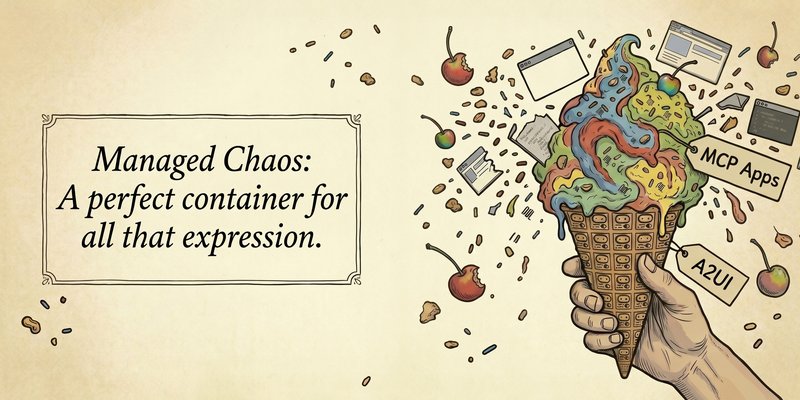
This post introduces three architectural patterns designed to integrate Model Context Protocol (MCP) Apps and Agent-to-User Interface (A2UI) to solve the tradeoff between highly custom iframe environments and native, declarative rendering. By combining these approaches, developers can serve native-feeling UIs directly over MCP servers, embed complex and stateful iframe apps securely inside declarative views, or inject generative UI components into legacy systems. Ultimately, these hybrid frameworks empower engineering teams to deliver secure, performant, and brand-consistent agentic user experiences tailored to their specific project constraints.
JUNE 16, 2026 / Mobile
Google is enhancing Sign in with Google by introducing new OIDC standard claims—specifically auth_time and amr (Authentication Methods Reference) to provide developers with deeper session metadata. These updates allow verified apps to verify the "freshness" of a user's login and the specific authentication methods used (such as MFA or hardware keys), enabling more dynamic, risk-based access controls. By leveraging these federated identity signals, platforms can better prevent account takeover and fraud while implementing granular security policies like step-up authentication for sensitive actions.
JUNE 3, 2026 / Mobile
Google DeepMind’s Gemma 4 12B model brings agentic, multimodal AI capabilities to everyday laptops with 16GB of RAM, enabling local data processing and visual insight generation. Users can leverage this model on macOS through the Google AI Edge Gallery for dynamic Python code execution and visualization, as well as via Google AI Edge Eloquent for completely offline voice dictation and text editing. Additionally, developer workflows are enhanced by the LiteRT-LM CLI's new serve command, which creates an industry-compatible local endpoint to power fully-local AI tools and agents.
MAY 28, 2026 / Pay
Google has announced the new Google Pay & Wallet Developer MCP server, an open-standard tool designed to securely connect AI development assistants and IDEs with real-time API and account context. The server allows developers to remain within their development environment to search official documentation, validate Wallet pass definitions, check integration status, and manage merchant accounts. Ultimately, this integration aims to reduce friction and accelerate development workflows by minimizing context switching and providing up-to-date, grounded AI support.
MAY 27, 2026 / Google Pay
Google Pay is evolving for "agentic commerce" by introducing the Universal Commerce Protocol and a new MCP server that allows AI agents to manage integrations and analyze trends. New Android updates introduce dynamic callbacks for seamless express checkouts and extend payment support into social media apps via WebViews. Additionally, the platform is launching cross-device biometric authentication and new transaction signals to help merchants reduce friction and optimize processing costs.
MAY 19, 2026 / Mobile
Google AI Edge’s LiteRT-LM provides a production-proven, highly optimized infrastructure for running Gemma 4 across cross-platform mobile and edge environments. It actively unlocks the model's native multimodal and agentic features on-device by utilizing memory-efficient dynamic loading, Multi-Token Prediction for up to a 2.2x speedup, and advanced orchestration tools like Thinking Mode and Constrained Decoding. Furthermore, the engine is rapidly expanding its integration surfaces beyond Android, introducing new native Swift APIs for Apple ecosystems and WebGPU-accelerated JavaScript APIs for high-performance, serverless browser inference.
MAY 19, 2026 / Mobile
The Google AI Edge Gallery app has expanded its on-device AI capabilities by introducing experimental support for the open-source Model Context Protocol (MCP) on Android, allowing Gemma 4 to coordinate complex tasks across external data sources like Google Workspace and Google Maps. To enable more proactive and persistent user interactions, the update adds a "Schedule Notification" skill for automating routines and a persistent chat history feature that restores long session contexts nearly instantly. Driven by an open-source toolkit, the platform encourages community developers to build and share custom utility-focused workflows, prompt configurations, and tool integrations via its GitHub repository.
MAY 19, 2026 / Cloud
Google announced the transition from assistive AI to independent agents, highlighting the launch of the Gemini 3.5 series and major updates to its Antigravity agent-first development platform. For mobile developers, the post introduces new Android CLI tools, the Android Bench evaluation leaderboard, and an automated Migration agent designed to rapidly convert various frameworks into native Kotlin code. Web development is also being transformed through Chrome DevTools for agents, the HTML-in-Canvas API, and the proposal of WebMCP, an open web standard that enables browser-based AI agents to execute complex tasks.
APRIL 17, 2026 / Mobile
A2UI v0.9 introduces a framework-agnostic standard designed to help AI agents generate real-time, tailored UI widgets using a company’s existing design system. This update simplifies the developer experience with a new Agent SDK for Python, a shared web-core library, and official support for renderers like React, Flutter, and Angular. By decoupling UI intent from specific platforms, the release enables seamless, low-latency streaming of generative interfaces across web and mobile applications. Integrating with broader ecosystems like AG2 and Vercel, A2UI v0.9 aims to move generative UI from experimental demos to production-ready digital products.
APRIL 15, 2026 / Pay
Google has introduced enhancements to the Google Pay API to provide developers with greater flexibility and control over merchant-initiated transactions (MIT). The update includes new objects within the PaymentDataRequest to specifically handle recurring subscriptions, deferred payments like hotel bookings, and automatic account reloads. By allowing merchants to clearly define future payment terms, these changes improve transparency for users and help reduce transaction declines through better token management. Developers can now implement these features to create more seamless and secure long-term payment experiences.