
Scaling your business needs robust solutions, and a multi-cloud strategy can exactly help you achieve that. There has been a debate on whether organizations should go for multi-cloud or stick to a single vendor. Recently, one of the users of Reddit posted a question, “Do you need a multi-cloud strategy?”
Responses to the question offer some interesting observations, in which large organizations are considering the multi-cloud strategy as failover situations. Most organizations migrate toward multi-cloud strategies to:
- Avoid vendor lock-in.
- Porting over dependency for computing function toward one cloud service.
- Achieve self-containerization and portability.
Multi-cloud is a strategy in which organizations seek services from heterogeneous cloud providers. Such providers can be specialized in platform as a service (PaaS), infrastructure as a service (IaaS) and software as a service (SaaS). Multi-cloud can also include public cloud, private cloud and even hybrid cloud service.
The strategy has been quite popular among organizations across the globe. The global market for multi-cloud management will reach more than $1659.6 million by the end of 2020 and is expected to grow at a CAGR of 16.1% for the forecast period of 2021-2026.
Here, we are going to discover some fantastic architecture designs for multi-cloud deployments. But, before that, let’s answer the question that most organizations should ask.
Why Deploy a Multi-Cloud Strategy?
Suppose you are a big organization like Spotify and all your data is handled by a single vendor—say Google Cloud Platform (GCP). Now, the streaming service has all the chips on a single vendor here. It is not that GCP is inefficient, but the dependency is higher. So, what to do for the worst-case scenario?
Multi-cloud is an architectural decision for an organization. It helps reduce the dependency on a single vendor and creates a fail-safe.
So, let’s discover some interesting multi-cloud migration strategies for your business.
Redeployment Multi-Cloud Migration Pattern
Re-deployment of an application or software needs refactoring of the architecture. It is a great way to revisit the deployment strategy, especially when you are migrating to multi-cloud. This migration pattern can help transform the existing architecture into a multi-cloud design. It includes pre-defined architecture elements including the service, cloud platform, connectors and even onsite storage devices.
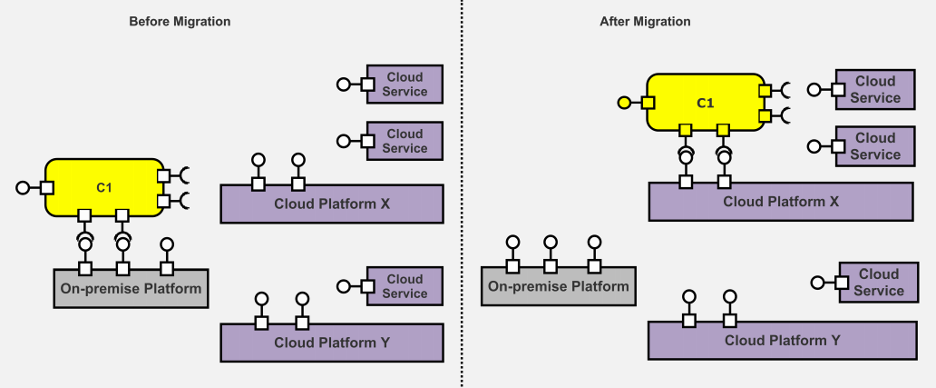
Any service component can be atomic or allow a hierarchical redundancy. Here, before the migration, the component uses services from the on-premises platform. These services can be the coordination of different component architecture or IaaS.
Once we migrate the component to multi-cloud architecture design, the on-premises service is replaced by a public cloud platform. So, the application is re-employed on a cloud platform without higher operational expenses, offering greater virtualizations.
Cloudification
Cloudification design architecture explores the integration of public cloud platforms for added capabilities. Before the migration, the component uses on-premises services without any additional capabilities. It reduces the extensibility, increases redundancy and decreases reusability.
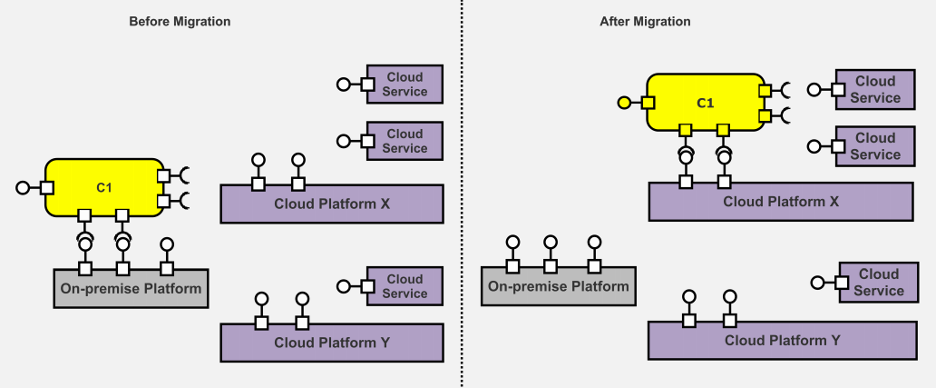
The solution here is simple: You can migrate to the cloudification architecture. Here, the on-premises service is integrated with the existing public cloud platform for extended capabilities.
Relocation Design Pattern
Sometimes significant changes in the multi-cloud architecture design can increase the operational expenditures. The solution to such an issue is a relocation strategy that helps maximize the existing architecture with multi-cloud capabilities.
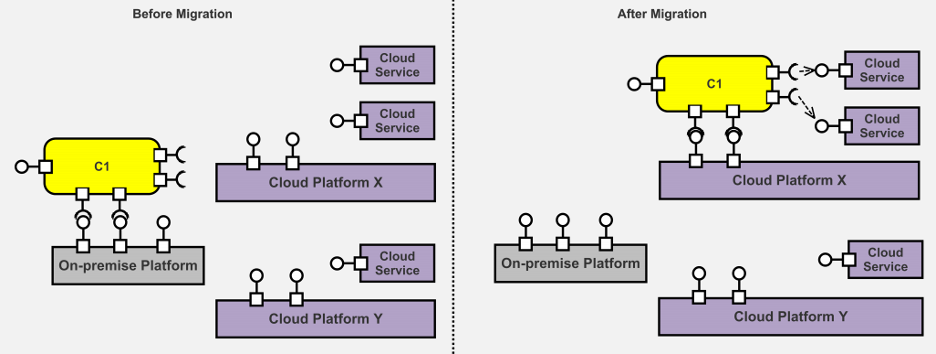
Here, the architecture uses queues, partitions of the database and other tools such as NoSQL or cache to capitalize on cloud services. It helps improve the efficiency of the components rehosted in the cloud.
Multi-Cloud Refactoring
Many large organizations opt for multi-cloud architecture designs. The component is often pretty large to capitalize on the advanced optimizations offered by cloud platforms. The bulky components do not respond well to changes and variations in data.
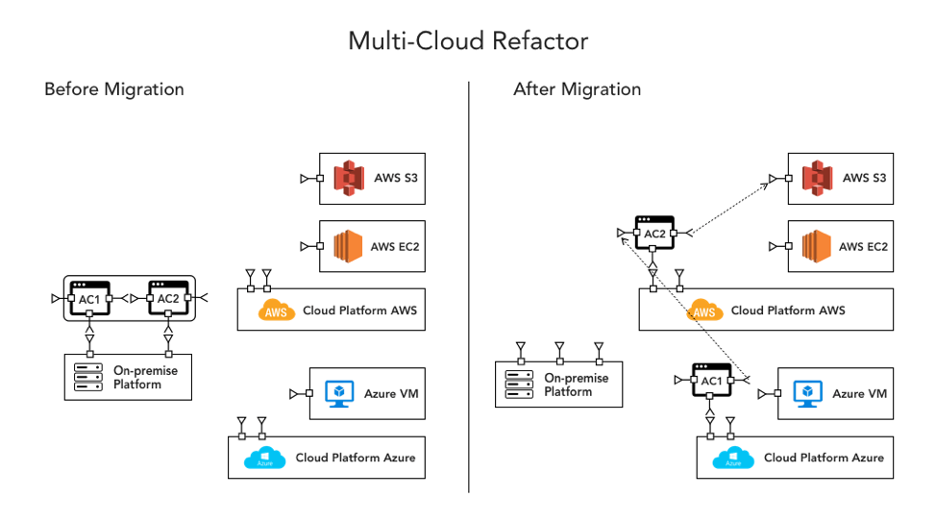
The solution is to refactor the multi-cloud architecture. The application is refactored into small components that are optimized individually for lower usage. A parallel architecture helps with better performance, scalability and flexibility of multi-cloud features through integration.
Multi-Cloud Rebinding
Multi-cloud rebinding is an especially fail-safe architecture. Take an example of Netflix’s streaming service: You are watching a movie on the app, but streaming stops due to a bug in the cloud platform. Netflix simply routes the traffic to the nearest healthy data center or cloud service for an uninterrupted experience.
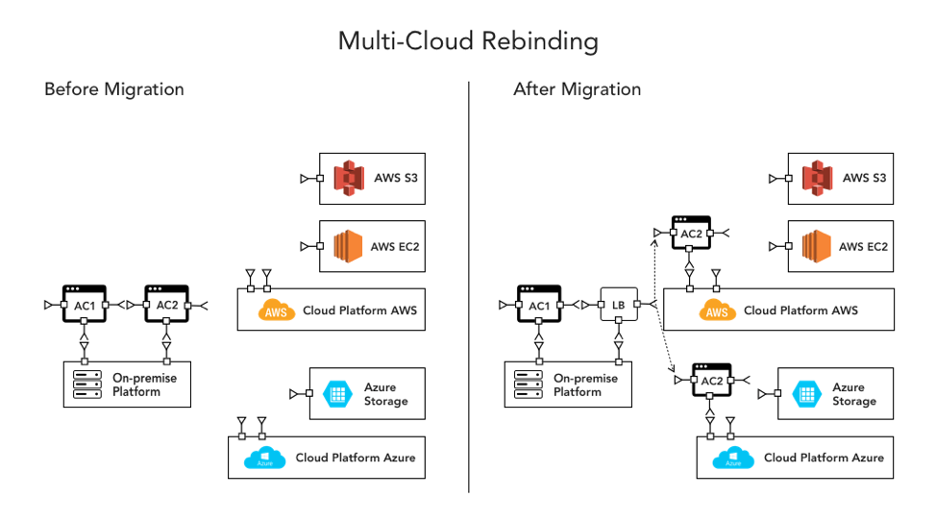
Rebinding the multi-cloud architecture can help redirect the traffic while your unhealthy instances come back to normal during a failover. So, you can again use the original cloud services and direct the traffic back.
Replacement Architecture Design
Innovation in existing products often needs services with higher capabilities. For example, you want to integrate a machine learning algorithm into an application, but the current architecture does not have that capability due to existing cloud service. So, you can replace the cloud service with the ones that have better performance and handle such integrations.
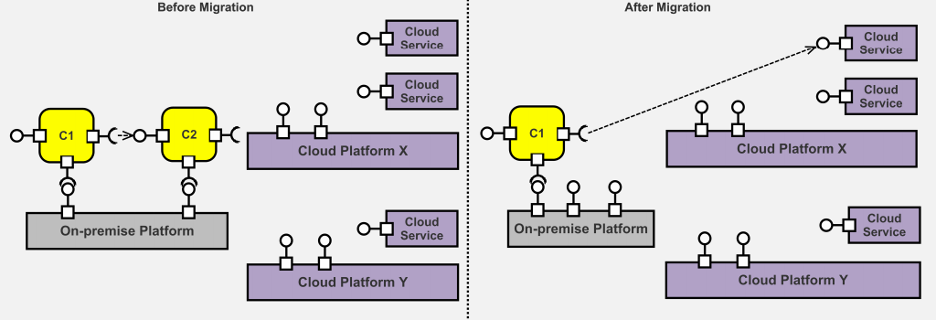
Replacement architecture saves your re-engineering efforts and operational costs. It helps improve the performance of your products through cloud services with advanced technology.
Multi-Application Modernization
Many organizations tend to create a portfolio of on-premises applications for cost reduction and better consistency. What transpires in the real world, however, is often different from the envisioned architecture. These shared components do not have that consistency and cost higher.
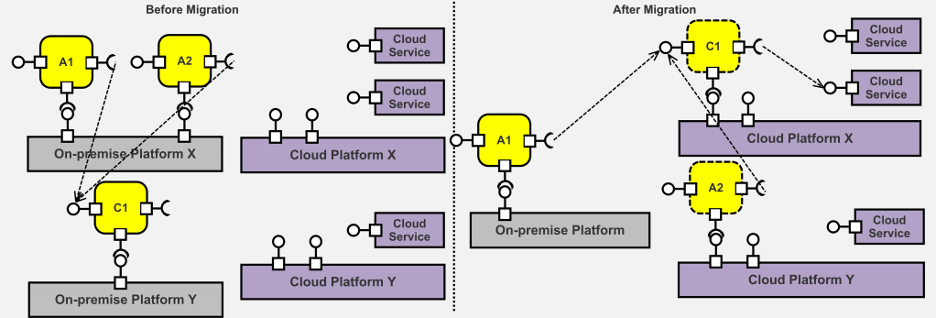
Here, you can see that A1/A2, C1 shares the on-premises platform as a portfolio deployed on the cloud environment. Instead of a portfolio, these services are separately deployed in a re-architected multi-cloud design. It helps in identifying the capabilities of different components and finding the solutions shared among them. It will help organizations have constant information on shared solutions and reduce operational costs through optimizations.
Conclusion
The current application market has many organizations leaping through innovations and advancements. It emboldens these firms to use multi-cloud architectures to leverage different microservices and containers. The multi-cloud landscape is growing and a new era of function as a service (FaaS) has emerged.
Breaking the single vendor lock-in to deploy apps with services from multi-cloud is popular these days. The best things about this revolutionary change are better consistency, flexibility and performance, which become evident. Organizations can switch to multiple vendors to share the workloads and create an ecosystem of services.