
The mouse pink-eyed dilution locus: a model for aspects of Prader-Willi syndrome, Angelman syndrome, and a form of hypomelanosis of Ito
- Review
- Published:
- Volume 3, pages 187–191, (1992)
- Cite this article
Abstract
The region of mouse Chromosome (Chr) 7 containing the mouse pink-eyed dilution locus, p, is syntenic with human chromosome 15q11–q13, a region associated with three human syndromes, Prader-Willi syndrome (PWS), Angelman syndrome (AS), and a form of hypomelanosis of Ito (HI). Because some mutant alleles of p also share a subset of phenotypes with PWS, AS, and HI, the same gene or genes disrupted by p locus mutations are potentially involved in the phenotypes of PWS, AS, and HI.
This is a preview of subscription content, to check access.
Access this article
Subscribe and save
- Starting from 10 chapters or articles per month
- Access and download chapters and articles from more than 300k books and 2,500 journals
- Cancel anytime
Buy Now
Price excludes VAT (USA)
Tax calculation will be finalised during checkout.
Instant access to the full article PDF.
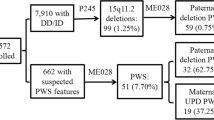
Genetic testing for Prader-Willi syndrome and Angelman syndrome in the clinical practice of Guangdong Province, China
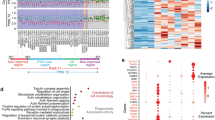
Genetic subtypes and phenotypic characteristics of 110 patients with Prader-Willi syndrome
Explore related subjects
Discover the latest articles, books and news in related subjects, suggested using machine learning.References
Apkarian, P., Spekreijse, H., Van Swaay, E., and Van Schooneveld, M.: Visual evoked potentials in Prader-Willi syndrome. Doc Ophthalmol 71: 355–367, 1989.
Bray, G.A., Dahms, W.T., Swerdloff, R.S., Fisher, R.H., Atkinson, R.L., and Carrel, R.E.: The Prader-Willi syndrome: a study of 40 patients and a review of the literature. Medicine 62: 59–80, 1983.
Brilliant, M.H., Gondo, Y., and Eicher, E.M.: Direct identification of the mouse pink-eyed unstable mutation by genome scanning. Science 252: 566–569, 1991.
Brumbaugh, J.A., Wilkins, L.M., and Moore, J.W.: Genetic dissection of eumelanogenesis. Pigment Cell 4: 150–158, 1979.
Buiting, K., Neumann, M., Ludecke, H.-J., Senger, G., Claussen, U., Antich, J., Passarge, E., and Horsthemke, B.: Microdissection of the Prader-Willi syndrome chromosome region and identification of potential gene sequences. Genomics 6: 521–527, 1990.
Butler, M.G.: Hypopigmentation: a common feature of Prader-Labhart-Willi syndrome. Am J Hum Genet 45: 140–146, 1989.
Chaillet, J.R., Knoll, J.H.M., Horsthemke, B., and Lalande, M.: The syntenic relationship of the critical deletion region for the Prader-Willi/Angelman syndromes and proximal mouse chromosome 7. Genomics 11: 773–776, 1991.
Creel, D.J., Bendel, C.M., Wiesner, G.L., Wirtschafter, J.D., Arthur, D.C., and King, R.A.: Abnormalities of the central visual pathways in Prader-Willi syndrome associated with hypopigmentation. N Engl J Med 314: 1606–1609, 1986.
Donlon, T.A., Lalande, M., Wyman, A., Bruns, G., and Latt, S.A.: Isolation of molecular probes associated with the chromosome 15 instability in the Prader-Willi syndrome. Proc Natl Acad Sci USA 83: 4408–4412, 1986.
Ferguson-Smith, A.C., Cattanach, B.M., Barton, S.C., Beechey, C.V., and Surani, M.A.: Embryological and molecular investigations of parental imprinting on mouse chromosome 7. Nature 351: 667–670, 1991.
Foster, M.: Mammalian pigment genetics. Adv Genet 13: 311–339, 1965.
Fryburg, J.S., Breg, W.R., and Lindgren, V.: Diagnosis of Angelman syndrome in infants. Am J Med Genet 38: 58–64, 1991.
Green, M.C.: Catalog of mutant genes and polymorphic loci. In M.F. Lyon and A.G. Searle (eds.), Genetic Variants and Strains of the Laboratory Mouse, pp. 12–403, Oxford University Press, New York, 1989.
Gregory, C.A., Schwartz, J., Kirkilionis, A.J., Rudd, N., and Hamerton, J.L.: Somatic recombination rather than uniparental disomy suggested as another mechanism by which genetic imprinting may play a role in the etiology of Prader-Willi syndrome. Hum Genet 88: 42–48, 1991.
Haldane, J.B.S., Sprunt, A.D., and Haldane, N.M.: Reduplication in mice. J Genet 5: 133–135, 1915.
Hamabe, J., Fukushima, Y., Harada, N., Abe, K., Matsuo, N., Nagai, T., Yoshioka, A., Tonoki, H., Tsukino, R., and Niikawa, N.: Molecular study of the Prader-Willi syndrome: deletion, RFLP, and phenotype analyses of 50 patients. Am J Med Genet 41: 54–63, 1991a.
Hamabe, J., Kuroki, Y., Imaizumi, K., Sugimoto, T., Fukushima, Y., Yamaguchi, A., Izumikawa, Y., and Niikawa, N.: DNA deletion and its parental origin in Angelman syndrome patients. Am J Med Genet 41: 64–68, 1991b.
Handel, M.A., Washburn, L.L., Rosenberg, M.P., and Eicher, E.M.: Male sterility caused by p 6H and qk mutations is not corrected in chimeric mice. J. Exp. Zool. 243: 82–92, 1987.
Heim, R.A., Dunn, D.S., Candy, S.E., Zwane, E., Kromberg, J.G.R., and Jenkins, T.: The tyrosinase-positive oculocutaneous albinism locus is not linked to the β-globin locus in man. Hum Genet 79: 89, 1988.
Hittner, H.M., King, R.A., Riccardi, V.M., Ledbetter, D.H., Borda, R.P., Ferrell, R.E., and Kretzer, F.L.: Oculocutaneous albinoidism as a manifestation of reduced neural crest derivatives in the Prader-Willi syndrome. Am J Ophthalmol 94: 328–337, 1982.
Hoffman, E.P., Brown, R.H., Jr., and Kunkel, L.M.: Dystrophin: the product of the Duchenne muscular dystrophy locus. Cell 51: 919–928, 1987.
Hollander, W.F., Bryan, J.H.D., and Gowen, J.W.: Pleiotropic effects of a mutant at the p locus from X-irradiated mice. Genetics 45: 413–418, 1960.
Hunt, D.M. and Johnson, D.R.: Abnormal spermiogenesis in two pink-eyed sterile mutants in the mouse. J Embryol Exp Morphol 26: 111–121, 1971.
Johnson, D.R. and Hunt D.M.: Endocrinological findings in sterile pink-eyed mice. J Reprod Fertil 42: 51–58, 1975.
Kirkilionis, A.J., Gregory, C.A. and Hamerton, J.L.: Long-range restriction mapping and linkage analysis of the Prader-Willi chromosome region (PWCR). Genomics 9: 524–535, 1991.
Knoll, J.H.M., Nicholls, R.D., Magenis, R.E., Graham, J.M. Jr., Lalande, M., and Latt, S.A.: Angelman and Prader-Willi syndromes share a common Chromosome 15 deletion but differ in parental origin of the deletion. Am J Med Genet 32: 285–290, 1989.
Knoll, J.H.M., Nicholls, R.D., Magenis, R.E., Glatt, K., Graham, J.M., Jr., Kaplan, L., and Lalande, M.: Angelman syndrome: three molecular classes identified with chromosome 15q11q13-specific DNA markers. Am J Hum Genet 47: 149–155, 1990.
Little, C.C.: Coat color in rodents and carnivores. Quart Rev Biol 33:, 103–137, 1958.
Magenis, R.E., Toth-Fejel, S., Allen, L.J., Black, M., Brown, M.G., Budden, S., Cohen, R., Friedman, J.M., Kalousek, D., Zonana, J., Lacy, D., LaFranchi, S., Lahr, M., Macfarlane, J., and Williams, C.P.S.: Comparison of the 15q deletions in Prader-Willi and Angelman syndromes: specific regions, extent of deletions, parental origins, and clinical consequences. Am J Med Genet 35: 333–349, 1990.
Melvold, R.W.: Spontaneous somatic reversion in mice—effects of parental genotype on stability at the p-locus. Mutat Res 12: 171–174, 1971.
Melvold, R.W.: The effects of mutant p-alleles on the reproductive system in mice. Genet Res 23: 319–325, 1974.
Nakatsu, Y., Gondo, Y., and Brilliant, M. H.: The p locus is closely linked to the mouse homologue of a gene from the Prader-Willi chromosomal region. Mammalian Genome 2: 69–71, 1992.
Nicholls, R.D.: A cDNA from proximal human chromosome 15q maps near Mtv-1 on mouse Chromosome 7. Mouse News Lett 84: 87–88, 1989.
Nicholls, R.D., Knoll, J.H.M., Butler, M.G., Karam, S., and Lalande, M.: Genetic imprinting suggested by maternal heterodisomy in non-deletion Prader-Willi syndrome. Nature 342: 281–285, 1989a.
Nicholls, R.D., Knoll, J.H., Glatt, K., Hersh, J.H., Brewster, T.D., Graham, J.M. Jr., Wurster-Hill, D., Wharton, R. and Latt, S.A.: Restriction fragment length polymorphisms within proximal 15q and their use in molecular cytogenetics and the Prader-Willi syndrome. Am J Med Genet 33: 66–77, 1989b.
Pettigrew, A.L., Gollin, S.M., Greenberg, F., Riccardi, V.M. and Ledbetter, D.H.: Duplication of proximal 15q as a cause of Prader-Willi syndrome. Am J Med Genet 28: 791–802, 1987.
Phillips, R.J.S.: Description of phenotypes of p-alleles (other than p) held at Harwell—correction. Mouse News Lett 57: 18, 1977b.
Robinson, W.P., Bottani, A., Yagang, X., Balakrishman, J., Binkert, F., Machler M., Prader, A., and Schinzel, A. Molecular, cytogenetic, and clinical investigations of Prader-Willi Syndrome patients. Am J Hum Genet 49: 1219–1234, 1991.
Roderick, T.H. and Guidi, J.H.: Strain distribution of polymorphic variants. In M.F. Lyon and A.G. Searle (eds.); Genetic Variants and Strains of the Laboratory Mouse, pp. 663–772, Oxford University Press, Oxford, 1989.
Russell, E.S.: A quantitative histological study of the pigment found in the coat color mutants of the house mouse. IV. The nature of the effects of genic substitution in five major allelic series. Genetics 34: 146–166, 1949.
Searle, A.G. and Beechy, C.V.: Genome imprinting phenomena on mouse Chromosome 7. Genet Res 56: 237–244, 1990.
Silvers, W.K.: The p-locus (pink-eyed dilution). In The Coat Colors of Mice, pp. 90–101. Springer Verlag, New York, 1979.
Stephenson, D.A. and Hornby, J.E.: Gene expression at the pinkcyed dilution (p) locus in the mouse is confirmed to be pigment cell autonomous using recombinant embryonic skin grafts. J Embryol Exp Morphol 87: 65–73, 1985.
Tantravahi, U., Nicholls, R.D., Stroh, H., Ringer, S., Neve, R.L., Kaplan, L., Wharton, R., Wurster-Hill, D., Graham, J.M., Jr., Cantu, E.S., Frias, J.L., Kousseff, B.G., and Latt, S.A.: Quantitative calibration and use of DNA probes for investigating chromosome abnormalities in the Prader-Willi syndrome. Am J Med Genet 33: 78–87, 1989.
Thomas, I.T., Frias, J.L., Cantu, E.S., Lafer, C.Z., Flannery, D.B., and Graham, J.G. Jr.: Association of pigmentary anomalies with chromosomal and genetic mosaicism and chimerism. Am J Hum Genet 45: 193–205, 1989.
Wagstaff, J., Chaillet, J.R., and Lalande, M.: The GABAA receptor β3 subunit gene: characterization of a human cDNA from Chromosome 15q11q13 and mapping to a region of conserved synteny on mouse Chromosome 7. Genomics 11: 1071–1078, 1991a.
Wagstaff, J., Knoll, J.H.M., Fleming, J., Kirkness, E.F., Martin-Gallardo, A., Greenberg, F., Graham, J.M. Jr., Menninger, J., Ward, D., Venter, J.C. and Lalande, M.: Localization of the gene encoding the GABAA receptor β3 subunit to the Angelman/Prader-Willi region of human Chromosome 15. Am J Hum Genet 49: 330–337, 1991b.
Wallis, C.E. and Beighton, P.H.: Synchrony of oculocutaneous albinism, the Prader-Willi syndrome, and a normal karyotype. J Med Genet 26: 337–339, 1989.
Wiesner, G.L., Bendel, C.M., Olds, D.P., White, J.W., Arthur, D.C., Ball, D.W., and King, R.A.: Hypopigmentation in the Prader-Willi syndrome. Am J Hum Genet 40: 431–442, 1987.
Willems, P.J., Dijkstra, I., Brouwer, O.F., and Smit, G.P.A.: Recurrence risk in the Angelman (“happy puppet”) syndrome. Am J Med Genet 27: 773–780, 1987.
Williams, C.A., Zori, R.T., Stone, J.W., Gray, B.A., Cantu, E.S., and Ostrer, H.: Maternal origin of 15q11-13 deletions in Angelman syndrome suggests a role for genomic imprinting. Am J Med Genet 35: 350–353, 1990.
Witkop, C.J. Jr., Quevedo, W.C. Jr., Fitzpatrick, T.B., and King, R.A.: Albinism. In C.R. Sciver, A. Beaudet, W.S. Sly, and D. Valle (eds.); The Metabolic Basis of Inherited Disease, pp. 2905–2947, McGraw-Hill, New York, 1990.
Wolfe, H.G.: Two unusual mutations affecting pigmentation in the mouse. In S.J. Geerts (ed.), Proc XIth Int Congr Genet, pp. 251, Pergamon, Elmsford, N.Y., 1963.
Wolfe, H.G.: Sterility of mice carrying mutant genes at the pinkeyed dilution locus. Genetics 74: s298, 1973.
Wolfe, H.G., Erikson, R.P., and Schmidt, L.C.: Effects on sperm morphology by alleles at the pink-eyed dilution locus in mice. Genetics 85: 303–308, 1977.
Wright, S.: Color inheritance in mammals. J Hered 8: 224–235, 1917.
Rights and permissions
About this article
Cite this article
Brilliant, M.H. The mouse pink-eyed dilution locus: a model for aspects of Prader-Willi syndrome, Angelman syndrome, and a form of hypomelanosis of Ito. Mammalian Genome 3, 187–191 (1992). https://doi.org/10.1007/BF00355717
Received:
Accepted:
Issue date:
DOI: https://doi.org/10.1007/BF00355717
Share this article
Anyone you share the following link with will be able to read this content:
Sorry, a shareable link is not currently available for this article.
Provided by the Springer Nature SharedIt content-sharing initiative