
Abstract
Toll-like receptors (TLRs) recognize conserved microbial structures called pathogen-associated molecular patterns. Signaling from TLRs leads to upregulation of co-stimulatory molecules for better priming of T cells and secretion of inflammatory cytokines by innate immune cells1,2,3,4. Lymphocyte-deficient hosts often die of acute infection, presumably owing to their lack of an adaptive immune response to effectively clear pathogens. However, we show here that an unleashed innate immune response due to the absence of residential T cells can also be a direct cause of death. Viral infection or administration of poly(I:C), a ligand for TLR3, led to cytokine storm in T-cell- or lymphocyte-deficient mice in a fashion dependent on NK cells and tumor necrosis factor. We have further shown, through the depletion of CD4+ and CD8+ cells in wild-type mice and the transfer of T lymphocytes into Rag-1–deficient mice, respectively, that T cells are both necessary and sufficient to temper the early innate response. In addition to the effects of natural regulatory T cells, close contact of resting CD4+CD25−Foxp3− or CD8+ T cells with innate cells could also suppress the cytokine surge by various innate cells in an antigen-independent fashion. Therefore, adaptive immune cells have an unexpected role in tempering initial innate responses.
This is a preview of subscription content, access via your institution
Access options
Subscribe to this journal
Receive 12 print issues and online access
$259.00 per year
only $21.58 per issue
Buy this article
- Purchase on SpringerLink
- Instant access to the full article PDF.
USD 39.95
Prices may be subject to local taxes which are calculated during checkout
Infection-induced type I interferons critically modulate the homeostasis and function of CD8+ naïve T cells
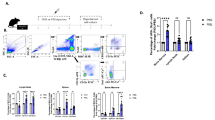
Acute effects of FLT3L treatment on T cells in intact mice
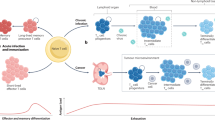
Regulators of CD8+ T cell exhaustion
References
Medzhitov, R. & Janeway, C.A. Jr. Innate immunity: the virtues of a nonclonal system of recognition. Cell 91, 295–298 (1997).
Poltorak, A. et al. Defective LPS signaling in C3H/HeJ and C57BL/10ScCr mice: mutations in Tlr4 gene. Science 282, 2085–2088 (1998).
Gazzinelli, R.T. & Denkers, E.Y. Protozoan encounters with Toll-like receptor signalling pathways: implications for host parasitism. Nat. Rev. Immunol. 6, 895–906 (2006).
Trinchieri, G. & Sher, A. Cooperation of Toll-like receptor signals in innate immune defence. Nat. Rev. Immunol. 7, 179–190 (2007).
Lavi, E., Gilden, D.H., Highkin, M.K. & Weiss, S.R. Persistence of mouse hepatitis virus A59 RNA in a slow virus demyelinating infection in mice as detected by in situ hybridization. J. Virol. 51, 563–566 (1984).
Haring, J. & Perlman, S. Mouse hepatitis virus. Curr. Opin. Microbiol. 4, 462–466 (2001).
Schroder, M. & Bowie, A.G. TLR3 in antiviral immunity: key player or bystander? Trends Immunol. 26, 462–468 (2005).
Proft, T. & Fraser, J.D. Bacterial superantigens. Clin. Exp. Immunol. 133, 299–306 (2003).
Pfeffer, K. et al. Mice deficient for the 55 kd tumor necrosis factor receptor are resistant to endotoxic shock, yet succumb to L. monocytogenes infection. Cell 73, 457–467 (1993).
Glauser, M.P., Zanetti, G., Baumgartner, J.D. & Cohen, J. Septic shock: pathogenesis. Lancet 338, 732–736 (1991).
Maloy, K.J. et al. CD4+CD25+ T(R) cells suppress innate immune pathology through cytokine-dependent mechanisms. J. Exp. Med. 197, 111–119 (2003).
Kim, J.M., Rasmussen, J.P. & Rudensky, A.Y. Regulatory T cells prevent catastrophic autoimmunity throughout the lifespan of mice. Nat. Immunol. 8, 191–197 (2007).
Fontenot, J.D. et al. Regulatory T cell lineage specification by the forkhead transcription factor foxp3. Immunity 22, 329–341 (2005).
Andoniou, C.E. et al. Interaction between conventional dendritic cells and natural killer cells is integral to the activation of effective antiviral immunity. Nat. Immunol. 6, 1011–1019 (2005).
Andrews, D.M., Scalzo, A.A., Yokoyama, W.M., Smyth, M.J. & Degli-Esposti, M.A. Functional interactions between dendritic cells and NK cells during viral infection. Nat. Immunol. 4, 175–181 (2003).
Fernandez, N.C. et al. Dendritic cells directly trigger NK cell functions: cross-talk relevant in innate anti-tumor immune responses in vivo. Nat. Med. 5, 405–411 (1999).
Munz, C., Steinman, R.M. & Fujii, S. Dendritic cell maturation by innate lymphocytes: coordinated stimulation of innate and adaptive immunity. J. Exp. Med. 202, 203–207 (2005).
Vitale, M. et al. NK-dependent DC maturation is mediated by TNFα and IFNγ released upon engagement of the NKp30 triggering receptor. Blood 106, 566–571 (2005).
El-Sawy, T., Miura, M. & Fairchild, R. Early T cell response to allografts occurring prior to alloantigen priming up-regulates innate-mediated inflammation and graft necrosis. Am. J. Pathol. 165, 147–157 (2004).
Acknowledgements
We would like to acknowledge L. Su, H. Deng, X. Shi and Y. Liu for productive discussion and suggestions. We thank C.-R. Wang (University of Chicago) for MHC class II–deficient mice (originally from Jackson Laboratory), A.Y. Rudensky (Univ. Washington) for FoxP3 (GFP) knock-in mice and R. Baric (Univ. North Carolina) for the MHV-A59 virus and cell line. This research was in part supported by US National Institutes of Health grants AI062026, CA115540 and DK58891 to Y.X.F. and by a National Science Foundation of China grant (30430640) and Ministry of Science and Technology grants (2002CB513000, 2004BA519A61, 2006CB504300) to H.T. S.A. is part of the Medical Scientist Training Program at the University of Chicago and is supported by a Medical Scientist National Research Service Award (5 T32 GM07281).
Supplementary information
Supplementary Text and Figures (download PDF )
Supplementary Figs. 1–8 (PDF 132 kb)
Rights and permissions
About this article
Cite this article
Dong Kim, K., Zhao, J., Auh, S. et al. Adaptive immune cells temper initial innate responses. Nat Med 13, 1248–1252 (2007). https://doi.org/10.1038/nm1633
Received:
Accepted:
Published:
Issue date:
DOI: https://doi.org/10.1038/nm1633
Share this article
Anyone you share the following link with will be able to read this content:
Sorry, a shareable link is not currently available for this article.
Provided by the Springer Nature SharedIt content-sharing initiative
This article is cited by
-
Soluble CD4 effectively prevents excessive TLR activation of resident macrophages in the onset of sepsis
Signal Transduction and Targeted Therapy (2023)
-
Mutant LRRK2 in lymphocytes regulates neurodegeneration via IL-6 in an inflammatory model of Parkinson’s disease
npj Parkinson's Disease (2022)
-
Association of polymorphisms in long pentraxin 3 and its plasma levels with COVID-19 severity
Clinical and Experimental Medicine (2022)
-
Severe Type of COVID-19: Pathogenesis, Warning Indicators and Treatment
Chinese Journal of Integrative Medicine (2022)
-
Early immune responses and prognostic factors in children with COVID-19: a single-center retrospective analysis
BMC Pediatrics (2021)
