
Abstract
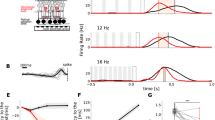
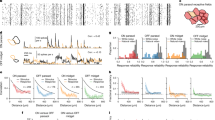
Retinal ganglion cells convey the visual image from the eye to the brain. They generally encode local differences in space and changes in time rather than the raw image intensity. This can be seen as a strategy of predictive coding, adapted through evolution to the average image statistics of the natural environment. Yet animals encounter many environments with visual statistics different from the average scene. Here we show that when this happens, the retina adjusts its processing dynamically. The spatio-temporal receptive fields of retinal ganglion cells change after a few seconds in a new environment. The changes are adaptive, in that the new receptive field improves predictive coding under the new image statistics. We show that a network model with plastic synapses can account for the large variety of observed adaptations.
This is a preview of subscription content, access via your institution
Access options
Subscribe to this journal
Receive 52 print issues and online access
$199.00 per year
only $3.83 per issue
Buy this article
- Purchase on SpringerLink
- Instant access to the full article PDF.
USD 39.95
Prices may be subject to local taxes which are calculated during checkout
Biophysical neural adaptation mechanisms enable artificial neural networks to capture dynamic retinal computation
Temporal pattern recognition in retinal ganglion cells is mediated by dynamical inhibitory synapses
Nonlinear receptive fields evoke redundant retinal coding of natural scenes
References
Dong, D. W. & Atick, J. J. Statistics of natural time-varying images. Network 6, 345–358 (1995)
Field, D. J. Relations between the statistics of natural images and the response properties of cortical cells. J. Opt. Soc. Am. A 4, 2379–2394 (1987)
Srinivasan, M. V., Laughlin, S. B. & Dubs, A. Predictive coding: a fresh view of inhibition in the retina. Proc. R. Soc. Lond. B 216, 427–459 (1982)
Kuffler, S. W. Discharge patterns and functional organization of mammalian retina. J. Neurophysiol. 16, 37–68 (1953)
Barlow, H. B. Summation and inhibition in the frog's retina. J. Physiol. (Lond.) 119, 69–88 (1953)
Meister, M. & Berry, M. J. II The neural code of the retina. Neuron 22, 435–450 (1999)
Barlow, H. B. in Sensory Communication (ed. Rosenblith, W. A.) 217–234 (MIT Press, Cambridge, Massachusetts, 1961)
van Hateren, J. H. Real and optimal neural images in early vision. Nature 360, 68–70 (1992)
Atick, J. J. & Redlich, A. N. What does the retina know about natural scenes? Neural Comput. 4, 196–210 (1992)
Barlow, H. & Földiák, P. in The Computing Neuron (eds Durbin, R., Miall, C. & Mitchison, G.) 54–72 (Addison-Wesley, Wokingham, 1989)
Barlow, H. B. in Vision: Coding and Efficiency (ed. Blakemore, C.) 363–375 (Cambridge Univ. Press, Cambridge, 1990)
Smirnakis, S. M., Berry, M. J., Warland, D. K., Bialek, W. & Meister, M. Adaptation of retinal processing to image contrast and spatial scale. Nature 386, 69–73 (1997)
Baccus, S. A. & Meister, M. Fast and slow contrast adaptation in retinal circuitry. Neuron 36, 909–919 (2002)
Graham, N. V. S. Visual Pattern Analyzers (Oxford Univ. Press, New York, 1989)
Mollon, J. D. in The Perceptual World (eds Von Fiendt, K. & Monstgaard, I. K.) 71–97 (Academic, London, 1977)
Rieke, F. Temporal contrast adaptation in salamander bipolar cells. J. Neurosci. 21, 9445–9454 (2001)
Bloomfield, S. A. Orientation-sensitive amacrine and ganglion cells in the rabbit retina. J. Neurophysiol. 71, 1672–1691 (1994)
Cook, P. B. & McReynolds, J. S. Lateral inhibition in the inner retina is important for spatial tuning of ganglion cells. Nature Neurosci. 1, 714–719 (1998)
Chander, D. & Chichilnisky, E. J. Adaptation to temporal contrast in primate and salamander retina. J. Neurosci. 21, 9904–9916 (2001)
Snippe, H. P., Poot, L. & van Hateren, J. H. Asymmetric dynamics of adaptation after onset and offset of flicker. J. Vis. 4, 1–12 (2004)
Fairhall, A. L., Lewen, G. D., Bialek, W. & van Steveninck, R. R. D. Efficiency and ambiguity in an adaptive neural code. Nature 412, 787–792 (2001)
Masland, R. H. The fundamental plan of the retina. Nature Neurosci. 4, 877–886 (2001)
Yang, C. Y., Lukasiewicz, P., Maguire, G., Werblin, F. S. & Yazulla, S. Amacrine cells in the tiger salamander retina: morphology, physiology, and neurotransmitter identification. J. Comp. Neurol. 312, 19–32 (1991)
Cook, P. B., Lukasiewicz, P. D. & McReynolds, J. S. Action potentials are required for the lateral transmission of glycinergic transient inhibition in the amphibian retina. J. Neurosci. 18, 2301–2308 (1998)
Warland, D. K., Reinagel, P. & Meister, M. Decoding visual information from a population of retinal ganglion cells. J. Neurophysiol. 78, 2336–2350 (1997)
De Valois, K. K. Spatial frequency adaptation can enhance contrast sensitivity. Vision Res. 17, 1057–1065 (1977)
Blakemore, C. & Campbell, F. W. On the existence of neurones in the human visual system selectively sensitive to the orientation and size of retinal images. J. Physiol. (Lond.) 203, 237–260 (1969)
Movshon, J. A. & Lennie, P. Pattern-selective adaptation in visual cortical neurones. Nature 278, 850–852 (1979)
Snowden, R. J. & Hammett, S. T. Subtractive and divisive adaptation in the human visual system. Nature 355, 248–250 (1992)
Bell, C. C. Memory-based expectations in electrosensory systems. Curr. Opin. Neurobiol. 11, 481–487 (2001)
Aizenman, C. D., Huang, E. J., Manis, P. B. & Linden, D. J. Use-dependent changes in synaptic strength at the Purkinje cell to deep nuclear synapse. Prog. Brain Res. 124, 257–273 (2000)
Gaiarsa, J. L., Caillard, O. & Ben-Ari, Y. Long-term plasticity at GABAergic and glycinergic synapses: mechanisms and functional significance. Trends Neurosci. 25, 564–570 (2002)
Shapley, R. & Enroth-Cugell, C. in Progress in Retinal Research (eds Osborne, N. & Chader, G.) Vol. 3 263–346 (Pergamon, London, 1984)
Baccus, S. A. & Meister, M. Retina versus cortex; contrast adaptation in parallel visual pathways. Neuron 42, 5–7 (2004)
Meister, M., Pine, J. & Baylor, D. A. Multi-neuronal signals from the retina: acquisition and analysis. J. Neurosci. Methods 51, 95–106 (1994)
Chichilnisky, E. J. A simple white noise analysis of neuronal light responses. Network 12, 199–213 (2001)
Cook, P. B., Lukasiewicz, P. D. & McReynolds, J. S. GABAC receptors control adaptive changes in a glycinergic inhibitory pathway in salamander retina. J. Neurosci. 20, 806–812 (2000)
Schnitzer, M. J. & Meister, M. Multineuronal firing patterns in the signal from eye to brain. Neuron 37, 499–511 (2003)
Acknowledgements
We thank members of the Meister laboratory, H. Sompolinsky and D. Fisher for advice. This work was supported by grants from the National Eye Institute (M.M. and S.A.B.) and the Human Frontier Science Program (T.H.).Author Contributions T.H. and M.M. planned the study, T.H. and S.A.B. performed the experiments, and T.H. and M.M. completed the analysis and wrote the manuscript.
Ethics declarations
Competing interests
Reprints and permissions information is available at npg.nature.com/reprintsandpermissions. The authors declare no competing financial interests.
Supplementary information
Supplementary Notes (download PDF )
This contains Supplementary Methods and Legends to accompany Supplementary Figures S1-S3 (PDF 748 kb)
Rights and permissions
About this article
Cite this article
Hosoya, T., Baccus, S. & Meister, M. Dynamic predictive coding by the retina. Nature 436, 71–77 (2005). https://doi.org/10.1038/nature03689
Received:
Accepted:
Issue date:
DOI: https://doi.org/10.1038/nature03689
Share this article
Anyone you share the following link with will be able to read this content:
Sorry, a shareable link is not currently available for this article.
Provided by the Springer Nature SharedIt content-sharing initiative
