How much does Decagon AI actually cost? A 2026 Decagon pricing breakdown

Last edited May 7, 2026
Table of Contents
- A look at the Decagon pricing structure
- Breaking down the two types of Decagon pricing models
- What else affects Decagon pricing?
- What's the catch with Decagon pricing?
- A real-world example: Stamp Camp's Decagon pricing problem
- A better alternative: How eesel AI's pricing works
- Does Decagon's pricing model fit your team's needs?
Disclosure: This article is published by eesel AI, a competitor of Decagon. We encourage you to read Decagon's own materials for their perspective.
AI customer support tools all promise to cut your costs and give your team superpowers, but finding out the actual price can feel like a runaround. You see the big claims, but the cost is usually tucked away behind a "Contact Sales" form.
Decagon is a prominent name in enterprise AI, and their agents are known for end-to-end support. The technology is impressive, but their custom pricing model isn't for everyone. When you're trying to set a budget, a vague "it depends" from a vendor just doesn't cut it.
This guide gives you a clear look at Decagon pricing. We'll cover what you get, what you might not see coming, and explain why a quote-based model might not be the best fit for your team. For many businesses, clear pricing isn't just nice to have. It's a must.
A look at the Decagon pricing structure
The first thing to understand about Decagon's pricing is that it's not your typical software subscription. Most SaaS tools charge you per person (or per "seat"). Decagon is different because they view their AI agents as independent workers, not just another tool for your human agents. That means their price is based on the work the AI actually does.
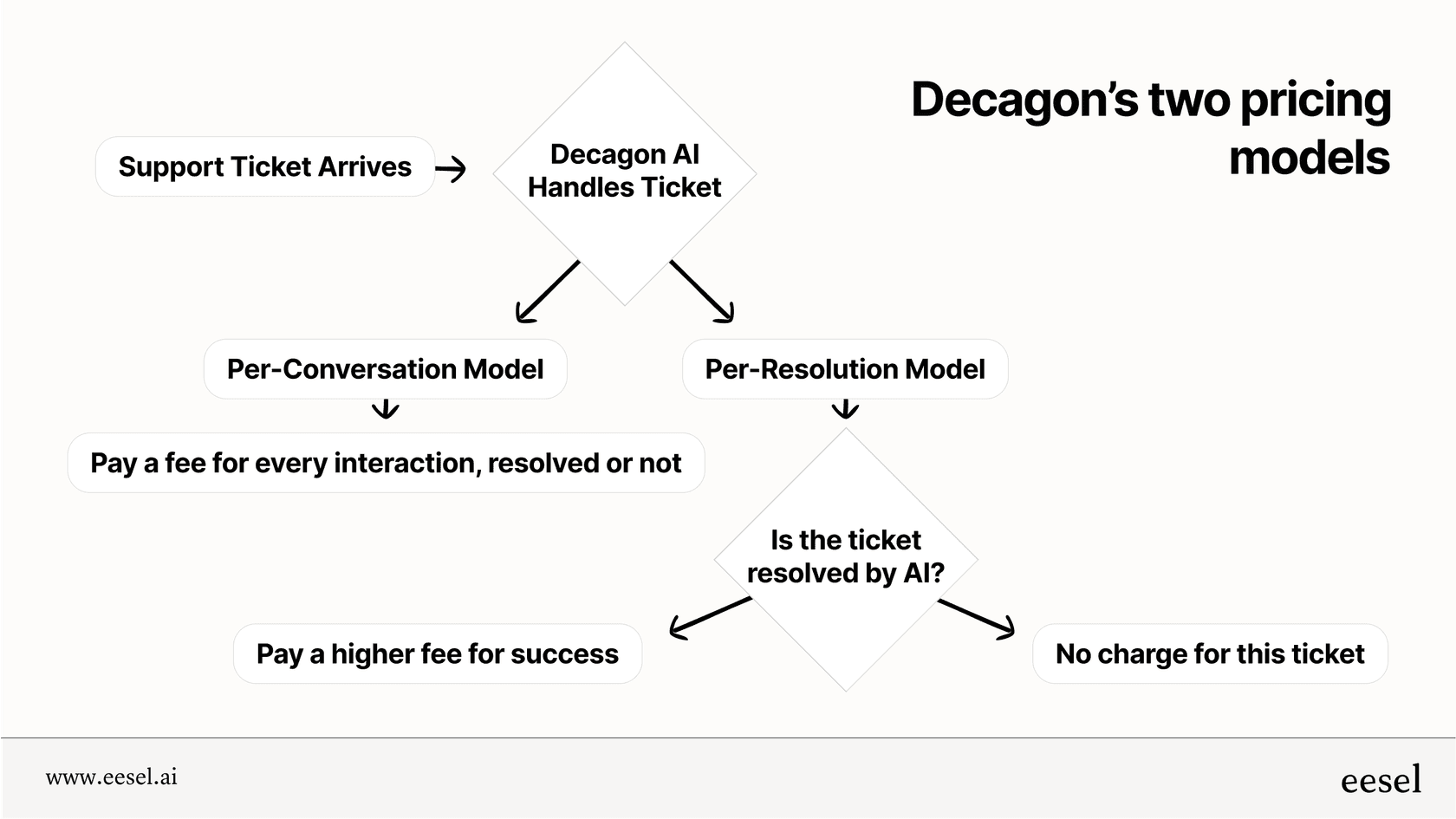
You'll typically choose between pricing models based on what you want to achieve:
-
Per-conversation pricing: You pay a set price for every conversation the AI agent is involved in, whether it solves the problem or not.
-
Per-resolution pricing: You pay a higher set price, but only for the tickets the AI manages to solve by itself.
Decagon has noted that the per-conversation model as the most popular. But here's the bottom line: all of their pricing is custom. no public pricing. To get any numbers, you have to schedule a call with their sales team for a personalized quote.
Breaking down the two types of Decagon pricing models
Let's get into the details of each model and what the trade-offs are for you.
The per-conversation Decagon pricing model
This one is straightforward: you pay a flat fee for every interaction your AI agent handles. If it touches 10,000 conversations in a month, you're billed for 10,000 conversations.
For Decagon, this makes billing predictable and avoids billing disputes. For you, it means your costs scale directly with your support volume, which can make budgeting feel manageable.
The catch is that you're paying for effort, not results. You get charged even if the AI gives a simple answer, fails to fix the issue, or has to pass the ticket to a human. It can feel like paying an employee just for showing up, regardless of what they get done.
The per-resolution Decagon pricing model
With this model, you only open your wallet when the AI successfully closes a ticket without human help. The cost per resolution is higher, but it ties your spending directly to the value you're getting.
The best part is that your goals are aligned with Decagon's. You only pay for success, which gives them a strong incentive to build a bot that works well.
The main challenge, though, is the ambiguity. What exactly counts as a "resolution"? If a customer gets a partial answer and gives up, does that count? Should a simple password reset cost the same as a complicated technical fix? This gray area can lead to billing disputes and makes it tough to forecast your spending.
| Feature | Per-Conversation Pricing | Per-Resolution Pricing |
|---|---|---|
| Cost basis | Fixed rate per interaction | Higher rate per successful resolution |
| Predictability | High (easy to forecast based on volume) | Lower (depends on resolution rate) |
| Value alignment | Aligned with usage/volume | Aligned with outcomes/success |
| Risk | Paying for unresolved or simple tickets | Ambiguity in defining "resolution" |
| Best for | Teams wanting budget certainty | Teams focused on outcome-based ROI |
What else affects Decagon pricing?
With any custom quote, the first price you hear is just the opening offer. Several other things will shape the final number, and they aren't always spelled out upfront.
-
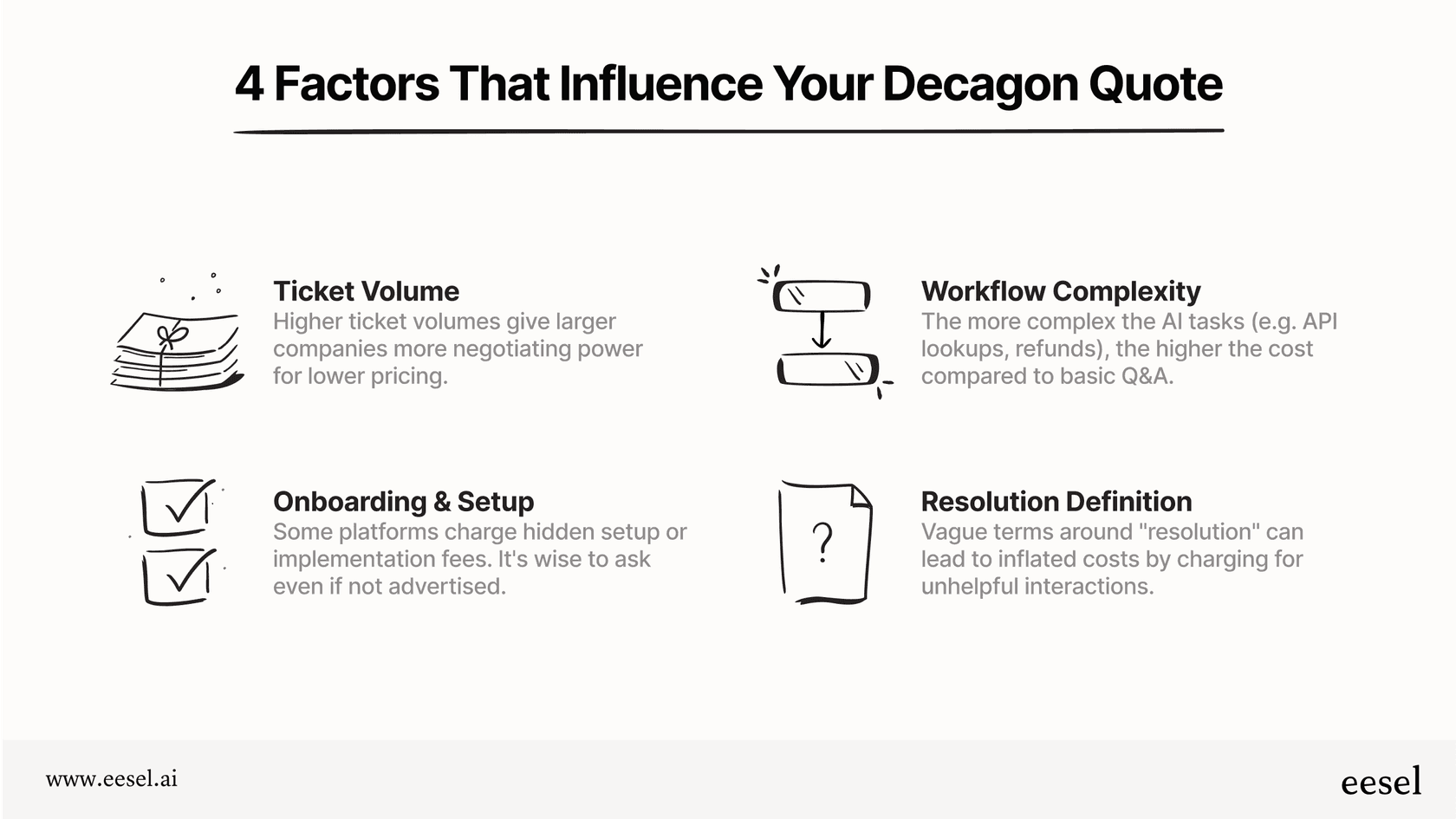
Ticket volume: This is the biggest piece of the puzzle. Companies with large ticket volumes have more room to negotiate lower rates. If you're a small or mid-sized business, you might not have the same leverage to get the best price.
-
Complexity of workflows: What you need the AI to do will change the quote. Basic Q&A will be cheaper than complex tasks that need to connect to other systems, like looking up order details or processing a refund.
-
Onboarding and setup: Decagon does not publish implementation costs, but their team walks you through professional services costs during the discovery call process. It's worth asking about this early so it doesn't come as a surprise.
-
The "resolution" gray area: The vague definition of a "resolution" can affect your bill. If it's defined loosely, you could pay for interactions that didn't fully help the customer, inflating your costs without adding real value.
What's the catch with Decagon pricing?
While Decagon's approach works for some large companies, it has real drawbacks for businesses that need to be nimble and clear on costs.
The biggest problem is the lack of transparency. pricing not disclosed, so you can't tell if the tool is even in your budget without getting on a sales call first. This is a meaningful difference from platforms like eesel AI, which post their pricing publicly so you know what you're getting into right away.
Decagon's platform is enterprise customers, as their customer roster makes clear. The focus on high-volume deals and custom negotiations makes it a tough fit for startups and SMBs who need a tool that can grow with them without a large upfront commitment.
This creates another issue: there's no clear path for growth. As your business scales, how does your price change? With custom contracts, you're stuck renegotiating terms every time your needs change, which adds uncertainty.
Finally, with the per-conversation model, you're paying for incomplete work. Every time the bot tries and fails, you still get a bill. This model doesn't reward efficiency or quality, just activity.
A real-world example: Stamp Camp's Decagon pricing problem
Let's look at how this plays out for a fictional company. Meet "Stamp Camp," an online store for stamp collectors that gets swamped with support tickets during the holidays.
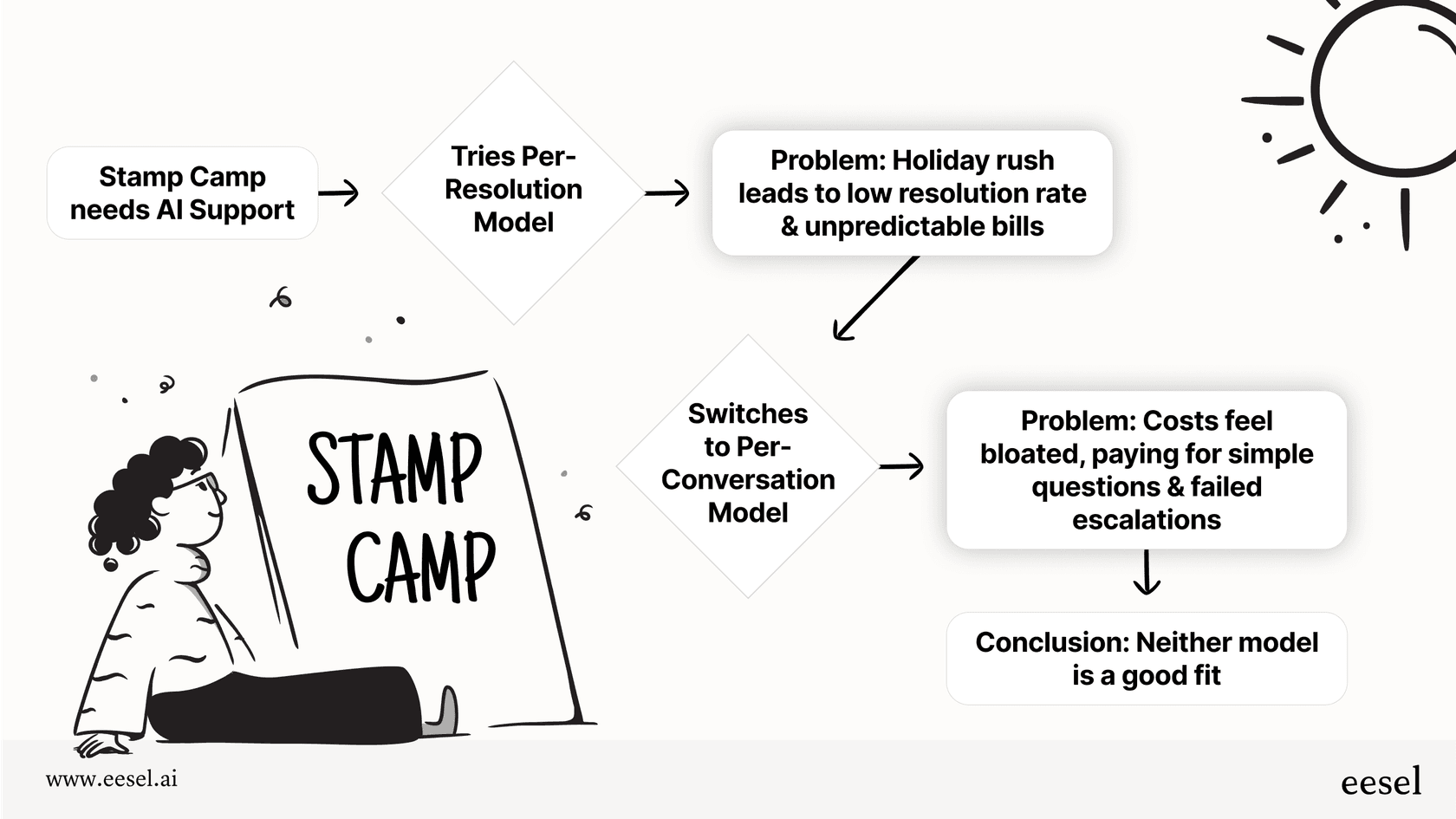
First, they try Decagon's per-resolution model. During the holiday rush, ticket volume skyrockets with tricky shipping questions, and the AI's resolution rate plummets. Their bill becomes totally unpredictable. To top it off, they get into disputes with Decagon's billing team over what a "resolved" ticket even is when customers just give up and leave the chat.
Tired of the guessing game, they switch to the per-conversation model. Now their costs are steady, but they feel bloated. They're paying the same amount for simple "Where's my order?" questions as they do for complex ones, and they still pay every single time the bot fails and escalates to a person.
In the end, neither model feels right. Stamp Camp is caught between unpredictable costs and paying for effort that doesn't produce results. They need something more flexible, transparent, and built to scale.
A better alternative: How eesel AI's pricing works
eesel AI offers a direct contrast to Decagon's opaque pricing.
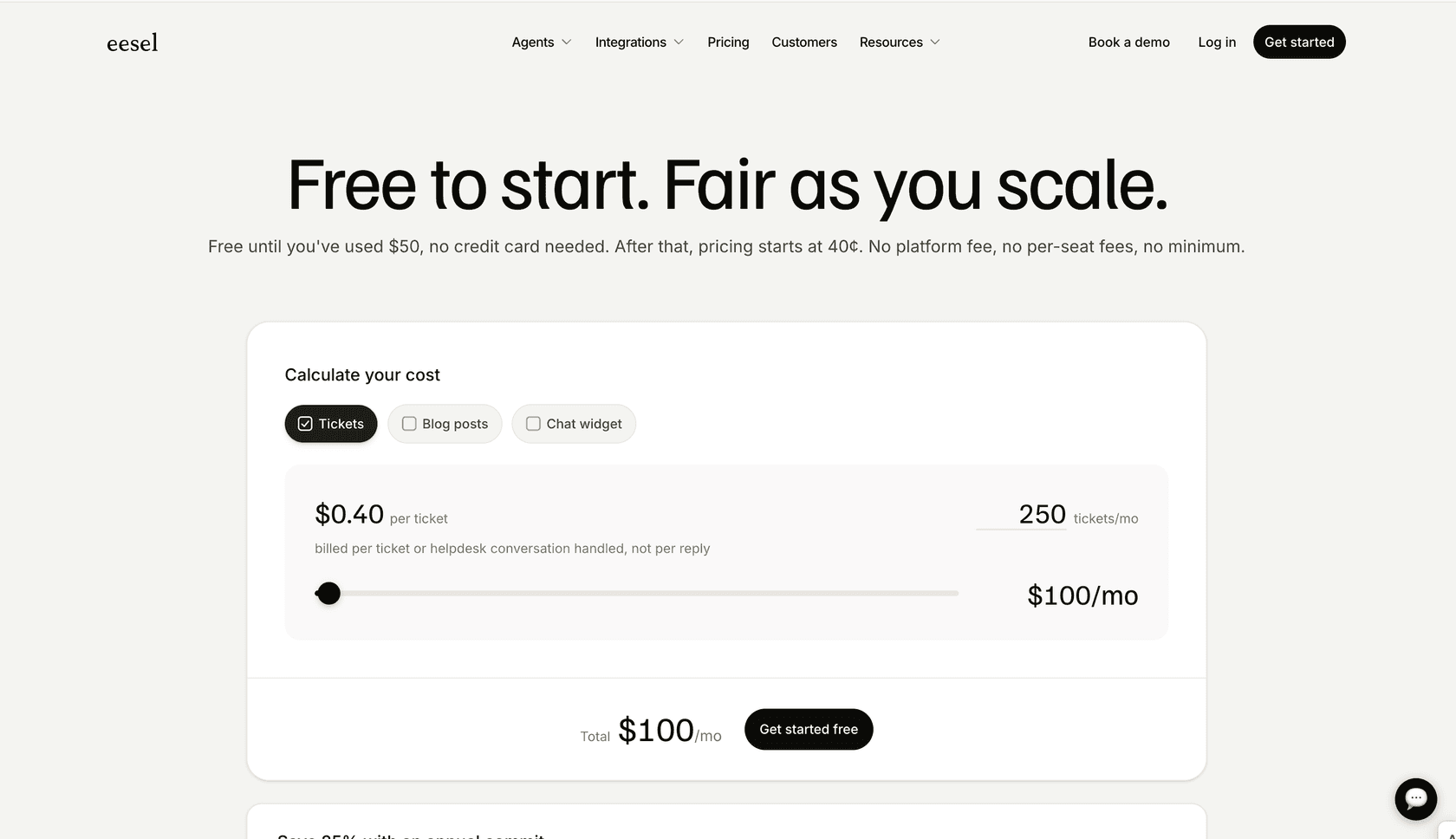
First, full transparency. eesel AI publishes its pricing for everyone to see. You don't have to talk to sales just to find out if it fits your budget.
Second, no per-seat fees. This is a significant plus. Unlike most help desk software, eesel AI's price doesn't go up when you hire more support agents. For growing teams, this means you can add staff without your AI bill getting bigger.
Third, task-based billing. eesel AI charges per task rather than per conversation: one helpdesk task is one AI reply or action, and pricing is predictable because you're billed only for what the AI actually does. There's no charge for inactive seats or unused capacity.
| Usage type | Price | What it covers |
|---|---|---|
| Helpdesk task | $0.40 per task | One AI reply or action in Zendesk, Freshdesk, or any supported helpdesk |
| Heavy task | $4.00 per task | Complex automations and multi-step workflows |
| Enterprise add-on | $1,000/month | Priority support, custom integrations, and dedicated onboarding |
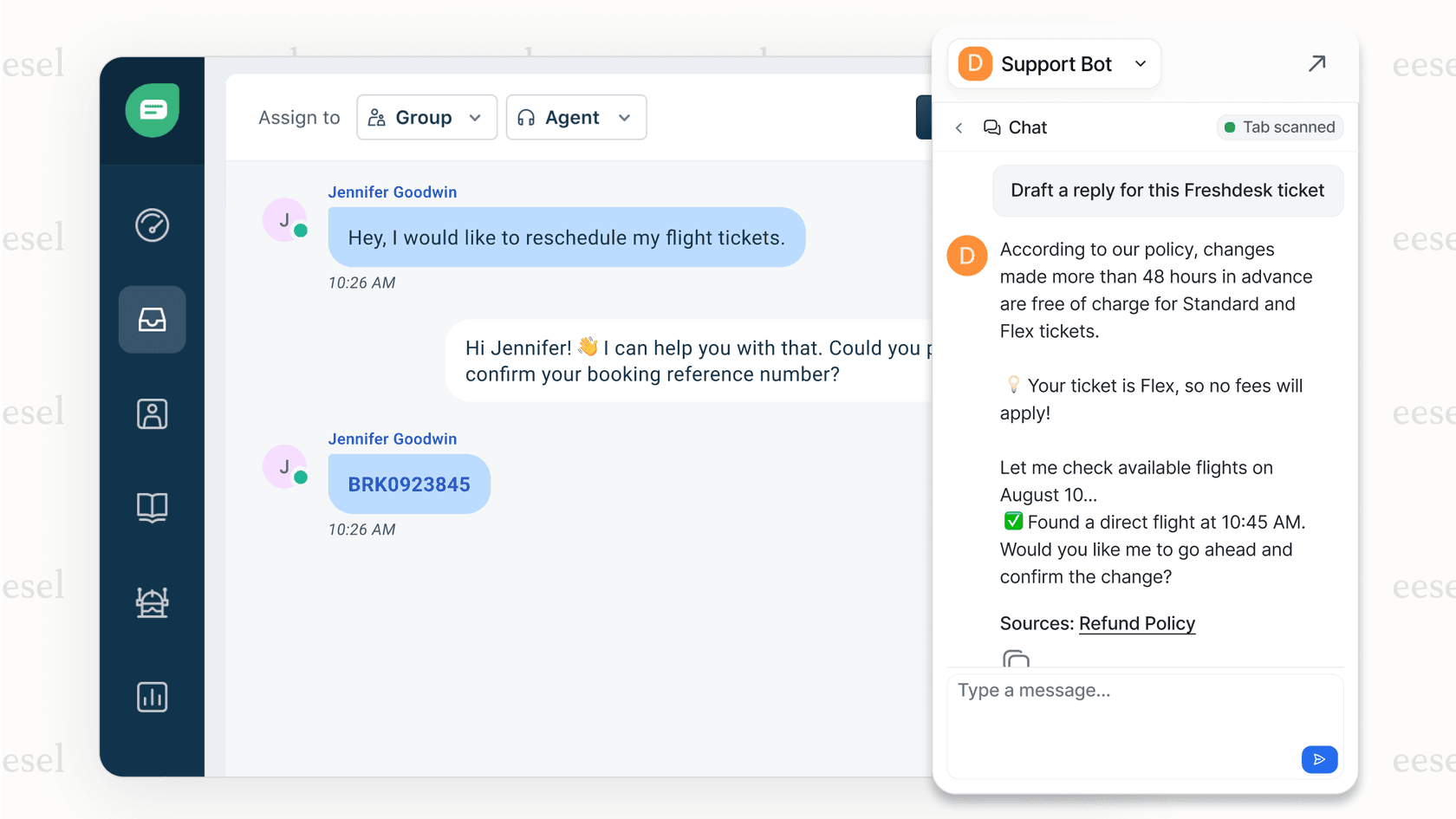
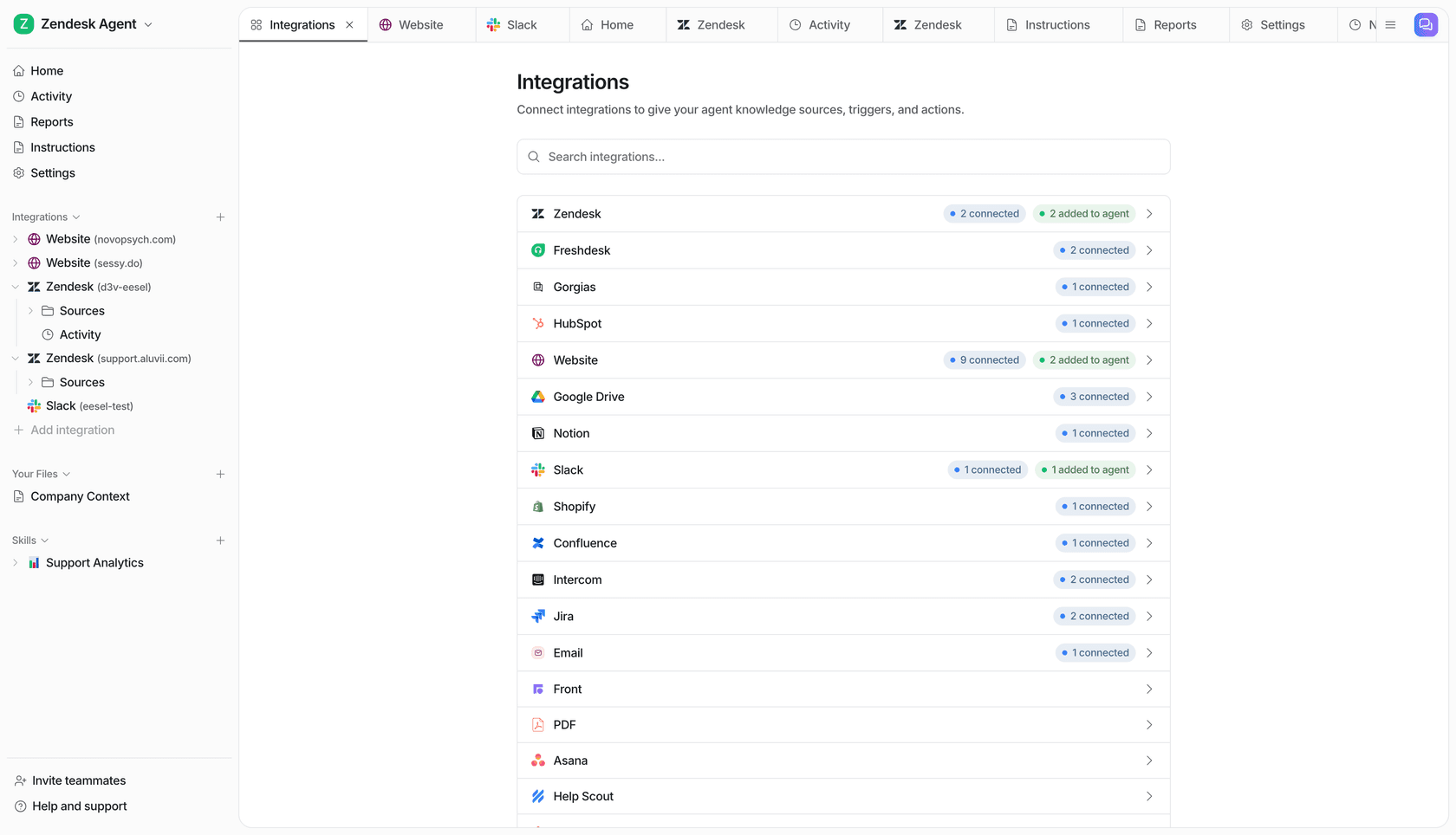
Pricing starts at $0.40 per helpdesk task, which means you're paying for outcomes, not just activity. eesel AI works with the tools you already use, including Zendesk and Freshdesk, and you can see exactly what you'll pay before signing anything.
Does Decagon's pricing model fit your team's needs?
Decagon has powerful technology aimed at the enterprise market. But its reliance on custom quotes can create a lack of transparency, unpredictable costs, and a structure that doesn't work for many growing businesses.
For teams that need clarity, scalability, and control over their budget, a platform with transparent pricing is a better fit. It's worth looking at solutions based not just on their features, but on a pricing model that helps you grow instead of holding you back.
If transparent pricing and powerful automation that works with the tools you already use like Zendesk and Freshdesk sounds like what you need, it's worth taking a look at eesel AI. You can request a demo video or start your free trial today.
Frequently asked questions

Share this article

Article by
Kenneth Pangan
Writer and marketer for over ten years, Kenneth Pangan splits his time between history, politics, and art with plenty of interruptions from his dogs demanding attention.