

Baadre | |
|---|---|
Town | |
| 👁 Image | |
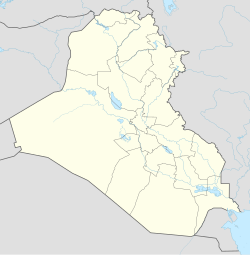
Location in Iraq Baadre (Iraqi Kurdistan) | |
| Coordinates: 36°43′05″N 43°15′15″E / 36.71806°N 43.25417°E / 36.71806; 43.25417 | |
| Country | 👁 Image Iraq |
| Region | 👁 Image Kurdistan Region |
| Governorate | Dohuk Governorate |
| District | Shekhan District |

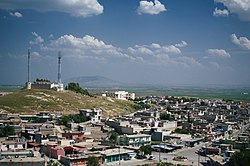



Baadre (Kurdish: باعەدرێ, romanized: Baedrê;[1][2] Syriac: Beṯ ʿEḏraï)[3][a] is a town located in the Shekhan District of the Nineveh Governorate, Iraq. It is located in the Nineveh Plains. It belongs to the disputed territories of Northern Iraq. In 2014, the urban population was 9835 and the rural population was 5167.[5]
It is mostly inhabited by Yazidis and it is considered the political capital of the Yazidis as it is the historical seat of the ruling dynasty of the Sheikhan principality and the Mir.[6][7][8] The castle of the princely family is found here.[9]
History
Beṯ ʿEḏraï (today called Baadre) was historically inhabited by Church of the East Christians.[10] A synod was hosted at Beṯ ʿEḏraï in August-September 485 AD.[11] It was conquered by Utba ibn Farqad al-Sulamī during the Arab conquest of Mesopotamia in 641, according to Futuh al-Buldan by the 9th-century historian Al-Baladhuri.[12] Al-Baladhuri noted that the district of Bā ʿAdhra had a Kurdish population.[12] A school was established in the village by the 8th-century reformer Rabban Babāï.[13]
In the 9th century, the village is attested as part of the Church of the East diocese of Margā as per Thomas of Marga's Book of Governors, in which it is mentioned that one resident had practised sun worship prior to converting to Christianity.[14] The father of Patriarch Abraham II of Seleucia-Ctesiphon (r. 837–850) was from Beṯ ʿEḏraï.[15] The monk Joseph Busnaya (d. 979) was born at Beṯ ʿEḏraï.[16] Beṯ ʿEḏraï likely ceased to be Christian during the thirteenth or fourteenth centuries, at which time a Yazidi community was established.[17]
In Ba'athist Iraq, the population of Baadre was deported because of their support for Peshmerga.[18] According to Shamal Adeeb, who was the town's mayor at the time, the town and the 10 villages in the vicinity took in 2,028 displaced families totaling 12,115 people fleeing the Sinjar massacre in 2014.[8]
References
Notes
Citations
- ^ "Li nêzîkî Şêxanê 5 kesên ji malbatekê canê xwe ji dest dan". Rûdaw (in Kurdish). 6 June 2019. Retrieved 19 December 2019.
- ^ "چەند پرۆژەیەک لە باعەدرێ جێبەجێ دەکرێن". Kurdistan Democratic Party (in Kurdish). Retrieved 19 December 2019.
- ^ Wilmshurst (2000), p. 203.
- ^ Brock (2011), p. 436; Van Rompay (2011), p. 27; Wilmshurst (2000), p. 203; Allison (2004); Wallis Budge (1893), p. 327; Ahmad b. Yahya al-Baladhuri (2022), p. 335.
- ^ "Demographic Survey: Kurdistan Region of Iraq - Iraq". ReliefWeb. Retrieved 25 May 2021.
- ^ Allison (2004).
- ^ З, Мосаки Нодар; В, Пирбари Димитрий (2 December 2019). "Кончина эмира езидов и будущее езидской общины". Азия и Африка сегодня (in Russian) (11): 49–54. doi:10.31857/S032150750007023-7. ISSN 0321-5075.
- ^ a b Melchior, Jillian Kay (19 September 2014). "Escape from Mount Sinjar". National Review. Retrieved 7 October 2014.
- ^ "The Yazidi mausoleum Mîr Alî Beg in Ba'adrê". Mesopotamia Heritage. Retrieved 25 May 2021.
- ^ Wilmshurst (2000), p. 156.
- ^ Van Rompay (2011), p. 27.
- ^ a b Minorsky (1986), p. 451; Ahmad b. Yahya al-Baladhuri (2022), p. 335.
- ^ Wilmshurst (2000), p. 157.
- ^ Wilmshurst (2000), p. 191; Wallis Budge (1893), pp. 327–328.
- ^ Wallis Budge (1893), pp. 327–328.
- ^ Brock (2011), p. 436.
- ^ Wilmshurst (2000), pp. 189, 203.
- ^ Spät (2018), p. 427.
Bibliography
- Ahmad b. Yahya al-Baladhuri (2022). History of the Arab Invasions: The Conquest of the Lands: A New Translation of al-Baladhuri's Futuh al-Buldan. Translated by Hugh Kennedy.
- Allison, Christine (20 July 2004). "Yazidis i: General". Encyclopædia Iranica. Retrieved 20 April 2026.
- Brock, Sebastian P. (2011). "Yawsep Busnaya". In Sebastian P. Brock; Aaron M. Butts; George A. Kiraz; Lucas Van Rompay (eds.). Gorgias Encyclopedic Dictionary of the Syriac Heritage. Gorgias Press. pp. 436–437. Retrieved 20 April 2026.
- Minorsky, V. (1986). "Kurds, Kurdistān". In P. Bearman; Th. Bianquis; C. E. Bosworth; E. Donzel; W. P. Heinrichs (eds.). Encyclopaedia of Islam. Vol. 5 (2nd ed.). pp. 447–64. Retrieved 20 April 2026.
- Spät, Eszter (2018). "Yezidi Identity Politics and Political Ambitions in the Wake of the ISIS Attack". Journal of Balkan and Near Eastern Studies. 20 (5): 420–438. doi:10.1080/19448953.2018.1406689. S2CID 148897618.
- Van Rompay, Lucas (2011). "Aqaq". In Sebastian P. Brock; Aaron M. Butts; George A. Kiraz; Lucas Van Rompay (eds.). Gorgias Encyclopedic Dictionary of the Syriac Heritage. Gorgias Press. p. 27. Retrieved 20 April 2026.
- Wallis Budge, E.A. (1893). The Book of Governors: The Historia Monastica of Thomas of Marga AD 840. Vol. 2. Retrieved 21 April 2026.
- Wilmshurst, David (2000). The Ecclesiastical Organisation of the Church of the East, 1318–1913 (PDF). Peeters Publishers. Retrieved 30 October 2024.


- Pages using gadget WikiMiniAtlas
- CS1 Kurdish-language sources (ku)
- CS1 Russian-language sources (ru)
- Wikipedia pages semi-protected against vandalism
- Use dmy dates from April 2026
- Use British English from April 2026
- All Wikipedia articles written in British English
- Articles with short description
- Short description is different from Wikidata
- Coordinates on Wikidata
- Articles containing Kurdish-language text
- Articles containing Syriac-language text
- Commons category link is on Wikidata