
This article may incorporate text from a large language model. It may include hallucinated information, copyright violations, claims not verified in cited sources, original research, or fictitious references. Any such material should be removed. (August 2025) (Learn how and when to remove this message) |


Bhimber
بھمبر | |
|---|---|
| Bhimber | |
|
Bhimber City | |
| Coordinates: 32°58′29″N 74°04′23″E / 32.97472°N 74.07306°E / 32.97472; 74.07306 | |
| Administering country | Pakistan |
| Dependent Territory | Azad Kashmir |
| District | Bhimber |
| Government | |
| • Chairman Municipal Corporation | Ch. Altaf Ibrahim |
| • Deputy Commissioner | Chaudhary Tariq |
| • MLA | Chaudhry Anwarul Haq (who also serve as Prime minister of Azad Kashmir 2023-2025) |
| Population (2017)[1] | |
• Total | 27,636 |
| Time zone | UTC+5 (PST) |
| Postal code | 10040 |
| Dialling code | 0092-05828 |
| Website | Official Website |


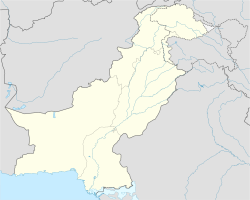
Bhimber (Urdu: بھمبر) is a town and the headquarters of the eponymous district in Pakistan-administered Azad Kashmir. The town and district are between the Jammu region of Indian-administered Kashmir and Pakistan proper, about 47 km (29 mi) by road southeast of Mirpur.
History
[edit]This section has multiple issues. Please help improve it or discuss these issues on the talk page. (Learn how and when to remove these messages)
(Learn how and when to remove this message)
|


Bhimber was the capital of the Chibhal dynasty, which lasted from 1400 to 1856.[2][3][4]
In 1486, Raja Howns (probably Hans) of Bhimber defeated a force from the Punjab that attempted to enter through Bhimber.[5][6]
Bhimber was listed in the Ain-i Akbari (c. 1595) as a mahal under Lahore Subah, counted as part of the Jech Doab. It was listed with an assessed revenue of 1,200,000 dams and was not listed as supplying any troops to the Mughal army.[7]: 322
Bhimber lies on the route that was followed by the Mughal emperors during their frequent visits to the Kashmir Valley. It is also known as "Baab-e-Kashmir" (Door to Kashmir) because of its importance and geographical location, which made it suitable for the Mughal emperors to enter Kashmir. Therefore, the Mughals used Bhimber as a staging point for their journey to Srinagar. The Mughal emperor Jahangir mentions Bhimber in his book Tuzk-e-Jahangiri.[8]
Bhimber is also mentioned on page 19 of the Atlas Maior, published in 1665 by Joan Blaeu, a Dutch cartographer.


Modern history
[edit]In the 19th century, Chibhal came under the Maharaja Gulab Singh. Around 1822, along with Poonch, it was granted as a jagir (feudal land grant) to Raja Dhian Singh of the Dogra dynasty, Gulab Singh's brother. After the death of Maharaja Ranjit Singh, the Sikh court fell into disunity, and Dhian Singh was murdered in court intrigue. Subsequently, the princely state of Jammu and Kashmir was formed under the suzerainty of the British Empire, and these territories were transferred to Jammu and Kashmir. The jagir given to Dhian Singh was respected, however, and Dhian Singh's sons Moti Singh and Jawahir Singh were retained as their Rajas.[9][10][11]
In 1852, the brothers Jawahir and Moti Singh quarrelled, and the Punjab Board of Revenue awarded a settlement. Moti Singh was awarded the Poonch district, and Jawahir Singh was awarded Bhimber, Mirpur and Kotli.[12][13] In 1859, Jawahir Singh was accused of 'treacherous conspiracy' by Maharaja Ranbir Singh (r. 1857–1885), who succeeded Gulab Singh. The British agreed with the assessment and forced Jawahir Singh to exile in Ambala. Ranbir Singh paid Jawahir Singh an annual stipend of Rs. 100,000 until his death, and appropriated his territory afterwards because Jawahir Singh had no heirs.[14]
The appropriated territory was organised as the Bhimber district (wazarat) in 1860. In the decade preceding 1911, the district headquarters was shifted to Mirpur and it came to be called the Mirpur district.[15][16] Bhimber remained a tehsil headquarters until 1947. It had a Hindu majority population, mostly consisting of Mahajans.[17]
Geography and climate
[edit]

Bhimber is a valley. Its hot, subhumid climate and other geographical conditions closely resemble those of Gujrat, the adjoining district in Punjab.
The climate in Bhimber is classified as warm and temperate. Summers have a good deal of rainfall; winters have much less. This location is classified as Cwa by Köppen. The average annual temperature is 23.6 °C (74.5 °F) with a yearly average rainfall of 974 mm (38.3 in). July and August are the wettest months. Temperatures are highest in June.[18]
Climate data for Bhimber, elevation: 325 m (1,066 ft)
| |||||||||||||
|---|---|---|---|---|---|---|---|---|---|---|---|---|---|
| Month | Jan | Feb | Mar | Apr | May | Jun | Jul | Aug | Sep | Oct | Nov | Dec | Year |
| Mean daily maximum °C (°F) | 18.7 (65.7) |
21.6 (70.9) |
26.9 (80.4) |
33.1 (91.6) |
38.5 (101.3) |
40.6 (105.1) |
36.2 (97.2) |
34.3 (93.7) |
34.9 (94.8) |
32.7 (90.9) |
26.7 (80.1) |
21 (70) |
30.4 (86.8) |
| Daily mean °C (°F) | 12.2 (54.0) |
14.9 (58.8) |
20 (68) |
25.6 (78.1) |
30.7 (87.3) |
33.5 (92.3) |
31.2 (88.2) |
29.8 (85.6) |
29.1 (84.4) |
24.9 (76.8) |
18.3 (64.9) |
13.4 (56.1) |
23.6 (74.5) |
| Mean daily minimum °C (°F) | 5.7 (42.3) |
8.2 (46.8) |
13.1 (55.6) |
18.2 (64.8) |
23 (73) |
26.5 (79.7) |
26.3 (79.3) |
25.4 (77.7) |
23.3 (73.9) |
17.1 (62.8) |
10 (50) |
5.9 (42.6) |
16.9 (62.4) |
| Average rainfall mm (inches) | 54 (2.1) |
56 (2.2) |
57 (2.2) |
30 (1.2) |
26 (1.0) |
52 (2.0) |
258 (10.2) |
272 (10.7) |
112 (4.4) |
21 (0.8) |
12 (0.5) |
24 (0.9) |
974 (38.2) |
| Source: Climate-Data.org[18] | |||||||||||||
Notable people
[edit]- Chaudhry Anwarul Haq — 15th Prime Minister of Azad Kashmir
- Raja Muhammad Zulqarnain Khan — politician, ex-President of Azad Jammu and Kashmir
- Manzoor Mirza — economist
- Brig. Ret.Habib ur Rahman — (1913-1978) Ex Indian National Army
- Ghulam Rasul Raja — Pakistan Army officer
- Baba Shadi Shaheed — Sufi saint who fought against the Sikhs
References
[edit]- ^ "Statistical Year Book 2019" (PDF). Statistics Azad Jammu and Kashmir. Archived (PDF) from the original on 30 June 2020. Retrieved 20 April 2020.
- ^ Gulabnama of Diwan Kirpa Ram: A History of Maharaja Gulab Singh of Jammu & Kashmir, page 41
- ^ History of the Punjab Hill States by Hutchison and Vogel, reprinted edition, 2 volumes in 1 Chapter XXIV. 1933 AD
- ^ The Ancient Geography of India by Alexander Cunningham page 134 1871
- ^ Vogel, J. Ph. (1933). History of the Panjab Hill States, Vol. 2. Superintendent of Government Printing, Lahore. p. 726.
- ^ Kaul, P. K. (1993). Himalayan Principalities in Jammu, Kangra, and Bhadarwah. Jay Kay Book House. p. 22.
- ^ Abu'l-Fazl ibn Mubarak (1891). The Ain-i-Akbari. Translated by Jarrett, Henry Sullivan. Calcutta: Asiatic Society of Bengal. Retrieved 31 May 2024.
- ^ Government of Azad Jammu & Kashmir Website. "Jahangir discussed Bhimber in his book Tuzk-e-Jahangiri". Archived from the original on 28 September 2011. Retrieved 8 December 2011.
- ^ Panikkar, Gulab Singh 1930, pp. 121–123.
- ^ Brahma Singh, History of Jammu and Kashmir Rifles 2010.
- ^ Satinder Singh, Raja Gulab Singh's Role 1971, pp. 52–53.
- ^ Snedden, Kashmir: The Unwritten History 2013, p. 232.
- ^ Panikkar, Gulab Singh 1930, p. 123.
- ^ Snedden, Kashmir: The Unwritten History 2013, p. 233.
- ^ "A peep into Bhimber". dailyexcelsior.com. 6 November 2016. Archived from the original on 2 April 2019. Retrieved 7 May 2019.
- ^ India Census Commissioner (1912), Census of India, 1911, Superintendent of government printing, India, archived from the original on 4 September 2021, retrieved 23 November 2018
- ^ Saraf, Kashmiris Fight for Freedom, Volume 2 2015, p. 238.
- ^ a b "Climate Bhimber". en.climate-data.org. Archived from the original on 7 May 2019. Retrieved 7 May 2019.
Bibliography
[edit]- Bamzai, P. N. K. (1994), Culture and Political History of Kashmir, M.D. Publications Pvt. Ltd., ISBN 978-81-85880-31-0, archived from the original on 6 July 2017, retrieved 23 November 2018
- Effendi, Col. M. Y. (2007), Punjab Cavalry: Evolution, Role, Organisation and Tactical Doctrine 11 Cavalry, Frontier Force, 1849-1971, Karachi: Oxford University Press, ISBN 978-0-19-547203-5, archived from the original on 8 June 2020, retrieved 23 November 2018
- Huttenback, Robert A. (1961), "Gulab Singh and the Creation of the Dogra State of Jammu, Kashmir, and Ladakh" (PDF), The Journal of Asian Studies, 20 (4): 477–488, doi:10.2307/2049956, JSTOR 2049956, archived from the original (PDF) on 15 August 2016, retrieved 23 November 2018
- Panikkar, K. M. (1930). Gulab Singh. London: Martin Hopkinson Ltd.
- Raghavan, Srinath (2010), War and Peace in Modern India, Palgrave Macmillan, pp. 101–, ISBN 978-1-137-00737-7, archived from the original on 19 August 2019, retrieved 22 January 2019
- Rai, Mridu (2004), Hindu Rulers, Muslim Subjects: Islam, Rights, and the History of Kashmir, C. Hurst & Co, ISBN 1850656614, archived from the original on 4 September 2021, retrieved 21 September 2020
- Schofield, Victoria (2003) [First published in 2000], Kashmir in Conflict, London and New York: I. B. Taurus & Co, ISBN 1860648983
- Saraf, Muhammad Yusuf (1977), Kashmiris Fight for Freedom: 1819-1946, Lahore: Ferozsons, p. 238, LCCN 78930778, archived from the original on 16 March 2017, retrieved 2 January 2021
- Singh, Bawa Satinder (1971), "Raja Gulab Singh's Role in the First Anglo-Sikh War", Modern Asian Studies, 5 (1): 35–59, doi:10.1017/s0026749x00002845, JSTOR 311654
- Singh, K. Brahma (2010) [first published Lancer International 1990], History of Jammu and Kashmir Rifles, 1820-1956: The State Force Background (PDF), brahmasingh.co.nf, ISBN 978-81-7062-091-4, archived from the original (PDF) on 6 March 2016, retrieved 23 November 2018
- Snedden, Christopher (2013) [first published as The Untold Story of the People of Azad Kashmir, 2012], Kashmir: The Unwritten History, HarperCollins India, ISBN 978-9350298985, archived from the original on 2 February 2020, retrieved 23 November 2018
- Zaheer, Hasan (1998), The Times and Trial of the Rawalpindi Conspiracy, 1951: The First Coup Attempt in Pakistan, Oxford University Press, ISBN 978-0-19-577892-2, archived from the original on 14 March 2017, retrieved 23 November 2018

- Pages using gadget WikiMiniAtlas
- Articles with short description
- Short description is different from Wikidata
- Use British English from October 2012
- All Wikipedia articles written in British English
- Use dmy dates from July 2020
- Articles containing suspected AI-generated texts from August 2025
- Pages using photo montage with one or fewer images
- Coordinates on Wikidata
- Articles containing Urdu-language text
- Wikipedia articles needing rewrite from March 2025
- All articles needing rewrite
- Articles needing additional references from March 2025
- All articles needing additional references
- Articles with multiple maintenance issues