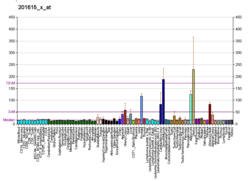
Mammalian protein found in Homo sapiens
Caldesmon is a protein that in humans is encoded by the CALD1 gene.[3][4]
Caldesmon is a calmodulin binding protein. Like calponin, caldesmon tonically inhibits the ATPase activity of myosin in smooth muscle.
This gene encodes a calmodulin- and actin-binding protein that plays an essential role in the regulation of smooth muscle and nonmuscle contraction. The conserved domain of this protein possesses the binding activities to 👁 {\displaystyle {\text{Ca}}^{2+}}
-calmodulin, actin, tropomyosin, myosin, and phospholipids. This protein is a potent inhibitor of the actin-tropomyosin activated myosin MgATPase, and serves as a mediating factor for 👁 {\displaystyle {\text{Ca}}^{2+}}
-dependent inhibition of smooth muscle contraction. Alternative splicing of this gene results in multiple transcript variants encoding distinct isoforms.[4]
In diagnostic immunochemistry, caldesmon is a marker for smooth muscle differentiation.
- Huber PA (1998). "Caldesmon". Int. J. Biochem. Cell Biol. 29 (8–9): 1047–51. doi:10.1016/S1357-2725(97)00004-6. PMID 9415999.
- Gusev NB (2002). "Some properties of caldesmon and calponin and the participation of these proteins in regulation of smooth muscle contraction and cytoskeleton formation". Biochemistry Mosc. 66 (10): 1112–21. doi:10.1023/A:1012480829618. PMID 11736632. S2CID 310781.
- Wang CL (2002). "Caldesmon and smooth-muscle regulation". Cell Biochem. Biophys. 35 (3): 275–88. doi:10.1385/CBB:35:3:275. PMID 11894847. S2CID 195271255.
- Mani RS, McCubbin WD, Kay CM (1992). "Calcium-dependent regulation of caldesmon by an 11-kDa smooth muscle calcium-binding protein, caltropin". Biochemistry. 31 (47): 11896–901. doi:10.1021/bi00162a031. PMID 1445920.
- Hayashi K, Yano H, Hashida T, et al. (1993). "Genomic structure of the human caldesmon gene". Proc. Natl. Acad. Sci. U.S.A. 89 (24): 12122–6. doi:10.1073/pnas.89.24.12122. PMC 50710. PMID 1465449.
- Humphrey MB, Herrera-Sosa H, Gonzalez G, et al. (1992). "Cloning of cDNAs encoding human caldesmons". Gene. 112 (2): 197–204. doi:10.1016/0378-1119(92)90376-Z. PMID 1555769.
- Adam LP, Gapinski CJ, Hathaway DR (1992). "Phosphorylation sequences in h-caldesmon from phorbol ester-stimulated canine aortas". FEBS Lett. 302 (3): 223–6. doi:10.1016/0014-5793(92)80446-N. PMID 1601129. S2CID 46129878.
- Horiuchi KY, Chacko S (1989). "Interaction between caldesmon and tropomyosin in the presence and absence of smooth muscle actin". Biochemistry. 27 (22): 8388–93. doi:10.1021/bi00422a014. PMID 3242591.
- der Terrossian E, Deprette C, Lebbar I, Cassoly R (1994). "Purification and characterization of erythrocyte caldesmon. Hypothesis for an actin-linked regulation of a contractile activity in the red blood cell membrane". Eur. J. Biochem. 219 (1–2): 503–11. doi:10.1111/j.1432-1033.1994.tb19965.x. PMID 8307018.
- Surgucheva I, Bryan J (1996). "Over-expression of smooth muscle caldesmon in mouse fibroblasts". Cell Motil. Cytoskeleton. 32 (3): 233–43. doi:10.1002/cm.970320307. PMID 8581978.
- Bonaldo MF, Lennon G, Soares MB (1997). "Normalization and subtraction: two approaches to facilitate gene discovery". Genome Res. 6 (9): 791–806. doi:10.1101/gr.6.9.791. PMID 8889548.
- Graether SP, Heinonen TY, Raharjo WH, et al. (1997). "Tryptophan residues in caldesmon are major determinants for calmodulin binding". Biochemistry. 36 (2): 364–9. doi:10.1021/bi962008k. PMID 9003189.
- Wang Z, Danielsen AJ, Maihle NJ, McManus MJ (1999). "Tyrosine phosphorylation of caldesmon is required for binding to the Shc.Grb2 complex". J. Biol. Chem. 274 (47): 33807–13. doi:10.1074/jbc.274.47.33807. PMID 10559276.
- Adam L, Vadlamudi R, Mandal M, et al. (2000). "Regulation of microfilament reorganization and invasiveness of breast cancer cells by kinase dead p21-activated kinase-1". J. Biol. Chem. 275 (16): 12041–50. doi:10.1074/jbc.275.16.12041. PMID 10766836.
- Hall SM, Hislop AA, Pierce CM, Haworth SG (2000). "Prenatal origins of human intrapulmonary arteries: formation and smooth muscle maturation". Am. J. Respir. Cell Mol. Biol. 23 (2): 194–203. doi:10.1165/ajrcmb.23.2.3975. PMID 10919986.
- Nimmrich I, Erdmann S, Melchers U, et al. (2000). "Seven genes that are differentially transcribed in colorectal tumor cell lines". Cancer Lett. 160 (1): 37–43. doi:10.1016/S0304-3835(00)00553-X. PMID 11098082.
- Hisaoka M, Wei-Qi S, Jian W, et al. (2003). "Specific but variable expression of h-caldesmon in leiomyosarcomas: an immunohistochemical reassessment of a novel myogenic marker". Appl. Immunohistochem. Mol. Morphol. 9 (4): 302–8. doi:10.1097/00022744-200112000-00003. PMID 11759055. S2CID 25653139.
- Sobue K, Muramoto Y, Fujita M, Kakiuchi S (Sep 1981). "Purification of a calmodulin-binding protein from chicken gizzard that interacts with F-actin". Proc. Natl. Acad. Sci. U.S.A. 78 (9): 5652–5. Bibcode:1981PNAS...78.5652S. doi:10.1073/pnas.78.9.5652. PMC 348816. PMID 6946503.