
This article is missing information about conditions of achieving this rank, promotion requirements, service length, authorities and responsibilities. Please expand the article to include this information. Further details may exist on the talk page. (November 2018) |


The army rank of captain (from the French: capitaine) is a commissioned officer rank historically corresponding to the command of a company of soldiers. The rank is also used by some air forces and marine forces, but usually refers to a more senior officer.
History
[edit]This section does not cite any sources. Please help improve this section by adding citations to reliable sources. Unsourced material may be challenged and removed. Find sources: "Captain" armed forces – news · newspapers · books · scholar · JSTOR (May 2021) (Learn how and when to remove this message) |


The term ultimately goes back to Late Latin capitaneus meaning "head of [something]"; in Middle English adopted as capitayn in the 14th century, from Old French capitaine.
The military rank of captain was in use from the 1560s, referring to an officer who commands a company. The naval sense, an officer who commands a man-of-war, is somewhat earlier, from the 1550s, later extended in meaning to "master or commander of any kind of vessel". A captain in the period prior to the professionalization of the armed services of European nations subsequent to the French Revolution, during the early modern period, was a nobleman who purchased the right to head a company from the previous holder of that right. He would in turn receive money from another nobleman to serve as his lieutenant. The funding to provide for the troops did not come from the monarch or their government; the captain responsible for feeding, housing, and provisioning their company. If he was unable to support the company, or was otherwise court-martialed, he would be dismissed ("cashiered"), and the monarch would sell his commission to another nobleman to command the company. Otherwise, the only pension for the captain was selling the right to another nobleman when he was ready to retire.
Modern usage
[edit]Today, a captain is typically either the commander or second-in-command of a company or artillery battery (or United States Army cavalry troop or Commonwealth squadron). In the Chinese People's Liberation Army, a captain may also command a company, or be the second-in-command of a battalion.
In some militaries, such as United States Army and Air Force and the British Army, captain is the entry-level rank for officer candidates possessing a professional degree, namely, most medical professionals (doctors, pharmacists, dentists) and lawyers. In the U.S. Army, lawyers who are not already officers at captain rank or above enter as lieutenants during training, and are promoted to the rank of captain after completion of their training if they are in the active component, or after a certain amount of time, usually one year from their date of commission as a lieutenant, for the reserve components.
The rank of captain should not be confused with the naval rank of captain, or with the UK-influenced air force rank of group captain, both of which are equivalent to the army rank of colonel.
Air forces
[edit]Many air forces, such as the United States Air Force, use a rank structure and insignia similar to those of the army.
However, the United Kingdom's Royal Air Force, many other Commonwealth air forces and a few non-Commonwealth air forces[1] use an air force-specific rank structure in which flight lieutenant is OF-2. A group captain is derived from the naval rank of captain.
Canada is a unique exception. Due to the unification of the Canadian Armed Forces in 1968, the air force rank titles are the same as those of the Canadian Army. However, like their Commonwealth counterparts, rank braids are pearl grey and increase in half strip increments. The decision was taken not to restore the historic rank titles for the RCAF due to it being deemed 'too confusing'.[2]
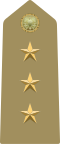
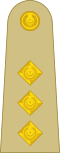
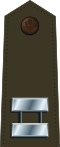
Insignia
[edit]-
U.S. Army (dress)


.svg)




.svg)


See also
[edit]- Kapitan (rank)
- Captain (United Kingdom)
- Captain (United States)
- Senior captain
- Staff captain
- Katepano
- Rittmaster
References
[edit]- ^ Non-Commonwealth air forces using an air force-specific rank structure include the Egyptian Air Force, Hellenic Air Force, Royal Air Force of Oman, Royal Thai Air Force and the Air Force of Zimbabwe.
- ^ "New insignia for the Royal Canadian Air Force". Royal Canadian Air Force. September 24, 2014. Archived from the original on Dec 4, 2021.

- Articles containing Spanish-language text
- Articles containing Brazilian Portuguese-language text
- Articles containing Czech-language text
- Articles containing Finnish-language text
- Articles containing French-language text
- Articles containing Georgian-language text
- Articles containing Indonesian-language text
- Articles containing Irish-language text
- Articles containing Italian-language text
- Articles containing Limburgish-language text
- Articles containing Macedonian-language text
- Articles containing Dutch-language text
- Articles containing Urdu-language text
- Articles containing Filipino-language text
- Articles containing Afrikaans-language text
- Articles containing Swedish-language text
- Articles with short description
- Short description is different from Wikidata
- Articles to be expanded from November 2018
- Articles needing additional references from May 2021
- All articles needing additional references
- Articles containing Latin-language text
- Articles containing Middle English (1100-1500)-language text