
تل شاغربازار | |
👁 Chagar Bazar/Ašnakkum is located in Syria Chagar Bazar/Ašnakkum Shown within Syria | |
| Location | Al-Hasakah Governorate, Syria |
|---|---|
| Coordinates | 36°52′30″N 40°53′53″E / 36.875°N 40.898°E / 36.875; 40.898 |
| Type | settlement |
| Area | 12 ha |
| History | |
| Founded | ca. 6,000 BC |
| Periods | Neolithic |
| Site notes | |
| Excavation dates | 1934—1937 1999—2010 |
| Archaeologists | Max Mallowan, Augusta McMahon |
| Ownership | Public |
| Public access | Yes |

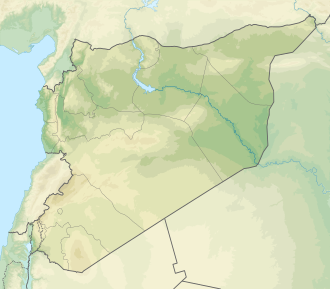

Chagar Bazar (Akk. Ašnakkum; Šagir Bazar, Arabic: تل شاغربازار) is a tell, or settlement mound, in northern Al-Hasakah Governorate, Syria, approximately 35 kilometres (22 mi) north of Al-Hasakah, on the Wadi Dara, a tributary to the Khabur River. It is a short distance from the major ancient city of Nagar (Tell Brak). The site was occupied from the Halaf period (c. 6100 to 5100 BC) until the middle of the 2nd millennium BC.


History
[edit]

Neolithic-Chalcolithic
[edit]Chagar Bazar was already settled in the Neolithic. Excavations revealed pottery belonging to the Halaf and Ubaid cultures. [1]
Early Bronze
[edit]By the Early Bronze Age, in the third millennium BC, Chagar Bazar had turned into a small town with the size of 12 hectares / 30 acres. The site appears to have been abandoned by the end of the third millennium BC.
Middle Bronze
[edit]In the Middle Bronze, it was resettled in the Old Babylonian period and it has been proposed as the city of Ašnakkum though there is no epigraphic evidence for that found at the site. On an Old Babylonian period itinerary text detailing a trade route from Larsa to Emar and back Ašnakkum is after Assur and then Šubat-Enlil in the westbound direction (not including currently unlocated towns).[2][3]
The town was part of the Kingdom of Upper Mesopotamia under Amorite ruler Shamshi-Adad I (c. 1813–1776 BC) and his son Yasmah-Adad.[4][5][6] One administrator of the city in that time, Sin-iqišam, is known to have had "two main wives, five secondary wives, as well as thirty-three songstresses, a group that may well have included concubines".[7] The city then fell under the control of Mari under Zimri-Lim (c. 1775 to 1760 BC).[8] When that city was destroyed by Hammurabi (c. 1792-1750 BC) the area came under the control of Babylon. Onomastics indicate that 29 % of all personal names found in the cuneiform texts from Chagar Bazar are Hurrian.[9] Talhawum has also been suggested as the name in this period.[10] Texts showed that large scale pig herding was practiced at the site in this period.[11]
Ašnakkum
[edit]

Assuming it was indeed Ašnakkum then Chagar Bazar would have been part of the Ida-Maraṣ region along with Ašlakkā, Ilān-surā, Kahat, Susā, and Šunā.[12][13] Ašnakkum is mentioned in a year name of Naram-Sin of Eshnunna (c. 1810-1801 BC) "Year in which (the land of) Ašnakkum was seized", alternately "Year the lands of Ašnakkum and Tarnip were seized".[14] In a text found at Mari the ruler of Ašnakkum complained to the ruler of Mari "I have exhausted all the clay of Ašnakkum for the letters that I repeatedly send!".[15]
Some rulers during the period when Zimri-Lim of Mari controlled most of the Ida-maras are known:
- Sammetar[16] In a letter to Zimri-Lime, Ibal-Addu of Ašlakka wrote:
"Sammetar of Ašnakkum, who even married Zimri-Lim’s sister, people from [...] wrapped him in leather and delivered him to Elamite power. Why did your lord, Zimri-Lim, not save him?"[17]
- Isme-Addu (who ended up being beheaded and his head sent to Saggarâtum)[18][19]
- Qarnilim[20]
- Sadum-Labua[21]
Late Bronze
[edit]In the Late Bronze, this region was part of the Mitanni Empire.
Archaeology
[edit]

The site contains two mounds, a higher but smaller one to the south and a lower larger northern one. Occupation was Halaf at the northern end then at the southern end in the Late Chalcolithic period followed by full occupation in the 3rd millennium BC. The 2nd millennium BC occupation was restricted to the northern (5 hectare) mound. Chagar Bazar was excavated for three seasons by the British archaeologist Max Mallowan, with his wife Agatha Christie, under the auspices of the British Museum and of the British School of Archaeology in Iraq from 1935 to 1937 after two trial trenches (A and B) were dug in 1934. Intrusive Roman and Islamic period burials were on the surface.[22][23][24] Virgin soil was found at a depth of 16 meters where pottery of the Sakje Geuzi (Coba Höyük) type was found. Fifteen occupational layers were determined and finds included painted figurines and a Halaf period cylinder seal. About 1/2 (10 levels) of the occupation was from the Halaf period and the remaining 1/2 (5 periods) from the "historic" period. There was a noticeable period of abandonment between the 5th and 6th layers.[25] Two nearby mounds,Tell Germayir and Tell Arbit, were also sounded and remains from the 3rd and 4th millennium found.[26] Many of the artifacts discovered were brought to the British Museum.
Besides pottery, about 120 Old Babylonian period clay tablets and fragments written in cuneiform script were discovered, of an administrative nature. The tablets came from a 7 year period when the city was under the rulership of Yasmah-Adad, son of Shamshi-Adad I (c. 1808–1776 BC) of Ekallatum, Amorite ruler of the Kingdom of Upper Mesopotamia. Yasmah-Adad was put in charge of Mari and the regions it controlled, including Ida-maras, after the death of his brother Yahdun-Lim in c. 1796 BC. The majority came from a building associated with grain storage[27] [28][29][30][31]
Work was resumed at the site in 1999 by an expedition from the British School of Archaeology in Iraq in cooperation with University of Liège archaeologists and the Syrian Directorate-General of Antiquities and Museums.[32][33][34] Work at the site continued until 2010 but no results have yet been published for work after 2002.[35] Old Babylonian period textiles were found to contain Molluscan purple dye.[36] Over 200 cuneiform tablets and fragments from the same period were found in the 1999-2002 excavations and published.[37] More tablets emerged in the succeeding seasons and partially published. [38][39] The majority of the administrative tablets came from a palace near the discovery spot of the earlier excavation tablets and dealt mostly with household accounting and records of messengers and dignitaries.[40]
See also
[edit]References
[edit]- ^ W. Cruells and OP Nieuwenhuyse, "The Proto-Halaf period in Syria. New sites New data", Paléorient, vol. 30, no. 1, p. 47–68, 2004
- ^ Hallo, William W., "The Road to Emar", Journal of Cuneiform Studies, vol. 18, no. 3, pp. 57–88, 1964
- ^ Goetze, Albrecht, "An Old Babylonian Itinerary", Journal of Cuneiform Studies, vol. 7, no. 2, pp. 51–72, 1953
- ^ Cyrus H. Gordon and Gary A. Rendsburg (eds.), "Eblaitica: Essays on the Ebla Archives and Eblaite Language, Volume 4", Winona Lake, Eisenbrauns, 2002 ISBN 978-1-57506-060-6
- ^ Lacambre, Denis, "Les dates du séjour de Yasmah-Addu à Chagar Bazar (Ašnakkum)", Nouvelles Assyriologiques Brèves et Utilitaires 2016, pp. 103-105, 2016
- ^ [1]Lacambre, Denis, "L'administration de Chagar Bazar (Ašnakkum) à l'époque de Samsī-Addu", City Administration in the Ancient Near East, Proceedings of the 53e Rencontre Assyriologique Internationale, 23th-28th July 2007, Moscow & St Petersburg, Russia, vol. 2 5, pp. 97-113, 2010
- ^ Sharlach, T. M., "Was There a Harem in Early Mesopotamia?", An Ox of One's Own: Royal Wives and Religion at the Court of the Third Dynasty of Ur, Berlin, Boston: De Gruyter, pp. 71-100, 2017
- ^ Sasson, Jack M., "The King and I a Mari King in Changing Perceptions", Journal of the American Oriental Society, vol. 118, no. 4, pp. 453–70, 1998
- ^ Streck, M. P., "Old Babylonian", in History of the Akkadian Language, Leiden, The Netherlands: Brill, pp. 993–1038, 2021
- ^ Alfonso Archi. "History of Syria in the Third Millennium: the Written Sources", Ebla and Its Archives: Texts, History, and Society, Berlin, München, Boston: De Gruyter, pp. 13-31, 2015
- ^ Lion, Brigitte and Cécile Michel, "Les porcs dans la documentation textuelle paléo-babylonienne", Journal for Semitics16/3, pp. 680–700, 2007
- ^ Guichard, Michaël, "Political Space–Local Political Structures in Northern Syria: The Case of the Country of Ida-Maras in the Eighteenth Century BC", Constituent, Confederate, and Conquered Space. The Emergence of the Mittani State (Topoi–Berliner Studien der Alten Welt 17), Berlin/Boston, pp. 147-160, 2014
- ^ Jesper Eidem, with a contribution by Lauren Ristvet and Harvey Weiss, "The Royal Archives from Tell Leilan. Old Babylonian Letters and Treaties from the Lower Town Palace East", PIHANS 117, The Netherlands Institute for the Near East, Leiden, 2011
- ^ [2] Henri Frankfort, Seton Lloyd, and Thorkild Jacobsen with a chapter by Günter Martiny, "The Gimilsin Temple and the Palace of the Rulers at Tell Asmar", Oriental Institute Publication 43, 1940
- ^ Michel, Cécile, "What about 3D Manuscripts? The Case of the Cuneiform Clay Tablets", Exploring Written Artefacts: Objects, Methods, and Concepts, edited by Jörg B. Quenzer, Berlin, Boston: De Gruyter, pp. 89-114, 2021
- ^ Douglas Frayne, "Ašnakkum", Old Babylonian Period (2003-1595 B.C.): Early Periods, Volume 4, Toronto: University of Toronto Press, pp. 769-770, 1990
- ^ [3]Sasson, Jack M., "Wit, Banter and Sarcasm in Mari Letters", Ina dmarri u qan ṭuppi. Par la bêche et le stylet, pp. 181-190, 2019
- ^ Charpin, Dominique, "Un souverain éphémère en Ida-Maras: Išme-Addu d'Ašnakkum", Mari, Annales de Recherches Interdisciplinaires. Vol. 7., 1993
- ^ Alfonso Archi, "Two Heads for the King of Ebla", Ebla and Its Archives: Texts, History, and Society, Berlin, München, Boston: De Gruyter, pp. 292-300, 2015
- ^ Artzi, P., and A. Malamat, "The Correspondence of Šibtu, Queen of Mari in ARM X", Orientalia, vol. 40, no. 1, 1971, pp. 75–89, 1971
- ^ Kupper, Jean-Robert, "Un épisode de l'histoire du royaume d'Ašnakkum", Revue d'assyriologie et d'archéologie orientale 93.1, pp. 79-90, 1999
- ^ M.E.L. Mallowan, "Excavations at Chagar Bazar and an Archaeological Survey of the Habur Region of North Syria 1934-5", Iraq, vol. 3, no. 1, pp. 1–85, 1936
- ^ M.E.L. Mallowan, "Excavations at Tall Chagar Bazar and an Archaeological Survey of the Habur Region, Second Campaign 1936", Iraq, vol. 4, no. 2, pp. 91–177, 1937
- ^ M.E.L. Mallowan, "Excavations at Brak and Chagar Bazar", Iraq, no. 9, pp. 1–259, 1947
- ^ "Editorial Notes", Iraq, vol. 2, no. 2, pp. 232–232, 1935
- ^ Albright, W. F., and Nelson Glueck, "Archaeological Exploration and Excavation in Palestine, Transjordan, and Syria during 1936", American Journal of Archaeology, vol. 41, no. 1, pp. 146–53, 1937
- ^ C. J. Gadd, "Tablets from Chagar Bazar 1936", Iraq, vol. 4, no. 2, pp. 178–185, 1937
- ^ C. J. Gadd, "Tablets from Chagar Bazar and Tell Brak 1937–38", Iraq, vol. 7, pp. 22–61, 1940
- ^ Philippe Talon, "Old Babylonian Texts From Chagar Bazar", FAGD/ASGD, 1997 ISBN 90-90-10838-6
- ^ Loretz, O., "Texte aus Chagar Bazar und Tell Brak, Teil 1", Alter Orient und Altes Testament 3. Neukirchen-Vluyn: Butzon & Bercker, 1969
- ^ Snell, D., "The Old Babylonian Cuneiform Texts from Chagar Bazar in the Aleppo Museum", Annales archéologiques arabes syriennes 33:2, pp.217-241, 1983
- ^ Augusta McMahon, Onhan Tunca, and Abdul-Massih Bagdo, "New Excavations at Chagar Bazar 1999–2000", Iraq, vol. 63, pp. 201–222, 2001
- ^ A.M. McMahon, C. Colantoni and M.J. Semple, "British excavations at Chagar Bazar, 2001–2002", Iraq, vol. 67, no. 2, pp. 1–16, 2003
- ^ McMahon, A., C. Colantoni, J. Frane, and A. Soltysiak, "Once There Was A Place: Settlement Archaeology at Chagar Bazar 1999-2002", London, British Institute for the Study of Iraq, 2009 ISBN 978-0903472272
- ^ Chagar Bazar IX (Syria): A key Halafian site in the Sixth Millennium cal. BC - Levey-White Foundation - 2022
- ^ Hofmann-de Keijzer, Regina, Bommel, Maarten R., Joosten, Ineke and Bogensperger, Ines, "Appendix N: Molluscan purple", Late Antique Textiles from the Papyrus Collection of the Austrian National Library: Scientific investigation of fibres, dyes and dyeing techniques, Berlin, Boston: De Gruyter, pp. 398-401, 2024
- ^ O. Tunca and A. Baghdo, "Chagar Bazar (Syrie) III: Les trouvailles epigraphiques et sigillographiques du chantier I (2000–2002)", Peeters, 2008, ISBN 90-429-2089-0
- ^ Denis Lacambre - The archives of Chagar Bazar (ancient Ašnakkum) in Paleo-Babylonian times - Video - 2023
- ^ Lacambre, Denis, "Nouvelles découvertes épigraphiques à Chagar Bazar/Ašnakkum (2005-2010): L’année après la mort de Samsî-Addu et l’éponyme Ennam-Aššur (KEL G 84)", 57e Rencontre Assyriologique Internationale, Tradition and Innovation in the Ancient Near East, 4-8 juillet 2011, Sapienza–Università di Roma, 2011.
- ^ Rattenborg, Rune, "Land of Behemoths: Re-Casting Political Territories of the Middle Bronze Age Jazirah", New Agendas in Remote Sensing and Landscape Archaeology in the Near East, pp. 202-212, 2020
Further reading
[edit]- R Ali and J-M Cordy, "Chagar Bazar (Syrie) VII: Les tombes ordinaires de l'âge du Bronze ancien et moyen des chantiers D-F-H-I (1999-2011): Les Ossements", (Publications de la ... de L'Universite de), Peeters Publishers, 2018 ISBN 978-9042936362
- J. E. Curtis, "Some Axe-Heads from Chagar Bazar and Nimrud", Iraq, vol. 45, no. 1, pp. 73–81, 1983
- [4]Bach Gómez, Anna, and Walter Cruells Banzo, "Time and technological transfer in proto-Halaf and Halaf sequences at Chagar Bazar (Khabur valley, Syria)", pp. 69-84, 2018
- Healey, Elizabeth, "Out of the stores: further obsidian objects from Tell Chagar Bazar", 'To Aleppo gone …'. Essays in honour of Jonathan N. Tubb, hrsg. v. Irving Finkel, J. A. Fraser, St John Simpson (Archaeopress Ancient Near Eastern Archaeology 10)., pp. 104-111, 2023
- [5]Lacambre, Denis, "Le bureau de la bière de Chagar Bazar (Syrie)", Cahier des thèmes transversaux ArScAn 9, pp. 385-391, 2009
- S. Leon, "Chagar Bazar (Syrie) VI: Les tombes ordinaires de l'âge du Bronze ancien et moyen des chantiers D-F-H-I (1999-2011): Les objets", (Publications de la ... de L'Universite de), Peeters Publishers, 2018 ISBN 978-9042936355
- [6]Quenet, Philippe, "Une lame en croissant de lune de Tell Chagar Bazar", Syria, pp. 43-56, 2004
- J. Mas and O. Tunca, "Chagar Bazar (Syrie) V: Les tombes ordinaires de l'âge du Bronze ancien et moyen des chantiers D-F-H-I (1999-2011): La poterie", (Publications de la ... de L'Universite de), Peeters Publishers, 2018 ISBN 978-9042936348
- Talon, Philippe, "Šāġir Bāzār (Chagar Bazar). A. Philologisch", in Reallexikon der Assyriologie 11, edited by Michael P. Streck, Berlin: Walter de Gruyter, pp. 524–26, 2006–2008
- Schaeffer, C. F. A., "Le Cylindre A 357 de Chagar Bazar", Iraq, vol. 36, no. 1/2, pp. 223–28, 1974
- O. Tunca et al., "Chagar Bazar (Syrie) I: Les sondages prehistoriques (1999–2001)", Peeters, 2006, ISBN 90-429-1796-2
- O. Tunca et al., "Chagar Bazar (Syrie) II: Les vestiges post-akkadiens du chantier D et etudes diverses", Peeters, 2007, ISBN 90-429-1948-5
- Tunca, Ö., Bagdhou, a. und Léon, S., "Chagar Bazar (Syrie) IV. Les tombes ordinaires de l’âge du bronze ancien et moyen des chantiers D-f-H-I (1999−2011)", Étude archéologique, Peeters Publishers, 2018 ISBN 978-9042936331
- Tunca, Ö., Bagdhou, A, "Chagar Bazar (Syrie) VIII. Les tombes ordinaires de l’âge du bronze ancien et moyen des chantiers D-f-H-I (1999−2011): Études diverses", Étude archéologique, Peeters Publishers, 2018 ISBN 978-9042936379
- Tunca, Önhan, "Essai de typologie des tombes ordinaires de l"âge du Bronze ancien et moyen dans la Jezireh orientale en Syrie: le cas de Chagar Bazar et ses implications", “L’Heure immobile”. Entre ciel et terre. Mélanges en l’honneur d’Antoine Souleiman, hrsg. v. Philippe Quenet, Michel Maqdissi (Subartu 31)., pp. 137-156, 2012
- van Koppen, Frans, "Equids in Mari and Chagar Bazar", AoF 29, pp. 19–30, 2002
- Tunca, Ö., A. McMahon and A.-M. Bagdo, "Premiere campagne de fouille a Chagar Bazar", Orient Express 2000 /1, pp. 8-9, 2000
- Tunca, Ö., A. McMahon and A.-M. Bagdo, "Deuxieme campagne de fouille a Chagar Baz", Orient Express 2000 /4, pp. 91-4, 2000