


Chi Ceti is a double star in the equatorial constellation of Cetus. The name is a Bayer designation that is Latinized from χ Ceti, and abbreviated Chi Cet or χ Cet. They appear to be common proper motion companions, sharing a similar motion through space.[18] The brighter component, HD 11171, is visible to the naked eye with an apparent visual magnitude of 4.66, while the fainter companion, HD 11131, is magnitude 6.75.[2] Both lie at roughly the same distance, with the brighter component lying at an estimated distance of 76.6 light years from the Sun based upon an annual parallax shift of 42.58 mas.

The primary, component A, is an evolved K-type giant star with a stellar classification of F3 III.[5] However, Houk and Swift (1999) listed a classification of F0 V,[6] which would match an F-type main sequence star. It displays an infrared excess at a wavelength of 70 μm and thus is a candidate host of an orbiting debris disk.[20]
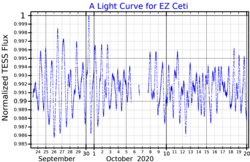
The common proper motion companion, component B, is a G-type main sequence star with a classification of G3 V.[6] It is a BY Draconis variable with a periodicity of 8.92 days and a variable star designation of EZ Cet.[7]
References
[edit]- ^ a b c d e Vallenari, A.; et al. (Gaia collaboration) (2023), "Gaia Data Release 3. Summary of the content and survey properties", Astronomy and Astrophysics, 674: A1, arXiv:2208.00211, Bibcode:2023A&A...674A...1G, doi:10.1051/0004-6361/202243940, S2CID 244398875 Gaia DR3 record for this source at VizieR.
- ^ a b c d e f g Mermilliod, J.-C. (1986), Compilation of Eggen's UBV data, transformed to UBV (unpublished), p. 0, Bibcode:1986EgUBV........0M.
- ^ a b c d e f Vallenari, A.; et al. (Gaia collaboration) (2023), "Gaia Data Release 3. Summary of the content and survey properties", Astronomy and Astrophysics, 674: A1, arXiv:2208.00211, Bibcode:2023A&A...674A...1G, doi:10.1051/0004-6361/202243940, S2CID 244398875 Gaia DR3 record for this source at VizieR.
- ^ Hardegree-Ullman, Kevin K.; et al. (2023), "Bioverse: A Comprehensive Assessment of the Capabilities of Extremely Large Telescopes to Probe Earth-like O2 Levels in Nearby Transiting Habitable-zone Exoplanets", The Astronomical Journal, 165 (6): 267, arXiv:2304.12490, Bibcode:2023AJ....165..267H, doi:10.3847/1538-3881/acd1ec.
- ^ a b c Luck, R. Earle (September 2015), "Abundances in the Local Region. I. G and K Giants", The Astronomical Journal, 150 (3): 23, arXiv:1507.01466, Bibcode:2015AJ....150...88L, doi:10.1088/0004-6256/150/3/88, S2CID 118505114, 88.
- ^ a b c d Houk, N.; Swift, C. (1999), "Michigan catalogue of two-dimensional spectral types for the HD Stars", Michigan Spectral Survey, 5: 0, Bibcode:1999MSS...C05....0H.
- ^ a b Kazarovets, E. V.; et al. (2006), "The 78th Name-List of Variable Stars", Information Bulletin on Variable Stars, 5721: 1, Bibcode:2006IBVS.5721....1K.
- ^ Holmberg, J.; et al. (July 2009), "The Geneva-Copenhagen survey of the solar neighbourhood. III. Improved distances, ages, and kinematics", Astronomy and Astrophysics, 501 (3): 941–947, arXiv:0811.3982, Bibcode:2009A&A...501..941H, doi:10.1051/0004-6361/200811191, S2CID 118577511.
- ^ de Bruijne, J. H. J.; Eilers, A.-C. (October 2012), "Radial velocities for the HIPPARCOS-Gaia Hundred-Thousand-Proper-Motion project", Astronomy & Astrophysics, 546: 14, arXiv:1208.3048, Bibcode:2012A&A...546A..61D, doi:10.1051/0004-6361/201219219, S2CID 59451347, A61.
- ^ Porto de Mello, G. F.; et al. (March 2014), "A photometric and spectroscopic survey of solar twin stars within 50 parsecs of the Sun; I. Atmospheric parameters and color similarity to the Sun", Astronomy and Astrophysics, 563: A52, arXiv:1312.7571, Bibcode:2014A&A...563A..52P, doi:10.1051/0004-6361/201322277, S2CID 119111150.
- ^ a b c d e f g h Stassun, Keivan G.; et al. (2019), "The Revised TESS Input Catalog and Candidate Target List", The Astronomical Journal, 158 (4): 138, arXiv:1905.10694, Bibcode:2019AJ....158..138S, doi:10.3847/1538-3881/ab3467.
- ^ a b c Borisov, Sviatoslav B.; et al. (2023), "New Generation Stellar Spectral Libraries in the Optical and Near-infrared. I. The Recalibrated UVES-POP Library for Stellar Population Synthesis", The Astrophysical Journal Supplement Series, 266 (1): 11, arXiv:2211.09130, Bibcode:2023ApJS..266...11B, doi:10.3847/1538-4365/acc321.
- ^ a b c Datson, Juliet; et al. (February 2015), "Spectroscopic study of solar twins and analogues", Astronomy & Astrophysics, 574: 12, arXiv:1412.8168, Bibcode:2015A&A...574A.124D, doi:10.1051/0004-6361/201425000, S2CID 53708062, A124.
- ^ Isaacson, Howard; Fischer, Debra (2010), "Chromospheric Activity and Jitter Measurements for 2630 Stars on the California Planet Search", The Astrophysical Journal, 725 (1): 875, arXiv:1009.2301, Bibcode:2010ApJ...725..875I, doi:10.1088/0004-637X/725/1/875.
- ^ a b Llorente De Andrés, F.; et al. (2021), "The evolution of lithium in FGK dwarf stars. The lithium-rotation connection and the Li desert", Astronomy and Astrophysics, 654, arXiv:2108.05852, Bibcode:2021A&A...654A.137L, doi:10.1051/0004-6361/202141339.
- ^ "chi Cet", SIMBAD, Centre de données astronomiques de Strasbourg, retrieved 2017-02-12.
- ^ "V* EZ Cet", SIMBAD, Centre de données astronomiques de Strasbourg.
- ^ Soderblom, David R.; Mayor, Michel (January 1993), "Stellar kinematic groups. I - The Ursa Major group", Astronomical Journal, 105 (1): 226–249, Bibcode:1993AJ....105..226S, doi:10.1086/116422.
- ^ MAST: Barbara A. Mikulski Archive for Space Telescopes, Space Telescope Science Institute, retrieved 8 December 2021.
- ^ Koerner, D. W.; et al. (February 2010), "New Debris Disk Candidates Around 49 Nearby Stars" (PDF), The Astrophysical Journal Letters, 710 (1): L26–L29, Bibcode:2010ApJ...710L..26K, doi:10.1088/2041-8205/710/1/L26, S2CID 122844702.
External links
[edit]- Kaler, James B., "Chi Ceti, plus HD 11131", Stars, University of Illinois, retrieved 2017-02-13.
- http://www.alcyone.de/cgi-bin/search.pl?object=HR0531 Archived 2016-03-03 at the Wayback Machine
- http://server3.wikisky.org/starview?object_type=1&object_id=1287
