
This article needs additional citations for verification. Please help improve this article by adding citations to reliable sources. Unsourced material may be challenged and removed. Find sources: "Clepsydrops" – news · newspapers · books · scholar · JSTOR (April 2015) (Learn how and when to remove this message) |


| Clepsydrops Temporal range: Carboniferous
| |
|---|---|
| 👁 Image | |
| Life restoration | |
| Scientific classification 👁 Edit this classification | |
| Kingdom: | Animalia |
| Phylum: | Chordata |
| Clade: | Synapsida |
| Family: | †Ophiacodontidae |
| Genus: | † Cope, 1875 |
| Species | |
| |
| Synonyms | |
| |

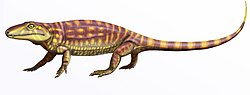

Clepsydrops is an extinct genus of primitive synapsids from the early Late Carboniferous that was related to Archaeothyris. The name means 'hour-glass appearance' (Greek klepsydra = "hourglass" + Greek ops = "eye, face, appearance").[1]
Synapsida is the group (or clade) that includes mammals, but the term is mainly used to refer to its earliest members. Like many other early terrestrial amniotes, it probably had the diet of insects and smaller animals. It probably laid eggs on land rather than in the water, as most amniote tetrapods did.
A paleobiological inference model for the femur suggests a terrestrial lifestyle for Clepsydrops,[2] as for its more recent relative Ophiacodon.[3] This is consistent with its rather thin, compact cortex. Its jaws were slightly more advanced than those of other early amniote tetrapods like Paleothyris and Hylonomus.
See also
[edit]

References
[edit]- ^ "Re: [dinosaur] DECODING COPE'S TEXAS TAXA: Eryops and Dimetrodon natalis". Archived from the original on 2019-08-20. Retrieved 2019-08-20.
- ^ Quémeneur, S.; de Buffrénil, V.; Laurin, M. (2013). "Microanatomy of the amniote femur and inference of lifestyle in limbed vertebrates". Biological Journal of the Linnean Society. 109 (3): 644–655. doi:10.1111/bij.12066.
- ^ Laurin, M.; de Buffrénil, V. (2015). "Microstructural features of the femur in early ophiacodontids: A reappraisal of ancestral habitat use and lifestyle of amniotes". Comptes Rendus Palevol. 15 (1–2): 115–127. doi:10.1016/j.crpv.2015.01.001.



.jpg)


.jpg)
