


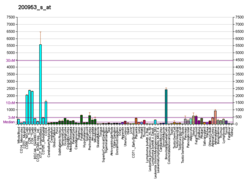
G1/S-specific cyclin-D2 is a protein that in humans is encoded by the CCND2 gene.[5]
Function
[edit]The protein encoded by this gene belongs to the highly conserved cyclin family, whose members are characterized by a dramatic periodicity in protein abundance through the cell cycle. Cyclins function as regulators of cyclin-dependent kinases. Different cyclins exhibit distinct expression and degradation patterns which contribute to the temporal coordination of each mitotic event. This cyclin forms a complex with and functions as a regulatory subunit of CDK4 or CDK6, whose activity is required for cell cycle G1/S transition. This protein has been shown to interact with and be involved in the phosphorylation of tumor suppressor protein Rb. Knockout studies of the homologous gene in mouse suggest the essential roles of this gene in ovarian granulosa and germ cell proliferation. High level expression of this gene was observed in ovarian and testicular tumors.[6]
Clinical significance
[edit]Mutations in CCND2 are associated to megalencephaly-polymicrogyria-polydactyly-hydrocephalus syndrome.[7]
References
[edit]- ^ a b c GRCh38: Ensembl release 89: ENSG00000118971 – Ensembl, May 2017
- ^ a b c GRCm38: Ensembl release 89: ENSMUSG00000000184 – Ensembl, May 2017
- ^ "Human PubMed Reference:". National Center for Biotechnology Information, U.S. National Library of Medicine.
- ^ "Mouse PubMed Reference:". National Center for Biotechnology Information, U.S. National Library of Medicine.
- ^ Inaba T, Matsushime H, Valentine M, Roussel MF, Sherr CJ, Look AT (Jul 1992). "Genomic organization, chromosomal localization, and independent expression of human cyclin D genes". Genomics. 13 (3): 565–74. doi:10.1016/0888-7543(92)90126-D. PMID 1386335.
- ^ "Entrez Gene: CCND2 cyclin D2".
- ^ Mirzaa GM, Parry DA, Fry AE, Giamanco KA, Schwartzentruber J, Vanstone M, Logan CV, Roberts N, Johnson CA, Singh S, Kholmanskikh SS, Adams C, Hodge RD, Hevner RF, Bonthron DT, Braun KP, Faivre L, Rivière JB, St-Onge J, Gripp KW, Mancini GM, Pang K, Sweeney E, van Esch H, Verbeek N, Wieczorek D, Steinraths M, Majewski J, Boycott KM, Pilz DT, Ross ME, Dobyns WB, Sheridan EG (May 2014). "De novo CCND2 mutations leading to stabilization of cyclin D2 cause megalencephaly-polymicrogyria-polydactyly-hydrocephalus syndrome". Nature Genetics. 46 (5): 510–5. doi:10.1038/ng.2948. PMC 4004933. PMID 24705253.
Further reading
[edit]- Xiong Y, Menninger J, Beach D, Ward DC (Jul 1992). "Molecular cloning and chromosomal mapping of CCND genes encoding human D-type cyclins". Genomics. 13 (3): 575–84. doi:10.1016/0888-7543(92)90127-E. PMID 1386336.
- Zhu W, Zhao M, Mattapally S, Chen S, Zhang J (October 2017). "CCND2 Overexpression Enhances the Regenerative Potency of Human Induced Pluripotent Stem Cell-Derived Cardiomyocytes: Remuscularization of Injured Ventricle". Circulation Research. 122 (1): 88–96. doi:10.1161/CIRCRESAHA.117.311504. PMC 5756126. PMID 29018036.
- Hirai H, Roussel MF, Kato JY, Ashmun RA, Sherr CJ (May 1995). "Novel INK4 proteins, p19 and p18, are specific inhibitors of the cyclin D-dependent kinases CDK4 and CDK6". Molecular and Cellular Biology. 15 (5): 2672–81. doi:10.1128/MCB.15.5.2672. PMC 230497. PMID 7739547.
- Meyerson M, Harlow E (Mar 1994). "Identification of G1 kinase activity for cdk6, a novel cyclin D partner". Molecular and Cellular Biology. 14 (3): 2077–86. doi:10.1128/MCB.14.3.2077. PMC 358568. PMID 8114739.
- Maruyama K, Sugano S (Jan 1994). "Oligo-capping: a simple method to replace the cap structure of eukaryotic mRNAs with oligoribonucleotides". Gene. 138 (1–2): 171–4. doi:10.1016/0378-1119(94)90802-8. PMID 8125298.
- Ewen ME, Sluss HK, Sherr CJ, Matsushime H, Kato J, Livingston DM (May 1993). "Functional interactions of the retinoblastoma protein with mammalian D-type cyclins". Cell. 73 (3): 487–97. doi:10.1016/0092-8674(93)90136-E. PMID 8343202. S2CID 41911038.
- Palmero I, Holder A, Sinclair AJ, Dickson C, Peters G (Apr 1993). "Cyclins D1 and D2 are differentially expressed in human B-lymphoid cell lines". Oncogene. 8 (4): 1049–54. PMID 8455931.
- Brooks AR, Shiffman D, Chan CS, Brooks EE, Milner PG (Apr 1996). "Functional analysis of the human cyclin D2 and cyclin D3 promoters". The Journal of Biological Chemistry. 271 (15): 9090–9. doi:10.1074/jbc.271.15.9090. PMID 8621559.
- Hirai H, Sherr CJ (Nov 1996). "Interaction of D-type cyclins with a novel myb-like transcription factor, DMP1". Molecular and Cellular Biology. 16 (11): 6457–67. doi:10.1128/MCB.16.11.6457. PMC 231647. PMID 8887674.
- Sicinski P, Donaher JL, Geng Y, Parker SB, Gardner H, Park MY, Robker RL, Richards JS, McGinnis LK, Biggers JD, Eppig JJ, Bronson RT, Elledge SJ, Weinberg RA (Dec 1996). "Cyclin D2 is an FSH-responsive gene involved in gonadal cell proliferation and oncogenesis". Nature. 384 (6608): 470–4. Bibcode:1996Natur.384..470S. doi:10.1038/384470a0. PMID 8945475. S2CID 4331964.
- Kitagawa M, Higashi H, Jung HK, Suzuki-Takahashi I, Ikeda M, Tamai K, Kato J, Segawa K, Yoshida E, Nishimura S, Taya Y (Dec 1996). "The consensus motif for phosphorylation by cyclin D1-Cdk4 is different from that for phosphorylation by cyclin A/E-Cdk2". The EMBO Journal. 15 (24): 7060–9. doi:10.1002/j.1460-2075.1996.tb01097.x. PMC 452531. PMID 9003781.
- Suzuki Y, Yoshitomo-Nakagawa K, Maruyama K, Suyama A, Sugano S (Oct 1997). "Construction and characterization of a full length-enriched and a 5'-end-enriched cDNA library". Gene. 200 (1–2): 149–56. doi:10.1016/S0378-1119(97)00411-3. PMID 9373149.
- Guidato S, McLoughlin DM, Grierson AJ, Miller CC (Jan 1998). "Cyclin D2 interacts with cdk-5 and modulates cellular cdk-5/p35 activity". Journal of Neurochemistry. 70 (1): 335–40. doi:10.1046/j.1471-4159.1998.70010335.x. PMID 9422379. S2CID 23986161.
- Gómez Lahoz E, Liegeois NJ, Zhang P, Engelman JA, Horner J, Silverman A, Burde R, Roussel MF, Sherr CJ, Elledge SJ, DePinho RA (Jan 1999). "Cyclin D- and E-dependent kinases and the p57(KIP2) inhibitor: cooperative interactions in vivo". Molecular and Cellular Biology. 19 (1): 353–63. doi:10.1128/mcb.19.1.353. PMC 83893. PMID 9858559.
- Bartkova J, Rajpert-de Meyts E, Skakkebaek NE, Bartek J (Apr 1999). "D-type cyclins in adult human testis and testicular cancer: relation to cell type, proliferation, differentiation, and malignancy". The Journal of Pathology. 187 (5): 573–81. doi:10.1002/(SICI)1096-9896(199904)187:5<573::AID-PATH289>3.0.CO;2-H. PMID 10398124. S2CID 9474072.
- Bouchard C, Thieke K, Maier A, Saffrich R, Hanley-Hyde J, Ansorge W, Reed S, Sicinski P, Bartek J, Eilers M (Oct 1999). "Direct induction of cyclin D2 by Myc contributes to cell cycle progression and sequestration of p27". The EMBO Journal. 18 (19): 5321–33. doi:10.1093/emboj/18.19.5321. PMC 1171602. PMID 10508165.
- Sansal I, Dupont E, Toru D, Evrard C, Rouget P (Oct 2000). "NPDC-1, a regulator of neural cell proliferation and differentiation, interacts with E2F-1, reduces its binding to DNA and modulates its transcriptional activity". Oncogene. 19 (43): 5000–9. doi:10.1038/sj.onc.1203843. PMID 11042687. S2CID 41370242.
- Choi D, Lee EY, Yoon S, Hwang S, Yoon BK, Lee JH (Nov 2000). "Clinical correlation of cyclin D2 mRNA expression in human luteinized granulosa cells". Journal of Assisted Reproduction and Genetics. 17 (10): 574–9. doi:10.1023/A:1026470825514. PMC 3455455. PMID 11209538.
- Tanguay DA, Colarusso TP, Doughty C, Pavlovic-Ewers S, Rothstein TL, Chiles TC (Apr 2001). "Cutting edge: differential signaling requirements for activation of assembled cyclin D3-cdk4 complexes in B-1 and B-2 lymphocyte subsets". Journal of Immunology. 166 (7): 4273–7. doi:10.4049/jimmunol.166.7.4273. PMID 11254678.
- Choi D, Yoon S, Lee E, Hwang S, Yoon B, Lee J (Feb 2001). "The expression of pseudogene cyclin D2 mRNA in the human ovary may be a novel marker for decreased ovarian function associated with the aging process". Journal of Assisted Reproduction and Genetics. 18 (2): 110–3. doi:10.1023/A:1026538826392. PMC 3455561. PMID 11285977.
External links
[edit]- Overview of all the structural information available in the PDB for UniProt: P30279 (G1/S-specific cyclin-D2) at the PDBe-KB.

