
This article has multiple issues. Please help improve it or discuss these issues on the talk page. (Learn how and when to remove these messages)
(Learn how and when to remove this message)
|


| Dangpa | |
| 👁 Image | |
| Korean name | |
|---|---|
| Hangul | 당파 |
| Hanja | 鐺鈀 |
| RR | dangpa |
| MR | tangp'a |


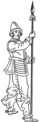
Dangpa (Korean: 당파) is the Korean name for a Ranseur (three-pronged trident-like spear) first described in the Muyejebo, a Korean martial arts manual of the Joseon Dynasty (published 1610).
Types
[edit]There were several types of dangpa, such as the iron cheolpa (철파, 鐵鈀) and the wooden mokpa (목파, 木鈀). The two outer teeth of the cheolpa would be slightly curved outward. The teeth of the mokpa were made of wood, but covered with iron.
The middle tine would always be slightly longer than the two other tips. This design was intended to lessen the chance of the weapon becoming stuck in an opponent's body. Common variations were bladed along the outer prongs for cutting power, while others were more similar to traditional western style as spearpoints
At the other end of the pole would be a sharp tip as well, in case two-handed combat with the dangpa became necessary in battle - this way soldiers fighting with the dangpa had fighting tips on both ends of the weapon.
Usage
[edit]The dangpa is a defensive close combat weapon used to trap an enemy's sword between two of the three prongs.
Techniques
[edit]In the Muyedobotongji one set of techniques is given. This form of 22 movements is called dangpa chongbo (당파총보, 鐺鈀總譜) accompanied by a diagram to explain the same form called dangpa chongdo (당파총도, 鐺鈀總圖).
References
[edit]


.png)
- Articles with short description
- Short description matches Wikidata
- Articles lacking sources from October 2025
- All articles lacking sources
- Articles with topics of unclear notability from December 2025
- All articles with topics of unclear notability
- Copied and pasted articles and sections from March 2026
- All copied and pasted articles and sections
- Articles with multiple maintenance issues
- Articles containing Korean-language text
- All stub articles