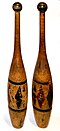
The manipulation of the devil stick (also devil-sticks, devilsticks, flower sticks, bâtons fleurs, stunt sticks, gravity sticks, or juggling sticks) is a form of gyroscopic juggling or equilibristics, consisting of manipulating one stick ("baton", 'center stick') between one or two other sticks held one in each hand. The baton is lifted, struck, or stroked by the two control sticks ('handsticks', 'sidesticks', or 'handles'), stabilizing the baton through gyroscopic motion.[1]
Manipulating devil sticks is one of the circus arts and is sometimes called devil-sticking, twirling, sticking, or stick juggling.
History
[edit]Devil sticks are believed to have originated in China in the distant past as simple wooden juggling sticks.[2][3][4][5] Although devil sticks are often described as having ancient origins in China, some sources note that the earliest verifiable documentation dates to the early 19th century, including documented performances in Europe and an image of the Indian performers Medua and Mooty Samme printed in Prague around 1820.[6][7] It was apparently brought to Britain sometime around 1813, when a publication mentioned that previous generations had not known of it.[8]
The first scientific analysis of the physics behind the game, known as "the Devil on Two Sticks," was published in 1855 by Benjamin Peirce.[9]
Variants
[edit]Devil sticks vary widely in size and construction materials, but the batons are generally based on one of two basic designs: tapered and straight. Tapered batons are tapered from the ends towards the middle such that the middle is thinner than the ends. Straight batons are uniform in width but have weights attached to the ends. Rarely, a hybrid design consisting of a tapered baton with weights attached to the ends is used.
Devil sticks are usually constructed of wood, plastic, aluminum, or composite materials such as fiberglass or carbon fiber. They are most often covered with an elastomer that both increases the friction coefficient (grip) between the baton and handles as well as providing some protection against repeated drops. Infrequently, other coverings such as cloth, suede, or leather are used. Even more rarely, a vinyl or mylar covering which reduces the stick's "grip" is used.
The terms "devil stick" and "flower stick" are sometimes used interchangeably, although "flower stick" more specifically refers to straight batons with tasselled or padded ends. Flower sticks differ from traditional devil sticks in both construction and handling. While devil sticks are typically tapered or biconical in shape, flower sticks are generally straight and fitted with tasselled or weighted ends. These end attachments increase air resistance and friction, slowing the movement of the baton and allowing for greater control during manipulation.[10] As a result, flower sticks are also used in teaching environments and are associated with techniques that involve wrapping and contact-based manipulation.
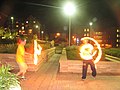
Fire devil sticks (also known as firesticks) typically have an aluminum core and have fuel-soaked wicks on the ends to allow them to be set on fire for visual effect. Both flower and non-flower versions of firesticks exist.
Illuminated devilsticks can create interesting visual effects in darkness with the use of battery-powered electric 'seed' bulbs, LEDs, or with phosphorescent or chemiluminescent materials.
Gallery
[edit]-
👁 Fire devil sticks. The photographer has used a long exposure time to capture the trails of motion.Fire devil sticks. The photographer has used a long exposure time to capture the trails of motion.
-
👁 A devil stick (right), flower stick (middle, with rubber flares to slow it down), and two smaller control sticks (left).A devil stick (right), flower stick (middle, with rubber flares to slow it down), and two smaller control sticks (left).
-
2 devilsticks and a set of handsticks



See also
[edit]References
[edit]- ^ Burgess, Hovey; Finelli, Judy (1976). Circus techniques: juggling, equilibristics, (+) vaulting. Drama Book Specialists. p. 106. ISBN 9780917643002. Retrieved 8 September 2012.
- ^ Burgess; Finelli (1976). Circus techniques. p. 108.
Although devil sticks have been known in the West for a long time, they originated in China and even today's Chinese acrobat- jugglers excel at devil sticks.
- ^ Ghosh, Sampa; Banerjee, Utpal Kumar (1 January 2006). Indian Puppets. Abhinav Publications. p. 287. ISBN 978-81-7017-435-6. Retrieved 8 September 2012.
The ancient Chinese were skilful craftsmen and one of the oldest props in juggling; the devil on two sticks.
- ^ Cullen, Frank; Hackman, Florence; McNeilly, Donald (16 October 2006). Vaudeville, Old and New: An Encyclopedia of Variety Performers in America 2V Set. Psychology Press. p. 308. ISBN 978-0-415-93853-2. Retrieved 8 September 2012.
Originally simple wooden sticks that originated centuries ago in China...
- ^ Strong, Todd (1990). The Devil Stick Book. B. Dube. p. 51. ISBN 9780917643071. Retrieved 3 October 2018.
Devil Sticks originated in China....
- ^ "A short history of Devilstick". eJuggle / International Jugglers' Association. 2016-12-29.
- ^ "The Indian Brothers Medua and Mooty Samme". eJuggle / International Jugglers' Association. 2016-11-22.
- ^ The European Magazine, and London Review. Philological Society of London. 1813. p. 209.
- ^ Peirce, Benjamin (1855). A System of Analytic Mechanics. Little, Brown. p. 451.
- ^ "Basic Techniques in Circus Arts: Flower Stick" (PDF). Cirque du Soleil / National Circus School. 2011.