
This draft appears to contain copyrighted material from https://dokumen.pub/ancient-objects-and-sacred-realms-interpretations-of-mississippian-iconography-9780292795433.html, which has been removed. Wikipedia strictly prohibits copyright violations. Assume all text is copyrighted unless released under a compatible license.
👁 Image This draft reads like an essay or opinion piece. Wikipedia is not a place for original research or personal opinions. The draft should:
Where to get help
How to improve a draft
You can also browse Wikipedia:Featured articles and Wikipedia:Good articles to find examples of Wikipedia's best writing on topics similar to your proposed article. Improving your odds of a speedy review To improve your odds of a faster review, tag your draft with relevant WikiProject tags using the button below. This will let reviewers know a new draft has been submitted in their area of interest. For instance, if you wrote about a female astronomer, you would want to add the Biography, Astronomy, and Women scientists tags. Editor resources
|


- 👁 Image
Comment: This draft copies a lot from the "Path of Souls" book that features as a reference. NeoGaze (talk) 10:55, 16 June 2026 (UTC)
.jpg)

The Path of Souls (Creek: Poya Fik-tcalk Innini lit.'The Spirit's Road') in Eastern Woodland cosmology was the Milky Way, associated with death motifs like skull and bones.[1] This identification with the Milky Way though the details differ than the Mississippian-centric interpretation presented here. Menominee, Miami, Lenape, as well as groups far to the south in the Andes, far to north in Siberia, and far to the west in California.
Description
[edit]entry often represented in Mississippian art with an eye in a hand. The free-soul, someone's personality and consciousness, leaves the life-soul or body-soul in the dead body. After gathering the spirits of the objects left with the body, they depart westward to the edge of the earth-disk. During the days which the free-soul walks towards the west, the living have to so Once the free-soul arrives at is a camping or waiting place. can only be entered at the optimum time;[2]


Once portal, he is transported to stretched out before them, leading far to the south Many narratives describe the Path of Souls as a path on a simple reflection of our world, while others along the Path, the free-soul will arrive at a stream that must be crossed over by a special must be made. Among Algonquian groups, as well as some Siouans, before advancing either before or after the bridge.[3]
Deities
[edit]Recorded among groups on the northern periphery of the Mississippian world (various Algonquians, and Northern Iroquoians) is the Brain Taker (Meskwaki: Po’kitapawa, lit. 'Knocks-a-hole-in-the-head' , Wyandot: Oscotarach, lit. 'Pierce-head'), whose dog is the one who guards the bridge. Her purpose is to destroy the free-souls' human memory, or the humanity. For the Cherokee, Stansbury Hagar identified One must feed both dogs in order to continue Not all narratives of the dog are negative. Among principally Mississippian groups, like the Choctaw, Creek, and Natchez, as well as other Cherokee, the dog was the creator spilling a bag of maize flour to do so.[4]

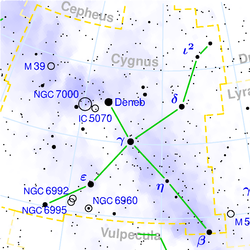
For the Southeastern Mississippians, the main antagonist was the Great Eagle rather than the dog (Creek: Talaki-Thlacco, Alabama: Talaktochoba, lit. 'Great Eagle'). Dead bodies were equipped with weapons like bow-and-arrows, burnt wood, and knives to fight this Great Eagle. The Great Eagle can be identified in equivalent to the Greek constellation Cygnus.[4]
dressed in a buffalo robe who judged the soul, allowing a shortcut for those who have been good, or lesser serpents.[3]
- ^ Lankford, George E. "The ‘‘Path of Souls’’: Some Death Imagery in the Southeastern Ceremonial Complex." In Ancient objects and sacred realms: Interpretations of Mississippian iconography, pp. 174-212. University of Texas Press, 2006. p. 175
- ^ Lankford, George E. "The ‘‘Path of Souls’’: Some Death Imagery in the Southeastern Ceremonial Complex." In Ancient objects and sacred realms: Interpretations of Mississippian iconography, pp. 174-212. University of Texas Press, 2006. p. 175-177
- ^ a b Lankford, George E. "The ‘‘Path of Souls’’: Some Death Imagery in the Southeastern Ceremonial Complex." In Ancient objects and sacred realms: Interpretations of Mississippian iconography, pp. 174-212. University of Texas Press, 2006. p. 178-179
- ^ a b Lankford, George E. "Chapter 10 The Raptor on the Path." In Visualizing the sacred: Cosmic visions, regionalism, and the art of the Mississippian world, pp. 240-250. University of Texas Press, 2011.