
This article needs additional citations for verification. Please help improve this article by adding citations to reliable sources. Unsourced material may be challenged and removed. Find sources: "Fabia Eudokia" – news · newspapers · books · scholar · JSTOR (January 2024) (Learn how and when to remove this message) |


| Eudokia | |
|---|---|
| Augusta | |
| 👁 Image Imaginary 16th-century portrait from Speculum Romanae Magnificentiae | |
| Empress consort of the Eastern Roman Empire | |
| Tenure | 610–612 |
| Born | c. 580 Exarchate of Africa |
| Died | 13 August 612 (aged c. 31–32) Constantinople (modern-day Istanbul, Turkey) |
| Burial | |
| Spouse | Heraclius |
| Issue | Eudoxia Epiphania Constantine III |
| Dynasty | Heraclian |
| Father | Rogas |

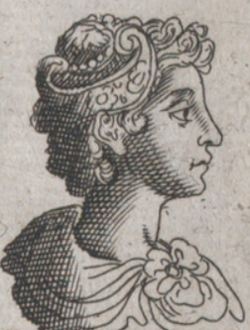
Eudokia or Eudocia (Greek: Εύδοκία, romanized: Eúdokía; c. 580 – 13 August 612), originally named Fabia, was a Greek woman who became Eastern Roman empress as the first wife of Heraclius from 610 to her death.[1][2] She was a daughter of Rogas, a landowner in the Exarchate of Africa, according to Theophanes the Confessor.[1]
Empress
[edit]Her birth name was Fabia. She was betrothed to Heraclius when the future emperor still resided in the Exarchate. The Exarch at the time was her father-in-law Heraclius the Elder.
Heraclius had started a revolt against Phocas in 608. Under unknown circumstances both Fabia and her mother-in-law Epiphania seem to have been captured by Phocas by 610. They spent their captivity in the monastery "Nea Metanoia" (New Repentance) and were used as hostages to prevent Heraclius from besieging Constantinople. The two women were eventually released by members of the Green faction of Byzantine chariot racing events. They were delivered to Heraclius at the small island of Kalonymos in the Sea of Marmara, leaving him free to launch his successful assault. The Excubitors defected to his side and thus allowed him to enter the city without serious resistance.[citation needed] On 5 October 610, Heraclius was proclaimed Emperor and, on the same day, married Fabia. She took the name Eudokia and was granted the title of Augusta.[3]
Death
[edit]Eudokia died on 13 August 612. According to the Chronographikon syntomon of Ecumenical Patriarch Nikephoros I of Constantinople, the cause of death was epilepsy. According to Nikephoros, her funeral was accompanied with an incident revealing how popular she was with the general populace. A maidservant spat out of an upstairs window while the funeral procession was just below it. The coffin was still open, and the saliva reached the robes of the corpse. The crowds took offense and burned the girl alive.
Eudokia was buried the next day in the Church of the Holy Apostles. Heraclius went on to marry his niece Martina.
Children
[edit]Eudokia and Heraclius had two children:
- Eudoxia Epiphania, a daughter. Born on 7 July 611. She was proclaimed Augusta on 4 October 612.
- Heraclius Constantine, a son, who went on to be Emperor Constantine III. Born on 3 May 612. Crowned co-emperor on 22 January 613.
See also
[edit]
References
[edit]- ^ a b Kaegi, Walter E. (27 March 2003). Heraclius, Emperor of Byzantium. Cambridge University Press. ISBN 978-0-521-81459-1.
- ^ Garland, Lynda (4 January 2002). Byzantine Empresses: Women and Power in Byzantium AD 527-1204. Routledge. ISBN 978-1-134-75638-4.
- ^ Kaegi, Walter E. (2003). Heraclius: emperor of Byzantium. Cambridge University Press. p. 51. ISBN 0-521-81459-6.
External links
[edit]- 580s births
- 612 deaths
- Heraclian dynasty
- Burials at the Church of the Holy Apostles
- 6th-century Byzantine women
- 6th-century Greek people
- 7th-century Byzantine empresses
- Fabii
- Heraclius
- Neurological disease deaths in Turkey
- Deaths from epilepsy
- Royalty and nobility with epilepsy
- Mothers of Byzantine emperors
- Monastery prisoners
- Articles with short description
- Short description is different from Wikidata
- Use dmy dates from August 2022
- Articles needing additional references from January 2024
- All articles needing additional references
- Articles containing Greek-language text
- All articles with unsourced statements
- Articles with unsourced statements from January 2024