
Gregory Tsamblak[a] (c. 1365 – c. 1420), member of the Tzamplakon family, was a Bulgarian writer and cleric active in Bulgaria, Moldavia, Serbia, Grand Duchy of Lithuania, and the Principality of Kiev.
Biography
[edit]Early life
[edit]He was born into the Tzamplakon family in the Bulgarian capital of Tarnovo around 1364/1365.[1]
Serbia
[edit]During his sojourn in Serbia he wrote a biography of Stephen Uroš III, a hymn for the church service honoring Stefan of Dečani, and a report on the transfer of the remnants of Saint Paraskeva to Serbia, for which he also rewrote the service.[2]
Grand Duchy of Lithuania
[edit]
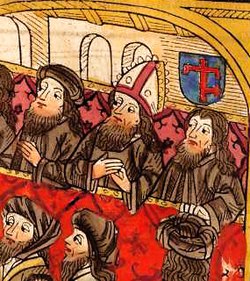
In 1414, Grand Duke Vytautas attempted to re-establish the Metropolis of Lithuania. He arranged for a synod of bishops to elect Gregory as the Metropolitan of Lithuania.[3] The consecration took place without the consent of Patriarch Euthymius II of Constantinople who deposed and anathematized him and who confirmed the same in letters to Metropolitan Photius of Kiev, Emperor Manuel II Palaeologos and Grand Prince Vasily I. After Gregory’s death in the winter of 1419–1420, Photius made peace with Vytautas. As a result, the entire Metropolis of Kiev and all Rus', including Halych, was unified under Photius until his death in 1431.[1]
The rivalry between Vilnius and Moscow effectively ended in 1448 when Moscow began selecting the metropolitans independently without approval from the Ecumenical Patriachate, which collapsed in 1453.[4][1]
See also
[edit]- Constantine of Kostenets
- Dimitar of Kratovo
- Nicodemus of Tismana
- Anonymous Athonite
- Patriarch Evtimiy
Notes
[edit]References
[edit]- ^ a b c "Radoslava Stankova — 'Gregory Tsamblak — ca 1364/1365 – ca 1419/1420 — Metropolitan of Kiev, diplomat, father superior of several monasteries, writer in Bulgarian, Serbian, Moldovan and Russian literature. Author of works in all medieval genres – oratory, prose, hagiography, and hymnography. Representative of the Tarnovo Literary School.'". SESDiva.eu. Archived from the original on 2023-01-14.
- ^ Đorđe Radojičić (1971). Živan Milisavac (ed.). Jugoslovenski književni leksikon [Yugoslav Literary Lexicon] (in Serbo-Croatian). Novi Sad (SAP Vojvodina, SR Serbia): Matica srpska. p. 57.
- ^ Rowell 1994, p. 168.
- ^ Rowell 1994, p. 169.
Works cited
[edit]- Rowell, Stephen Christopher (1994). Lithuania Ascending: A Pagan Empire Within East-Central Europe, 1295–1345. Cambridge: Cambridge University Press. ISBN 978-1-107-65876-9. Retrieved 14 July 2021.
External links
[edit]
- 1365 births
- 1420 deaths
- 14th-century Bulgarian writers
- 15th-century Bulgarian writers
- 15th-century Moldavian people
- Bulgarian male writers
- Metropolis of Moldavia and Bukovina
- Metropolitans of Kiev and all Rus' (claimed or partially recognised)
- People from Veliko Tarnovo
- Stephen the Great
- Tzamplakon family
- Tarnovo Literary School
- Hesychasts
- History of literature in Romania
- Articles containing Bulgarian-language text
- Articles containing Greek-language text
- Articles containing Romanian-language text
- Articles containing Serbian-language text
- Pages using Lang-xx templates
- Articles containing Ukrainian-language text
- CS1 Serbo-Croatian-language sources (sh)
- Articles with short description
- Short description is different from Wikidata
- Template:Succession box: 'after' parameter includes the word 'abolished'
- S-aft: 'after' parameter includes the word 'abolished'