HDPE is known for its high strength-to-density ratio.[4] The density of HDPE ranges from 930 to 970 kg/m3.[5] Although the density of HDPE is only marginally higher than that of low-density polyethylene, HDPE has little branching, giving it stronger intermolecular forces and tensile strength (38 MPa versus 21 MPa) than LDPE.[6] The difference in strength exceeds the difference in density, giving HDPE a higher specific strength.[7] It is also harder and more opaque and can withstand somewhat higher temperatures (120 °C/248 °F for short periods). High-density polyethylene, unlike polypropylene, cannot withstand normally required autoclaving conditions. The lack of branching is ensured by an appropriate choice of catalyst (e.g., Ziegler–Natta catalysts) and reaction conditions.
HDPE is resistant to many different solvents, and is exceptionally challenging to glue; joints are typically made by welding.
The physical properties of HDPE can vary depending on the molding process that is used to manufacture a specific sample; to some degree, a determining factor is the international standardized testing methods employed to identify these properties for a specific process. For example, in rotational molding (rotomolding), to identify the environmental stress crack resistance of a sample, the notched constant tensile load test (NCTL) is put to use.[8]
Owing to these desirable properties, pipes constructed out of HDPE are ideally applicable for drinking water[9] and waste water (storm and sewage).[10]
HDPE has a wide variety of applications; for applications that fall within the properties of other polymers, the choice to use HDPE is usually economic:
HDPE is preferred by the pyrotechnics trade for mortars over steel or PVC tubes, being more durable and safer: HDPE tends to rip or tear in a malfunction instead of shattering and becoming shrapnel like the other materials.
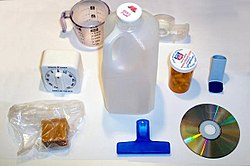
Milk bottles, jugs, and other hollow goods manufactured through blow molding are the most important application area for HDPE, accounting for one-third of worldwide production, or more than 8 million tonnes.
Above all, China, where beverage bottles made from HDPE were first imported in 2005, is a growing market for rigid HDPE packaging as a result of its improving standard of living. In India and other highly populated, emerging nations, infrastructure expansion includes the deployment of pipes and cable insulation made from HDPE.[2] The material has benefited from discussions about possible health and environmental problems caused by PVC and polycarbonate associated bisphenol A (BPA), as well as its advantages over glass, metal, and cardboard.
Industrial production of HDPE from ethylene happens through either Ziegler-Natta polymerization or the Phillips slurry process. The Ziegler-Natta method uses a combination of catalysts, including titanium tetrachloride, in contact with gaseous ethylene to precipitate high-density polyethylene.[17] In a similar way, the Phillips slurry process uses silica-based catalysts in contact with a fast-moving hydrocarbon and polyethylene slurry to precipitate high density polyethylene.[18]
Processing will determine the properties of the HDPE. The method used to synthesize the HDPE is crucial because the micro structure of the HDPE will vary. The Phillips Slurry process results in HDPE with less branching and more precise molecular weights than the Ziegler process, but the Ziegler process provides greater flexibility in the type of polyethylene produced.[18]
The molecular weight of HDPE refers to the length of the polyethylene chains, and helps determine properties such as flexibility, yield strength, and melt temperature. After the precipitate is formed, the temperature, pressure, and cooling time during processing will dictate the degree of crystallinity, with a higher degree of crystallinity resulting in greater rigidity and chemical resistance.[19] Depending on the application, the method and processing steps can be adjusted for an ideal result.
Once the HDPE has been synthesized, it is ready to be used in commercial products. Industrial production methods for HDPE products include injection molding for complex shapes such as toys. Extrusion molding is used for constant-profile products such as pipes and films. Blow molding is intended for hollow products, specifically bottles and plastic bags. Rotational molding is used for large, seamless parts such as chemical drums and kayaks.[19] The method used during processing depends on the product requirements, with each having benefits for a given application.


.jpg)