
| 👁 Image A woman making kisra | |
| Type | Flatbread |
|---|---|
| Place of origin | Sudan |
| Main ingredients | Sorghum flour |
| Similar dishes | Injera |


Kisra, also spelled kissra (Sudanese Arabic: [ˈkisra] ⓘ), is a Sudanese popular thin fermented bread[1] made in Sudan, Chad, South Sudan, Algeria and some parts of Uganda and Kenya. It is made from durra or wheat.
There are two different forms of kisra: thin baked sheets, known as kisra rhaheefa, which is similar to injera; and a porridge known as kisra aseeda or aceda. The latter is usually paired with a meat and vegetable stew, such as mullah.[2]
As of 1995, the then-undivided country of Sudan ate an estimated 20,000 to 30,000 short tons (18,000 to 27,000 t) of sorghum flour annually in kisra.[3]
In 2025, CNN listed kisra as one of the world's top 50 breads.[4]
Sorghum in kisra
[edit]
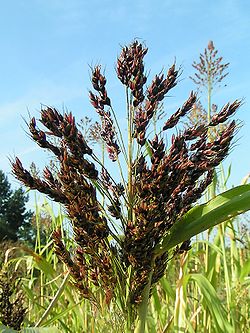
Traditionally, in Sudanese households, sorghum is used as a base for making kisra. Sorghum grains are known for having high nutritional value through its minerals and vitamins, which contribute to its anti-inflammatory properties. Two common sorghum varieties are feterita and tabat, which are used to mill fermented flour. This flour is then used in fermented batter that contains a starter from fungal or bacterial fermentation.[5]
In 2025, Sudan joined the United Nations' global initiative "One Country One Priority Product" to promote export of sorghum. Previously, sorghum production has stilted, and the crop has been a victim of inflation, making it difficult to make kisra and other sorghum-based foods.[6] Some Sudanese families have turned to other alternatives, like sweet potato porridge.[7]
Preparation
[edit]The making of kisra is strongly gendered and typically done only by women.[8][9] A recipe for kisra is included in Omer Al Tijani's 2025 cookbook "The Sudanese Kitchen."[10]
Grinding sorghum
[edit]

Sorghum is traditionally ground into sorghum flour using saddle quern and grindstones. A saddle quern can withstand up to 2-3 generations of use, and the stone is replaced when dull. The sorghum is soaked in water for one hour, then it is run through the grindstone up to 3 times to create a fine powder. The finished flour is dried in the sun before consumption. In larger cities, families can also buy machine-ground sorghum flour at markets.[8]
Fermentation
[edit]The sorghum flour is mixed with water and some salt to create a paste. The batter is left to ferment overnight to create a sourdough.[4] Sometimes, it can be mixed with a small amount of older batter that acts as a starter. Fermentation prevents food poisoning by degrading contaminants and suppressing the growth of bacteria.[8]


Baking
[edit]Kisra is typically cooked in the early morning. Oil or animal fat is added to the douka, a traditional metal or clay griddle.[7] The batter is spread out thin over the surface in order to create a paper thin texture. It takes only about half a minute to cook through.[8][9]
See also
[edit]Further reading
[edit]- Mariod, Abdalbasit (17 February 2023). "Kisra: A Traditional Fermented Flatbread from Sorghum and Millet". Traditional Sudanese Foods: Sources, Preparation, and Nutritional and Therapeutic Aspects. Cambridge Scholars Publishing. ISBN 978-1-5275-9314-5.
- Steinkraus, Keith (4 May 2018). Handbook of Indigenous Fermented Foods, Revised and Expanded. CRC Press. ISBN 978-1-351-44251-0.
- Sulieman, Abdel Moneim Elhadi; Mariod, Abdalbasit Adam (31 January 2022). African Fermented Food Products- New Trends. Springer Nature. ISBN 978-3-030-82902-5.
References
[edit]- ^ de la Guardia, M.; Garrigues, S. (2015). Handbook of Mineral Elements in Food. Wiley. p. 566. ISBN 978-1-118-65436-1.
- ^ Wagner, Amuna (11 July 2025). "'The Sudanese Kitchen Cookbook:' A Culinary Map of Sudan's Rich Food Traditions | OkayAfrica". www.okayafrica.com. Retrieved 24 February 2026.
- ^ Steinkraus, Keith (14 November 1995). Handbook of Indigenous Fermented Foods, Second Edition, Revised and Expanded. CRC Press. p. 196. ISBN 978-0-8247-9352-4.
- ^ a b "World's 50 best breads". CNN. 18 October 2025. Retrieved 25 February 2026.
- ^ Mariod, Abdalbasit (2023). Traditional Sudanese Foods: Sources, Preparation, and Nutritional and Therapeutic Aspects. Cambridge Scholars Publishing. pp. 1–3. ISBN 978-1-5275-9313-8.
- ^ "Sudan's Sorghum Joins FAO's One Country One Priority Product (OCOP) Global Initiative". FAORegionalOffice-NearEast-RNE. Retrieved 24 February 2026.
- ^ a b Xylom, The (9 April 2025). "River Nile Blues: Famished Sudanese Turn to the Humble Sweet Potato". The Xylom. Retrieved 24 February 2026.
- ^ a b c d Ulrike Nowotnick, « Glimpses into cooking practices—observations on past and present Sudanese griddle baking », Afriques [En ligne], 14 | 2023, mis en ligne le 29 janvier 2024, consulté le 25 février 2026. URL : http://journals.openedition.org/afriques/4167 ; DOI : https://doi.org/10.4000/afriques.4167
- ^ a b Hamid, Manhal Gobara; Böhme, Claudia; Mustafa, Khitma Abdalha; Idris, Yousif M. A.; Muneer, Faraz; Elsafy, Mohammed; Rahmatov, Mahbubjon; Johansson, Eva; Abdelhalim, Tilal Sayed (1 June 2025). "Sensory evaluation and consumer acceptance of Kisra, a sudanese fermented flatbread made with biofortified sorghum: Insights from check-all-that-apply (CATA) method". Applied Food Research. 5 (1) 100920. doi:10.1016/j.afres.2025.100920. ISSN 2772-5022.
- ^ Latif, Leila (16 July 2025). "The Sudanese Kitchen: more than just a cookbook". Hyphen. Retrieved 24 February 2026.