
This article has multiple issues. Please help improve it or discuss these issues on the talk page. (Learn how and when to remove these messages)
(Learn how and when to remove this message)
|


The Department of Canadian Heritage lays out protocol guidelines for the display of flags, including an order of precedence; these instructions are only conventional, however, and are generally intended to show respect for what are considered important symbols of the state or institutions.[1] The Sovereign's Flag for Canada is supreme in the order of precedence, followed by those for the monarch's representatives (depending on jurisdiction), the personal flags of other members of the Royal Family,[2] and then the national flag and provincial flags.
Many museums across Canada display historic flags in their exhibits. The Canadian Museum of History, in Hull, Quebec has many culturally important flags in their collections. Settlers, Rails & Trails Inc., in Argyle, Manitoba holds the second largest exhibit - known as the Canadian Flag Collection.
National and provincial flags
[edit]National
[edit]| Flag | Date | Use | Description |
|---|---|---|---|
| 👁 Image |
1965–present | National Flag of Canada (The Maple Leaf, l'Unifolié) |
A vertical bicolour triband of red, white, red with a red maple leaf emblem charged in the Canadian pale |
.svg)

Provincial
[edit]| Flag | Date | Use | Description |
|---|---|---|---|
| 👁 Image |
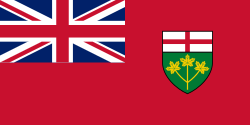
1965–present | Flag of Ontario | A Red Ensign (red field with the Royal Union Flag in the canton) defaced with the shield of the coat of arms of Ontario in the fly |
| 👁 Image |
1948–present | Flag of Quebec (The Fleurdelisé) |
A blue field with an ordinary white cross and a white fleur-de-lis in each quadrant |
| 👁 Image |
1858 (first use)
1929 (arms adopted) 2013 (flag adopted) –present |
Flag of Nova Scotia | A banner of arms of the coat of arms of Nova Scotia |
| 👁 Image |
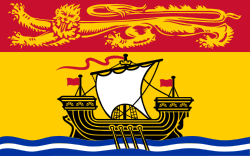
1965–present | Flag of New Brunswick | A banner of the coat of arms of New Brunswick |
| 👁 Image |
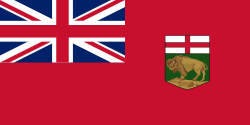
Flag of Manitoba | A Red Ensign (red field with the Royal Union Flag in the canton) defaced with the shield of the coat of arms of Manitoba charged in the fly | |
| 👁 Image |
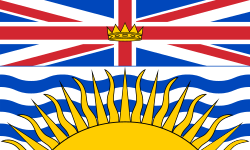
1960–present | Flag of British Columbia | A banner of the coat of arms of British Columbia |
| 👁 Image |
1964–present | Flag of Prince Edward Island | A banner of the coat of arms of Prince Edward Island within a bordure compony of red and white |
| 👁 Image |
1969–present | Flag of Saskatchewan | A field party per fess, green and yellow, with the shield of the coat of arms of Saskatchewan in the canton and western red lily emblem charged in the fly |
| 👁 Image |
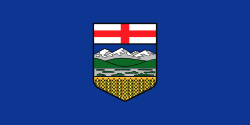
1968–present | Flag of Alberta | A blue field with the shield of the escutcheon of the coat of arms of Alberta charged in the centre |
| 👁 Image |
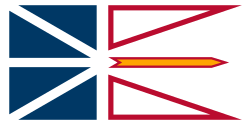
1980–present | Flag of Newfoundland and Labrador | A blue and white field party per pale (at nombril point) with a white border, white ordinary cross and white saltire, two triangular divisions in the fly lined in red, a golden arrow between two triangular divisions |








Territorial
[edit]| Flag | Date | Use | Description |
|---|---|---|---|
| 👁 Image |
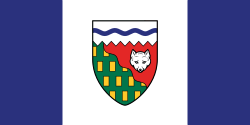
1969–present | Flag of the Northwest Territories | A vertical bicolour triband of blue, white, blue with the shield of the coat of arms of the Northwest Territories charged in the Canadian pale |
| 👁 Image |
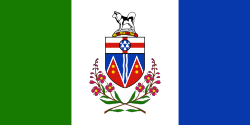
1968–present | Flag of Yukon | A vertical tricolour triband of green, white, blue with the shield of the coat of arms of Yukon above a wreath of fireweed charged in the pale, with pale ratio of 1 to 1.5 to 1 |
| 👁 Image |
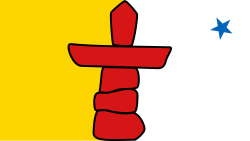
1999–present | Flag of Nunavut | A field party per pale, yellow and white, with a red inukshuk charged in the centre and a blue star in the upper fly |



Ceremonial
[edit]| Flag | Date | Use | Description |
|---|---|---|---|
| 👁 Image |
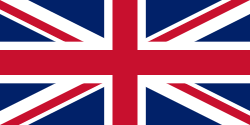
1965–present | Royal Union Flag | The Cross of St. Andrew counterchanged with the Cross of St. Patrick and over all the Cross of St. George. |
.svg)
Royal
[edit]| Flag | Date | Use | Description |
|---|---|---|---|
| 👁 Image |
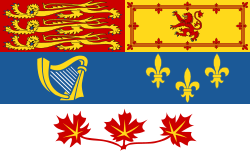
2023–present | Sovereign's Flag for Canada | A banner of the royal arms of Canada undifferentiated |
| 👁 Image |
2011–present | Personal flag of the Prince of Wales for use in Canada | A banner of the royal arms of Canada differentiated by a white three-pointed label and defaced with the Prince of Wales's feathers |
| 👁 Image |
2013–present | Personal flag of the Princess Royal for use in Canada | A banner of the royal arms of Canada differentiated by a white three-pointed label; the first and third labels bearing a red cross, the centre label bearing a red heart; and defaced with a royal cypher of Princess Anne |
| 👁 Image |
2014–present | Personal flag of the Duke of Edinburgh for use in Canada | A banner of the royal arms of Canada differentiated by a three-pointed label; the centre label bearing a Tudor rose; and defaced with a royal cypher of Prince Edward, Duke of Edinburgh |
| 👁 Image |
2015–present | Other members of the royal family | A banner of the royal arms of Canada with a border of ermine |

.svg)

.svg)

.svg)


Viceregal and administrative
[edit]Governor general
[edit]| Flag | Date | Use | Description |
|---|---|---|---|
| 👁 Image |
1981–1999 2002–present |
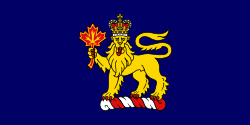
Flag of the governor general of Canada | A blue field with the crest of the royal arms of Canada charged in the centre |
| 👁 Image |
1994–present | Banner of arms of the Canadian Heraldic Authority | A square white field with the red maple leaf of Canada differenced by a white inescutcheon charged in the centre |



Lieutenant governors and commissioners
[edit]Supreme Court of Canada
[edit]| Flag | Date | Use | Description |
|---|---|---|---|
| 👁 Image |
2021–present | Flag of the Supreme Court of Canada | Gules on a Canadian pale Argent a lozenge lozengy of the first and the second charged with maple leaves alternately Or and of the field |


Military and civilian law enforcement organizations
[edit]Canadian Armed Forces
[edit]| Flag | Date | Use | Description |
|---|---|---|---|
| 👁 Image |
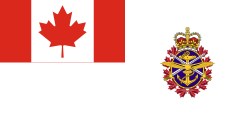
1968–present | Flag of the Canadian Armed Forces | A white field with the National Flag of Canada in the canton and the Canadian Armed Forces badge charged in the fly[3] |
| 👁 Image |
1920–present | Flag of the Royal Military College of Canada | A field tierced per pale, red, white, and red with the badge of the Royal Military College of Canada charged in the centre |
| 👁 Royal Military College Saint-Jean |
Flag of the Royal Military College Saint-Jean | A field tierced per pale, blue, white, and blue with the badge of the Royal Military College Saint-Jean charged in the centre | |
| 👁 Image |
2000–present | Banner of the Commander-in-Chief Unit Commendation | A field tierced per pale, blue, red, and azure, with the crest of the royal arms of Canada charged in the centre |
| 👁 Image |
2009–present | Camp flag of the Cadet Instructors Cadre | The badge of the Cadet Instructors Cadre, with the traditional colours of the Navy, Army and the Air Force. The golden border represents the young people that CIC officers work for. |
| 👁 Image |
−1965 | King's Colour, as used by the Royal Military College of Canada | King's Colour of the Royal Military College of Canada with the Union Flag. |



Canadian Army
[edit]| Flag | Date | Use | Description |
|---|---|---|---|
| 👁 Image |
1939–1944 | Old flag of the Canadian Army | |
| 👁 Image |
1968–1998 | ||
| 👁 Image |
1998–2013 | ||
| 👁 Image |
2013–2016 | ||
| 👁 Image |
2016–present | Flag of the Canadian Army | A scarlet red field with the National Flag of Canada in the canton and the Canadian Army badge charged in the fly |
| 👁 Image |
–present | Flag of the Commander of the Canadian Army |
.svg)

.svg)

.svg)

.svg)


.svg)

Royal Canadian Navy
[edit]| Flag | Date | Use | Description |
|---|---|---|---|
| 👁 Image |
1968–present | Canadian Naval Ensign (2013-present), naval jack (1968-2013) | A white field with the National Flag of Canada in the canton and charged in the fly with an anchor, eagle and naval crown in blue |
| 👁 Image |
1979–present[4] | Canadian Forces Auxiliary Jack | A blue field with the National Flag of Canada in the canton and charged in the fly with an anchor, eagle and naval crown in white |
| 👁 Image |
c. 1964–present | Flag of the Canadian Navy Board | A field party per bend, blue and sanguine, with a fouled anchor in gold charged in the centre |
| 👁 Image |
RCN (1911–1965) RCSCC (1905–1965) |
Used as the ensign of the Royal Canadian Navy and some Royal Canadian Sea Cadets corps. Used throughout the entire British Empire by the Royal Navy and by several former British colonies even after they became independent and established their own navies. | White Ensign, St George's Cross with the Union Flag in the canton. |
| 👁 Image |
RCN (1957-1965) | The Blue Ensign, worn as a jack by the Royal Canadian Navy | Blue Ensign defaced with the royal arms of Canada. The maple leaves at the bottom of the shield are red. |
| 👁 Image |
RCN (1921–1957) RCSCC (1929–1953) |
The Blue Ensign, worn as a jack by the Royal Canadian Navy and used by the RCSCC | Blue Ensign defaced with the royal arms of Canada. The maple leaves at the bottom of the shield are green. |
| 👁 Image |
Naval Service of Canada / Royal Canadian Navy (1910–1911, as ensign; 1911-1921 as jack) RCSCC (1910–1922) |
The Blue Ensign, worn as ensign then jack by the Naval Service of Canada/Royal Canadian Navy | Blue Ensign defaced with the 1868 Great Seal of Canada. Worn as ensign from 1910 to 1913, then jack from 1913 to 1921, after Navy authorized to fly the British White Ensign.[5][6] |


.svg)

.svg)

.svg)

Royal Canadian Air Force
[edit]| Flag | Date | Use | Description |
|---|---|---|---|
| 👁 Image |
1921–1940 | Royal Canadian Air Force Ensign | A field of air force blue with the Union Flag in the canton and the Royal Air Force roundel charged in the fly |
| 👁 Image |
1941–1968 | A field of air force blue with the Union Flag in the canton and the Royal Canadian Air Force roundel charged in the fly | |
| 👁 Image |
1982–present | A field of air force blue with the National Flag of Canada in the canton and the Royal Canadian Air Force roundel charged in the fly |


.svg)


Canadian Special Operations Forces Command
[edit]| Flag | Date | Use | Description |
|---|---|---|---|
| Link to file | -present | Flag of the Canadian Special Operations Forces Command | A white field with the National Flag of Canada in the canton and the CANSOFCOM badge charged in the fly |

Canada Border Services Agency
[edit]| Flag | Date | Use | Description |
|---|---|---|---|
| 👁 Image |
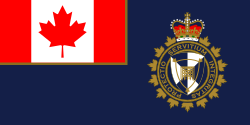
2012–present | Flag of the Canada Border Services Agency | A Blue field with the National Flag of Canada in the canton and the Canada Border Services Agency badge charged in the fly |

Canadian Coast Guard
[edit]| Flag | Date | Use | Description |
|---|---|---|---|
| 👁 Image |
1965–present | Jack of the Canadian Coast Guard | A banner of the arms of the Canadian Coast Guard: vertical diband of white and blue, a red maple leaf emblem charged in the hoist and a pair of dolphins in gold and facing opposite directions charged in the fly. Features current 11-point maple leaf designed by Jacques St-Cyr.[7] |
| 👁 Image |
1962–1965 | Jack of the Canadian Coast Guard, original design | A white field with blue flank/side one third length of flag at the fly; field charged with a red maple leaf emblem and side at fly charged with a pair of heraldic dolphins in gold, one above the other and facing opposite directions.[nb 1] Features original 13-point maple leaf designed by Alan Beddoe.[9] |
| 👁 Image |
1962–1965 | Ensign of the Canadian Coast Guard | Blue Ensign of Canadian Government Ships, defaced with Coat of Arms of Canada |
| 👁 Image |
–present | Honorary Commissioner Flag | Governor General's flag in the canton. |


.svg)


Police services
[edit]| Flag | Date | Use | Description |
|---|---|---|---|
| 👁 Image |
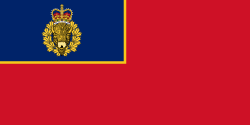
1991–present | Ensign of the Royal Canadian Mounted Police | A red field with a blue canton bordered yellow with a representation of the Badge of the RCMP. |
| Link to file | 1998–present | Flag of the Ontario Provincial Police | Blue with the heraldic badge of the OPP. |
| 👁 Image |
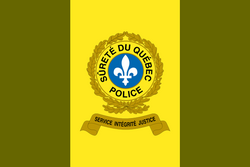
1983–present | Flag of the Sûreté du Québec | A green field, on a Canadian Pale Yellow charged with the badge of the Sûreté du Québec. |
| 👁 Image |
–present | Flag of the Royal Newfoundland Constabulary | A blue field with the badge of the RNC in the centre. |





Youth cadets organizations
[edit]| Flag | Date | Use | Description |
|---|---|---|---|
| 👁 Image |
1953–1976[10] | Former flag of the Royal Canadian Sea Cadets | A white flag with a Union Flag at the canton, with the badge of the Royal Canadian Sea Cadets at the fly. This is the basis of the current flag of the Royal Canadian Sea Cadets. |
| 👁 Image |
1976–present[10] | Flag of the Royal Canadian Sea Cadets | A white flag with a Canadian Flag at the canton, with the badge of the Royal Canadian Sea Cadets at the fly. |
| 👁 Image |
2009–present[11] | Flag of the Navy League of Canada | A white flag with a Canadian Flag at the canton, with the current badge of the Navy League of Canada at the fly. |
| 👁 Image |
1985–present[12] | Banner of the Royal Canadian Army Cadets | A Canadian flag in the same shape as a queen's colour used in the Canadian Armed Forces, with the maple leaf modified with the badge of the Royal Canadian Army Cadets. At the canton, the cypher of Prince Philip, Duke of Edinburgh, as former colonel-in-chief of the Royal Canadian Army Cadets. At the fly, a badge representing the Canadian Army (the crown of Saint Edward above crossed swords). |
| 👁 Image |
1944–1973 | Flag of the Royal Canadian Army Cadets used by individual Army Cadet Corps used before 1973. | |
| 👁 Image |
January 1973–present | Flag of the Royal Canadian Army Cadets used by individual Army Cadet Corps. | |
| 👁 Image |
Camp Flag of the Royal Canadian Army Cadets. | On a white field, the badge of the Royal Canadian Army Cadets in the centre. | |
| 👁 Image |
1995–present[13] | Flag of the Army Cadet League of Canada. | A banner of the shield of the arms of the Army Cadet League of Canada. According to the heraldic grant, the shield of the arms of the Army Cadet League of Canada is "Argent two swords in saltire Argent fimbriated Gules hilted and pommelled Or surmounted by a maple leaf Gules veined Or all within an orle of twelve maple leaves stems inward Gules."[14] The web site of the Governor General of Canada explains this description as follows: "The white shield, bearing a maple leaf and crossed broad swords, alludes to a central Canadian entity with direct connection to the military. The twelve smaller maple leaves show singleness of purpose but at the Branch level.[14] |
| 👁 Image |
1991–present[15][12] | Banner of the Royal Canadian Air Cadets | Based on the design of Queen's Colour for the Royal Canadian Air Force, with the badge of the Royal Canadian Air Cadets replacing the maple leaf. At the canton, the cypher of Prince Philip, Duke of Edinburgh, as former air commodore in chief of the Royal Canadian Air Cadets. On the bottom fly, the first badge of the Royal Canadian Air Cadets, a golden maple leaf above an eagle. |
| 👁 Image |
1971–present[15] | Ensign of the Royal Canadian Air Cadets | An Air Force blue flag, with a Canadian flag at the canton, with the historical badge of the Royal Canadian Air Cadets. |
| 👁 Image |
Squadron Banner of the Royal Canadian Air Cadets | An Air Force blue flag, with the badge of the Royal Canadian Air Cadets and a scroll stating the squadron's name and number (this example, 643 St-Hubert Squadron. | |
| 👁 Image |
Camp flag of the Junior Canadian Rangers | A 1/3 red and 2/3 green flag with the badge of the Junior Canadian Rangers on the fly. |
.svg)


.png)


.png)


Civil
[edit]| Flag | Date | Use | Description |
|---|---|---|---|
| 👁 Image |
1922–1923 | Canadian Civil Aviation Ensign, briefly used by the Air Board. | A field of light blue with the Union Flag in the canton and a shield with white albatross superimposed upon three maple leaves in the middle of the fly. |
.svg)

Corporations
[edit]Crown corporations
[edit]| Flag | Date | Use | Description |
|---|---|---|---|
| 👁 Image |
1992–present | Flag of the Canadian Broadcasting Corporation | A blue and red field with the logo of the Canadian Broadcasting Corporation charged in the centre; logo was first introduced in 1992 |
| 👁 Image |
1978–present | Flag of the Royal Canadian Mint | A red field with the logo of the Royal Canadian Mint charged in the centre; logo was first introduced in 1978 |


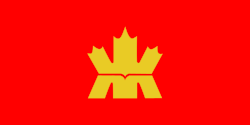
Hudson's Bay Company
[edit]Civic organizations
[edit]| Flag | Date | Use | Description |
|---|---|---|---|
| 👁 Image |
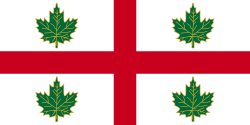
1934 | Flag of the Société nationale Jacques Cartier | A white field with a royal blue symmetric cross cantoned with four green maple leaves and charged with a golden fleur-de-lis, all enclosed with a dark crimson border. Designed by Maurice Brodeur for the 400th anniversary of Cartier's claiming of Canada for France.[16][17] |
| 👁 Image |
1943-present | Flag of the 4-H Clubs of Quebec | A gold field charged with a dark green maple leaf voided by a gold disc inscribed with the numeral '4' and letter 'H' of the dark green of the leaf, all enclosed with a dark green border of the same dark green. Designed by Maurice Brodeur.[18] |
| 👁 Image |
present | Flag of the Canadian Flag Society | A white field charged with the red maple leaf of Canada, surrounded by a red border, all party per pale, counter-changed |
.svg)

.svg)


Religious
[edit]| Flag | Date | Use | Description |
|---|---|---|---|
| 👁 Image |
1955–present | Flag of the Anglican Church of Canada | |
| 👁 Image |
–present | Flag of the Grand Orange Lodge of Canada |



Ethnic groups
[edit]Indigenous nations
[edit]Francophone peoples
[edit]| Flag | Date | Use | Description |
|---|---|---|---|
| 👁 Image |
1884–present | Acadian flag | Tri-coloured flag, blue, white then red. A yellow star representing independence and unique culture from main land France. |
| 👁 Image |
1975–present | Flag of the Franco-Ontarians | A field party per pale, green and white, with a white fleur-de-lys charged in the hoist and a green trillium emblem charged in the fly |
| 👁 Image |
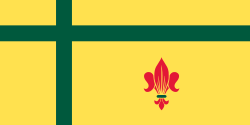
1976–present | Flag of the Fransaskois | A yellow field with a green Nordic cross centred towards the upper hoist and a red fleur-de-lis charged in the lower fly |
| 👁 Image |
1980–present | Flag of the Franco-Manitobans | A white field with yellow over sanguine bars with a green plant emblem in four pieces charged in the hoist |
| 👁 Image |
1981–present | Flag of the Franco-Columbians | A white field party per pale by a bar gemelles and dancetty, a fleur-de-lys and Pacific Dogwood emblem charged in the fly; Dogwood is the floral emblem of British Columbia, the blue stripes evoke the Pacific Ocean and the rising mountains beside, the yellow centre of the Dogwood flower represents the sun |
| 👁 Image |
1982–present | Flag of the Franco-Albertans | A field party per bend sinister, blue and white, by a bend cotised white and blue with a white fleur-de-lys in the upper hoist and a red wild rose in the lower fly |
| 👁 Image |
1985–present | Flag of the Franco-Yukonnais | A blue field and three diagonal stripes set from lower hoist to upper fly. The colours of the stripes are white and golden yellow. The effect created by the arrangement of the stripes is meant to represent Yukon's many mountains. Blue is for the French people and the sky. White is for winter and snow. Yellow represents the gold rush and the Franco-Yukonnais contributions to history of the territory. |
| 👁 Image |
1986–present | Flag of the Fédération des Francophones de Terre-Neuve et du Labrador (Franco-Terreneuviens) | Three unequal panels of blue, white, and red, with two yellow sails set on the line between the white and red panels. The sail on top is charged with a spruce twig, while the bottom sail is charged with a pitcher flower. |
| 👁 Image |
1992–present | Flag of the Franco-Ténois | A polar bear on a snowy hill, looking forward towards a snowflake/Fleur-de-lis combined, representing the French community of the Northwest Territories of Canada. |
| 👁 Image |
2002–present | Flag of the Franco-Nunavois | Blue that represents the Arctic sky and white recalls the snow, abundantly present on the territory. The principal shape represent an igloo, and under this one, the inukshuk which symbolise the human presence. A single dandelion flower grows from beneath it. |




Other ethnic groups
[edit]| Flag | Date | Use | Description |
|---|---|---|---|
| 👁 Image |
2006?–present? | Flag of Black Canadians | The Canadian national flag with black instead of red.[19] |
| 👁 Image |
2008–present | Flag of Gaelic Canadians | Adopted by the Comhairle na Gàidhlig (The Gaelic Council of Nova Scotia), the salmon represents the gift of knowledge in the Gaelic storytelling traditions of Nova Scotia, Scotland and Ireland and the Isle of Man. The "G" represents the Gaelic language and the ripples are the manifestations of the language through its rich culture of song, story, music, dance and custom and belief system.[20] |
| 👁 Image |
2021–present | Flag of Black Nova Scotians | The red represents blood and sacrifice. The gold conveys cultural richness. The green symbolizes fertility and growth. The black stands for the people.
The wave in the bottom centre has a dual meaning, representing the ocean and movements as well as honouring the journey of African Nova Scotian ancestors through the middle passage during the slave trade. On the left is half of a stylized heart (a version of the Sankofa symbol) with a yin and yang-like symbol embedded to represent heartbreak balanced with awareness. The image is encompassed with an incomplete circle representing those things absent but yet to come.[21] |
| 👁 Image |
2024–present | Flag of Irish Heritage Quebec | A yellow Celtic cross on a green background with a white crenellated border. Inspired by the flag of Quebec City.[22] |
.svg)


Municipal
[edit]





Historical
[edit]Historical national flags
[edit]| Flag | Date | Use | Description |
|---|---|---|---|
| 👁 Image |
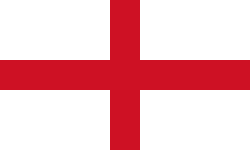
1497–1707 | Flag on John Cabot's ship, and used during the English colonization of the Americas before the Act of Union. | White Ensign, St George's Cross. |
| 👁 Image |
1621–1707 | Flag used during the Scottish colonization of the Americas before the Act of Union. | White saltire on blue ensign, St. Andrew's Cross. |
| 👁 Image |
1608 | Etandart François[23] | Possibly flown by Samuel de Champlain at Quebec City.[24] |
| 👁 Image |
16th c. on | Ensign of the Royal French Navy | A plain white banner, as naval ensign, also used on land, especially on fortifications, as symbol of authority of the French state.[25] |
| 👁 Image |
1664 | Flag of the Compagnie française des Indes occidentales | A white banner defaced with the Arms of France, three golden fleurs-de-lis on a blue escutcheon.[26] |
| 👁 Image |
1689 | Merchant Flag of France | |
| 👁 Image |
1707 | United Empire Loyalists (British North America) | United Empire loyalist flag which was similar to the earlier version of the Union Jack but had slight changes in the fimbriation width. The United Empire Loyalists brought this flag to British North America when they left the United States. In present-day Canada, the flag continues to be used as symbol of pride and heritage for loyalist townships and organizations.[27] |
| 👁 Image |
1801–1964 | Union Flag (1801–1964); Canadian Royal Union Flag (1964–present) |

.svg)

.svg)

.svg)

.svg)

.svg)


Royal
[edit]| Flag | Date | Use | Description |
|---|---|---|---|
| 👁 Image |
1643 | Royal standard of France | |
| 👁 Image |
1534–1763 | Royal Banner of France or "Bourbon Flag" was the most commonly used flag in New France[28][29][30][31] | The banner flag has three gold fleur-de-lis on a dark blue field arranged two and one |
| 👁 Image |
1962–2022 | Queen Elizabeth II's personal Canadian flag | A banner of the royal arms of Canada defaced with a royal cypher of Queen Elizabeth II |
| 👁 Image |
2014–2025 | Personal flag of the Duke of York for use in Canada | No longer used after Andrew Mountbatten-Windsor's withdrawal from public roles. |
| 👁 Image |
2011–2022 | Personal flag of the Duke of Cambridge for use in Canada |


.svg)

.svg)

.svg)

Coronation standards
[edit]| Flag | Date | Use | Description |
|---|---|---|---|
| 👁 Image |
1937 and 1953 | Coronations of George VI and Elizabeth and Elizabeth II | Banner of arms of Royal Coat of Arms of Canada |
| 👁 Image |
1911 | Coronation of George V and Mary | Banner of arms of Royal Coat of Arms of Canada |
.svg)

.svg)

Viceregal
[edit]Civil ensigns
[edit]| Flag | Date | Use | Description |
|---|---|---|---|
| 👁 Image |
1892–1922 | Canadian Red Ensign as authorized for use as a civil ensign through Admiralty warrant. Informal use of the Canadian Red Ensign as a symbol of Canada began as early as 1868. | |
| 👁 Image |
1907–1922 | 1907 informal version of the Canadian Red Ensign commonly used in western Canada. Note the inclusion of all the provincial emblems. | |
| 👁 Image |
1922–1957 | 1922 version of the Canadian Red Ensign used from 1922 to 1957, which was also used as a de facto national flag. | |
| 👁 Image |
1957–1965 | 1957 version of the Canadian Red Ensign that had evolved as the de facto national flag until 1965. |
.svg)

.svg)

.svg)

.svg)

Government ensigns
[edit]| Flag | Date | Description | Use |
|---|---|---|---|
| 👁 Image |
1868–1922 | A British colonial Blue Ensign defaced with the 1868 Great Seal of Canada | Since Confederation, worn by Canadian federal government ships, including of the Department of Marine and Fisheries, involved in tending lighthouses, performing search and rescue, ice-breaking, resupply of isolated outposts, and other services. Worn by Canadian government warships prior to formation of Naval Service of Canada/Royal Canadian Navy.[32][33] (Also from 1910-1911 as naval ensign, then 1911-1922 as naval jack.) |
| 👁 Image |
1922–1957 | A British colonial Blue Ensign defaced with the 1921 Arms of Canada | Used by ships of various Canadian federal departments, including Department of Transport fleet from 1936 -1957.[34] (Also as naval jack 1922-1957.) |
| 👁 Image |
1957–1965 | A British colonial Blue Ensign defaced with the 1957 Arms of Canada | Used by ships of various Canadian federal departments, including Canadian Marine Service (1959-1962), and Canadian Coast Guard (as ensign) from 1962-1965.[35] (Also as naval jack 1957-1965.) |
Newfoundland
[edit]| Flag | Date | Use | Description |
|---|---|---|---|
| 👁 Image |
1904–1949 | Dominion of Newfoundland | |
| 👁 Image |
1870–1904 | Newfoundland Colony | |
| 👁 Image |
1862–1870 |
.svg)

.svg)

.svg)

Rebellions
[edit]| Flag | Date | Use | Description |
|---|---|---|---|
| 👁 Image |
1968–1971 | Front de libération du Québec | Flag of the FLQ as seen at demonstrations in Montreal and the U.S. between 1968 and 1971[36] |
| 👁 Image |
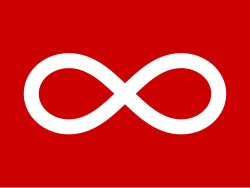
1812–1821 | Pemmican War | Metis Flag |
| 👁 Image |
1837 | Lower Canada Rebellion | This flag was created by Marie-Louise Félix, Émilie Berthelot and Marie-Louise-Zéphirine Labrie in 1837, also involved in the Association of Patriotic Ladies of the Deux-Montagnes County. We see a maple branch surmounted by a muskellunge, surrounded by a crown of cone and pine branches. The C would mean "Canada" (in the sense that this term had for the Patriots at the time) and JB would mean "Jean-Baptiste", the patron saint of "Canadians" since the creation of the Société Saint-Jean- Baptiste in 1834. The original is in Château Ramezay, in Montreal. |
| 👁 Image |
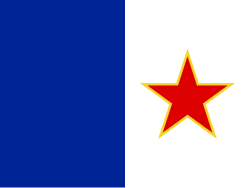
1832–1838 | Patriote flag | The proposed flag for the Republic of Lower Canada (1838). It is still used today by some souverainists, in mostly 4 variants: the original, and three versions with the yellow star in the top left corner. Of which, two of them have Henri Julien's Patriot painting of 1904, one in colour and the other stylised in black and white. |
| 👁 Image |
1837–1838 | Flag of the Republic of Canada | A blue-white-red vertical tricolour with two white stars representing the colonies of Upper and Lower Canada and a crescent moon representing the "hunter's clubs" that organized and led the insurrection affixed at the hoist.[37] |
| 👁 Image |
1869-1870 | North-West Rebellion | Often mistaken as the flag used in the 1885 resistance, the flag used by the Provisional Government of Rupert's Land and the North-West was described in various ways. Most descriptions mention a fleur-de-lys, shamrock and a white background.[38][39] |
| 👁 Image |
1885 | Provisional Government of Saskatchewan | The day of the provisional government's proclamation, Father Vital Fourmond, a witness, wrote "As a flag [Riel] chose the white flag of ancient France [with a royal blue shield bearing three golden fleurs de lys], saying that he was called to renew its ancient glories. On it he placed a large image of Mary's immaculate heart."[40] |




.svg)
.svg)


Other
[edit]| Flag | Date | Use | Description |
|---|---|---|---|
| 👁 Image |
1827 | Flag of the short lived Republic of Madawaska which was situated between Canada and the US. | |
| 👁 Image |
1868 | The Canadian Red Ensign used at Dominion Day celebrations in Barkerville, BC in support of Canadian Confederation, as Canada did not have an official flag.[41] | |
| 👁 Image |
1910–1913 | Sledge flag used in Antarctica by C.S. Wright, a Canadian member of Robert Falcon Scott's Terra Nova Expedition. | |
| 👁 Image |
Post 1910–c. 1945 | British Empire flag | An unofficial flag of the British Empire featuring symbols of its constituent dominions and India. The Canadian coat of arms are present in the bottom left. It was flown by civilians as a display of patriotism on special occasions such as Empire Day. A surviving specimen from the British Empire Exhibition in 1924 is kept in the Canadian Flag Collection.[42] |


.svg)

Proposed
[edit]Regional
[edit]Official
[edit]| Flag | Date | Use | Description |
|---|---|---|---|
| 👁 Image |
1994–present | Flag of Cape Breton Island | A white field with four narrow horizontal stripes at the bottom, blue over green over yellow over gray with a narrow black fimbriation. Toward the fly, the green bar rises to silhouette a hill or island. Toward the hoist is a green, stylized eagle in flight.
Despite not being widely used, the Eagle flag was officially recognized and adopted by the Nova Scotian government in 1994.[43] |
| 👁 Image |
1938–present | Flag of Saguenay–Lac-Saint-Jean | A field party per fess, green and yellow, with a red-bordered grey ordinary cross; green represents the region's forests, yellow its agriculture, grey its industry and commerce, and red the vitality of the population |
.svg)


Unofficial
[edit]| Flag | Date | Use | Description |
|---|---|---|---|
| 👁 Image |
Disputed–present | Flag of Cape Breton Island | A field tierced per forest green and white, with a green saltire and yellow circle reading "Cape Breton Island" on the top, and "Canada" on the bottom, with a green stylized map of Cape Breton Island in the middle. The green is taken from the island's tartan.
Though being the most commonly used flag it is not the official flag and is disputed by supporters of the officially recognized 1993 flag designed by Kelly Gooding[43] |
| 👁 Image |
1974–present | Flag of Labrador | A field party per fess, white and azure, with a green horizontal band across the centre and a spruce twig in the upper hoist |
| 👁 Image |
1880s–present | Newfoundland Tricolour | A field tierced per pale green, white, and pink |
| 👁 Image |
1949–present | Flag of Outer Bald Tusket Island | Flag used by one of the first micronations, named Principality of Outer Baldonia, it is sometimes used on fishing boats and on souvenirs. |
| 👁 Image |
1988–present | Flag of Vancouver Island | A Blue Ensign defaced with the great seal of the Colony of Vancouver Island. Used informally today.[44] This unofficial flag was designed in the 1980s to retroactively represent the colony (1849–1866). In 1865 the Crown gave colonies permission to place their badges on the fly of the Blue Ensign; thus vexillologists could argue that this flag is official.[45] |
| 👁 Image |
1988–present | Flag of Western Canada | Originally used by the Western Independence Party, it was designed in 1988 ahead of the party's first election. |
.svg)





House flags of Canadian freight companies
[edit]| Flag | Date | Use | Description |
|---|---|---|---|
| 👁 Image |
1965–present | Canada Steamship Lines | |
| 👁 Image |
1958-1965 | ||
| 👁 Image |
1867-1958 | Quebec Steamship Company and Canada Steamship Lines | |
| 👁 Image |
1944–present | Coopérative de Transport Maritime et Aérien | The project differs in different periods of the company's activity. |
| 👁 Image |
1811–2019 | Bowring Brothers | |
| 👁 Image |
1893–1953 | Canadian Australasian Line | |
| 👁 Image |
1919–1986 | Canadian National Steamship Company | |
| 👁 Image |
1887–2005 | CP Ships | |
| 👁 Image |
19th–1967 | Job Brothers & Co., Limited | |
| 👁 Image |
1910–1916 | Royal Line |


.svg)




.svg)

Yacht clubs of Canada
[edit]| Burgee | Club |
|---|---|
| 👁 Image |
Armdale Yacht Club |
| 👁 Image |
Barrachois Harbour Yacht Club |
| 👁 Image |
Bay of Quinte Yacht Club |
| 👁 Image |
Bras d'Or Yacht Club |
| 👁 Image |
Bronte Harbour Yacht Club |
| 👁 Image |
Buffalo Canoe Club |
| 👁 Image |
Dobson Yacht Club |
| 👁 Image |
Etobicoke Yacht Club |
| 👁 Image |
Northern Yacht Club |
| 👁 Image |
Oakville Yacht Squadron |
| 👁 Image |
Royal Hamilton Yacht Club |
| 👁 Image |
Royal Lake of the Woods Yacht Club |
| 👁 Image |
Royal St. Lawrence Yacht Club |
| 👁 Image |
Royal Vancouver Yacht Club |
| 👁 Image |
Royal Victoria Yacht Club |
| 👁 Image |
Royal Canadian Yacht Club |
| 👁 Image |
Royal Nova Scotia Yacht Squadron |
| 👁 Image |
Windsor Yacht Club |
| 👁 Image |
Queen's University at Kingston (College team) |
| 👁 Image |
University of British Columbia (College team) |


See also
[edit].svg)

- Canadian Heraldic Authority
- Canadian heraldry
- Canadian royal symbols
- Great Canadian Flag Debate
- List of Canadian provincial and territorial symbols
- National symbols of Canada
Notes
[edit]References
[edit]- ^ Department of Canadian Heritage. "Ceremonial and Canadian Symbols Promotion > Flag Etiquette in Canada". Queen's Printer for Canada. Retrieved 18 September 2010.
- ^ Department of Canadian Heritage. "Ceremonial and Canadian Symbols Promotion > Personal Flags and Standards". Queen's Printer for Canada. Retrieved 18 September 2010.
- ^ "Confirmation of the blazon of a Flag". Public Register of Arms, Flags and Badges of Canada. Official website of the Governor General. Retrieved 19 March 2025.
- ^ Bertosa, Brian (2023). "It Was Supposed to Be Blue: Roads Not Taken with the Canadian Armed Forces Naval Jack, 1967-68". Northern Mariner / Le Marin du Nord. 32 (4): 545–574. doi:10.25071/2561-5467.1045. Retrieved 29 March 2025.
- ^ Government of Canada/Gouvernement du Canada. "History of Canadian naval flags". Canada.ca. Government of Canada/Gouvernement du Canada. Retrieved 16 March 2025.
- ^ Perrin, William Gordon (1922). British Flags: Their Early History, and Their Development at Sea; With an Account of the Origin of the Flag as a National Device. London: Cambridge at The University Press. p. 121. Retrieved 16 March 2025.
- ^ "1963-1965: The birth of Canada's National Flag — Who's who". Government of Canada/Gouvernement du Canada. 4 January 2023. Retrieved 18 March 2025.
- ^ Canadian Heraldic Authority. "Canadian Coast Guard". The Public Register of Arms, Flags, and Badges of Canada. The Governor General of Canada. Retrieved 8 April 2025.
- ^ McWilliam, Yvonne (November–December 1963). "The Story Behind Our Flags". News on the DOT. 14 (6): 6–8. Retrieved 15 March 2025.
- ^ a b "Flags of National Defence".
- ^ "The Navy League of Canada [Civil Institution]". 12 November 2020.
- ^ a b "Heritage Structure | Annex A – Cadet Flags". 12 October 2018.
- ^ "The Army Cadet League of Canada [Civil Institution]". 12 November 2020.
- ^ a b "The Army Cadet League of Canada [Civil Institution]". 12 November 2020.
- ^ a b Department of National Defence (2001-01-05). A-AD-200-000/AG-000 The Honours, Flags and Heritage Structure of the Canadian Forces Chap 4 Annex A. Directorate of History and Heritage.
- ^ Bouvier, Luc (December 1996). "Du tricolore canadien au fleurdelisé québécois". L'Action nationale. LXXXVI (10): 110–111. Retrieved 11 December 2025.
- ^ Maurice Brodeur (July 1934). "Le Drapeau Jacques Cartier". La Revue Populaire. pp. 10, 52–53. Retrieved 12 December 2025.
- ^ "Les clubs 4-H du Québec". L'Action catholique. 12 May 1946. pp. 4, 6. Retrieved 21 December 2025.
- ^ "Afro-Canadian flags".
- ^ "Gaelic Flags (Canada)".
- ^ Currie, Brooklyn (February 15, 2021). "New official African Nova Scotian flag looking to connect past, present and future". CBC News.
- ^ Christopher Eby (7 January 2025). "Irish Heritage Quebec Unveils New Flag Design at Annual Meeting". The Flag Chronicle. Retrieved 14 May 2025.
- ^ Desjardins, Gustave (1874). Recherches sur les drapeaux français : oriflamme, bannière de France, marques nationales, couleurs du Roi, drapeaux de l'armée, pavillons de la marine. Paris: A. Morel et cie, éditeurs. p. Plate X. Retrieved 4 April 2025.
- ^ Stanley, George F. G. (1972). The Story of Canada's Flag, A Historical Sketch (Revised ed.). Toronto: McGraw-Hill Ryerson Ltd. p. 14. ISBN 978-0-7700-0197-1. Retrieved 29 March 2025.
- ^ Vachon, Auguste. "Banniére de France et Pavillon Blanc en Nouvelle-France". Heraldic Science Héraldique. Retrieved 1 April 2025.
- ^ Vachon, Auguste. "Banniére de France et Pavillon Blanc en Nouvelle-France". Heraldic Science Héraldique. Retrieved 1 April 2025.
- ^ "The Loyalist Flag". UELAC. 2021-12-06. Retrieved 2024-12-26.
- ^ New York State Historical Association (1915). Proceedings of the New York State Historical Association with the Quarterly Journal: 2nd-21st Annual Meeting with a List of New Members. The Association.
It is most probable that the Bourbon Flag was used during the greater part of the occupancy of the French in the region extending southwest from the St. Lawrence to the Mississippi, known as New France... The French flag was probably blue at that time with three golden fleur - de - lis ....
- ^ "Fleur-de-lys | The Canadian Encyclopedia". www.thecanadianencyclopedia.ca.
At the time of New France (1534 to the 1760s), two flags could be viewed as having national status. The first was the banner of France — a blue square flag bearing three gold fleurs-de-lys. It was flown above fortifications in the early years of the colony. For instance, it was flown above the lodgings of Pierre Du Gua de Monts at Île Sainte-Croix in 1604. There is some evidence that the banner also flew above Samuel de Champlain's habitation in 1608. ..... the completely white flag of the French Royal Navy was flown from ships, forts and sometimes at land-claiming ceremonies.
- ^ "INQUINTE.CA | CANADA 150 Years of History ~ The story behind the flag". inquinte.ca.
When Canada was settled as part of France and dubbed "New France," two flags gained national status. One was the Royal Banner of France. This featured a blue background with three gold fleurs-de-lis. A white flag of the French Royal Navy was also flown from ships and forts and sometimes flown at land-claiming ceremonies.
- ^ W. Stewart Wallace (1948). The Encyclopedia of Canada, Vol. II, Toronto, University Associates of Canada. pp. 350–351.
During the French régime in Canada, there does not appear to have been any French national flag in the modern sense of the term. The "Banner of France", which was composed of fleur-de-lys on a blue field, came nearest to being a national flag, since it was carried before the king when he marched to battle, and thus in some sense symbolized the kingdom of France. During the later period of French rule, it would seem that the emblem...was a flag showing the fleur-de-lys on a white ground.... as seen in Florida. There were, however, 68 flags authorized for various services by Louis XIV in 1661; and a number of these were doubtless used in New France
- ^ McWilliam, Yvonne (November–December 1963). "The Story Behind Our Flags". News on the DOT. 14 (6): 6–8. Retrieved 15 March 2025.
- ^ "History of icebreaking in Canada". Canadian Coast Guard. Government of Canada/Gouvernement du Canada. 16 May 2019. Retrieved 20 March 2025.
- ^ McWilliam, Yvonne (November–December 1963). "The Story Behind Our Flags". News on the DOT. 14 (6): 6–8. Retrieved 15 March 2025.
- ^ McWilliam, Yvonne (November–December 1963). "The Story Behind Our Flags". News on the DOT. 14 (6): 6–8. Retrieved 15 March 2025.
- ^ Flags of the World (retrieved on 31 July 2007)
- ^ "Photos for Fort Malden National Historic Park". Yelp.com. Retrieved 16 March 2025.
- ^ Begg, Alexander. "The Red River Troubles". The Globe (Letter to the Editor).
- ^ Osler, Edmund Boyd (1961). The Man Who Had to Hang Louis Riel. Longmans Green. p. 69.
- ^ Payment, Diane P (February 2009). "A National Feast Day, a Flag, and Anthem". The Free People - Li Gens Libres: A History of the Métis Community of Batoche, Saskatchewan (2 ed.). Calgary, AB, Canada: University of Calgary Press. ISBN 978-1-55238-239-4.
- ^ "Dominion Day and the "New" Canadian Flag". Barkerville Historic Town & Park. 1 July 2019. Archived from the original on 2 August 2019. Retrieved 2 August 2019.
- ^ Stevenson, Lorraine (23 May 2018). "Argyle museum waves the flag – all 1,300 of them". The Manitoba Co-operator. Archived from the original on 6 August 2021. Retrieved 20 August 2023.
- ^ a b "Woman wants Cape Breton flag designed by her daughter recognized | Saltwire". www.capebretonpost.com. Retrieved 2020-09-30.
- ^ FOTW Flags of the World: Vancouver Island (British Colony, Canada)
- ^ Flags of Canada: British Columbia
External links
[edit]


- Articles with short description
- Short description is different from Wikidata
- Articles needing additional references from October 2021
- All articles needing additional references
- Articles that may contain original research from October 2021
- All articles that may contain original research
- Articles with accessibility problems
- Wikipedia articles lacking focus from July 2025
- All Wikipedia articles lacking focus
- Articles with multiple maintenance issues
- Articles containing French-language text
- Articles containing Scottish Gaelic-language text
- Commons category link is on Wikidata