




The metallic mean (also metallic ratio, metallic constant, or noble mean[1]) of a natural number n is a positive real number, denoted here 👁 {\displaystyle S_{n},}
that satisfies the following equivalent characterizations:
- the unique positive real number 👁 {\displaystyle x}
such that 👁 {\textstyle x=n+{\frac {1}{x}}} - the positive root of the quadratic equation 👁 {\displaystyle x^{2}-nx-1=0}
- the number 👁 {\textstyle {\frac {n+{\sqrt {n^{2}+4}}}{2}}={\frac {2}{{\sqrt {n^{2}+4}}-n}}}
- the number whose expression as a continued fraction is
Metallic means are (successive) derivations of the golden (👁 {\displaystyle n=1}
) and silver ratios (👁 {\displaystyle n=2}
), and share some of their interesting properties. The term "bronze ratio" (👁 {\displaystyle n=3}
) (Cf. Golden Age and Olympic Medals) and even metals such as copper (👁 {\displaystyle n=4}
) and nickel (👁 {\displaystyle n=5}
) are occasionally found in the literature.[2][3][a]
In terms of algebraic number theory, the metallic means are exactly the real quadratic integers that are greater than 👁 {\displaystyle 1}
and have 👁 {\displaystyle -1}
as their norm.
The defining equation 👁 {\displaystyle x^{2}-nx-1=0}
of the nth metallic mean is the characteristic equation of a linear recurrence relation of the form 👁 {\displaystyle x_{k}=nx_{k-1}+x_{k-2}.}
It follows that, given such a recurrence the solution can be expressed as
where 👁 {\displaystyle S_{n}}
is the nth metallic mean, and a and b are constants depending only on 👁 {\displaystyle x_{0}}
and 👁 {\displaystyle x_{1}.}
Since the inverse of a metallic mean is less than 1, this formula implies that the quotient of two consecutive elements of such a sequence tends to the metallic mean, when k tends to the infinity.
For example, if 👁 {\displaystyle n=1,}
👁 {\displaystyle S_{n}}
is the golden ratio. If 👁 {\displaystyle x_{0}=0}
and 👁 {\displaystyle x_{1}=1,}
the sequence is the Fibonacci sequence, and the above formula is Binet's formula. If 👁 {\displaystyle n=1,x_{0}=2,x_{1}=1}
one has the Lucas numbers. If 👁 {\displaystyle n=2,}
the metallic mean is called the silver ratio, and the elements of the sequence starting with 👁 {\displaystyle x_{0}=0}
and 👁 {\displaystyle x_{1}=1}
are called the Pell numbers.
Geometry
[edit]




The defining equation 👁 {\textstyle x=n+{\frac {1}{x}}}
of the nth metallic mean induces the following geometrical interpretation.
Consider a rectangle such that the ratio of its length L to its width W is the nth metallic ratio. If one remove from this rectangle n squares of side length W, one gets a rectangle similar to the original rectangle; that is, a rectangle with the same ratio of the length to the width (see figures).
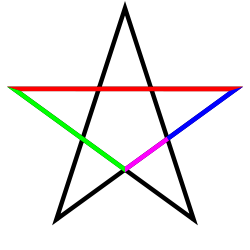
Some metallic means appear as segments in the figure formed by a regular polygon and its diagonals. This is in particular the case for the golden ratio and the pentagon, and for the silver ratio and the octagon; see figures.
Powers
[edit]This section does not cite any sources. Please help improve this section by adding citations to reliable sources. Unsourced material may be challenged and removed. (August 2020) (Learn how and when to remove this message) |


Denoting by 👁 {\displaystyle S_{m}}
the metallic mean of m one has
where the numbers 👁 {\displaystyle K_{n}}
are defined recursively by the initial conditions K0 = 0 and K1 = 1,
and the recurrence relation
Proof: The equality is immediately true for 👁 {\displaystyle n=1.}
The recurrence relation implies 👁 {\displaystyle K_{2}=m,}
which makes the equality true for 👁 {\displaystyle k=2.}
Supposing the equality true up to 👁 {\displaystyle n-1,}
one has
End of the proof.
One has also [citation needed]
The odd powers of a metallic mean are themselves metallic means. More precisely, if n is an odd natural number, then 👁 {\displaystyle S_{m}^{n}=S_{M_{n}},}
where 👁 {\displaystyle M_{n}}
is defined by the recurrence relation 👁 {\displaystyle M_{n}=mM_{n-1}+M_{n-2}}
and the initial conditions 👁 {\displaystyle M_{0}=2}
and 👁 {\displaystyle M_{1}=m.}
Proof: Let 👁 {\displaystyle a=S_{m}}
and 👁 {\displaystyle b=-1/S_{m}.}
The definition of metallic means implies that 👁 {\displaystyle a+b=m}
and 👁 {\displaystyle ab=-1.}
Let 👁 {\displaystyle M_{n}=a^{n}+b^{n}.}
Since 👁 {\displaystyle a^{n}b^{n}=(ab)^{n}=-1}
if n is odd, the power 👁 {\displaystyle a^{n}}
is a root of 👁 {\displaystyle x^{2}-M_{n}-1=0.}
So, it remains to prove that 👁 {\displaystyle M_{n}}
is an integer that satisfies the given recurrence relation. This results from the identity
This completes the proof, given that the initial values are easy to verify.
In particular, one has
and, in general,[citation needed]
where
For even powers, things are more complicated. If n is a positive even integer then[citation needed]
Additionally,[citation needed]
- 👁 {\displaystyle {1 \over {S_{m}^{4}-\left\lfloor S_{m}^{4}\right\rfloor }}+\left\lfloor S_{m}^{4}-1\right\rfloor =S_{\left(m^{4}+4m^{2}+1\right)}}
- 👁 {\displaystyle {1 \over {S_{m}^{6}-\left\lfloor S_{m}^{6}\right\rfloor }}+\left\lfloor S_{m}^{6}-1\right\rfloor =S_{\left(m^{6}+6m^{4}+9m^{2}+1\right)}.}
For the square of a metallic ratio we have:👁 {\displaystyle S_{m}^{2}=[m{\sqrt {m^{2}+4}}+(m+2)]/2=(p+{\sqrt {p^{2}+4}})/2}
where 👁 {\displaystyle p=m{\sqrt {m^{2}+4}}}
lies strictly between 👁 {\displaystyle m^{2}+1}
and 👁 {\displaystyle m^{2}+2}
. Therefore
👁 {\displaystyle S_{m^{2}+1}<S_{m}^{2}<S_{m^{2}+2}}
Generalization
[edit]One may define the metallic mean 👁 {\displaystyle S_{-n}}
of a negative integer −n as the positive solution of the equation 👁 {\displaystyle x^{2}-(-n)x-1.}
The metallic mean of −n is the multiplicative inverse of the metallic mean of n:
Another generalization consists of changing the defining equation from 👁 {\displaystyle x^{2}-nx-1=0}
to 👁 {\displaystyle x^{2}-nx-c=0}
. If
is any root of the equation, one has
The silver mean of m is also given by the integral[4]
Another form of the metallic mean is[4]
Relation to half-angle cotangent
[edit]A tangent half-angle formula gives
👁 {\displaystyle \cot \theta ={\frac {\cot ^{2}{\frac {\theta }{2}}-1}{2\cot {\frac {\theta }{2}}}}}
which can be rewritten as
👁 {\displaystyle \cot ^{2}{\frac {\theta }{2}}-(2\cot \theta )\cot {\frac {\theta }{2}}-1=0\,.}
That is, for the positive value of 👁 {\textstyle \cot {\frac {\theta }{2}}}
, the metallic mean
👁 {\displaystyle S_{2\cot \theta }=\cot {\frac {\theta }{2}}\,,}
which is especially meaningful when 👁 {\textstyle 2\cot \theta }
is a positive integer, as it is with some Pythagorean triangles.
Relation to Pythagorean triples
[edit]

For a primitive Pythagorean triple, a2 + b2 = c2, with positive integers a < b < c that are relatively prime, if the difference between the hypotenuse c and longer leg b is 1, 2 or 8 then the Pythagorean triangle exhibits a metallic mean. Specifically, the cotangent of one quarter of the smaller acute angle of the Pythagorean triangle is a metallic mean.[5]
More precisely, for a primitive Pythagorean triple (a, b, c) with a < b < c, the smaller acute angle α satisfies
👁 {\displaystyle \tan {\frac {\alpha }{2}}={\frac {c-b}{a}}\,.}
When c − b ∈ {1, 2, 8}, we will always get that
👁 {\displaystyle n=2\cot {\frac {\alpha }{2}}={\frac {2a}{c-b}}}
is an integer and that
👁 {\displaystyle \cot {\frac {\alpha }{4}}=S_{n}\,,}
the n-th metallic mean.
The reverse direction also works. For n ≥ 5, the primitive Pythagorean triple that gives the n-th metallic mean is given by (n, n2/4 − 1, n2/4 + 1) if n is a multiple of 4, is given by (n/2, (n2 − 4)/8, (n2 + 4)/8) if n is even but not a multiple of 4, and is given by (4n, n2 − 4, n2 + 4) if n is odd. For example, the primitive Pythagorean triple (20, 21, 29) gives the 5th metallic mean; (3, 4, 5) gives the 6th metallic mean; (28, 45, 53) gives the 7th metallic mean; (8, 15, 17) gives the 8th metallic mean; and so on.
Numerical values
[edit]Relation to Aperiodic Order
[edit]The 👁 {\displaystyle k}
-th metallic mean serves as the inflation ratio for one-dimensional substitution tilings, such as 👁 {\displaystyle a\to a^{k}b}
and 👁 {\displaystyle b\to a}
. These sequences exhibit long-range aperiodic order. By applying an interval removal process to these tilings, one can construct self-similar Cantor sets where the Hausdorff dimension is determined by the metallic mean scaling factor.[19]
See also
[edit]Notes
[edit]References
[edit]- ^ M. Baake, U. Grimm (2013) Aperiodic order. Vol. 1. A mathematical invitation. With a foreword by Roger Penrose. Encyclopedia of Mathematics and its Applications, 149. Cambridge University Press, Cambridge, ISBN 978-0-521-86991-1.
- ^ de Spinadel, Vera W. (1999). "The metallic means family and multifractal spectra" (PDF). Nonlinear Analysis, Theory, Methods and Applications. 36 (6). Elsevier Science: 721–745.
- ^ de Spinadel, Vera W. (1998). Williams, Kim (ed.). "The Metallic Means and Design". Nexus II: Architecture and Mathematics. Fucecchio (Florence): Edizioni dell'Erba: 141–157.
- ^ a b "Metallic means - OeisWiki". oeis.org. Retrieved 2025-07-31.
- ^ Rajput, Chetansing; Manjunath, Hariprasad (2024). "Metallic means and Pythagorean triples | Notes on Number Theory and Discrete Mathematics". Bulgarian Academy of Sciences.
{{cite web}}: CS1 maint: numeric names: authors list (link) - ^ Weisstein, Eric W. "Table of Silver means". MathWorld.
- ^ "An Introduction to Continued Fractions: The Silver Means", maths.surrey.ac.uk.
- ^ Sloane, N. J. A. (ed.). "Sequence A001622 (Decimal expansion of golden ratio phi (or tau) = (1 + sqrt(5))/2)". The On-Line Encyclopedia of Integer Sequences. OEIS Foundation.
- ^ OEIS: A014176, Decimal expansion of the silver mean, 1+sqrt(2).
- ^ OEIS: A098316, Decimal expansion of [3, 3, ...] = (3 + sqrt(13))/2.
- ^ a b c "The Family of Metallic Means".
- ^ OEIS: A098317, Decimal expansion of phi^3 = 2 + sqrt(5).
- ^ OEIS: A098318, Decimal expansion of [5, 5, ...] = (5 + sqrt(29))/2.
- ^ OEIS: A176398, Decimal expansion of 3+sqrt(10).
- ^ OEIS: A176439, Decimal expansion of (7+sqrt(53))/2.
- ^ OEIS: A176458, Decimal expansion of 4+sqrt(17).
- ^ OEIS: A176522, Decimal expansion of (9+sqrt(85))/2.
- ^ OEIS: A176537, Decimal expansion of 5 + sqrt(26).
- ^ Hutchinson, John (1981). "Fractals and self similarity". Indiana University Mathematics Journal. 30 (5): 713. doi:10.1512/iumj.1981.30.30055. ISSN 0022-2518.
Further reading
[edit]- Stakhov, Alekseĭ Petrovich (2009). The Mathematics of Harmony: From Euclid to Contemporary Mathematics and Computer Science, p. 228, 231. World Scientific. ISBN 9789812775832.
External links
[edit]- Cristina-Elena Hrețcanu and Mircea Crasmareanu (2013). "Metallic Structures on Riemannian Manifolds", Revista de la Unión Matemática Argentina.
- Rakočević, Miloje M. "Further Generalization of Golden Mean in Relation to Euler's 'Divine' Equation", Arxiv.org.

