


There are NASA facilities across the United States and internationally. NASA Headquarters in Washington, D.C. provides overall policy direction and leadership for the agency.[1] Ten field centers manage and execute NASA's programs and activities, with all other facilities assigned to the authority of at least one of these centers.[2]
In 2013, a report by the NASA Office of Inspector General recommended the creation of a Base Realignment and Closure (BRAC)-style process to consolidate underutilized facilities.[3] The report found that at least 33 of NASA's 155 facilities were underutilized.
List of field centers
[edit]NASA has ten field centers.[4] Four were inherited from its predecessor, the National Advisory Committee for Aeronautics (NACA), two were transferred from the United States Army, and four were commissioned and built by the agency after its formation in 1958.
Inherited from NACA
[edit]
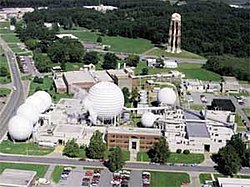


Langley Research Center located in Hampton, Virginia, was established in 1917 by NACA and is the oldest of NASA's field centers. The center is named after aviation pioneer Samuel Langley.[5] The center conducts research in aeronautics and spaceflight, with aeronautics accounting for the majority of its work.[6] It operates numerous wind tunnels used to study aircraft and spacecraft performance and safety. Langley also supported early human spaceflight programs, housing the Space Task Group responsible for Project Mercury until its relocation to Houston.[7][8]
Ames Research Center located at Moffett Field in Northern California, was established on December 20, 1939 and named after NACA founding member Joseph Sweetman Ames.[9] Originally focused on wind tunnel research for propeller-driven aircraft, Ames has expanded to include work in aeronautics, spaceflight, and information technology.[10] Its research areas include astrobiology, small satellites, robotic exploration, and thermal protection systems.
Glenn Research Center located in Brook Park, Ohio, was established in 1942 as a laboratory for aircraft engine research.[11] It was renamed in 1999 in honor of astronaut and U.S. senator John Glenn.[12] The center conducts research in propulsion, power systems, communications, and materials for aeronautics and spaceflight. It has contributed technologies to programs ranging from early human spaceflight to the International Space Station.[13]
Armstrong Flight Research Center located at Edwards Air Force Base in Southern California, originated as a NACA facility before 1946. It was renamed in 2014 in honor of astronaut Neil Armstrong. The center conducts flight research using experimental and modified aircraft.[14][15]
Transferred from the Army
[edit]
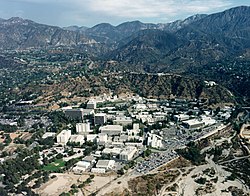


Jet Propulsion Laboratory (JPL) located in La Cañada Flintridge in Southern California, became part of NASA at its formation. The name reflects its original focus on jet-assisted propulsion systems.[16][17] Managed by the California Institute of Technology, it designs and operates robotic spacecraft for planetary, Earth science, and astronomy missions.[18] JPL also operates NASA's Deep Space Network, with tracking stations in California, Spain, and Australia.[19]
Marshall Space Flight Center located at Redstone Arsenal in Huntsville, Alabama, was transferred from the U.S. Army to NASA in 1958. It is named after U.S. Army General and statesman George C. Marshall.[20] The center led development of the Saturn V rocket and Skylab. It supports propulsion systems, payload integration, and elements of the International Space Station.[21][22][23] The center also oversees the Michoud Assembly Facility in New Orleans.[24]
Built by NASA
[edit]


Goddard Space Flight Center located in Greenbelt, Maryland, was established on March 1, 1959.[25] It is named after American rocket pioneer Robert H. Goddard. The center develops and operates uncrewed scientific spacecraft and conducts research in Earth science, astrophysics, and planetary science. GSFC also manages spaceflight tracking networks and supports satellite programs, including those for the National Oceanic and Atmospheric Administration.[26] The center also oversees the Wallops Flight Facility in Virginia, the Goddard Institute for Space Studies at New York's Columbia University, and the Katherine Johnson Independent Verification and Validation Facility in West Virginia.[27][28]
Stennis Space Center located in Hancock County, Mississippi, was commissioned on October 25, 1961.[29] It is named after U.S. senator John C. Stennis. The center serves as a major rocket engine test facility and is used by government and commercial organizations.[30][31]


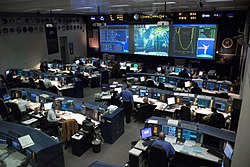
Johnson Space Center located in Houston, Texas, was established on November 1, 1961 as the Manned Spacecraft Center.[32] It was renamed in 1973 in honor of U.S. president Lyndon B. Johnson.[33][34] The center is responsible for astronaut training, mission control, and human spaceflight operations. It houses the NASA Astronaut Corps and the Christopher C. Kraft Jr. Mission Control Center.[32] The center also oversees the White Sands Test Facility in New Mexico


.jpg)
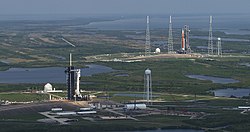
Kennedy Space Center located in Florida near Cape Canaveral, was established in 1962 as the Launch Operations Center. It was renamed in 1963 in honor of U.S. president John F. Kennedy.[35][36] The center serves as NASA's primary launch site for human spaceflight. The center includes the Vehicle Assembly Building, one of the largest structures by volume.[37]
Organization
[edit]- Ames Research Center
- Armstrong Flight Research Center
- Glenn Research Center
- Goddard Space Flight Center
- Jet Propulsion Laboratory
- Johnson Space Center
- Kennedy Space Center
- Langley Research Center
- Marshall Space Flight Center
- Stennis Space Center
List of minor facilities
[edit]
Communication and telescope facilities[edit]
|
See also
[edit]- Category:NASA facilities
- Category:NASA groups, organizations, and centers
- List of NASA Visitor Centers
- Columbia Scientific Balloon Facility
- Crawlerway
- Lunar Sample Laboratory Facility
- National Transonic Facility
- Shuttle Landing Facility
References
[edit]- ^ Shouse, Mary (July 9, 2009). "Welcome to NASA Headquarters". Retrieved July 15, 2009.
- ^ "NASA Center Assignments by State". NASA. 2012-09-10. Retrieved 2013-01-23.
- ^ "Does NASA Need a Closure Commission To Shut Down Idle Facilities? – SpaceNews.com". 1 April 2013.
{{cite web}}: CS1 maint: deprecated archival service (link) - ^ "NASA Facilities and Centers" (PDF). NASA. Archived from the original (PDF) on October 25, 2020. Retrieved July 30, 2020.
- ^ Tennant, Diane (September 5, 2011). "What's in a name? NASA Langley Research Center". The Virginian-Pilot. Retrieved September 5, 2011.
- ^ Rothman, Lily (January 5, 2017). "What to Know About the Real Research Lab From Hidden Figures". Time. Retrieved September 8, 2022.
- ^ Swenson Jr., Lloyd S.; Grimwood, James M.; Alexander, Charles C. "Space Task Group Gets a New Home and Name". This New Ocean, SP-4201. NASA. Retrieved July 24, 2019.
- ^ Korsgaard, Sean (20 July 2019). "Williamsburg recalls watching Apollo 11 and helping crew get there". Virginia Gazette, Daily Press. Tribune Media. Archived from the original on 24 July 2019. Retrieved 24 July 2019.
- ^ Pearlman, Robert (January 15, 2014). "Should NASA Ames Be Renamed After Sally Ride?". space.com. Retrieved September 8, 2022.
- ^ Tillman, Nola (January 12, 2018). "Ames Research Center: R&D Lab for NASA". space.com. Retrieved September 7, 2022.
- ^ "NASA Glenn's Historical Timeline". NASA. April 16, 2015. Retrieved September 4, 2022.
- ^ "NASA Glenn Research Center Name Change". NASA. Archived from the original on May 5, 2021. Retrieved September 4, 2022.
- ^ "History of John H. Glenn Research Center at Lewis Field". NASA. September 20, 2016. Retrieved September 4, 2022.
- ^ "House passes bill to rename NASA facility for Armstrong". Spaceflight Now. 2012-12-31. Retrieved 2013-01-01.
- ^ "NASA Center Redesignated for Neil Armstrong; Test Range for Hugh Dryden". 9 March 2015. Archived from the original on 27 June 2017. Retrieved 18 April 2014.
- ^ "Why does everyone say NASA's JPL is in Pasadena when this other city is its real home?". 14 July 2016.
- ^ NASA.gov
- ^ Voosen, Paul (June 3, 2022). "New director of NASA's storied Jet Propulsion Lab takes on ballooning mission costs". science.com. Retrieved September 7, 2022.
- ^ Werner, Debra (January 27, 2022). "Microsoft helps JPL with Deep Space Network scheduling". Space News. Retrieved September 7, 2022.
- ^ "Marshall Space Flight Center, ca. 1960s". Encyclopedia of Alabama. Retrieved 2021-09-14.
- ^ Dunn, Marcia (August 6, 2018). "Rocket City, Alabama: Space history and an eye on the future". ap news. Retrieved September 8, 2022.
- ^ Fentress, Steve (July 6, 2021). "NASA's Marshall Space Flight Center: A hub for historic and modern-day rocket power". space.com. Retrieved September 8, 2022.
- ^ "MSFC_Fact_sheet" (PDF). NASA. Archived (PDF) from the original on October 25, 2011. Retrieved October 1, 2011.
- ^ Haines, Matt (November 14, 2019). "New Orleans' NASA Michoud Facility Is The History And Future Of Space Exploration". verylocal.com. Retrieved September 7, 2022.
- ^ "History of Goddard Space Flight Center". NASA. September 20, 2016. Retrieved September 4, 2022.
- ^ Fentress, Steve (February 10, 2020). "NASA's Goddard Space Flight Center: Exploring Earth and space by remote control". space.com. Retrieved September 8, 2022.
- ^ "About NASA's IV&V Program". NASA. March 9, 2015. Retrieved September 4, 2022.
- ^ Yan, Holly (February 24, 2019). "NASA renames facility for real-life 'Hidden Figures' hero Katherine Johnson". CNN. Retrieved September 4, 2022.
- ^ Cite error: The named reference
ref25was invoked but never defined (see the help page). - ^ Lopez, Kenny (August 9, 2022). "Stennis Space Center tests rocket engines that will be used in NASA's historic Artemis I mission to the moon". WGNO TV. Retrieved September 4, 2022.
- ^ "Stennis Space Center set for active testing year". Meridian Star. January 22, 2022. Retrieved September 4, 2022.
- ^ a b NASA. "Lyndon B. Johnson Space Center". Archived from the original on 1998-12-01. Retrieved 2008-08-27.
- ^ "Houston Space Center Is Named for Johnson". The New York Times. February 20, 1973. p. 19.
- ^ Nixon, Richard M. (February 19, 1973). "50 – Statement About Signing a Bill Designating the Manned Spacecraft Center in Houston, Texas, as the Lyndon B. Johnson Space Center". Retrieved July 9, 2011.
- ^ "The National Archives, Lyndon B. Johnson Executive Order 11129". Retrieved April 26, 2010.
- ^ "Kennedy Space Center Story". NASA. 1991. Archived from the original on May 20, 2017. Retrieved November 5, 2015.
- ^ "Senate". Congressional Record: 17598. September 8, 2004.


- Pages with reference errors
- CS1 maint: deprecated archival service
- Pages with broken reference names
- Articles with short description
- Short description is different from Wikidata
- Use American English from July 2019
- All Wikipedia articles written in American English
- Pages using multiple image with auto scaled images