


Namaste (Sanskrit pronunciation: [nɐmɐsteː],[1] Devanagari: नमस्ते), sometimes called namaskār and namaskāram, is a customary Hindu[2][3][4] manner of respectfully greeting and honouring a person or group, used at any time of day.[5] It is used by people of the Hindu, Buddhist and Jain traditions. Namaste is usually spoken with a slight bow and hands pressed together, palms touching and fingers pointing upwards, thumbs close to the chest. This gesture is Añjali Mudrā; the standing posture in modern yoga that incorporates it is pranāmāsana.[6]
Etymology, meaning and origins
[edit]


Right: Entrance pillar relief (Thrichittatt Maha Vishnu Temple, Kerala).
Namaste (Namas + te) is derived from Sanskrit and is a combination of the word namas and the second person dative pronoun in its enclitic form, te.[7] The word namaḥ takes the form namas before the sound te.[8][9]
It is found in the Vedic literature. Namas-krita and related terms appear in the Hindu scripture Rigveda such as in the Vivaha Sukta, verse 10.85.22[10] in the sense of "worship, adore", while Namaskara appears in the sense of "exclamatory adoration, homage, salutation and worship" in the Atharvaveda, the Taittiriya Samhita, and the Aitareya Brahmana. It is an expression of veneration, worship, reverence, an "offering of homage" and "adoration" in the Vedic literature and post-Vedic texts such as the Mahabharata.[11][12] The phrase Namas-te appears with this meaning in Rigveda 8.75.10,[13] Atharvaveda verse 6.13.2, Taittirya Samhita 2.6.11.2 and in numerous other instances in many early Hindu texts.[14] It is also found in numerous ancient and medieval era sculpture and mandapa relief artwork in Hindu temples.[15]
According to the Indologist Stephen Phillips, the terms "te and tvam" are an informal, familiar form of "you" in Sanskrit, and it is typically not used for unfamiliar adults. It is reserved for someone familiar, intimate, divine or a child.[16][17] By using the dative form of tvam in the greeting Namas-te, there is an embedded secondary, metaphorical sense in the word. This is the basis of the pragmatic meaning of Namas-te, that is "salutations to the (divine) child (in your heart)", states Phillips.[16]
In the contemporary era, namaḥ means 'bow', 'obeisance', 'reverential salutation' or 'adoration'[18] and te means 'to you' (singular dative case of 'tvam'). Therefore, namaste literally means "bowing to you".[19] In Hinduism, it also has a spiritual import reflecting the belief that "the divine and self (atman, Self) is same in you and me", and connotes "I bow to the divine in you".[20][5][21] According to the sociologist Holly Oxhandler, it is a Hindu term which means "the sacred in me recognizes the sacred in you".[22]
A less common variant is used in the case of three or more people being addressed namely Namo vaḥ which is a combination of namaḥ and the enclitic second person plural pronoun vaḥ.[7] The word namaḥ takes the sandhi form namo before the sound v.[8] An even less common variant is used in the case of two people being addressed, namely, Namo vām, which is a combination of namaḥ and the enclitic second person dual pronoun vām.[7]
Excavations at Indus Valley Civilisation sites have found male and female terracotta figures in a posture like Añjali Mudrā.[23][24] These archaeological findings are dated to the Mature Harappan.[25][26]
Anjali mudra
[edit]The gesture of folding hands during a namaste is called the Añjali Mudrā.[27] In addition to namaste, this mudra is one of the postures found in Indian classical dance such as Bharatanatyam,[28] and in yoga practice.[29] It is widely found in Indian temple reliefs and sculpture in mandapam, at entrances and iconography such as the Lingobhavamurti of Shaivism.[30][31] The Anjali mudra differs from namaste by being a non-verbal gesture, while namaste can be said with or without any gesture. According to Bhaumik and Govil, the Anjali mudra and Namaskara mudra are very similar but have a subtle difference. The back of the thumbs in Anjali mudra face the chest and are perpendicular to other fingers, while the thumbs in Namaskara mudra are aligned with the other fingers.[32]
Anjali mudra is described in Sanskrit texts such as in verse 9.127–128 of the Natya Shastra (200 BCE – 200 CE), in temple architecture texts dated after the sixth-century CE such as in verse 5.67 of the Devata murti prakarana and those on painting called the Citrasutras. The Natya Shastra, a classical Indian dance text, describes it to be a posture where the two hands are folded together in a reverential state and that this is used to pray before a deity, receive any person one reveres and also to greet friends. The Natya Shastra further states that for prayers inside a temple, the Anjali mudra should be placed near one's head or above, while meeting someone venerable it is placed in front of one's face or chin, and for friends near one's chest.[33][34]
Uses
[edit]Greeting
[edit]Añjali Mudrā is widely used throughout the Indian subcontinent, parts of Asia and beyond where people of South and Southeast Asian origins have migrated.[20] Namaste is a respectful form of greeting, acknowledging and welcoming a relative, guest or stranger.[35] In some contexts, namaste is used by one person to express gratitude for assistance offered or given, and to thank the other person for their generous kindness.[36]
Since namaste is a non-contact form of greeting, some world leaders adopted the gesture as an alternative to hand shaking during the 2020 Coronavirus pandemic as a means to prevent the spread of the virus.[37][38]
- World leaders adopting Namaste during COVID-19


.jpg)

Hindu veneration practice
[edit]Namaskara is one of the 16 upacharas (veneration practices) used in temples and places of formal puja (worship).[39] Namaste in the context of deity worship, scholars conclude,[40][41] has the same function as in greeting a guest or anyone else. It expresses politeness, courtesy, honor, and hospitality from one person to the other. It is used in goodbyes as well. This is sometimes expressed, in ancient Hindu scriptures such as Taittiriya Upanishad, as Atithi Devo Bhava (literally, treat the guest like a god).[42][43] Namaskara is one of the six forms of pranāma, and in parts of India these terms are used synonymously.[44][45]
-
A Hindu man making the Añjali Mudrā
-
👁 The ninth line from the top, last word in the Rigveda manuscript above is namas in the sense of "reverential worship"The ninth line from the top, last word in the Rigveda manuscript above is namas in the sense of "reverential worship"
-
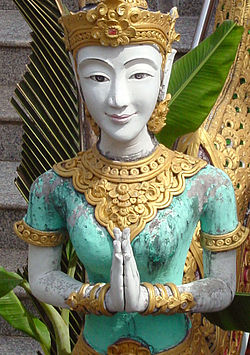
Wai gesture in a Thai temple
-
Yakshi salabhanjika, c. 100 BCE, Satna, Madhya Pradesh
-
Statue in Bali, Indonesia




In modern yoga
[edit]It's the end of a typical yoga class. The teacher sits cross-legged, takes their hands in a prayer position, and reverently intones namaste. Dutiful students whisper namaste in unison in return without understanding the meaning of namaste.[27]
'Namaste' has been adopted in modern yoga as exercise as a respectful word, spoken in unison at the end of a class, or by a solitary practitioner as a personal meditation; from there, it has become a T-shirt slogan.[27] The Indian-born journalist Neha Tandon writes that nobody "buys a 'Namaste in bed' shirt with ill intentions", though in her view that does not excuse what she considers to be the evident cultural appropriation.[46] The British Pakistani yoga teacher Nadia Gilani writes that the western pronunciation "nama-stay" is incorrect; South Asians pronounce it "num us teh", while the association of 'namaste' with yoga is a modern western invention.[47] Rita Geno, writing in Yoga Journal, calls the usage "at the very least, puzzling"; it quotes the Indian yoga therapist Susanna Barkataki as saying it's a "rather formal" greeting, reserved for teachers and elders; it is not used to at a parting. Geno suggests that usage may be changing, quoting the author Deepak Singh as saying that the greeting was given to "every tourist" when he visited Rajasthan.[27] On the other hand, T-shirt puns like "Nama'stay in bed" or "Namaslay" are, Geno writes, straightforwardly offensive, misusing a "respectful and spiritually resonant" term.[27] As for use in a yoga class, the Indian American yoga teacher Aadil Palkhivala suggests that Namaste and Añjali Mudrā could be used both at the start, as a respectful greeting, and at the end, in gratitude and connection.[27]
- In modern yoga as exercise
-
The modern yoga guru Sharon Gannon, co-founder of Jivamukti Yoga, making the Añjali Mudrā
-
👁 'Namaste' has been adopted in modern yoga as exercise as a respectful word, and less appropriately as a T-shirt slogan.[27]'Namaste' has been adopted in modern yoga as exercise as a respectful word, and less appropriately as a T-shirt slogan.[27]


![👁 'Namaste' has been adopted in modern yoga as exercise as a respectful word, and less appropriately as a T-shirt slogan.[27]](https://upload.wikimedia.org/wikipedia/commons/thumb/e/e2/Namaste_in_bed.jpg/250px-Namaste_in_bed.jpg)
See also
[edit]References
[edit]- ^ "namaste". Oxford English Dictionary (Online ed.). Oxford University Press. (Subscription or participating institution membership required.). The British pronunciation is either /ˈnaməsteɪ/ or /naməˈsteɪ/, and the American is /ˈˌnɑməˈˌsteɪ/.
- ^ "How 'Namaste' Entered The English Language". www.merriam-webster.com. Retrieved 2021-08-18.
- ^ "Why 'namaste' has become the perfect pandemic greeting". Religion News Service. 2020-10-01. Retrieved 2021-08-18.
- ^ "Here's the history behind these no-touch greetings". Travel. 2020-03-23. Archived from the original on April 13, 2021. Retrieved 2021-08-18.
- ^ a b Singh, K. V. (2015). Hindu Rites and Rituals: Origins and Meanings. Penguin Books. pp. 123–124. ISBN 978-0143425106. Archived from the original on 2019-12-17. Retrieved 2017-05-20.
- ^ Chatterjee, Gautam (2001). Sacred Hindu Symbols. Abhinav Publications. pp. 47–48. ISBN 9788170173977. Archived from the original on 2017-01-11. Retrieved 2017-12-28.
- ^ a b c Burrow, Thomas . The Sanskrit Language, pp. 263–268
- ^ a b Burrow, Thomas The Sanskrit Language, pp. 100–102
- ^ Namah Archived 2014-08-27 at the Wayback Machine Sanskrit Dictionary
- ^ "उदीर्ष्वातो विश्वावसो नमसेळा महे त्वा । अन्यामिच्छ प्रफर्व्यं सं जायां पत्या सृज ॥२२॥, Griffith translates it as, "Rise up from hence, Visvavasu, with reverence we worship thee. Seek thou another willing maid, and with her husband leave the bride; RV, Griffith, Wikisource Archived 2020-01-05 at the Wayback Machine; other instances include RV 9.11.6 and many other Vedic texts; for a detailed list, see Maurice Bloomfield, Vedic Concordance Archived 2019-03-31 at the Wayback Machine, Harvard University Press
- ^ Monier-Williams, Monier. Sanskrit-English Dictionary with Etymology Namas Archived 2019-05-18 at the Wayback Machine, Oxford University Press, p. 528
- ^ namas Archived 2018-10-06 at the Wayback Machine, Monier-Williams Sanskrit-English Dictionary 1899 edition], Harvard University update (2008)
- ^ RV 8.75.10, Wikisource:
नमस्ते अग्न ओजसे गृणन्ति देव कृष्टयः ।
Translation: "Homage to your power, Agni! The separate peoples hymn you, o god."
Translators: Stephanie Jamison & Joel Brereton (2014), The Rigveda, Volume 2 of three, Oxford University Press, ISBN 978-01-99363-780, p. 1172 - ^ Maurice Bloomfield, Vedic Concordance Archived 2019-03-31 at the Wayback Machine, Harvard University Press, pp. 532–533
- ^ Nambiar, A. K. Krishna (1979). Namaste: Its Philosophy and Significance in Indian Culture. pp. vii–viii with listed pages. OCLC 654838066. Archived from the original on 2020-01-01. Retrieved 2018-11-02.
- ^ a b Phillips, Stephen H. (2009). Yoga, Karma, and Rebirth: A Brief History and Philosophy. Columbia University Press. p. 272 note 26. ISBN 978-0-231-51947-2.
- ^ This is similar to tu / vous of French and Romance languages in Europe, states the Indologist Patrick Olivelle, see: Olivelle, Patrick (2005). Manu's Code of Law. Oxford University Press. pp. 346 note 11.205. ISBN 978-0-19-517146-4.
- ^ "Cologne Digital Sanskrit Lexicon". Cologne Digital Sanskrit Dictionaries (search results). University of Cologne. Archived from the original on September 25, 2013. Retrieved March 24, 2012..
- ^ Namaste Archived 2014-03-02 at the Wayback Machine Douglas Harper, Etymology Dictionary
- ^ a b Ying, Y. W., Coombs, M., & Lee, P. A. (1999), "Family intergenerational relationship of Asian American adolescents", Cultural Diversity and Ethnic Minority Psychology, 5(4), pp. 350–363
- ^ Lawrence, J. D. (2007), "The Boundaries of Faith: A Journey in India", Homily Service, 41(2), pp. 1–3
- ^ Oxhandler, Holly (2017). "Namaste Theory: A Quantitative Grounded Theory on Religion and Spirituality in Mental Health Treatment". Religions. 8 (9): 168. doi:10.3390/rel8090168.
- ^ Sharma, Deo Prakash; Sharma, Madhuri (2003). Panorama of Harappan Civilization. Noida: Devangana Prakashan. p. 129. ISBN 978-81-7479-057-6.
- ^ "Origins of Hinduism" Archived 2014-02-26 at the Wayback Machine. Hinduism Today, Volume 7, Issue 2 (April/May/June), Chapter 1, p. 3
- ^ Seated Male in Namaskar pose Archived 2014-02-23 at the Wayback Machine National Museum of India (2012)
- ^ Kalyanaraman, Srinivasan (2010). Indus Script Cipher. Srinivasan Kalyanaraman. pp. 234–236. ISBN 978-0-9828971-0-2.
- ^ a b c d e f g Geno, Rita (24 March 2024) [14 June 2021]. "The Meaning of Namaste". Yoga Journal. Retrieved 30 March 2026.
- ^ Anami, Basavaraj S.; Bhandage, Venkatesh A. (2018-06-04). "A vertical-horizontal-intersections feature based method for identification of bharatanatyam double hand mudra images". Multimedia Tools and Applications. 77 (23). Springer Science: 31021–31040. doi:10.1007/s11042-018-6223-y. S2CID 46968377.
- ^ Carroll, C.; Carroll, R. (2012). Mudras of India: A Comprehensive Guide to the Hand Gestures of Yoga and Indian Dance. SD Publishers. pp. 44–46. ISBN 978-0-85701-067-4.
- ^ Barrett, Douglas (1964). "An Early Cola Lingodbhavamurti". The British Museum Quarterly. 28 (1/2 (Summer)): 32–39. JSTOR 4422848.
- ^ Kramrisch, Stella (1957). "Indian Sculpture Newly Acquired". Philadelphia Museum of Art Bulletin. 52 (252): 30–38 with Figures 2 and 3. doi:10.2307/3795036. JSTOR 379036.
- ^ Bhaumik, Gopa; Govil, Mahesh Chandra (2020). "Buddhist Hasta Mudra Recognition Using Morphological Features". Communications in Computer and Information Science. Singapore: Springer Singapore. pp. 356–364. doi:10.1007/978-981-15-6315-7_29. ISBN 978-981-15-6314-0. ISSN 1865-0929. S2CID 225349190.
- ^ Nardi, Isabella (2003). The Theory of Indian Painting: the Citrasutras, their Uses and Interpretations. SOAS, University of London. pp. 132–134, 273 Figure 67.
- ^ Brandon, James R. (2009). Theatre in Southeast Asia. Harvard University Press. pp. 137–139. ISBN 978-0674028746.
- ^ Jones, Constance; Ryan, James D. "Namaste". Encyclopedia of Hinduism. p. 302. ISBN 978-0-8160-5458-9.
- ^ Shaules, Joseph (2007). Deep Culture: The Hidden Challenges of Global Living. pp. 68–70. ISBN 978-1847690166.
- ^ "Coronavirus: Indian greeting namaste goes global". BBC. March 13, 2020. Retrieved October 13, 2023.
- ^ "Greet the Indian way: Israeli PM urges citizens to adopt 'Namaste' instead of handshakes to avoid COVID-19". www.timesnownews.com. 5 March 2020. Archived from the original on 2020-03-12. Retrieved 2020-03-29.
- ^ Viswanatha, S. V. (2013-08-21). Racial Synthesis in Hindu Culture. Routledge. p. 209. ISBN 978-1-136-38420-2.
- ^ Lochtefeld, James. The Illustrated Encyclopedia of Hinduism, Volume 2, ISBN 0-8239-2287-1, 720 pp.
- ^ Fuller, C. J. (2004), The Camphor Flame: Popular Hinduism and Society in India, Princeton, New Jersey: Princeton University Press, pp. 66–70, ISBN 978-0-691-12048-5
- ^ Kelkar, Mayuresh (30 September 2010). "SERVDIV: A Vedic Approach to Measurement of Service Quality". Services Marketing Quarterly. 31 (4): 420–433. doi:10.1080/15332969.2010.510722. ISSN 1533-2969.
- ^ de Nobili, Roberto (2000). Preaching Wisdom to the Wise. Saint Louis, Missouri: Institute of Jesuit Sources. p. 132. ISBN 978-1-880810-37-8.
- ^ Mehrotra, R. R. (1995). "How to be polite in Indian English". International Journal of the Sociology of Language. 116 (1): 99–110.
- ^ Chatterjee, G. (2003). Sacred Hindu Symbols. Abhinav Publications. pp. 47–49. ISBN 978-8170173977.
- ^ Cite error: The named reference
Tandon 2022was invoked but never defined (see the help page). - ^ Gilani 2022a, pp. 254–256.
External links
[edit]


- The Meaning of Namaste Yoga Journal
- Saying goodbye in different languages- Namaste
- Modes of Greetings in Kashmiri, Indian Institute of Language Studies
- Ancient Indus Valley Seal print showing Namaste/anjali mudra, CSU Chico


- Pages with reference errors
- Pages with plain IPA
- Webarchive template wayback links
- Pages with broken reference names
- Harv and Sfn no-target errors
- Articles with short description
- Short description matches Wikidata
- Use Indian English from January 2022
- All Wikipedia articles written in Indian English
- Pages with Sanskrit IPA
- Commons category link from Wikidata