

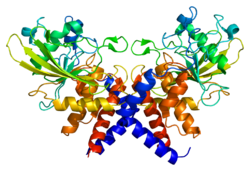


Receptor-type tyrosine-protein phosphatase-like N, also called "IA-2", is an enzyme that in humans is encoded by the PTPRN gene.[5][6]
Overview
[edit]The IA-2 protein encoded by PTPRN gene is a member of the protein tyrosine phosphatase (PTP) family and PTPRN subfamily. PTPs are known to be signaling molecules that regulate a variety of cellular processes including cell growth, differentiation, mitotic cycle, and oncogenic transformation. This PTP possesses an extracellular region, a single transmembrane region, and a single catalytic domain, and thus represents a receptor-type PTP. This PTP was found to be an autoantigen that is reactive with insulin-dependent diabetes mellitus (IDDM) patient sera, and thus may be a potential target of autoimmunity in diabetes mellitus.[6]
Structure
[edit]IA-2 and IA-2b belong to family of protein tyrosine phosphatase-like (PTP) molecules. IA-2 is a transmembrane protein with 979 amino acids encoded by a gene on human chromosome 2q35. Similarly, IA-2b has 986 amino acids, and it is located on human chromosome 7q36. The IA-2 is synthesised as a pro-protein of 110 kDa which is then converted by post-translational modifications into a 130 kDa protein.
The IA-2 and IA-2b shares 74% identity within the intracellular domains, but only 27% in the extracellular domains.
The IA-2 protein is expressed mainly in cells of neuroendocrine origin, such as pancreatic islets and brain. The IA-2 protein is localised in the membrane of secretory granules of pancreatic β-cells.[7][8]
Function
[edit]Even though the IA-2/b has a similar structure to other PTPs, there is a critical amino acid replacement at position 911 (Asp for Ala),[9] which is required for enzymatic activity. These proteins thus fail to show enzymatic activity and their function remains unclear.[7] They could play role in insulin secretory pathways, sorting out proteins or regulates other PTPs.[10]
Autoantigen in Type 1 Diabetes
[edit]The IA-2 is a second major autoantigen in Type 1 Diabetes. IA-2 autoantibodies are found in 78% type 1 diabetics at the time of diagnosis.[11] It has been shown that the autoantibodies exclusively react with the intracellular domain, also called juxtamembrane, but not with the extracellular domain of IA-2/b.[7]
It is suggested that IA-2 and not the IA-2b is the primary PTP-like autoantigen in Type 1 Diabetes. The juxtamembrane region in IA-2 is probably the early antibody target. Followed by multiple epitope spreading which is believed to take place in the early development of the disease.[12]
Autoantibodies in Type 1 Diabetes
[edit]Autoantibodies targeting pancreatic islet cell can occur years before a hyperglycaemia is established, therefore these autoantibodies are used in prediction of Type 1 Diabetes.
Islet cell autoantibodies are detected in serum, including ICA (islet cell cytoplasma autoantibodies), IAA (autoantibodies to insulin), GAD (glutamic acid decarboxylase), IA-2 (insulinoma-associated protein 2), and ZnT8 (zinc transporter of islet beta cells).[13]
However, it is not clear if a primary autoantigen exists and immune reaction against other molecules results from secondary antigen spreading, or multiple molecules represent a primary target.[14]
The first autoimmune targets are usually aimed against insulin or GAD, and it is unique to observe IA-2 or ZnT8 as the first autoantibodies. What set off the appearance of a first β-cell targeting autoantibody is unclear.[15]
The IAA antibody usually appears early in life, median age is 1.49. Presence of GAD as the first autoantibody is more widespread with median age 4.04. It is relatively rare to see IA-2 as the primary autoantibody, median age 3.03. Interestingly, secondary autoantibodies follow different patterns to mask the primary autoantibodies, if both are combined. If the primary autoantibody is IAA then GAD briskly appears with peak of 2 years age. Secondary IAA usually occurs after GAD, where the age distribution is over wide range.[14]
It is unknown whether the appearance of autoantibodies corresponds with insulitis process in the pancreas and if so, what is the combination of the autoantibodies.[13]
Interactions
[edit]PTPRN has been shown to interact with SPTBN4.[16]
References
[edit]- ^ a b c GRCh38: Ensembl release 89: ENSG00000054356 – Ensembl, May 2017
- ^ a b c GRCm38: Ensembl release 89: ENSMUSG00000026204 – Ensembl, May 2017
- ^ "Human PubMed Reference:". National Center for Biotechnology Information, U.S. National Library of Medicine.
- ^ "Mouse PubMed Reference:". National Center for Biotechnology Information, U.S. National Library of Medicine.
- ^ Lan MS, Lu J, Goto Y, Notkins AL (May 1994). "Molecular cloning and identification of a receptor-type protein tyrosine phosphatase, IA-2, from human insulinoma". DNA and Cell Biology. 13 (5): 505–514. doi:10.1089/dna.1994.13.505. PMID 8024693.
- ^ a b "Entrez Gene: PTPRN protein tyrosine phosphatase, receptor type, N".
- ^ a b c Notkins AL, Lan MS, Leslie RD (March 1998). "IA-2 and IA-2beta: the immune response in IDDM". Diabetes/Metabolism Reviews. 14 (1): 85–93. doi:10.1002/(SICI)1099-0895(199803)14:1<85::AID-DMR205>3.0.CO;2-I. PMID 9605631.
- ^ Lan MS, Lu J, Goto Y, Notkins AL (May 1994). "Molecular cloning and identification of a receptor-type protein tyrosine phosphatase, IA-2, from human insulinoma". DNA and Cell Biology. 13 (5): 505–514. doi:10.1089/dna.1994.13.505. PMID 8024693.
- ^ Notkins AL (November 2002). "Immunologic and genetic factors in type 1 diabetes". The Journal of Biological Chemistry. 277 (46): 43545–43548. doi:10.1074/jbc.R200012200. PMID 12270944.
- ^ Torii S (2009). "Expression and function of IA-2 family proteins, unique neuroendocrine-specific protein-tyrosine phosphatases". Endocrine Journal. 56 (5): 639–648. doi:10.1507/endocrj.K09E-157. PMID 19550073. S2CID 12710545.
- ^ Belhiba O, Aadam Z, Jeddane L, Saile R, Salih Alj H, Bousfiha AA, Jennane F (September 2020). "Research of anti-GAD and anti-IA2 autoantibodies by ELISA test in a series of Moroccan pediatric patients with diabetes type 1". African Health Sciences. 20 (3): 1337–1343. doi:10.4314/ahs.v20i3.40. PMC 7751543. PMID 33402983.
- ^ Naserke HE, Ziegler AG, Lampasona V, Bonifacio E (December 1998). "Early development and spreading of autoantibodies to epitopes of IA-2 and their association with progression to type 1 diabetes". Journal of Immunology. 161 (12): 6963–6969. doi:10.4049/jimmunol.161.12.6963. PMID 9862731. S2CID 46571282.
- ^ a b In't Veld P, Lievens D, De Grijse J, Ling Z, Van der Auwera B, Pipeleers-Marichal M, et al. (September 2007). "Screening for insulitis in adult autoantibody-positive organ donors". Diabetes. 56 (9): 2400–2404. doi:10.2337/db07-0416. PMID 17563060. S2CID 2572529.
- ^ a b Ilonen J, Hammais A, Laine AP, Lempainen J, Vaarala O, Veijola R, et al. (October 2013). "Patterns of β-cell autoantibody appearance and genetic associations during the first years of life". Diabetes. 62 (10): 3636–3640. doi:10.2337/db13-0300. PMC 3781470. PMID 23835325.
- ^ Katsarou A, Gudbjörnsdottir S, Rawshani A, Dabelea D, Bonifacio E, Anderson BJ, et al. (March 2017). "Type 1 diabetes mellitus". Nature Reviews. Disease Primers. 3 (1): 17016. doi:10.1038/nrdp.2017.16. PMID 28358037. S2CID 23127616.
- ^ Berghs S, Aggujaro D, Dirkx R, Maksimova E, Stabach P, Hermel JM, et al. (November 2000). "betaIV spectrin, a new spectrin localized at axon initial segments and nodes of ranvier in the central and peripheral nervous system". The Journal of Cell Biology. 151 (5): 985–1002. doi:10.1083/jcb.151.5.985. PMC 2174349. PMID 11086001.
Further reading
[edit]- Rabin DU, Pleasic SM, Shapiro JA, Yoo-Warren H, Oles J, Hicks JM, et al. (March 1994). "Islet cell antigen 512 is a diabetes-specific islet autoantigen related to protein tyrosine phosphatases". Journal of Immunology. 152 (6): 3183–3188. doi:10.4049/jimmunol.152.6.3183. PMID 8144912. S2CID 25401081.
- Solimena M, Dirkx R, Hermel JM, Pleasic-Williams S, Shapiro JA, Caron L, Rabin DU (May 1996). "ICA 512, an autoantigen of type I diabetes, is an intrinsic membrane protein of neurosecretory granules". The EMBO Journal. 15 (9): 2102–2114. doi:10.1002/j.1460-2075.1996.tb00564.x. PMC 450132. PMID 8641276.
- van den Maagdenberg AM, Olde Weghuis D, Rijss J, van de Wetering RA, Wieringa B, Geurts van Kessel A, Hendriks WJ (1996). "Assignment of the human gene for receptor-type protein tyrosine phosphatase IA-2 (PTPRN) to chromosome region 2q35 → q36.1 and identification of an intragenic genetic marker". Cytogenetics and Cell Genetics. 73 (1–2): 145–148. doi:10.1159/000134327. hdl:2066/23317. PMID 8646884.
- Cui L, Yu WP, DeAizpurua HJ, Schmidli RS, Pallen CJ (October 1996). "Cloning and characterization of islet cell antigen-related protein-tyrosine phosphatase (PTP), a novel receptor-like PTP and autoantigen in insulin-dependent diabetes". The Journal of Biological Chemistry. 271 (40): 24817–24823. doi:10.1074/jbc.271.40.24817. PMID 8798755.
- Xie J, Zhang B, Lan MS, Notkins AL (December 1998). "Genomic structure and promoter sequence of the insulin-dependent diabetes mellitus autoantigen, IA-2 (PTPRN)". Genomics. 54 (2): 338–343. doi:10.1006/geno.1998.5583. PMID 9828138.
- Ort T, Maksimova E, Dirkx R, Kachinsky AM, Berghs S, Froehner SC, Solimena M (September 2000). "The receptor tyrosine phosphatase-like protein ICA512 binds the PDZ domains of beta2-syntrophin and nNOS in pancreatic beta-cells". European Journal of Cell Biology. 79 (9): 621–630. doi:10.1078/0171-9335-00095. PMID 11043403.
- Park YS, Kawasaki E, Kelemen K, Yu L, Schiller MR, Rewers M, et al. (October 2000). "Humoral autoreactivity to an alternatively spliced variant of ICA512/IA-2 in Type I diabetes". Diabetologia. 43 (10): 1293–1301. doi:10.1007/s001250051525. PMID 11079748.
- Berghs S, Aggujaro D, Dirkx R, Maksimova E, Stabach P, Hermel JM, et al. (November 2000). "betaIV spectrin, a new spectrin localized at axon initial segments and nodes of ranvier in the central and peripheral nervous system". The Journal of Cell Biology. 151 (5): 985–1002. doi:10.1083/jcb.151.5.985. PMC 2174349. PMID 11086001.
- Diez J, Park Y, Zeller M, Brown D, Garza D, Ricordi C, et al. (April 2001). "Differential splicing of the IA-2 mRNA in pancreas and lymphoid organs as a permissive genetic mechanism for autoimmunity against the IA-2 type 1 diabetes autoantigen". Diabetes. 50 (4): 895–900. doi:10.2337/diabetes.50.4.895. PMID 11289059.
- Ort T, Voronov S, Guo J, Zawalich K, Froehner SC, Zawalich W, Solimena M (August 2001). "Dephosphorylation of beta2-syntrophin and Ca2+/mu-calpain-mediated cleavage of ICA512 upon stimulation of insulin secretion". The EMBO Journal. 20 (15): 4013–4023. doi:10.1093/emboj/20.15.4013. PMC 149140. PMID 11483505.
- Mikulecký M, Michalková D (2002). "Secular and seasonal cycling of IA2-ab autoantibody in Slovak diabetic children". Biomedicine & Pharmacotherapy. 55 (Suppl 1): 106s–109s. doi:10.1016/s0753-3322(01)90014-9. PMID 11774856.
- Miao D, Yu L, Tiberti C, Cuthbertson DD, Rewers M, di Mario U, et al. (March 2002). "ICA512(IA-2) epitope specific assays distinguish transient from diabetes associated autoantibodies". Journal of Autoimmunity. 18 (2): 191–196. doi:10.1006/jaut.2001.0577. PMID 11908951.
- Kawasaki E, Yamaguchi H, Hattori H, Egashira T, Eguchi K (April 2002). "Autoantibodies to IA-2 in type 1 diabetes: measurements with a new enzyme-linked immunosorbent assay". Annals of the New York Academy of Sciences. 958: 241–246. doi:10.1111/j.1749-6632.2002.tb02978.x. PMID 12021115. S2CID 45659598.
- Sanjeevi CB, Das AK, Shtauvere-Brameus A (April 2002). "BCG vaccination and GAD65 and IA-2 autoantibodies in autoimmune diabetes in southern India". Annals of the New York Academy of Sciences. 958 (1): 293–296. Bibcode:2002NYASA.958..293S. doi:10.1111/j.1749-6632.2002.tb02990.x. PMID 12021127. S2CID 44799912.
- Bearzatto M, Lampasona V, Belloni C, Bonifacio E (December 2003). "Fine mapping of diabetes-associated IA-2 specific autoantibodies". Journal of Autoimmunity. 21 (4): 377–382. doi:10.1016/j.jaut.2003.08.002. PMID 14624760.
- Trajkovski M, Mziaut H, Altkrüger A, Ouwendijk J, Knoch KP, Müller S, Solimena M (December 2004). "Nuclear translocation of an ICA512 cytosolic fragment couples granule exocytosis and insulin expression in {beta}-cells". The Journal of Cell Biology. 167 (6): 1063–1074. doi:10.1083/jcb.200408172. PMC 2172607. PMID 15596545.
- Ota T, Takamura T, Nagai Y, Bando Y, Usuda R (January 2005). "Significance of IA-2 antibody in Japanese type 1 diabetes: its association with GAD antibody". Diabetes Research and Clinical Practice. 67 (1): 63–69. doi:10.1016/j.diabres.2004.05.004. PMID 15620435.

