

.png)








The Pakistan Air Force (PAF) (Urdu: پاک فِضائیہ, romanised: Pāk Fizāʾiyah; pronounced [pɑːkfɪzɑːɪjəɦ])[Note 1] is the aerial warfare branch of the Pakistan Armed Forces, tasked primarily with the aerial defence of Pakistan, with a secondary role of providing air support to the Pakistan Army and Pakistan Navy when required, and a tertiary role of providing strategic airlift capability to Pakistan.
As of 2024[update], per the International Institute for Strategic Studies, the PAF has more than 70,000 active-duty personnel.[2] Its primary mandate and mission is "to provide, in synergy with other inter-services, the most efficient, assured and cost effective aerial defence of Pakistan." Since its establishment in 1947, the PAF has been involved in various combat operations, providing aerial support to the operations and relief efforts of the Pakistani military.[7] Under Article 243 of the Constitution, the president of Pakistan is the civilian commander-in-chief of the Pakistan Armed Forces. The Chief of the Air Staff (CAS), by statute a four-star air officer, is appointed by the president with the consultation and confirmation needed from the prime minister of Pakistan.[8]
History
1947–1950: Formative years
This section does not cite any sources. Please help improve this section by adding citations to reliable sources. Unsourced material may be challenged and removed. (February 2024) (Learn how and when to remove this message) |


The Royal Pakistan Air Force (RPAF) was established on 15 August 1947 with the independence of Pakistan from British India. The RPAF began with a paper share allotment of 2,332 personnel, a fleet of 24 Tempest II fighter-bombers, 16 Hawker Typhoon fighters, two H.P.57 Halifax bombers, two Auster aircraft, twelve North American Harvard trainers and ten de Havilland Tiger Moth biplanes. Very few were available to the RPAF on the ground as they were scattered throughout the British India to be given and collected later on. Of these very few were in flyable condition so that they could be used. Subsequently, it also got eight C-47 Dakota cargo planes which it used to transport supplies to soldiers fighting in the 1947 War in Kashmir against India. First two H.P.57 Halifax bombers were delivered in 1948 and were used during 1947 War for night-time supply drop missions at Skardu and other northern areas of Pakistan. All received against allotted at the time of independence of Pakistan from British India. It started with seven airbases scattered all over the provinces.
1948–1954: Waziristan rebellion
After the partition of British India, Faqir of Ipi, a Pashtun separatist leader rejected the creation of the newly created Pakistan.
In 1948, the Faqir of Ipi took control of North Waziristan's Datta Khel area and declared the establishment of an independent Pashtunistan, with support from neighbouring Kingdom of Afghanistan.
In response to the Faqir's rebellion, Pakistan Air Force in June 1949 inadvertently bombed the Afghan village of Mughalgai on the Waziristan border with Afghanistan while chasing the Pashtunistan separatists who had attacked Pakistani border posts from Afghanistan, this attack came to known as Mughalgai raid which left 23 separatists dead and further fuelled Afghan support for Pashtunistan. Faqir established Gurwek as headquarters for his activities. Faqir also established a rifle factory in Gurwek with the material support provided by the government of Afghanistan.
In 1953–1954, the PAF's No. 14 Squadron led an operation from Miranshah airbase and heavily bombarded the Faqir of Ipi's compound in Gurwek which ultimately forced Faqir to detach from an armed campaign against Pakistan.
1959 Indian aerial intrusion
On 10 April 1959, on the occasion of the Eid ul-Fitr festival holiday in Pakistan, an Indian Air Force (IAF) English Electric Canberra B(I)58 of No. 106 Squadron entered Pakistani airspace on a photo reconnaissance mission. Two PAF F-86F Sabres (Flt. Lt. M. N. Butt (leader) and Flt. Lt. M. Yunis) of No. 15 Squadron on Air Defence Alert (ADA) were scrambled from PAF Base Peshawar to intercept the IAF aircraft. Butt attempted to bring down the Canberra by firing his Sabre's machine guns, but the Canberra was flying at an altitude of more than 50,000 feet—beyond the operational ceiling of the F-86F. When Yunis took over from his leader, the Canberra suddenly lost height while executing a turn over Rawalpindi. Yunis fired a burst that struck the Canberra at an altitude of 47,500 feet and brought it down over Rawat, marking the first direct aerial victory of the PAF. Both crew members of the IAF Canberra ejected and were captured by Pakistani authorities. They were subsequently released after remaining in detention for some time.[9][10][11]
1960–1961 Bajaur Campaign
Between 1960 and 1961, Royal Afghan Army troops along with thousands of Pashtun tribesmen from Afghanistan crossed the extremely porous Pakistan–Afghanistan border and entered the semi-autonomous Bajaur Agency of Pakistan in an effort to annex the region.
The Pakistan Air Force sent F-86 Sabre jets in order to support the Pakistani forces and local Pashtun tribesmen of Pakistan who were fighting the Afghan infiltrators. The F-86 Sabre jets also executed bombing runs on Royal Afghan Army positions in Kunar, Afghanistan, thus leading Afghan forces to fall back to the international border. Although the Royal Afghan Air Force had seven MiG-17 squadrons and another MiG-21 squadron being operationalised, no known dogfight has been recorded between the two sides.
Indo-Pakistani War of 1965
The PAF fleet at the time consisted of 12 F-104 Starfighters, some 120 F-86 Sabres and around 20 B-57 Canberra bombers.[12] The PAF claims to have had complete air superiority over the battle area from the second day of operations.[13] However, IAF Air Chief Marshal Arjan Singh claimed that, despite having been qualitatively inferior to the PAF, the IAF allegedly achieved total air superiority in three days.[14]
Many publications have credited the PAF's successes in combat with the IAF to its U.S.-quality equipment, claiming it to be superior to the aircraft operated by the IAF and giving the PAF a "qualitative advantage". This statement has been refuted by some officials in Pakistan, who say that the IAF's MiG-21, Hawker Hunter and Folland Gnat aircraft had better performance than the PAF's F-86 fighters, without accounting for the obvious quantitative advantage that the IAF possessed.[15] According to retired PAF Air Commodore Sajad Haider, the F-86 Sabre was inferior in terms of both power and speed to the IAF's Hawker Hunter.[15][16][17][18]
Air Commodore Sajad Haider, who flew with No. 19 squadron also stated that the F-104 Starfighter did not deserve its reputation as "the pride of the PAF" because it "was unsuited to the tactical environment of the region. It was a high-level interceptor designed to neutralise Soviet strategic bombers in altitudes above 40,000 feet." Nevertheless, the IAF is believed to have feared facing the Starfighter in combat[16] despite its lack of effectiveness in comparison to the IAF's fleet of Folland Gnats.[19] According to Indian sources, the F-86F performed reasonably well against the IAF's Hunters but not as well against the Gnat, which was nicknamed the Sabre Slayer by the IAF.[20][21]


Per India, most of the aircraft losses of the IAF were allegedly on the ground while the PAF suffered most of their losses in aerial combat,[22] a claim that has widely been accepted by most international sources as "a stretch".[22] The IAF ran a larger offensive air campaign by devoting 40% of its air effort to offensive air support alone.[22]
The two countries have made contradictory claims of combat losses during the war and few neutral sources have verified the claims of either country, as is the case with most India-Pakistan conflicts. The PAF claims that it shot down 104 IAF aircraft and lost 19 of its own, while the IAF claimed it shot down 73 PAF aircraft while losing 60 of its own.[23] According to most independent and neutral sources, the PAF lost some 20 aircraft while the IAF lost somewhere between 60 and 75.[24]
Despite the intense fighting throughout the course of the war, the conflict was effectively a stalemate and inconclusive in its result.[25]
Indo-Pakistani War of 1971


By late 1971, the intensification of the independence movement in erstwhile East Pakistan led to the Bangladesh Liberation War (later joined by India).[26] On 22 November 1971, 10 days before the start of a full-scale war, four PAF F-86 Sabre jets attacked Indian and Mukti Bahini positions at Garibpur, near the international border. Two of the four PAF Sabres were shot down and one damaged by the IAF's Gnats.[27] On 3 December, India formally declared war against Pakistan following massive preemptive strikes by the PAF against IAF installations in Srinagar, Ambala, Sirsa, Halwara and Jodhpur. However, the IAF did not suffer any significant losses because the leadership had anticipated such a move and consequently, precautions were taken.[28] The IAF was quick to respond to Pakistani airstrikes, following which the PAF carried out mostly defensive sorties.[29]
Hostilities officially ended at 14:30 GMT on 17 December, after the fall of Dacca on 15 December. The PAF flew about 2,840 sorties and destroyed 71 IAF aircraft while losing 43 of its own. [30]But most independent and neutral sources claim that PAF lost 75 aircraft while the IAF lost 45–60 aircraft.[31][32][33]
1979–1989: Soviet–Afghan War
.jpg)

In 1979, the PAF's Chief of the Air Staff, Air Chief Marshal Anwar Shamim, was told by then-President and Chief of the Army Staff General Zia-ul-Haq, that Pakistan had reliable intelligence on Indian plans to attack and destroy Pakistan's nuclear research facilities in Kahuta. ACM Shamim told General Zia-ul-Haq that, in the PAF's current state, "Indian aircraft could reach the area in three minutes whereas the PAF would take eight minutes, allowing the Indians to attack the facility and return before the PAF could defend or retaliate". Because Kahuta was close to the Indian border, a consensus was reached acknowledging that the best way to deter a possible Indian attack would be to procure new advanced fighters and weaponry. These could be used to mount a retaliatory attack on India's nuclear research facilities in Trombay in the event of an Indian attack on Kahuta. It was decided the most suitable aircraft would be the F-16 Fighting Falcon, which the United States eventually agreed to supply after the PAF refused to purchase the F-5. In 1983, when the first batch of F-16s reached Pakistan, ACM Shamim informed Zia of the PAF's increasing capability to effectively respond to an attack on the nuclear research facilities at Kahuta.[34][35]
Due to rising tensions with the Soviet Union due to its invasion of Afghanistan, Pakistan's ISI systematically coordinated with the CIA, MI6 and Mossad to secure American resources and armaments for the Afghan mujahideen who were combating the invading Soviet forces. Various reports during this period widely indicated that the PAF had in fact covertly engaged in aerial combat against the Soviet Air Force in support of the Afghan Air Force during the course of the conflict;[36] one of which belonged to Alexander Rutskoy.[36]
A letter of agreement for up to 28 F-16A and 12 F-16B was signed in December 1981. The contracts, Peace Gate I and Peace Gate II were for 6 and 34 Block 15 models respectively, which would be powered by the F100-PW-200 engine. The first Peace Gate I aircraft was accepted at Fort Worth in October 1982. Two F-16A and four F-16B were subsequently delivered to Pakistan in 1983, with the first F-16 arriving at PAF Base Sargodha (now known as PAF Base Mushaf) on 15 January 1983 flown by Squadron Leader Shahid Javed. The 34 remaining aircraft as part of Peace Gate II were delivered between 1983 and 1987.[37]
Between May 1986 and November 1988,[38] the PAF's newly acquired F-16s had shot down at least eight intruding aircraft from Afghanistan. The first three of these (one Su-22, one probable Su-22, and one An-26) were shot down by two pilots from No. 9 Squadron. Pilots of No. 14 Squadron destroyed the remaining five intruders (two Su-22s, two MiG-23s, and one Su-25).[39] Most of these kills were by the AIM-9 Sidewinder, but at least one (a Su-22) was destroyed by cannon fire. Pakistani Flight Lieutenant Khalid Mahmoud is credited with three of these kills.[40][41]
The PAF is believed to have evaluated the French Dassault Mirage 2000 in early 1981 and was planning to evaluate the F-16 Fighting Falcon afterwards.[42]
1990–2001: U.S. arms embargo
| 👁 Flag of the PAF |
| Components |
|---|
|
| Administration |
| Overseas |
| Personnel |
| Equipment |
| History |
| Locations |
| Pakistan portal |
After the Pressler amendment was passed, the United States placed sanctions and an arms embargo on Pakistan starting on 6 October 1990 due to the continuance of the country's nuclear weapons research programme. All eleven Peace Gate III F-16s, along with seven F-16A and ten F-16B of the 60 Peace Gate IV F-16s, which had been built by the end of 1994 were embargoed and put into storage on U.S. soil.[37][43]
Desperate for a new high-tech combat aircraft, between late 1990 and 1993 the PAF evaluated the European Panavia Tornado MRCA (multi-role combat aircraft), and ultimately rejected it. France's Dassault Mirage 2000E and an offer from Poland for the supply of MiG-29s and Su-27s were also considered, but no deal materialised. In 1992, the PAF once again looked towards the French Mirage 2000, reviving a proposal from the early 1980s to procure around 20–40 aircraft, but a sale did not occur because France did not want to sell a fully capable version due to pressure from the United States. In August 1994, the PAF was offered the Saab JAS-39 Gripen by Sweden, but the sale did not occur because 20% of the Gripen's components were sourced from the U.S., which was still maintaining sanctions on Pakistan.[44]
In mid-1992, Pakistan was close to signing a contract for the supply of 40 Dassault Mirage 2000s, equipped with Thomson-CSF RDM/7 radars from France, although U.S. sanctions also prevented this deal from finalising.[45]
In mid-1994, it was reported that Russian manufacturers Sukhoi and Mikoyan were offering the Su-27 and MiG-29,[46] but Pakistan was reported to be negotiating for supply of the Mirage 2000–5.[47] French and Russian teams visited Pakistan on 27 November 1994 and it was speculated that the interest in Russian aircraft was to pressure France into reducing the price of the Mirage 2000. The stated requirement was for up to 40 aircraft.[48]
2001–2021: War in Afghanistan
The Pakistan Air Force is believed to have had a primary role in the alleged evacuation of Taliban personnel by the Pakistani military from Afghanistan. However, Pakistani and American officials have denied any such airlift taking place.[49][50]
2008 post-Mumbai attacks air alert
After the 2008 Mumbai attacks, the Pakistan Air Force was put on high alert in anticipation of any potential Indian accusations and offensives. It deployed to all its wartime locations and started routine combat air patrols. The speed and intensity of the deployment and PAF's readiness took the Indian Army High Command by surprise and later reports suggest that was the main factor to influence the Indians' decision of not going for cross border raids inside Pakistan.[51][52] The PAF was issued a standing order to launch an immediate counter-attack in case of an air attack from India, after a call from the Indian Foreign Minister Pranab Mukherjee to the Pakistani President Asif Ali Zardari (the call later turned out to be a hoax).[51][52][53][54][55]
2011 U.S. raid in Abbottabad
An initial investigation report revealed that the Pakistan Air Force (PAF) reported the movement of some half-a-dozen planes near the Jalalabad border at 23:00 before American helicopters entered Abbottabad to kill Osama bin Laden. "One aircraft was identified as a US AWACS and the remaining five were recognized as F/A-18 jets of the US. These planes flew near the Pakistani border, but did not cross into the airspace of Pakistan,"[56]
On the detection of an intrusion, PAF jets on air defence alert were scrambled and the PAF immediately took adequate operational measures as per standard operating procedure. The PAF aircraft continued their presence in the Abbottabad area until early morning and later returned to their air bases.[57]
However, the operation was conducted with stealthy modified versions of the Black Hawk helicopter which used special technology to avoid detection to entered Pakistani airspace, stayed for three hours to carry out a major operation. PAF jets only arrived at the location 24 minutes after the American helicopters had left. It was one of the most asymmetric capability incidents in PAF history.[58][59]
2001–2021: Counter-insurgency operations in North-West Pakistan


The Pakistan Army faced several problems during its 2009 offensive against the Taliban in North-West Pakistan. Hundreds of thousands of Pakistanis vacated the area when the offensive was announced and, eventually, over two million had to be accommodated in refugee camps. The offensive was to be completed as quickly as possible to allow the refugees to return to their homes but the army's fleet attack helicopters were insufficient to provide adequate support to infantry on the ground. The PAF was sent into action against the Taliban to make up for the lack of helicopter gunships. Because the PAF was trained and equipped to fight a conventional war, a new "counter-terrorist doctrine" had to be improvised.[60]
The PAF's Saffron Bandit exercise focused on extensive training of combat personnel to undertake COIN operations. New equipment was inducted to improve the PAF's joint intelligence, surveillance and reconnaissance (ISR) capabilities. A C-130 transport aircraft was indigenously modified for day/night ISR operations.[60][61]
Use of laser-guided bombs was increased to 80% of munitions used, as compared to 40% in the previous 1960s Bajaur campaign. A small corps of ground spotters were trained and used by the PAF, in addition to Pakistan Army spotters, to identify high-value targets.[62]
Prior to the Pakistan Army's offensive into South Waziristan, the PAF attacked militant infrastructure with 500 lb and 2000 lb bombs.[62]
A number of civilian casualties occurred during PAF airstrikes on 10 April 2010 in the FATA tribal region. According to sources from the Pakistani military, the first bombing was targeted at a gathering of militants in a compound. Locals who had quickly moved onto the scene of the first airstrike to recover the dead and wounded were then killed by a second airstrike. While there is no confirmed death toll, it is widely believed that at least 30 civilian deaths had occurred according to the military approximations, whereas a local official stated that at least 73 locals, including women and children, were killed.[63] A six-member committee of tribal elders from the area tasked with finding the exact number of civilian casualties reported that 61 civilians were killed and 21 were wounded. This was not confirmed by government figures but Pakistan's then-Chief of the Army Staff, General Ashfaq Kayani, gave a public apology on 17 April.[64][65] It is reported that BBC News and several other media correspondences were not allowed to take interviews from the injured.[66]
2019 Pakistan airstrikes in Jammu and Kashmir
_39W_Pakistan_Air_Force_Konya_AFB_30.6.22_(52233200683).jpg)

Following the Pulwama attack in Jammu and Kashmir, India accused Pakistan of involvement in this incident. In response, India carried out airstrikes in the vicinity of the town of Balakot in Khyber Pakhtunkhwa province,[67] several miles inside the province's boundary with Pakistan-administered Kashmir.[68] Pakistan's military claimed that the Indian planes dropped their payload in an uninhabited wooded hilltop area near Balakot after being intercepted by PAF fighter jets.[69]
On 27 February 2019, when a standoff between India and Pakistan had begun, Pakistan claimed to have struck six open spaces near Indian military installations inside Indian Controlled Kashmir, in what was codenamed "Operation Swift Retort".[70]
Indian Air Force jets were scrambled to intercept the PAF jets inside Jammu and Kashmir. Following the interception, a fierce dogfight ensued and Pakistani aircraft shot down an Indian MiG-21.[70][71]
Ten minutes before the 27 February airstrikes, an IAF Mi-17 helicopter was shot down by an Indian Spyder missile, having been mistaken for a PAF drone. This resulted in total loss of the aircraft and death of all on board: two pilots (squadron leaders Siddarth Vashista and Ninad Mandavgane), flight engineer Vishal Kumar Pandey, sergeant Vikrant Sehrawat, and corporals Deepak Pandey and Pankaj Kumars, and one civilian on the ground (Kifayat Hussain Gani).[72][73][74] In April 2023 IAF court martialled Group Captain Sumon Roy Chaudhry, second in command[75] of Srinagar Air Force Station at the time of the PAF strikes for negligence, and he was to be dismissed,[76] however the dismissal was ruled ultra vires by the High Court of Punjab and Haryana, who set a date of 12 September 2023 for their hearing[77][needs update] The pilots were posthumously awarded the Vayu Sena gallantry medal.[72]
India stated that it had only lost a single aircraft (a MiG-21) while claiming to have shot down a Pakistani F-16.[78] Pakistan rejected India's statement, stating that no F-16s were deployed.[79] India also accepted loss of its Mi-17 helicopter in a friendly fire terming it as "a big mistake".[80][81] Pakistan would later go on to accept that F-16s had been used, but maintained that none of them were shot down.[82] Pakistan also claimed to have shot down a Sukhoi Su-30 MKI, a claim rejected by Indian authorities. Wing Commander Abhinandan Varthaman, who was piloting the MiG-21 Bison, was captured and arrested by the Pakistani military upon being shot down. He was held for two days, before being released at the Wagah-Attari border crossing on 1 March in what the Pakistani Prime Minister Imran Khan called a gesture of peace.[83][84] Khan received praise from both sides of the border for his restraint and steps towards peace.[85]
Initially, Pakistani military officials claimed to have had two pilots in custody, one of whom died while undergoing treatment, a claim which was later changed to having only Abhinandan in custody. This was taken to be evidence of a Pakistani pilot being shot down by some Indian sources.[86] A US count of the PAFs F-16 fleet and several international military observers, did not support the Indian claim of shooting down a PAF F-16.[87]
2022 Pakistani airstrikes in Afghanistan
At least 47 people were killed and 22 injured in two airstrikes by Pakistani forces along the border with Afghanistan on 16 April 2022. The Taliban summoned Pakistan's ambassador in Kabul and registered their protest against the military airstrikes inside Afghanistan.[88] These airstrikes mark the first known instance of a foreign country launching attack on Afghan soil since the establishment of Islamic Emirate in Afghanistan.[89]
2024 Pakistani airstrikes in Iran
At least nine people were killed when Pakistan Air Force conducted retaliatory strikes, codenamed as Operation Marg Bar Sarmachar on seven targets within Iran's Sistan and Baluchestan province. The attack came two days after a similar Iranian missile strike inside Pakistani territory. According to Iran, nine foreign nationals were killed in the attack. Baloch Liberation Army, one of the group targeted in the strikes, said that the strikes had targeted and killed its people. It was first strike on Iranian soil by any foreign power since the time of end of Iran–Iraq War in 1988.[90]
March 2024 Pakistani airstrikes in Afghanistan
On 18 March 2024, in response to the attack from Afghanistan, Pakistan Air Force carried out two intelligence based airstrikes on Afghanistan's eastern border provinces of Khost and Paktika. The Afghan government claim that Pakistan killed five women and three children.[91] Pakistan denies this, claiming that it killed terrorists instead while targeting the Hafiz Gul Bahadur militant group, a splinter organisation of the Pakistani Taliban, and that it had successfully killed Sehra alias Janan, a high-value target (HVT) commander. Another commander, Abdullah Mehsud, was claimed to have been killed, but later released a video refuting the claim.[92] It was also reported that Mehsud's house was targeted in which his wife and a minor son was killed. Pakistan went on to blame the Pakistani Taliban and its splinter militias for the deaths of hundreds of Pakistani civilians, and claimed that they used Afghanistan as a base and that they had support from within the Taliban.[93] These airstrikes mark the second instance of attack by Pakistan on the sovereign soil of Afghanistan in a period less than two years. The first similar Pakistani airstrikes on Afghan soil came in 2022.[89]
December 2024 Pakistani airstrikes in Afghanistan
On 25 December 2024, the Pakistan Air Force launched precision airstrikes located across seven villages of Barmal District of Afghanistan Paktika province killing 20-25 terrorists. Afghan Taliban claim that Pakistani strikes had killed 46 people, including women and children, while Pakistan denies this claim and maintains terrorist camps operated by Tehreek-i-Taliban Pakistan(TTP) were gutted.[94] The villages targeted by PAF included Laman, Margha, and Murg Bazaar and four other villages of Barmal district. Reports indicate that the Murg Bazaar village in Barmal was completely destroyed. According to Pakistani sources, the Pakistani airstrikes took four High Value Targets (HVTs) that included terrorists camps and hideouts of key commanders of TTP. The targets included the compound of senior ranking Commander of TTP Sher Zaman alias Mukhlis Yar's hideout, the Commander Abu Hamza's recruitment camp and Akhtar Muhammad alias Khalil's suicide bomber camp. All of these commanders were using camps for recruitment and training young child suicide bombers and terrorists. The fourth target struck by PAF was "Umar Media" cell of TTP, being headed by the TTP's commander Shoaib Iqbal Cheema alias Muneeb Jatt, from where the TTP propagated its digital propaganda to recruit suicide bombers. Afghan Taliban's Defence Ministry and the Afghan Taliban regime official spokesperson Zabiullah Mujahid confirmed reports of the strike carried out by Pakistani forces, but claimed that the dead and injured included a number of children and other civilians. The PAF's strikes mark third instance of Pakistan launching attack on Afghan soil since the fall of Kabul. The Pakistan airstrikes coincided the birthday of Pakistan's founder and followed the PAF's 2022 Pakistani airstrikes in Afghanistan and 2024 Pakistani airstrikes in Afghanistan.[95][96][97][98]
2025 Afghanistan–Pakistan conflict
9 October 2025
In the early hours of 9 October 2025, Pakistan carried out airstrikes in Kabul, Khost, Jalalabad, and Paktika, targeting the Pakistani Taliban (TTP) which it code named "Operation Khyber Storm".[99] The group's leader, Noor Wali Mehsud, was the main target of the attack in Kabul, which occurred in Abdul Haq Square, but survived. On 9 October 2025, at around 9:50 p.m. AFT, two loud explosions were heard in Kabul, particularly in the eastern sectors near Abdul Haq Square, District 8 of Kabul.[100] Explosions and gunfire were heard in other parts of Kabul, leading residents to believe that an airstrike had taken place. Witnesses described hearing the sound of aircraft overhead shortly after the blasts. Subsequent reports said that the leader of the Tehreek-e-Taliban Pakistan/Pakistani Taliban (TTP), Noor Wali Mehsud was the target of the strike.[101] Airstrikes were also reported to have taken place in Khost, Jalalabad, and Paktika.[102] However, the Afghan government only confirmed airstrikes in Kabul and Paktika. A TTP official confirmed that the airstrike in Kabul killed at least two senior members of the group. Some sources claimed that TTP Emir Noor Wali Mehsud was killed in the strike; however, the TTP released an unverified voice recording purportedly from Mehsud, in which he states that he is alive. Mehsud later released a video showing that he was alive and escaped the strikes on him by the (PAF).[103][104][105]
Afghan journalists noted that the Afghan Taliban restricted access to the areas that had been struck by Pakistan.
The October 9 airstrikes was the unprecedented and first known airstrikes of Pakistan Air Force on Afghanistan's capital Kabul in the history of Afghanistan-Pakistan relations.[106]
12 October 2025
On 12 October, local sources in Afghanistan reported that a drone strike by Pakistan in Afghanistan's southern provinces of Kandahar and Helmand killed 19 Taliban fighters, including Commander Haji Nusrat. The casualties from the drone strike were not confirmed by Afghan officials.[107]
Pakistani state media claimed that its armed forces had captured 21 Afghan border posts, with the Taliban fighters at the posts being either killed or escaping and some allegedly surrendering in Kurram district.[108] The Inter-Services Public Relations, the media wing for the Pakistan Armed Forces, released aerial footage of its strike on cross-border Afghan positions. BBC Verify confirmed significant damage to an Afghan security compound in Spin Boldak following a Pakistani airstrike.[109]
15 October 2025
On 15 October 2025, Pakistani officials announced that they had carried out a series of precision airstrikes inside Afghanistan targeting several military installations. According to the officials, the strikes struck key hideouts of the Taliban and TTP, killing dozens of foreign and Afghan operatives. The airstrike in Kabul specifically targeted the headquarters and leadership of anti-Pakistan militants, according to Pakistani officials. According to Afghan media sources, Pakistan’s airstrikes in Kandahar struck the Fourth and Eighth Taliban Brigades as well as the Fifth Border Corps, reportedly killing between 15 and 20 Taliban fighters.[110]
Pakistan released video footage of its air attacks on Afghan military positions during the conflict, including the Durrani Camp, Manojba Camp Battalion Headquarters, Manojba Camp-2, and the Ghaznali Headquarters adjacent to the Nushki district in Balochistan province. Radio Television Afghanistan (RTA) confirmed Pakistani drone strikes in Spin Boldak. BBC Verify also confirmed a video of a Pakistani munition striking an Afghan military vehicle in Spin Boldak. Abdul Ghafoor Abed, a journalist for RTA, was killed and another individual was injured during crossfire in Spin Boldak. In Kandahar, locals reported airstrikes on an Afghan military base and two additional strikes on targets in the Aino Mina settlement. Afghan security personnel sealed off access to Aino Mina, preventing anyone from entering the area. Afghan state media reported that a number of civilians were killed in the Pakistani airstrikes in Kandahar.
In Kabul, a resident reported hearing four large explosions, with blasts continuing intermittently every few minutes. Several residents reported hearing the sound of fighter jets flying overhead just moments before the explosions. Residents state that the Lulu Tower, a residential building, and another building were targeted in the airstrikes. According to locals, some Taliban officials may have been living in the tower's apartments. Afghan officials dismissed any new reports airstrikes in Afghanistan and attributed the explosions to an oil tanker blast.[111]
The October 15 airstrikes was the second round of airstrikes by the Pakistan Air Force on Afghanistan's capital Kabul in the history of Afghanistan-Pakistan relations. At least five people were killed and 35 wounded in the blasts in Kabul, said Italian NGO, Emergency, which runs a hospital in the city. The casualties suffered shrapnel wounds, blunt force trauma, and burns, with 10 in critical condition, the NGO said.[112]
According to according to local health officials, the death toll from clashes in Spin Boldak rose to 40 on the Afghan side. At least 171 others remained injured, with several of them in critical condition. According to Afghan media, it remains unclear whether any Taliban military personnel were among the dead. However, reports from southern Afghanistan suggest that the bodies of several Taliban fighters were transferred to Spin Boldak and nearby districts. The Afghan government did not release any casualty figures.
17 October
The United Nations Assistance Mission in Afghanistan (UNAMA) disclosed that 37 civilians had died and 425 others had been injured due to cross-border violence in the past week. The provinces of Paktia, Paktika, Khost, Kunar, Kandahar, and Helmand saw the highest number of casualties.
On the same day, following the expiration of a 48-hour ceasefire, Pakistan carried out airstrikes in Paktika Province. According to Taliban officials, the airstrikes targeted three locations, with one strike hitting a house and killing 10 people. The victims included local cricket players, women, and children. The International Cricket Council (ICC) expressed sorrow over the deaths of three Afghan cricketers, condemned the violence, and stood in solidarity with the Afghanistan Cricket Board (ACB), which announced its withdrawal from the 2025 Pakistan T20I Tri-Nation Series that was to be played throughout November in respect for the victims. An Afghan spokesman confirmed the airstrikes, claiming they targeted civilians, and said Kabul reserved the right to respond, but had instructed fighters to hold back out of respect for the negotiating team. However, according to Pakistani officials, the airstrikes targeted hideouts of the militant belonging to the Hafiz Gul Bahadur Group, killing dozens of armed fighters.
2026 Afghanistan–Pakistan conflict
21 February 2026
During the late hours of 21 February, local sources in Afghanistan reported airstrikes in parts of Nangarhar, Paktika, and Khost provinces. In Nangarhar, the strikes were reported in Bihsud and Khogyani districts, while in Paktika, they were reported in Barmal and Urgun districts. Local sources also reported strikes in parts of Khost province, although no further details were provided. Local sources report that the airstrikes in Nangarhar province's Bihsud district struck a civilian home, trapping 23 people beneath the rubble. Pakistan's Ministry of Information and Broadcasting stated that the military conducted "intelligence-based selective targeting" of seven terrorist camps and hideouts along the border region. Specific locations reported by Afghan sources included Girdi Kas village in Bihsud District, Nangarhar Province, and areas in Bermal and Urgun Districts of Paktika Province. The Taliban claimed that the targets included civilian homes and a religious seminary.[113]
In a late-night press release, Pakistani officials confirmed that the (PAF) had carried out airstrikes in Afghanistan. Officials said the strikes were selective and intelligence-based, and targeted seven militant camps and hideouts linked to the Pakistani Taliban and Islamic State Khorasan Province near the Pakistan–Afghanistan border. Additionally, Pakistani officials stated that the strikes were conducted as retaliation for the recent terror attacks in Islamabad, Bajaur, and Bannu. A Pakistani newspaper, citing military sources, reported that the seven TTP hideouts in Nangarhar, Paktika, and Khost provinces were destroyed and that more than 80 militants were killed; however, Taliban officials in Afghanistan stated that airstrikes took place in Nangarhar and Paktika provinces. They said an airstrike in Bihsud District killed 18 civilians, including 11 children. Afghan Taliban officials also condemned the airstrikes and warned of a calculated response at an appropriate time.
Shayesteh Jan Ahadi, former head of the Paktia Provincial Council, stated that Pakistani airstrikes in several districts were very widespread and powerful. The UN Assistance Mission in Afghanistan (UNAMA) reported that Pakistan carried out airstrikes between 11:45 p.m. on 21 February and 12:15 a.m. on 22 February. UNAMA also reported that airstrikes in Paktika province damaged or destroyed infrastructure. On 23 February, UNAMA confirmed that over thirteen civilians had been killed by the Pakistani airstrikes, with an additional seven injured.
Pakistan described the operation as a retributive response to a series of suicide bombings inside Pakistan, including the 6 February bombing of a Shia mosque in Islamabad that killed 31 worshippers (claimed by ISKP), and attacks in Bajaur and Bannu districts in Khyber Pakhtunkhwa during the early days of Ramadan. Pakistan also claimed that the strikes were "intelligence-based, selective operations" against seven camps and hideouts belonging to the Tehreek-e-Taliban Pakistan (TTP, also referred to by Pakistani authorities as Fitna al-Khawarij), its affiliates, and the Islamic State – Khorasan Province (ISKP).This was the seventh time Pakistan has carried out airstrike in Afghanistan since the Afghan Taliban took over in August 2021.
The Taliban-led Afghan government condemned the strikes as a "blatant violation of Afghanistan’s territorial integrity" and a breach of international law, stating that they hit civilian homes, a religious seminary, and other civilian structures, killing at least 18 people (including women and children) and leaving others missing under rubble. In addition, one family in Girdi Kas lost 18 of 23 members, and additional casualties were reported in Paktika. Afghan officials vowed an "appropriate and measured response" at a suitable time.
26 February 2026
On 26th February 2026, Pakistan launched Operation Ghazab Lil Haq in response to Taliban-led Afghanistan's offensive against Pakistan what they described as a "retaliatory operation" along the border in the provinces of Nangarhar, Nuristan, Kunar, Khost, Paktia, and Paktika.
Under Operation Ghazab Lil Haq and carried and air strikes against Afghan Taliban positions in Kabul, Kandahar, Paktia, and Nangarhar were conducted by the Pakistan Army and Pakistan Air Force. Khawaja Asif, Pakistan's defense minister, announced the start of 'open war' between the two countries.
Pakistani officials stated that around 133 Taliban fighters were killed and more than 200 were injured during the clashes and subsequent operation. They further added that the airstrikes destroyed two corps headquarters, three brigade headquarters, two ammunition depots, one logistics base, three battalion headquarters, two sector headquarters, and more than 80 tanks, artillery pieces, and APCs (armoured personnel carriers). Pakistani officials also said that 27 border posts held by Taliban forces were destroyed and nine were captured. Taliban spokesperson Zabihullah Mujahid confirmed airstrikes in Kabul, Kandahar, Paktia, and several other locations, and stated that these airstrikes did not cause any casualties.
In Kabul, residents reported that airstrikes struck an ammunition depot near Darulaman, triggering hours of secondary explosions that rattled homes across the capital. Residents also reported hearing the sound of many ambulance sirens following the airstrike on the ammunition depot. Satellite images reviewed by The New York Times confirmed an airstrike on an ammunition depot in Kabul. Additionally, satellite imagery released by Planet Labs revealed damage at two locations in Kabul, which are 400 meters apart. In Gardez, scorch marks and damage to four buildings at a military base belonging to Taliban forces were visible from satellite imagery. Furthermore, NASA gathered and published data indicating a significant heat signature at the military base, suggesting that a sizeable fire had erupted at the site overnight.
In Kandahar, Pakistani officials released aerial footage of a large explosion at an ammunition depot near Kandahar International Airport. BBC News, using satellite imagery, confirmed the location of an ammunition depot in Kandahar. In Paktika, a video shared on social media showed smoke rising from a Taliban military base in the Urgun District. BBC News confirmed the location by matching roads and a distinctive foreground building with satellite imagery. Analysts at Maiar, an intelligence firm, stated that Pakistan's strikes on buildings and other infrastructure in Afghanistan appeared to be largely confined to military sites. They said that one of the buildings struck in Kabul appeared to be a military headquarters or command-and-control centre, and that vehicles parked nearby suggested the building had been occupied. In Kandahar, the analysts reported damage to at least two buildings within a large complex, which they assessed to be a headquarters of some kind.
PAF airstrikes in Kandahar province also struck the former home of Mullah Omar, the late founder of the Taliban, which was currently serving as a base for the Taliban's suicide unit. The property is located about one kilometer from the residence of the current Taliban leader, Hibatullah Akhundzada. According to local Afghan sources, about 15 Taliban members were killed in the strike. Elsewhere in the province, parts of Spin Boldak District were also struck. Additionally, Taliban forces' facility in Pul-e-Charkhi was also struck by the PAF. Following Pakistan's airstrikes on Kabul and Kandahar, Zabihullah Mujahid stated that the Taliban were ready to negotiate with Pakistan.
27 February
In the morning, the PAF carried out airstrikes in parts of Paktika and Laghman provinces, according to local Afghan sources. The airstrike in Laghman targeted the 201 Khalid Ibn Walid Corps, while the one in Paktika struck a house. However, according to some Afghan sources, the Taliban-led Afghan armed forces base in Paktika was the one that was struck by the PAF. Afghan local sources also report an airstrike on the Taliban-led Afghan border brigade in Paktika province. Later the same day, at around noon, the Taliban-led Afghan border brigade in Gardez was also struck by an airstrike carried out by the PAF. An additional airstrike in parts of Nangarhar was also reported by local Afghan sources. The Taliban-led Afghan armed forces base in Khost Province was also struck in the airstrikes that were carried out on 27 February.
On the same day, the Taliban-led Afghan Ministry of Defense announced that it had carried out airstrikes in Pakistan targeting military sites in Faizabad, Nowshera, Jamrud, and Abbottabad. The ministry did not provide details about the type of aircraft or equipment allegedly used in the attacks. Pakistani officials, however, stated that attempts to strike in Abbottabad, Swabi, and Nowshera using small drones had been foiled using anti-drone systems. They denied that any strike had taken place in Faizabad or Jamrud, and said that these attacks were the work of the Pakistani Taliban rather than the Afghan Taliban. The drone in Swabi crashed near a girls' school, injuring a student. A quadcopter attack on a mosque in Bannu injured five worshippers. Pakistan subsequently imposed a countrywide ban on drone flights.
28 February
In the early hours, clashes between Pakistan border guards and Afghan Taliban were reported along the border areas of Torkham. Later on, an airstrike was carried out by the PAF on Jalalabad Airport, the capital of Nangarhar province. An AFP journalist reported hearing sounds of two loud explosions from the direction of Jalalabad airport. Pakistan's media outlet also reported an airstrike in Nangarhar province targeting several Taliban headquarters. On the same day, Afghan forces claimed a Pakistani fighter was shot down over Jalalabad using anti-aircraft guns, with the pilot captured alive. Pakistan rejected the Afghan Taliban's claim, labeling it as wartime propaganda. Afterwards, the detained individual was severely beaten by the Afghan Taliban and locals, while being paraded through the market area in Jalalabad, with Taliban officials terming the event as an important war operation. However, later on, it was revealed that the pilot that Afghan forces captured was an ordinary Afghan national who was a parachutist and had no connection to the Pakistani army. Further investigation also revealed that news of downing a fighter jet was false, and the detained individual was later released.
Elsewhere, the PAF carried out airstrikes in parts of Khost, Kandahar provinces, and Kabul. Taliban-led Afghan government deputy spokesperson Hamdullah Fitrat said that 52 people had been killed and 66 others injured as a result of Pakistani attacks on the provinces of Paktika, Khost, Kunar, Nangarhar, and Kandahar.
The Pakistani officials said that the PAF had targeted 41 locations in Afghanistan, including brigade and battalion headquarters in Nangarhar province and an army headquarters in Kandahar province.
1 March Bagram Air Strikes
In the early hours, the PAF conducted airstrikes in Kabul with locals reporting hearing sounds of explosions and gunfire in several parts of Kabul, including Darulaman, and areas near the airport and Kārte Naw. According to residents, Pakistani fighter aircraft began patrolling and conducting intermittent strikes at about 20:30 local time on 28 February; explosions and gunfire were reported until about 06:00 the following morning. Residents also report hearing sound of explosions and gunfire around Shash Darak neighborhood. Shash Darak is home to several Afghan government and intelligence facilities, including Directorate 40 of the Taliban's intelligence service and offices of the Urban Development Ministry. Afghanistan's Ministry of Defense said that air-defense fire had been directed at Pakistani aircraft over Kabul and advised residents not to be alarmed. Later that day, the PAF carried out airstrikes on Bagram Airfield. Taliban officials claimed Pakistan's fighter jets attempted to bomb the base but were repelled by anti-aircraft fire and that no damage was sustained. However, satellite imagery published by The New York Times showed a hangar and two warehouses at the base had been destroyed. Pakistani officials later confirmed the strike on Bagram and said it also destroyed military supplies.
On the same day, the Afghan Ministry of Defence said it had carried out airstrikes on Pakistan's military sites in Khyber Pakhtunkhwa and Balochistan, without specifying the type of aircraft or aerial equipment used. Pakistan's Ministry of Information and Broadcasting rejected the claim and described it as false, stating that no evidence such as satellite imagery, flight data, ground footage, or eyewitness accounts had been provided to substantiate it. In Pakistan's Mohmand District, a drone crashed at Governor Model High School, causing no casualties or significant structural damage. Following the incident, Pakistani officials temporarily closed a number schools close to the border areas.
Later that day, Pakistani officials said that Operation Ghazab lil-Haq was ongoing and that, since the start of hostilities, 415 Afghan Taliban fighters had been killed and more than 580 wounded. According to the officials, Pakistan's forces had destroyed 182 Taliban posts, captured 31 others, and disabled 185 tanks and armoured personnel carriers. The officials further add that the PAF conducted airstrikes at 46 locations inside Afghanistan. The officials also released footage that they said showed Pakistani troops crossing into Afghanistan from North Waziristan and capturing a border outpost belonging to Afghan Taliban. Elsewhere, Pakistan's security forces claimed to have taken control of 32 square kilometres (12 sq mi) of Ghudwana, a strategic Afghan territory in Paktika Province.[114]
At night, local resident in Herat province said that fighter jets were patrolling the skies of the province. In Islam Qala, residents reported hearing two explosions as aircraft flew over.
2 March Panjshir-Kapisa Air Strikes
On 2 March, the PAF conducted airstrikes in Kabul which where confirmed by Taliban officials. According to Afghan local sources, the PAF also carried out airstrikes in parts of Panjshir, Kapisa, and Nangarhar provinces. In the provinces of Panjshir and Kapisa, local sources reported that, for the third consecutive night, they had heard aircraft, explosions, and ground-to-air gunfire. According to residents, scattered gunfire was also heard in the area known as Darband Mountain, which connects Panjshir, Kapisa, and Parwan. While in Nangarhar province, Pakistan's warplane bombed a Taliban-led Afghan armed forces' border brigade near the provincial capital Jalalabad.
2 March Panjshir-Kapisa-Badakshan-Herat-Kabul Air Strikes
On 3 March, the PAF conducted airstrikes in parts of Panjshir, Kabul, Badakhshan, Herat, and Kapisa. Residents of Kabul reported that the city had been subjected to daily airstrikes over the past six days. In Panjshir, residents reported hearing a loud explosion, and said that the Bazarak area was shaken by a strong tremor. In Herat, residents stated that fighter jets were patrolling over the city's airport and that gunfire was heard from the airport. In Badakhshan, residents reported that an airstrike had taken place in Fayzabad. Taliban officials did not release any official details regarding these airstrikes. A PAF airstrike was also reported in Afghanistan's Nuristan province.
As per the Taliban spokesperson, 110 Afghan civilians had been killed, while 120 others had been wounded. The spokesperson added that Pakistani attacks in Afghanistan have damaged public facilities, mosques, and houses. The spokesperson also said that Afghanistan has approached Russia, China, the European Union, and United Kingdom to help end the war. The spokesperson warned that as long as Pakistan's attacks inside Afghanistan will continue, Taliban forces will keep on responding. A spokesperson for Taliban-led Afghan Ministry of Defense said that Taliban forces has the ability to block Pakistan's air operations inside Afghanistan.
Pakistani officials added that since the start of hostilities 56 locations across Afghanistan targeted in air strikes.
4 March Kandahar Air Brigade and 205 Al-Badr Corps Airstrikes
On 4 March, armed clashes between Taliban forces and Pakistani border guards continued in the border areas of Zabul, Kandahar, Khost, and Kunar provinces. An Afghan media outlet quoting local sources in several provinces report that many of the Pakistani strikes in recent days appeared to have targeted Taliban military facilities. They also reported that, over the previous week, the military corps of the Taliban-led Afghan armed forces in Nangarhar province had been struck by the PAF. On the same day, the PAF carried out multiple airstrikes in Kandahar targeting the Taliban-led Afghan armed forces' air brigade, the third battalion of the border police, and the 205 Al-Badr Corps. Taliban officials had not commented on the reports of airstrikes on military sites in Kandahar province. Pakistani officials added that they had destroyed an ammunition depot and headquarters of 205 Corps brigade headquarters in Kandahar. Pakistani officials added that Pakistani airstrikes had targeted 62 locations across Afghanistan.
7 March
On 7 March, Pakistani officials stated that PAF had carried out air strikes along the Pakistan-Afghanistan border, destroying several Afghan Taliban positions. The officials added the airstrikes inflicted heavy casualties on the Taliban forces, forcing them to abandon and flee from those positions. Meanwhile, Taliban officials said that Pakistani forces had bombed the provinces of Paktia, Paktika, Khost, Maidan Wardak, and Kunar, resulting in civilian casualties and damage to homes and shops. Taliban officials did not comment on the casualties suffered by their forces. Taliban officials also urged the United Nations Security Council (UNSC) to take action to stop Pakistan's attacks. They cited recent strikes on several Afghan provinces, civilian casualties, displacement, and the expulsion and harassment of Afghan refugees in Pakistan, and called on the UNSC to help end the situation.
On 8 March, Pakistani officials stated that since the start of hostilities, 583 Afghan Taliban operatives had been killed and more than 795 injured. They added that Pakistani forces had destroyed 242 check-posts, captured 38 others, destroyed 213 tanks, armored vehicles, and artillery guns, and targeted 64 locations across Afghanistan in PAF air strikes.
9 March Shaheen Base Paktika Airstrikes
On 9 March, Pakistani officials stated that PAF destroyed an ammunition depot at Shaheen Base in Paktika province, Pakistani officials released a video of PAF airstrikes on ammunition depot at Shaheen Base in Paktika.
10 March
On 10 March, Taliban officials said that Pakistani forces had carried out airstrikes in parts of Paktika, Paktia, Khost, and Nuristan provinces, killing three civilians and injuring three others. In Pakistan's Mohmand district, Pakistani Taliban militants clashed with police, resulting in no casualties on either side.
Structure
Headquarters
Commands
- Air Defence Command (ADC), Rawalpindi
- Northern Air Command (NAC), Peshawar
- Central Air Command (CAC), Sargodha
- Southern Air Command (SAC), Karachi
- Western Air Command (WAC), Quetta
- Air Force Strategic Command (AFSC), Islamabad
- PAF Cyber Command (PAFCC), Islamabad
- PAF Space Command (PAFSC), Islamabad
Training establishments
- Pakistan Air Force Academy, Risalpur
- Combat Commanders' School (CCS), Sargodha
- PAF Airpower Centre of Excellence (PAF ACE), Sargodha
- PAF Air War College, Karachi
- Air University, Islamabad
Weapons production establishments
- Pakistan Aeronautical Complex (PAC), Kamra.
- Air Weapons Complex (AWC), Wah Cantonment.
- Precision Engineering Complex (Private) Limited
- National Aerospace Science & Technology Park
Bases
The PAF has 27 airbases of which 19 are flying bases and 8 are non-flying bases. Flying bases are operational bases from which aircraft operate during both peacetime and wartime; whereas non-flying bases conduct either training, administration, maintenance, air defence operations, or mission support.[115]
Flying bases
|
Non-flying bases
|
Squadrons
Rank structure
Commissioned officer ranks
The rank insignia of commissioned officers.
| Rank group | General / flag officers | Senior officers | Junior officers | |||||||||||||||||||||
|---|---|---|---|---|---|---|---|---|---|---|---|---|---|---|---|---|---|---|---|---|---|---|---|---|
| 👁 Image |
👁 Image |
👁 Image |
👁 Image |
👁 Image |
👁 Image |
👁 Image |
👁 Image |
👁 Image |
👁 Image |
👁 Image |
👁 Image | |||||||||||||
| Marshal of the Pakistan Air Force | Air chief marshal | Air marshal | Air vice marshal | Air commodore | Group captain | Wing commander | Squadron leader | Flight lieutenant | Flying officer | Pilot officer | ||||||||||||||
| سالار فضائیہ | امیرسالار فضائیہ | سالار فضائیہ | سالار فضائیہ مقابل | عَمِيد الفضاء | سردار جماعت | شارف الجناح | قائدِ دستہ | نقیبِ پرواز | منصبِ طیار | منصبِ پائلٹ | ||||||||||||||


Other ranks
The rank insignia of non-commissioned officers and enlisted personnel.
| Rank group | Senior NCOs | Junior NCOs | Enlisted | |||||||||||||||||||||||||||||||||
|---|---|---|---|---|---|---|---|---|---|---|---|---|---|---|---|---|---|---|---|---|---|---|---|---|---|---|---|---|---|---|---|---|---|---|---|---|
| 👁 Image |
👁 Image |
👁 Image |
👁 Image |
👁 Image |
👁 Image |
👁 Image |
👁 Image |
👁 Image |
👁 Image |
👁 Image | ||||||||||||||||||||||||||
| Chief warrant officer | Warrant officer | Assistant warrant officer | Chief technician | Senior technician | Corporal technician | Junior technician | Senior aircraftman | Leading aircraftman | Aircraftman | |||||||||||||||||||||||||||


Civilian occupations
- Gazetted Officer
- Steganographer
- Stenotypist
- Warehouse and Factory Personnel
- Clerk
Special forces
The Pakistan Air Force's Special Services Wing (SSW) is the branch's elite special operations fighting force. Originally coming into existence following the Indo-Pakistani War of 1965, the SSW is heavily modelled off of the United States Air Force's Special Tactics Squadrons with some elements inspired by the United States Army Rangers. The unit remained active but saw little prioritisation by the Pakistani military until after the Kargil War. In late 1999, the SSW was largely revived and restructured for active service and is currently fielding around 1,200 troops.[citation needed]
Women in the Pakistan Air Force
Religious minorities in the Pakistan Air Force
Since its inception, religious minorities have been free to pursue careers within the Pakistan Armed Forces, with the exception of Hindus until 2001. Following its involvement in the global U.S.-led war on terror, Pakistan released the Hindu minority in the country from the discriminatory law and granted them the same freedoms that were already present for their Christian, Sikh and other various counterparts.[116] Some notable religious minority figures in the Pakistan Air Force include: Air Vice Marshal Eric Gordon Hall, a Christian who served as the Base Commander of Chaklala Air Base during the Indo-Pakistani War of 1965. Air Commodore Nazir Latif and Group Captain Cecil Chaudhry (both Christians) fought in the Indo-Pakistani War of 1965 and later helped establish the Combat Commanders School (CCS). Wing Commander Melvin Leslie Middlecoat was the Commanding Officer of No. 9 Squadron during the 1965 war, he and Squadron Leader Peter Christy fought and were KIA in the Indo-Pakistani War of 1971. Patrick Desmond Callaghan was another Christian officer who rose to the rank of Air Vice Marshal.[117] Wing Commander Ronald Felix has been a notable Christian pilot known for being the first to fly the jointly-built Chinese and Pakistani JF-17 Thunder fighter jet since 2010 and was one of two PAF pilots flying the JF-17 at the 2011 Izmir Air Show in Turkey.
In 2020, the Pakistan Air Force recruited Rahul Dev, a Hindu from Tharparkar, Sindh in a major breakthrough for the Hindu minority from this remote distant area of Sindh.[116][118][119] He was commissioned as a general duty pilot officer on 6 May 2020.[120]
Equipment


.jpg)

,_Pakistan_-_Air_Force_AN1084290.jpg)

.jpg)


Combat aircraft


- Chengdu J-10C: The J-10C is a multirole combat aircraft. The PAF have ordered at least 25 aircraft on 25 June 2021, with the number is expected to rise to at least 36.[121] In March 2022, the initial batches of J-10s began to arrive in Pakistan, with at least 12 aircraft in operation in September 2022.[122]
- PAC/CAC JF-17 Thunder: A multirole combat aircraft produced by Pakistan with Chinese assistance, the JF-17 was developed to replace Pakistan's aging fleets of A-5C, F-7P/PG, Mirage III, and Mirage 5 aircraft. Currently, 149 JF-17s are in active service with the PAF, comprising 47 JF-17A Block 1, 62 JF-17A Block 2, and 25 JF-17B Block 2 variants.[123] A further 50 aircraft of the Block III model, incorporating advanced avionics systems and a new AESA radar, are expected to be produced. In addition the PAF is also expected to order 26 of the two-seat JF-17B variant.[124] The JF-17 is set to become the "backbone" of the PAF alongside its fleet of American F-16s.
- General Dynamics F-16 Fighting Falcon: The F-16 Fighting Falcon currently serves as the primary air fighter of the Pakistan Air Force (PAF) in addition to its ground attack capabilities. The PAF currently has ≈75 F-16s in active service, comprising 44 F-16AM/BM Block 15 MLU,[125][126][127] 13 F-16A/B ADF[128][129] and 18 F-16C/D Block 52+ variants.[130]
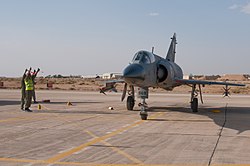
- Dassault Mirage III: Having been in service since 1967, the Mirage III, together with the Mirage 5, serves as the primary strike aircraft of the PAF. The PAF operates more than 80 Mirage III aircraft, comprising multiple variants including the Mirage IIIEP, IIIEL and IIIO fighter-bomber variants, the latter of which have been upgraded under Project ROSE, the Mirage IIIRP reconnaissance variant and the Mirage IIIBE, IIID, IIIDL and IIIDP training variants, the latter of which have also been upgraded under Project ROSE.[131][132]
- Dassault Mirage 5: The Mirage 5, together with the Mirage III, serves as the PAF's primary strike aircraft. The PAF operates around 90 Mirage 5 aircraft of multiple variants, including Mirage 5PA, PA2, PA3 and 5F ground attack aircraft, the latter of which have been upgraded under Project ROSE, the Mirage 5DR reconnaissance variant and the Mirage 5DD and DPA2 training variants.[131][132]
- Chengdu F-7PG: The Chengdu F-7 serves primarily as an interceptor, and around 140 aircraft are in service.[133] The PAF has phased out its F-7P aircraft from active service, replaced by the JF-17 Thunder. The F-7PG variant remains the primary variant to remain in service with the PAF, while the two seat FT-7PG variant is in use as operational conversion trainer.
Special mission aircraft
- Saab 2000: The PAF has been operating the Saab 2000 using the Erieye radar as its primary AEW&C platform since 2009. Out of the original four Saab 2000 in service, one was destroyed and two were damaged in a Taliban attack on PAF Base Minhas in August 2012. The damaged aircraft were subsequently repaired and put back into service. The PAF had ordered three more Erieye AEW&C aircraft from Saab with the first batch having been delivered in 2017.[134][needs update]
- Shaanxi Y-8: Four ZDK-03 variants, locally designated the Karakoram Eagle, are in service. They incorporate a Chinese AESA radar mounted on a Y-8F-600 airframe.[135]
- Dassault Falcon 20: The PAF operates three modified Dassault Falcon 20 aircraft with a primary role in electronic warfare.


Transport aircraft
- Lockheed C-130 Hercules: The C-130 Hercules has served as the backbone of the PAF's transport fleet since its induction in 1962. 15 aircraft, five C-130Bs, nine C-130Es and one L-100, are currently in service. PAF C-130s have been upgraded with Allison T56-A-15 turboprops and extended fatigue lives.[136][137]
- Harbin Y-12: Three Harbin Y-12 are operated as light utility aircraft by the PAF.
- Gulfsteam IV: The PAF currently operates two Gulfstream IV-SP variants.
- Embraer Phenom 100: Approximately four of these aircraft are in service with the PAF for transportation purposes.
- Cessna Citation Excel: Currently, only one of these aircraft are used by the PAF.
- Ilyushin Il-78: The PAF operates four Il-78MPs which can also be used as a general transporter by removing the refuel tanks from the cargo hold.[138]
Aerial refuelling aircraft
- Ilyushin Il-78: The PAF operates four Il-78MPs equipped with UPAZ refuelling pods, procured from Ukraine, as aerial refuelling tankers.[138]
Trainer aircraft
_Pakistan_Air_Force.jpg)

- PAC MFI-17 Mushshak: The Mushshak serves as the PAF's basic trainer. The PAF operates 120 Mushshak aircraft, including the improved Super Mushshak variant.
- Cessna T-37 Tweet: The PAF has operated the T-37 as a basic jet trainer since 1962, and these have been supplemented over the years with additional aircraft from Turkey and the United States.[139]
- Hongdu JL-8: The K-8 is operated as an intermediate trainer, before cadets move on to conversion trainers. The K-8 is also operated by the PAF's aerobatics display team, the Sherdils.
Helicopters
- AgustaWestland AW139: Beginning in 2018, the PAF started inducting the AW139 to replace the venerable Alouette. The first AW139 unit became operational in March of that same year.[140][141]
- Mil Mi-17: The PAF also operates the Mi-171, which serves primarily in CSAR roles.[141]
Air defence systems
- MBDA Spada 2000 – A medium altitude air defence system consisting of a radar with a range of 60 kilometres and four 6-cell missile launchers that can intercept enemy missiles and aircraft at a range of over 20 kilometres. A contract for ten batteries was signed when Aspide was selected over competing systems from Raytheon, Diehl BGT and Saab AB after pre-contract firing tests in Pakistan with assistance from the Italian Air Force.[142] Reports state that Pakistan tested the air defence system in July 2010, following deliveries of the first few batteries. Deliveries of all ten batteries are reported to have been completed in 2013 with further orders possible upon immediate request.[143] The missile system was tested by the Range & Instrumentation Division of SUPARCO in synergy with the PAF. Three drones were successfully intercepted and shot down by the missile system following extensive testing.
- Crotale – With the procurement of the Spada 2000, Pakistan reportedly decommissioned most of its Crotale short-range air defence missile systems.[144] However some modernised variants still remain in active service.[145]
- HQ-9B – In October 2003, it was reported that China had closed a deal with Pakistan to supply an unspecified number of FT-2000 systems, an anti-radiation variant of the HQ-9 long-range air defence system.[146] However, in March 2009, a report was published stating that Pakistan was not considering importing the missile.[147] It was reported in mid-2008 that Pakistan intended to purchase a high altitude air-missile defence system and the FD-2000, another variant of HQ-9, was expected to be chosen.[144][148] In 2023 PAF inducted the HQ-9B variant into service with a reported range of 260 km.[145]
- AML HE 60-20 – A modified version of the French Panhard armoured vehicle equipped with a 20mm anti-aircraft cannon used primarily for on-base security.[149] At least five were originally in service in the late 1990s.[150][151]
Drone technology
On 7 September 2015, Pakistan became the fifth nation globally to develop and use an armed unmanned combat aerial vehicle (drone), the NESCOM Burraq. Pakistan first started exploring drone technology when it acquired Falco drones from Selex Galileo for approximately $40 million in 2008. Since then, Pakistan has been developing variants of the original Falco drone in the Pakistan Aeronautical Complex (PAC) in collaboration with the Italian firm. The Burraq was developed which was based on the Falco's technology. By March 2015, Pakistan was able to test-fire Burraq armed with an air-to-surface missile named Barq with pin-point precision. Burraq drones were used extensively to provide support to the Pakistan Army during Operation Zarb-e-Azb.[152]
Pakistan has already talked with Turkey to manufacture parts for Anka UAV and possibly to produce the combat drones locally. Also the CAIG Wing Loong II UCAVs will be produced in Pakistan with collaboration with China.[153][154][155]
Modernisation and acquisitions


For a brief period, the Pakistan Air Force experienced a stall in modernisation efforts, however this ended in April 2006 when the Pakistani cabinet approved the PAF's proposals to procure new aircraft and systems from several sources, including modern combat aircraft from the United States and China. The AFFDP 2019 (Armed Forces Development Programme 2019) would oversee the extensive modernisation of the PAF from 2006 to 2019.[156]
On 24 July 2008, the Bush administration informed the U.S. Congress that it planned to shift nearly $230 million of $300 million in aid from counter-terrorism programs to upgrading Pakistan's ageing F-16s.[157] The administration had previously announced on 27 June 2008 that it was proposing to sell ITT Corporation's electronic warfare gear valued at up to $75 million to enhance Pakistan's existing inventory of F-16s.[158] Pakistan has asked about buying as many as 21 AN/ALQ-211(V)9 Advanced Integrated Defensive Electronic Warfare Suite Pods (AIDEWS) as well as other related equipment.[159] The proposed sale will ensure that the existing fleet is "compatible" with new F-16 Block 50/52 fighters being purchased by Islamabad.
After 9/11, the U.S. and Pakistan began discussing the release of the embargoed F-16s and Pakistan's ability to purchase new aircraft. Of the 28 F-16A/B built under the Peace Gate III/IV contracts and embargoed in 1990, 14 were delivered as EDA (Excess Defense Articles) from 2005 to 2008,[160] two of which were delivered on 10 July 2007.[161]
Between 2005 and 2008, 14 F-16A/B Block 15 OCU fighters were delivered to the PAF under renewed post-9/11 ties between the U.S. and Pakistan. These had originally been built for Pakistan under the Peace Gate III/IV contracts but were never delivered due to the subsequent U.S. arms embargo imposed on Pakistan in 1990.[162]
To upgrade the F-16A/B fleet, 32 Falcon STAR kits were purchased for the original Peace Gate I aircraft and 35 Mid-Life Update (MLU) kits were ordered, with 11 more MLU kits optional. Four F-16A/B being upgraded in the U.S. to F-16AM/BM had an expected delivery date of December 2011.[160] F-16A/B in the PAF's service were to be upgraded starting in October 2010 by Turkish Aerospace Industries, at a rate of one per month.[163][164]
The Peace Drive I contract for 12 F-16C and six F-16D Block 52+ (Advanced Block 52) aircraft, powered by F100-PW-229 engines was signed on 30 September 2006.[165][166] The first F-16 to be completed, an F-16D, was rolled out on 13 October 2009 and began flight testing immediately.[167][168][169][170][171] The first batch of F-16C/D Block 52+, two F-16D and one F-16C landed at PAF Base Shahbaz, Jacobabad, on 26 June 2010.[172][173][174] One more F-16C was received by 5 July 2010.[175]
On 13 December 2008, the Government of Pakistan stated that two Indian Air Force aircraft were intercepted by the Pakistan Air Force a few kilometers inside Pakistani airspace. This charge is denied by the Indian government.[176]
During talks with a delegation from the French Senate on 28 September 2009, Prime Minister Yousaf Raza Gillani stated that the PAF had used most of its stockpile of laser-guided munitions against militants in the Malakand and FATA regions and that replacements for such types of equipment were urgently required.[177]
_inflight.jpg)

In December 2009, Pakistan saw the delivery of the PAF's first Saab 2000 Erieye AEW&C from Sweden and an Il-78MP aerial refuelling tanker/military transport aircraft from Ukraine.[178][179][180]
The PAF was reported to be considering purchasing the Chinese Hongdu L-15 advanced jet trainer to train pilots for high-tech fighters such as the Chengdu J-10. Extensive evaluations of the aircraft took place in Pakistan in December 2009.[181][182]
According to Air Chief Marshal (ACM) Rao Qamar Suleman (then Chief of the Air Staff), the new fighters would eliminate the PAF's limitations in conducting precision night-time strike operations,[183] as the existing capability was based on around 34 Dassault Mirage 5 fighters upgraded with new avionics for night-time precision strike missions under the Retrofit of Strike Element (ROSE) programme during 1999–2004.[184][185][186] The SABIR (Special Airborne Mission Installation & Response System), a FLIR system that has Brite Star II and Star Safire III EO/IR sensors installed on a C-130 saw extensive usage during the Pakistani military's operations against militants in the FATA region.
In 2021, Pakistan agreed to buy 36 Chengdu J-10CP multirole fighter aircraft from China to counter the Dassault Rafale which India bought from France.[187]
On 11 March 2022, PAF inducted modern J-10C fighter aircraft in its fleet, the formal ceremony was conducted at the Minhas Airbase Kamra.[188][189]
At a ceremony in January 2024, Pakistan announced its intent to acquire the J-35 aircraft.[190]
Planned acquisitions
Mass production of the PAC JF-17 Thunder A Block-3, a 4.5 generation aircraft, is underway to replace the F-16 as the "backbone" of the Pakistan Air Force's arsenal. After every 3–5 years, newer blocks of the aircraft are expected to be produced. Pakistan has been in extensive talks with China to acquire between 40 and 60 upgraded fifth-generation Shenyang J-35 stealth fighter aircraft. The TAI TF Kaan, another fifth-generation aircraft under development by Turkey (intended to operate with critical assets such as the American F-35 Lightning II) has also been a viable offer for Pakistan, as these fighters can greatly strengthen the PAF's fleet before the country's own fifth-generation fighter is developed under Project Azm. Pakistan is also reportedly working on developing a strong arsenal of UAVs alongside China's CAIG GJ-2 MALE-UCAV.[191]
Project Azm
On 7 July 2017, the Pakistan Air Force announced the development of a fifth-generation fighter aircraft, a medium-altitude long-endurance unmanned aerial vehicle (MALE UAV) and munitions under the banner of Project Azm (Urdu for resolve/determination).[192][193][194][195][196] Air Chief Marshal (ACM) Sohail Aman stated that the design phase for the MALE UAV was in its final stages.[192][196]
Military exercises


The Pakistan Air Force sent a contingent of six F-16 A/B fighters to the 2004 international Anatolian Eagle exercise in Turkey.[197][198] In 2005, after around one year of planning, the PAF held the High Mark 2005 military exercise which lasted for one month and also involved the Pakistan Army and Pakistan Navy. The scenario saw two opposing forces, Blueland and Foxland, engaging in simulated combat which involved both offensive and defensive operations. It was stated that the exercise would consist of three stages and PAF aircraft would fly around 8200 sorties. The involvement of units from the Pakistan Army and Navy was aimed at providing more realistic operational scenarios. High Mark 2005 followed the Tempest-1 military exercise which was focused purely on air power but differed in terms of the duration, intensity and complexity of all air operations being conducted.[199]
In 2008, the Turkish Air Force sent five F-16C/D fighters and 50 personnel from 191 Cobras Squadron to Pakistan to take part in the joint Indus Viper exercise at PAF Base Mushaf.[198]
In the summer of 2005, a PAF team of 20 airmen, including pilots, navigators, engineers, maintenance technicians and a C-130E was sent to the United States to take part in the AMC (Air Mobility Command) Rodeo.[200] The PAF again took part in the AMC Rodeo two years later, in July 2007.[201][202]
In 2009, while undertaking combat operations against militants in the FATA and Swat regions, the PAF initiated the Saffron Bandit exercise with the aim of training the PAF's entire combat force to undertake such anti-terrorist operations.[203][204]
In December 2009, the PAF sent six Chengdu F-7PG fighters of No. 31 Wing based at PAF Base Samungli to the United Arab Emirates to take part in the Air Tactics Leadership Course (ATLC)—also known as Exercise Iron Falcon—at Al Dhafra Air Base.[205][206][207]
The PAF's High Mark 2010 exercise was launched on 15 March 2010, the first time a High Mark exercise had been conducted since 2005, after all PAF received their Air Tasking Orders (ATO). The country-wide exercise involved units based all over Pakistan, from Skardu to the Arabian Sea, at all Main Operating Bases and Forward Operating Bases. Joint operations involving the Pakistan Army and Pakistan Navy were also conducted, aiming to test and improve integration and co-operation between the three branches of the Pakistan Armed Forces. Operations emphasised a near-realistic simulation of a wartime environment, exposure of PAF aircrews to contemporary concepts of air combat, new employment concepts and joint operations between the Pakistan Air Force, Army and Navy. New inductions such as the JF-17 Thunder, Saab 2000 Erieye AEW&C and Il-78 MRTT also saw service in this exercise.[208] On 6 April 2010, the end of the first phase of exercise High Mark 2010 was celebrated with a 90-minute firepower demonstration at the PAF's firing range facility in the deserts of Thal. The H-2 SOW was also shown to the public for the first time, being launched from around 60 km away before hitting its target, and a mock counter-insurgency operation was performed by participating forces. The demo heralded the beginning of High Mark 2010's second phase, where the PAF would practice joint operations with the Pakistan Army during its own exercise Azm-e-Nau-3 (New Resolve 3).[209] During High Mark 2010, a Chengdu F-7 and Mirage 5 fighter practiced landing, refuelling and take-off operations from a motorway. It was reported that the PAF is in negotiations with the Ministry of Communications to set up any required facilities for PAF operations on various motorways in Pakistan.[210][211]

In July 2010, the PAF sent six F-16B fighters of No. 9 Griffins Squadron and 100 PAF personnel to Nellis Air Force Base in the U.S. to participate in the international Red Flag exercise for the first time. During the exercise, the PAF pilots practiced in-flight refuelling with their F-16s using the Boeing KC-135 Stratotanker.[212][213][214][215][216]
| External videos | |
|---|---|
| 👁 video icon Mirage III ROSE fighters of the PAF's No. 7 Bandits Squadron take part in the Falcon Air Meet 2010 exercise. |


In October 2010, the PAF's No. 7 Bandits Squadron sent a team of its Dassault Mirage III ROSE fighters to Jordan to participate in the Falcon Air Meet 2010 exercise at the Azraq Royal Jordanian Air Base.[217][218] January 2011 saw a PAF contingent of F-16A/B and Dassault Mirage fighters take part in the Al-Saqoor II exercise in Saudi Arabia with the Royal Saudi Air Force.[219][220][221][unreliable source?]
In March 2011, a joint Sino-Pakistani exercise, codenamed Shaheen-1, was conducted involving a contingent of Chinese aircraft and personnel from the PLAAF.[222] Information on which aircraft were used by each side in the exercise remained classified, but photos of Pakistani pilots inspecting what appeared to be Chinese Shenyang J-11B fighters were released on the internet. The exercise lasted for around four weeks and was the first time the PLAAF had deployed to Pakistan and conducted "operational" aerial maneuvers with the PAF.[223]
Involvement in Pakistani society
The Pakistan Air Force, alongside other branches of the armed forces has played an integral part in the civil society of Pakistan since its inception.[224] In 1996, General Jehangir Karamat described the Pakistani military's relations with Pakistan's populace:
In my opinion, if we have to repeat of past events then we must understand that military leaders can pressure only up to a point. Beyond that their own position starts getting undermined because the military is after all is a mirror image of the civil society from which it is drawn.
— General Jehangir Karamat on civil society–military relations, [224]
In times of natural disaster such as the chaotic floods of 1992 or the October 2005 earthquake, PAF engineers, medical and logistics personnel alongside the rest of the armed forces played a major role in bringing relief aid and supplies to those who were affected.[225]
In addition to the PAF's involvement in relief activities at home, it has also helped the Pakistani military's responses to natural disasters in many other countries globally.[225] The PAF was involved in the dispatching of relief to Indonesia, Bangladesh and Sri Lanka after they were hit by the 2004 Indian Ocean earthquake and tsunami. Coordinating a synergized response, the Pakistan Armed Forces sent ships and helicopters with aid and personnel to assist in the international relief operation.[225]
In popular culture
In Pakistani literature, the shaheen falcon has a special association with the poetry of the country's national poet, Allama Muhammad Iqbal.[226] The bird also appears on the official representative badge of the Pakistan Air Force.
Various Urdu-language drama serials on the PAF have been written, produced, directed, and televised nationwide. Notable Urdu drama serials and films involving the PAF are Shahpar and Sherdil, which were televised on PTV and ARY Digital, respectively.[227]
Notable personnel


The Nishan-e-Haider (Urdu: نشان حیدر, lit. 'Mark of Ali'), is the highest military award of Pakistan, and is roughly equivalent in value to the United States' Medal of Honor. Pilot Officer Rashid Minhas (1951 – 20 August 1971) is the only officer of the PAF to have been awarded the Nishan-e-Haider for sacrificing his life to save an aircraft from being hijacked to India.[228]
Other notable recipients of major military awards include:
- Air Commodore Muhammad Mahmood Alam – awarded for downing nine fighters[229] (of which five were downed within one minute[230][231][232][233][234]) of the Indian Air Force in direct air-to-air combat.[235] (Sitara-e-Jurat)
- Air Commodore Najeeb Ahmed Khan – B-57 Canberra bomber pilot who raided the Adampur Airbase several times during the 1965 war.[236] (Sitara-e-Jurat)
- Squadron Leader Sarfaraz Ahmed Rafiqui – awarded for refusing to abandon his group of fighters during a battle despite his guns being jammed. He continued his attempts to assist his squadron in the battle by chasing enemy fighters until eventually being shot down.[237] (Hilal-e-Jurat, Sitara-e-Jurat)
- Air Marshall Nur Khan – awarded for personally leading several operational missions that uplifted morale and enabled the air force to assert control over a larger and better-equipped enemy.[238] (Hilal-e-Jurat)
See also
- Air Force Strategic Command
- List of Pakistan Air Force bases
- List of Pakistan Air Force squadrons
- List of retired Pakistan Air Force aircraft
- Special Services Wing – (SSW)
- Pakistan Air Force Museum
- Pakistan Aeronautical Complex
Notes
- ^ Pāk is a term commonly used in South Asia (as well as outside of it) to refer to the country of Pakistan or anything related to it. In terms of pronouncing the words for the Pakistan Air Force in Urdu, the full form—Pākistān—would be used, with the respective spelling in Urdu being: ''پاکستان ہوائی فوج''
References
- ^ Barvarz, Fartash (2012). Islamic Atomic Bomb (google books) (1st ed.). Bloomington, Indiana, U.S.: AuthorHouse. p. 116. ISBN 9781426923661. Archived from the original on 5 February 2023. Retrieved 10 February 2019.
- ^ a b International Institute for Strategic Studies (February 2024). The Military Balance 2024. London: Routledge. p. 303. ISBN 9781032780047.
- ^ International Institute for Strategic Studies (February 2024). The Military Balance 2024. London: Routledge. ISBN 9781032780047.
- ^ "Pakistan Air Force – A Symbol of Pride for the Nation." Archived 4 June 2020 at the Wayback Machine Pakistan Air Force, 17 May 2020, Retrieved: 17 May 2020.
- ^ "A Hostile Middle East". 7 December 2020. Archived from the original on 3 July 2022. Retrieved 3 July 2022.
- ^ "Saudi-Pak relations are unique". Archived from the original on 3 July 2022. Retrieved 3 July 2022.
- ^ PAF. "History of PAF". AIr Force ISPR. Archived from the original on 15 December 2011. Retrieved 28 November 2014.
- ^ "Article 243". Archived from the original on 5 February 2012. Retrieved 18 January 2013.
- ^ History of the Pakistan Air Force 1947–1982, Pakistan Air Force Book Club, 1982 [page needed]
- ^ Pakistan, Horizon (June 1959). "The Canberra Incident". Pakistan Horizon. 12 (2): 153–160. JSTOR 41392273. Retrieved 11 February 2024.
- ^ "Remembering the sacrifices of our martyrs". The Express Tribune. 5 September 2021.
- ^ Fricker, John (1969), "Pakistan's Air Power", Flight International, p. 89, archived from the original on 14 January 2012, retrieved 21 September 2009
- ^ Fricker, John (1969), "Pakistan's Air Power", Flight International, p. 90, archived from the original on 12 January 2012, retrieved 21 September 2009
- ^ "1965 war: We achieved air superiority in three days, says Air Force Marshal Arjan Singh". 4 October 2015. Archived from the original on 14 June 2016. Retrieved 3 August 2016.
- ^ a b "Pakistan's Air Power", Flight International, issue published 5 May 1984 (page 1208). Can be viewed at FlightGlobal.com archives, URL: http://www.flightglobal.com/pdfarchive/view/1984/1984%20-%200797.html?search=F-86%20Pakistan Archived 12 January 2012 at the Wayback Machine. Retrieved 22 October 2009
- ^ a b Faruqui, Ahmad (14 September 2009). "The right stuff". Dawn News. Archived from the original on 29 March 2010. Retrieved 8 February 2016.
- ^ Werrell, Kenneth (2013). Sabres Over MiG Alley: The F-86 and the Battle for Air Superiority in Korea. Naval Institute Press. p. 188. ISBN 9781612513447.
- ^ Fricker, John. Battle for Pakistan: the air war of 1965. pp. 15–17. before we had completed more than of about 270-degree of the turn, at around 12-degree per second, all four hunters had been shot down ... My fifth victim of this sortie started spewing smoke and then rolled on to his back at about 1000 feet.
- ^ Chris Smith; Stockholm International Peace Research Institute (1994). India's Ad Hoc Arsenal: Direction Or Drift in Defence Policy?. Oxford University Press. p. 85. ISBN 978-0-19-829168-8.
- ^ Edward V. Coggins; Ed Coggins (2000). Wings That Stay on. Turner Publishing Company. p. 164. ISBN 978-1-56311-568-4. Archived from the original on 7 January 2016. Retrieved 15 November 2015.
- ^ Mike Spick (2002). The Illustrated Directory of Fighters. MBI Publishing Company LLC. p. 161. ISBN 978-0-7603-1343-5. Archived from the original on 7 January 2016. Retrieved 15 November 2015.
- ^ a b c Harry, B. (2 September 2006). "IAF combat kills – 1965 Indo-Pak Air War" (PDF). Order of Battle web site (orbat.com). Archived from the original (PDF) on 27 November 2010. Retrieved 29 December 2011.
- ^ "The India-Pakistan Air War of 1965". Archived from the original on 5 November 2006.
- ^ Thomas M. Leonard (2006). Encyclopedia of the developing world. Taylor & Francis. p. 806. ISBN 978-0-415-97663-3. Archived from the original on 5 February 2023. Retrieved 14 April 2011.
- ^ Coggins 2000, pp. 163–164.
- ^ Sisson, Richard; Rose, Leo E. (1991). War and Secession: Pakistan, India, and the Creation of Bangladesh (revised ed.). University of California Press. p. 229. ISBN 978-0-520-07665-5.
- ^ Jagan Pillarisetti. "Boyra Encounter – 22nd November 1971". Bharat Rakshak. Archived from the original on 18 November 2011. Retrieved 19 January 2012.
- ^ "Newsweek: the international newsmagazine: US edition". Newsweek: 34. 20 December 1971. ISSN 0028-9604.
Trying to catch the Indian Air Force napping, Yahya Khan, launched a Pakistani version of Israel's 1967 air blitz in hopes that one quick blow would cripple India's far superior air power. But India was alert and Yahya's strategy of scattering his thin air force over a dozen air fields failed!
- ^ Kainikara, Sanu (2007). Red Air: Politics in Russian Air Power. Universal Publishers. p. 195. ISBN 978-1-58112-983-0.
- ^ M. Leonard, Thomas (2006). Encyclopedia of the Developing World. Taylor & Francis. p. 806. ISBN 978-0415976640. Archived from the original on 5 February 2023. Retrieved 13 July 2015.
- ^ Boewe, Charles (2006). "Indian-Pakistani Wars". In Leonard, Thomas M. (ed.). Encyclopedia of the Developing World. Vol. 2. Routledge. p. 806. ISBN 978-0-415-97663-3. Retrieved 8 December 2023.
- ^ Bishop, Chris (2001). The Encyclopedia of 20th Century Air Warfare. Amber Books Limited. p. 'p' 387. ISBN 978-1-904687-26-9.
- ^ Gill, John H. (2003). An Atlas of the 1971 India - Pakistan War: The Creation of Bangladesh. National Defense University, Near East South Asia Center for Strategic Studies. p. 55.
- ^ Khan, Iftikhar A. (28 May 2010). "Threat to destroy Indian N-plant stopped attack on Kahuta". Dawn. Pakistan: The Dawn Media Group. Archived from the original on 30 May 2010. Retrieved 28 May 2010.
- ^ Shamim, M. Anwar (2010). Cutting Edge PAF: A Former Air Chief's Reminiscences of a Developing Air Force. Vanguard Books. ISBN 978-969-402-540-7.
- ^ a b "History of PAF". Pakistan Air Force. Archived from the original on 15 December 2011. Retrieved 20 December 2011.
- ^ a b "F16 Air Forces – Pakistan". F-16.net. Archived from the original on 29 May 2011. Retrieved 8 June 2011.
- ^ "PAF F-16 squadron pilots & crew during Soviet/Afghan War 1979–1988". Archived from the original on 6 January 2012. Retrieved 14 January 2012.
- ^ [1] Archived 15 January 2012 at the Wayback Machine. PAF F-16 air kills illustrations.
- ^ F-16 Air Forces – Pakistan Archived 23 July 2009 at the Wayback Machine. F-16.net. Retrieved 8 September 2010.
- ^ "Doubts crop up about F-16 Fighting Falcon's capabilities after PAF mishap". 31 July 1987. Archived from the original on 2 June 2019. Retrieved 2 June 2019.
- ^ "Pakistan evaluates fighters", Air International, p. 950, 4 April 1981, archived from the original on 12 January 2012, retrieved 6 May 2020
- ^ Lippman, Thomas W. (1 January 1999). "U.S. pays Pakistan for F-16s withheld over nuclear issue". Washington Post. Retrieved 17 September 2023.
- ^ How China keeps the PAF flying. Southasiaanalysis.org. Retrieved 8 September 2010.
- ^ "lockheed | Flight Archive". Flightglobal. 2 June 1992. Archived from the original on 12 January 2012. Retrieved 8 June 2011.
- ^ "1994 | Flight Archive". Flightglobal. 23 August 1994. Archived from the original on 3 March 2012. Retrieved 8 June 2011.
- ^ "McDonnell Douglas Flight Archive". Flightglobal. 18 October 1994. Archived from the original on 14 January 2012. Retrieved 8 June 2011.
- ^ "1994 Flight Archive". Flightglobal. 29 November 1994. Archived from the original on 13 January 2012. Retrieved 8 June 2011.
- ^ "The Getaway". The New Yorker. Archived from the original on 2 February 2019. Retrieved 21 January 2019.
- ^ "Context of 'November 14–25, 2001: US Secretly Authorizes Airlift of Pakistani and Taliban Fighters'". Archived from the original on 4 November 2018. Retrieved 21 January 2019.
- ^ a b "Mukherjee denies making phone call to Zardari". Paktribune.com. Archived from the original on 3 June 2013. Retrieved 28 November 2012.
- ^ a b Nelson, Dean (23 March 2011). "WikiLeaks: hoax phone call brought India and Pakistan to brink of war". The Daily Telegraph. London. Archived from the original on 17 October 2018. Retrieved 2 April 2018.
- ^ Nelson, Dean (23 March 2011). "WikiLeaks: hoax phone call brought India and Pakistan to brink of war". The Daily Telegraph. Archived from the original on 6 January 2016. Retrieved 30 March 2016.
- ^ Patrick Cockburn in Lahore (7 December 2008). "Pakistan on full military alert after hoax call". The Independent. Archived from the original on 9 March 2016. Retrieved 30 March 2016.
- ^ "Hoax Phone Call 'Almost Took Pakistan to War'". Common Dreams. Archived from the original on 4 March 2016. Retrieved 30 March 2016.
- ^ "PAF detected US planes near Jalalabad border before OBL operation". The News. 9 May 2011. Archived from the original on 20 December 2014. Retrieved 20 December 2014.
- ^ "Abbottabad commission visits PAF HQ". Dawn. Pakistan. 11 September 2011. Archived from the original on 5 February 2023. Retrieved 28 November 2012.
- ^ Walker, Peter (5 May 2011). "Osama bin Laden death: photos suggest use of 'stealth' helicopters". The Guardian. ISSN 0261-3077. Retrieved 16 July 2025.
- ^ Cenciotti, David (18 May 2011). "The Stealth Chinook involved in the Osama Bin Laden raid and why the Stealth Black Hawk crashed in Abbottabad". The Aviationist. Retrieved 16 July 2025.
- ^ a b Sehgal, Ikram (8 April 2010). "Airpower in COIN operations". The News. Pakistan: Jang Group. Retrieved 8 April 2010. [dead link]
- ^ U.S. hopes to give Pakistan drones within a year Archived 23 November 2010 at the Wayback Machine. Reuters. Retrieved 8 September 2010.
- ^ a b Schmitt, Eric (29 July 2009). "Pakistan Injects Precision into Air War on Taliban". Newspaper article. New York Times (www.nytimes.com). Archived from the original on 18 August 2011. Retrieved 8 April 2010.
- ^ Guerin, Orla (14 April 2010). "Pakistan admits civilian deaths". BBC News. Archived from the original on 5 February 2023. Retrieved 20 May 2010.
- ^ [2][dead link]
- ^ "General Kayani apologises over civilian deaths". Dawn.com (online newspaper). Pakistan. 17 April 2010. Archived from the original on 20 April 2010. Retrieved 21 April 2010.
- ^ "'Civilians die' in Pakistan raid". BBC News. 13 April 2010. Archived from the original on 8 August 2017. Retrieved 20 May 2010.
- ^ Slater, Joanna (26 February 2019). "India strikes Pakistan in severe escalation of tensions between nuclear rivals". The Washington Post. Archived from the original on 15 March 2019. Retrieved 15 April 2020.
- ^ Islamabad, Michael Safi Mehreen Zahra-Malik in; Srinagar, Azhar Farooq in (27 February 2019). "'Get ready for our surprise': Pakistan warns India it will respond to airstrikes". The Guardian. ISSN 0261-3077. Archived from the original on 31 March 2019. Retrieved 15 April 2020.
Pakistan, ... said the war planes made it up to five miles inside its territory
- ^ Abi-Habib, Maria; Ramzy, Austin (25 February 2019). "Indian Jets Strike in Pakistan in Revenge for Kashmir Attack". The New York Times. ISSN 0362-4331. Archived from the original on 27 February 2019. Retrieved 15 April 2020.
A spokesman for Pakistan's armed forces, Maj. Gen. Asif Ghafoor, on Tuesday posted on Twitter four images of a forested area pockmarked with small craters and debris, which he said was the site of Indian airstrikes.
- ^ a b "Pakistan shoots down two Indian fighter jets: Military". Al Jazeera. Archived from the original on 28 February 2019. Retrieved 28 February 2019.
- ^ "2 Indian aircraft violating Pakistani airspace shot down; pilot arrested". Dawn. Pakistan. 27 February 2019. Archived from the original on 27 February 2019. Retrieved 28 February 2019.
- ^ a b Roche, Elizabeth (26 January 2020). "Bravery award for IAF officers killed in chopper crash after friendly fire". mint. Retrieved 8 April 2024.
- ^ "The Wire: The Wire News India, Latest News, News from India, Politics, External Affairs, Science, Economics, Gender and Culture". thewire.in. Retrieved 8 April 2024.
- ^ "Probe nails 5 IAF officers for friendly fire that downed chopper killing 6". Hindustan Times. 24 August 2019. Retrieved 8 April 2024.
- ^ Pubby, Manu (15 September 2020). "IAF chopper crash: Tribunal sees 'faults' in Budgam probe, stays action against officers". The Economic Times.
- ^ "The Wire: The Wire News India, Latest News, News from India, Politics, External Affairs, Science, Economics, Gender and Culture". thewire.in. Retrieved 8 April 2024.
- ^ "Notice to Centre & IAF officers for pronouncing Group Captain's dismissal despite case pending in high court". The Times of India. 28 April 2023.
- ^ Pubby, Manu (28 February 2019). "Abhinandan Varthaman's MiG21 locked in Pakistan's F16". The Economic Times. Archived from the original on 28 February 2019. Retrieved 28 February 2019.
- ^ "Pakistan says no F-16 aircraft used, dismisses report of their fighter jet crashing". businesstoday.in. 27 February 2019. Archived from the original on 27 February 2019. Retrieved 28 February 2019.
- ^ "Shooting down of Mi-17 was a big mistake, admits IAF chief". The Hindu. 4 October 2019. ISSN 0971-751X. Retrieved 8 April 2024.
- ^ "Indian Air Force officer may be dismissed in Mi-17 friendly-fire incident". Hindustan Times. 11 April 2023. Retrieved 8 April 2024.
- ^ "Pak admits to using F-16 day after Balakot airstrike". Tribuneindia News Service. Archived from the original on 22 March 2022. Retrieved 22 March 2022.
- ^ Slater, Joanna; Constable, Pamela (28 February 2019). "Pakistan captures Indian pilot after shooting down aircraft, escalating hostilities". The Washington Post. Archived from the original on 27 February 2019. Retrieved 15 April 2020.
- ^ "Pakistan hands over captured pilot to India". Al Jazeera. Retrieved 30 December 2025.
- ^ "'Real statesmanship': Twitter erupts in praise over PM Khan's decision to release Indian pilot". Dawn. 28 February 2019. Retrieved 30 December 2025.
- ^ "8 pieces of clinching evidence that show how IAF's Abhinandan shot down a Pakistani F-16". ThePrint. 20 August 2019.
- ^ Seligman, Lara (11 April 2024). "Did India Shoot Down a Pakistani Jet? U.S. Count Says No". Foreign Policy. Retrieved 8 April 2024.
- ^ Goldbaum, Christina; Padshah, Safiullah; Steffensen, Nanna Muus (30 April 2022). "'I Lost Everything': Pakistani Airstrikes Escalate Conflict on Afghan Border". The New York Times. Archived from the original on 1 May 2022. Retrieved 2 May 2022.
- ^ a b "Pakistan's Twin Taliban Problem". United States Institute of Peace. Archived from the original on 4 May 2022. Retrieved 7 April 2024.
- ^ Siddiqui, Usaid. "Iran says at least nine killed in Pakistani strikes near southeast border". Al Jazeera. Retrieved 18 January 2024.
- ^ "Several killed in Pakistani air strikes on Afghanistan, says Kabul". France 24. 18 March 2024. Retrieved 7 April 2024.
- ^ "Taliban Issues Stern Warning To Islamabad Over Air Strikes In Afghanistan". Afghanistan International. 7 April 2024. Retrieved 7 April 2024.
- ^ Abdullah Momand; Tahir Khan; Javid Hussain; Iftikhar Shirazi (18 March 2024). "Pakistan carried out intelligence-based anti-terrorist operations in Afghanistan, FO confirms". DAWN. Retrieved 7 April 2024.
- ^ News Desk (25 December 2024). "46 dead in Pakistan's airstrikes on Afghan border, Taliban reports". The Express Tribune. Retrieved 26 December 2024.
- ^ "Pakistan strikes TTP camps in Afghanistan". DAWN.COM. 25 December 2024. Retrieved 25 December 2024.
- ^ Rahmati, Fidel (24 December 2024). "Pakistani airstrikes in Paktika kill 15, destroy village". Khaama Press. Retrieved 25 December 2024.
- ^ "Taliban government says Pakistani airstrikes caused civilian casualty in Afghanistan". Connected to India News I Singapore l UAE l UK l USA l NRI. 25 December 2024. Retrieved 25 December 2024.
- ^ "Reportedly, Pakistani Strikes Hit TTP Sites in Paktika". South Asia Times. 24 December 2024. Retrieved 25 December 2024.
- ^ Roggio, Bill (10 October 2025). "Pakistani Taliban leader thought to be targeted in airstrike on Afghan capital". FDD's Long War Journal. Retrieved 22 March 2026.
- ^ Hussain, Abid. "Taliban blame Pakistan after explosions in Kabul, amid outreach to India". Al Jazeera. Retrieved 22 March 2026.
- ^ admin (10 October 2025). "Pakistan Reportedly Launches Precision Airstrikes In Kabul, Targeting TTP Leader Amid Rising Border Tensions". Defence Security Asia. Retrieved 22 March 2026.
- ^ Desk, News (10 October 2025). "Pakistan Air Force (PAF) Attacks Kabul killing TTP Leader when Afghan FM is in Delhi". Global Village Space. Retrieved 22 March 2026.
{{cite web}}:|last=has generic name (help) - ^ "Afghanistan accuses Pakistan of 'violating Kabul's sovereign territory'". www.bbc.com. 10 October 2025. Retrieved 22 March 2026.
- ^ Azizi, Ahmad (9 October 2025). "Sources: TTP leader killed in Kabul". Amu TV. Retrieved 22 March 2026.
- ^ Mohammad (11 October 2025). "Pakistan's Strike on Kabul Was Neither Strange nor Unexpected". Hasht-e Subh. Retrieved 22 March 2026.
- ^ "Kabul Gripped By Fear Of More Attacks After Suspected Pakistani Air Strikes". Radio Free Europe/Radio Liberty. 16 October 2025. Retrieved 22 March 2026.
- ^ "Pakistan Confirms Airstrikes On Targets In Kabul & Kandahar". www.afintl.com. 15 October 2025. Retrieved 22 March 2026.
- ^ Dawn.com (15 October 2025). "All you need to know about the deadliest Pakistan-Afghanistan flare-up in years". Dawn. Retrieved 22 March 2026.
- ^ Azizi, Ahmad (15 October 2025). "Airstrike hits Spin Boldak amid border tensions". Amu TV. Retrieved 22 March 2026.
- ^ "Pakistan Confirms Airstrikes On Targets In Kabul & Kandahar". www.afintl.com. 15 October 2025. Retrieved 22 March 2026.
- ^ "Kabul Gripped By Fear Of More Attacks After Suspected Pakistani Air Strikes". Radio Free Europe/Radio Liberty. 16 October 2025. Retrieved 22 March 2026.
- ^ "Kabul Gripped By Fear Of More Attacks After Suspected Pakistani Air Strikes". Radio Free Europe/Radio Liberty. 16 October 2025. Retrieved 22 March 2026.
- ^ "Pakistan launches deadly strikes on Afghanistan". www.bbc.com. 22 February 2026. Retrieved 22 March 2026.
- ^ Nazar, Nuzhat (1 March 2026). "Strategically significant 'Ghudwana enclave' secured". Business Recorder. Archived from the original on 2 March 2026. Retrieved 2 March 2026.
- ^ "PAF Active Bases" Archived 26 June 2010 at the Wayback Machine PAF Official Website. Retrieved 28 February 2010
- ^ a b "The White of the Flag: Contributions of Non-Muslims for National Defense of Pakistan". Centre for Strategic and Contemporary Research. 6 September 2017. Archived from the original on 5 December 2020. Retrieved 14 May 2020.
- ^ "The News International: Latest News Breaking, Pakistan News". The News International. Archived from the original on 18 October 2015. Retrieved 30 March 2016.
- ^ "Know All About Rahul Dev, First Hindu Pilot Appointed In Pakistan Air Force". ABP News. 5 May 2020. Archived from the original on 27 May 2020. Retrieved 17 September 2020.
- ^ "Rahul Dev: The first Hindu youth to join Pakistan Air Force". Devan Herald. 6 May 2020. Archived from the original on 5 October 2020. Retrieved 16 September 2020.
- ^ "In a first, minority Hindu young man selected to become GD pilot in PAF". The Express Tribune. 6 May 2020. Archived from the original on 19 August 2020. Retrieved 16 September 2020.
- ^ Donald, David. "First Batch of Chinese J-10 Fighters Delivered to Pakistan". Aviation International News. Retrieved 8 June 2023.
- ^ "Pakistan receives first batch of China's J-10C fighter jets – SAMAA". 18 April 2022. Archived from the original on 18 April 2022. Retrieved 8 June 2023.
- ^ Gady, Franz-Stefan. "Pakistan Air Force to Receive Final Batch of JF-17 Block II Fighter Jets in June". thediplomat.com. Archived from the original on 1 December 2020. Retrieved 26 March 2020.
- ^ "JF-17 Block 3 Prototype Takes Flight". Quwa. 31 December 2019. Archived from the original on 26 March 2020. Retrieved 26 March 2020.
- ^ "Turkey to upgrade Pakistani F-16s". f-16.net. Archived from the original on 26 March 2020. Retrieved 26 March 2020.
- ^ "Turkey to upgrade PAF F-16s". The Nation. 11 December 2010. Archived from the original on 26 March 2020. Retrieved 26 March 2020.
- ^ "Turkish Aerospace to start Pakistani F-16 upgrades in 2010". Flightglobal. Archived from the original on 19 July 2010. Retrieved 8 June 2011.
- ^ "Pakistan receives first five F-16s from Jordan". f-16.net. Archived from the original on 5 January 2020. Retrieved 26 March 2020.
- ^ "PAF acquires F-16s from Jordan". The News International. Archived from the original on 26 March 2020. Retrieved 26 March 2020.
- ^ "US delivers three F-16 jets to Pakistan". Dawn News. 26 June 2010. Archived from the original on 28 June 2010. Retrieved 26 June 2010.
- ^ a b "Grande Strategy". archive.is. 24 November 2014. Retrieved 26 March 2020.
{{cite web}}: CS1 maint: deprecated archival service (link) - ^ a b Warnes, Alan (December 2013). "Pakistan's Amazing Mirages". Combat Aircraft Monthly. 14 (12): 56–63.
- ^ "World Air Forces 2020". Flightglobal Insight. 2020. Archived from the original on 23 January 2020. Retrieved 10 March 2020.
- ^ "Pakistan to get more Erieyes". Air Forces Monthly. Archived from the original on 5 March 2020. Retrieved 26 March 2020.
- ^ Pakistan to get Chinese AEW&C aircraft this year Archived 10 May 2010 at the Wayback Machine. Flightglobal. Retrieved 8 September 2010.
- ^ Photo gallery of C-130 Hercules in service with PAF. Archived 31 December 2011 at the Wayback Machine.
- ^ "Rockwell Collins Awarded $30.7 Million Pakistani C-130 Upgrade Contract". defense-aerospace.com. Archived from the original on 23 March 2016. Retrieved 30 March 2016.
- ^ a b "Pakistan Receiving IL-78 Refueling aircraft". Defense Industry Daily. Archived from the original on 15 April 2010. Retrieved 26 March 2020.
- ^ Haider, Mateen (28 October 2015). "Turkey to provide 34 T-37 aircraft to Pakistan free of cost". Dawn. Pakistan. Archived from the original on 26 March 2020. Retrieved 26 March 2020.
- ^ "PAF No. 88 Squadron Equipped With AgustaWestland AW139 Helicopters – History of PIA – Forum". historyofpia.com. Archived from the original on 23 April 2020. Retrieved 26 March 2020.
- ^ a b "AW139: The Pakistan Air Force's New Mainstay SAR Helicopter". Quwa. 22 October 2019. Archived from the original on 22 April 2020. Retrieved 26 March 2020.
- ^ MBDA Confirms Air Defense System Sale to Pakistan[dead link]. Defense News. Retrieved 8 September 2010.
- ^ Pakistan To Test-Fire Italy Air Defense Missiles. Defense News (7 April 2010). Retrieved 8 September 2010.
- ^ a b Pakistan Targets Air Combat[dead link]. Defense News (14 July 2008). Retrieved 8 September 2010.
- ^ a b "Pakistan Air Force Air Defence Development". Quwa. 17 March 2024. Retrieved 30 March 2024.
- ^ FT-2000 Archived 19 September 2008 at the Wayback Machine. MissileThreat. Retrieved 8 September 2010.
- ^ Analysis: China exports new SAM missile Archived 22 March 2009 at the Wayback Machine. Spacewar.com. Retrieved 8 September 2010.
- ^ "Pakistan May Seek Chinese Interceptor", Defense News www.defensenews.com
- ^ "Pakistan: Military takes security of Airports, Prisons and Defence Installations". Archived from the original on 29 November 2014.
- ^ African Defence Journal: Article "Panhard Armoured Cars and Reconnaissance Vehicles in Africa". The Journal Publishers, 1981 volume, Collected Issues 5–16 p. 58.
- ^ Bonsignore, Ezio, ed. (1993). "World Defence Almanac 1992–93: The Balance of Military Power". World Defence Almanac: The Balance of Military Power. Bonn: Monch Publishing Group: 200–201. ISSN 0722-3226.
- ^ Fazl-e-Haider, Syed (5 October 2015). "Islamabad Just Used Armed UAVs—Here's What It Means for the Region and World – Foreign Affairs". Foreign Affairs. Archived from the original on 2 February 2016. Retrieved 30 March 2016.
- ^ "IDEF 2021: Pakistan's NESCOM to manufacture parts for Anka UAV". Janes.com. 24 August 2021. Archived from the original on 28 April 2022. Retrieved 28 April 2022.
- ^ Nene, Vidi (11 October 2018). "China and Pakistan to Jointly Produce 48 Wing Loong II Drones". dronebelow.com. Archived from the original on 11 October 2018. Retrieved 28 April 2022.
- ^ "China, Pakistan to jointly produce Wing Loong II UAVs, says report". Jane's 360. 9 October 2018. Archived from the original on 9 October 2018. Retrieved 28 April 2022.
- ^ "Pakistan to buy 98 hi-tech aircraft from US and China". Business Recorder. Archived from the original on 21 October 2012. Retrieved 8 June 2011.
- ^ Schmitt, Eric (24 July 2008). "Plan Would Use Antiterror Aid on Pakistani Jets". The New York Times. Pakistan. Archived from the original on 6 April 2013. Retrieved 8 June 2011.
- ^ "US eyes electronic-warfare sale to Pakistan". Reuters. 27 June 2008. Archived from the original on 24 February 2009. Retrieved 8 June 2011.
- ^ "Pakistan – AN/ALQ-211(V)9 AIDEWS Pods". Asd-network.com. Archived from the original on 7 September 2009. Retrieved 8 June 2011.
- ^ a b "Written Statement of" (PDF). Archived from the original (PDF) on 29 June 2011. Retrieved 8 June 2011.
- ^ "Archive | Your Source of News on the World Wide Web". Dawn. Pakistan. 11 July 2007. Archived from the original on 5 February 2009. Retrieved 8 June 2011.
- ^ Asia Times Online :: South Asia news – Pakistan heading for a crackdown Archived 8 April 2009 at the Wayback Machine. Asia Times Online. (13 July 2007). Retrieved 8 September 2010.
- ^ "Turkish Aerospace Industries Inc". Tai.com.tr. 29 June 2009. Archived from the original on 27 May 2011. Retrieved 8 June 2011.
- ^ Govindasamy, Siva. "Turkish Aerospace to start Pakistani F-16 upgrades in 2010". Flightglobal. Archived from the original on 19 July 2010. Retrieved 8 June 2011.
- ^ "The News International: Latest News Breaking, Pakistan News". Retrieved 22 May 2011.[dead link]
- ^ "LOCKHEED MARTIN RECEIVES INITIAL $78 MILLION CONTRACT TO PRODUCE 18 NEW F-16s". Lockheedmartin.com. 11 December 2006. Archived from the original on 25 March 2008. Retrieved 8 June 2011.
- ^ "Unveils First New F-16 For Pakistan in Ceremony Attended By Air Force Chiefs". Lockheed Martin. 13 October 2009. Archived from the original on 1 July 2011. Retrieved 8 June 2011.
- ^ "Associated Press of Pakistan ( Pakistan's Premier NEWS Agency ) – Inauguration of first BLK-52 F-16D aircraft". App.com.pk. Archived from the original on 16 April 2015. Retrieved 8 June 2011.
- ^ "Peace Drive I – First F-16 unveiled". F-16.net. Archived from the original on 6 September 2011. Retrieved 8 June 2011.
- ^ "PICTURES: Lockheed Martin unveils first F-16 Block 52 ordered by Pakistan". Flightglobal. Archived from the original on 26 December 2010. Retrieved 8 June 2011.
- ^ "Rah-e-Nijat and PAF's new F-16". The Nation. Pakistan. 21 October 2009. Archived from the original on 27 October 2009. Retrieved 8 June 2011.
- ^ "US delivers three F-16 jets to Pakistan". Dawn News. 26 June 2010. Archived from the original on 28 June 2010. Retrieved 26 June 2010.
- ^ "PAF gets three F-16s". Geo News website (www.geo.tv). Geo Television Network. 26 June 2010. Archived from the original on 29 June 2010. Retrieved 26 June 2010.
- ^ "First batch of latest version of F-16 aircraft reaches Pakistan". APP website. Associated Press of Pakistan (APP). 24 June 2010. Archived from the original on 1 April 2012. Retrieved 29 June 2010.
- ^ "Pakistan gets fourth F-16 jet". The Express Tribune. 5 July 2010. Archived from the original on 8 July 2010. Retrieved 10 July 2010.
- ^ Pakistan, India row over 'violation' by fighter jets Archived 22 September 2011 at the Wayback Machine. News.asiaone.com (14 December 2008). Retrieved 8 September 2010.
- ^ Pakistan:Laser-guided munition exhausted, says Gilani Archived 3 October 2009 at the Wayback Machine. Dawn.Com (29 September 2009). Retrieved 8 September 2010.
- ^ PAF gets mid-air refueller aircraft Archived 3 January 2010 at the Wayback Machine. Dawn (20 December 2009). Retrieved 8 September 2010.
- ^ Pakistan Receiving IL-78 Refueling aircraft Archived 15 April 2010 at the Wayback Machine. Defenseindustrydaily.com (8 December 2008). Retrieved 8 September 2010.
- ^ "First aircraft tanker arrives in Pakistan: PAF". GEO.tv. 19 December 2009. Archived from the original on 16 April 2010. Retrieved 8 June 2011.
- ^ Pakistan Eyes Acquisition of Chinese Training Aircraft. Defense News (1 February 2010). Retrieved 8 September 2010.
- ^ "US-Pak air forces conduct joint refuelling operation". Daily Times. Pakistan. 5 March 2010. Archived from the original on 10 March 2010. Retrieved 5 March 2010.
- ^ "PAF attains night time attack capability: PAF Chief". App.com.pk. Archived from the original on 1 April 2012. Retrieved 8 June 2011.
- ^ Improvise and modernise-24 February 1999-Flight International Archived 17 January 2012 at the Wayback Machine. Flightglobal. (24 February 1999). Retrieved 8 September 2010.
- ^ Top Story: New Fighter Squadron added to Pakistan Air Force. Pakistan Times. Retrieved 8 September 2010.
- ^ PAF gets new Mirage fighter squadron – News – Webindia123.com Archived 18 July 2011 at the Wayback Machine. News.webindia123.com (20 April 2007). Retrieved 8 September 2010.
- ^ Dubois, Gastón (29 December 2021). "Pakistan buys Chengdu J-10 fighter jets from China". aviacionlie. Archived from the original on 2 January 2022. Retrieved 1 January 2022.
- ^ "PM Imran, Gen Bajwa attend special PAF ceremony to induct J-10C fighter jets". DAWN. 11 March 2022. Archived from the original on 12 March 2022. Retrieved 12 March 2022.
- ^ "Pakistan Air Force inducts China-made J-10C fighter jets". Brecorder. 11 March 2022. Archived from the original on 13 March 2022. Retrieved 12 March 2022.
- ^ "Pakistan's army chief praises air force's advanced weapon induction, calls it vital for regional power balance". Arab News. 3 January 2024. Retrieved 6 January 2024.
- ^ Tyler Rogoway (22 November 2014). "Pakistan Looking To Buy China's J-31 Stealth Fighter". Foxtrot Alpha. Archived from the original on 4 April 2016. Retrieved 30 March 2016.
- ^ a b Khan, Bilal (6 July 2017). "Pakistan Announces 5th-Gen Fighter And Medium-Altitude Long-Endurance UAV Programs". QUWA. Archived from the original on 10 July 2017. Retrieved 9 July 2017.
- ^ "PAF establishes Aviation City at Aeronautical Complex Kamra". The Nation. 6 July 2017. Archived from the original on 9 July 2017. Retrieved 9 July 2017.
- ^ Web Desk (6 July 2017). "Groundbreaking ceremony of Aviation City held in Kamra". The News International. Archived from the original on 12 July 2017. Retrieved 10 July 2017.
- ^ Khan, Bilal (9 July 2017). "Reviewing Pakistan's Goals for the Kamra Aviation City Initiative". QUWA Defence News and Analysis Group. Archived from the original on 10 July 2017. Retrieved 10 July 2017.
- ^ a b "Pakistan To Develop Long Endurance Attack Drone". Defence World. 8 July 2017. Archived from the original on 8 July 2017. Retrieved 10 July 2017.
- ^ "Pakistan Air Force F-16s Fly Off to Turkey for exercise". turks.us. 30 September 2004. Archived from the original on 27 July 2011. Retrieved 25 May 2011.
- ^ a b Daly, John C. K. (30 April 2008). "Turkey Holds Joint Air Force Exercises With Pakistan". Jamestown. The Jamestown Foundation. Archived from the original on 25 December 2010. Retrieved 23 May 2011.
- ^ "Pakistan Air Force exercise 'Highmark-2005' starts". Pakistan Times (pakistantimes.net). 2005. Archived from the original on 14 June 2011. Retrieved 25 May 2011.
- ^ R. Bakse, Colin (Summer 2005). "Rodeo 2005: McChord AFB, Washington, Hosts the Return of Air Mobility's Premier International Competition" (PDF). Airlift Tanker Quarterly. 13 (3): 6–17. Archived from the original (PDF) on 25 July 2011. Retrieved 26 May 2011.
- ^ "International teams build relationships at AMC Rodeo". 20 July 2007. Retrieved 26 May 2011.
{{cite web}}: CS1 maint: deprecated archival service (link) - ^ Haider, Masood (25 April 2007). "PAF to participate in US air show". Dawn News. Archived from the original on 12 January 2012. Retrieved 26 May 2011.
- ^ "PAF starts Saffron Bandits exercise". 6 September 2009. Archived from the original on 18 October 2015. Retrieved 26 May 2011.
- ^ "PAF 'Saffron Bandit' annual war games have begun". The Nation. Pakistan. 5 September 2009. Archived from the original on 14 October 2013. Retrieved 8 June 2011.
- ^ "Fighters from six nations train in the UAE's skies". Arabian Aerospace online news service. 6 August 2010. Archived from the original on 11 June 2011. Retrieved 21 May 2011.
- ^ Hoyle, Craig. "Dubai 09: Raptor and Typhoon make surprise appearances". Flight Daily News via Flightglobal. Archived from the original on 23 April 2020. Retrieved 21 May 2011.
- ^ Trimble, Stephen. "Dubai 09: UAE hosts first mock dogfights for F-22, Typhoon, Rafale". Flight International via Flightglobal. Archived from the original on 28 November 2009. Retrieved 21 May 2011.
- ^ "PAF starts High Mark-2010 exercise". The News International. 16 March 2010. Archived from the original on 24 January 2011. Retrieved 21 May 2011.
- ^ Minhas, Saeed (7 April 2010). "High Mark 2010 culminates in display of firepower". Daily Times. Pakistan. Archived from the original on 7 June 2011. Retrieved 22 May 2011.
- ^ PAF's tactical flexibility . Nation.com.pk (3 April 2010). Retrieved 8 September 2010.
- ^ F-16′s Motorway landing and Take off Archived 5 April 2010 at the Wayback Machine. MarketWatch.pk (3 April 2010). Retrieved 8 September 2010.
- ^ "Red Flag 10-04 kicks off 19 July". Archived from the original on 27 July 2010. Retrieved 21 July 2010.
- ^ "PAF F-16s depart for RED Flag Exercise in USA". Archived from the original on 19 November 2014. Retrieved 21 July 2010.
- ^ "Pakistan Air Force (PAF) At Red Flag Exercise". Archived from the original on 1 April 2012. Retrieved 21 July 2010.
- ^ "PAF's F-16 jets leave for 'Red Flag' exercises in US". Archived from the original on 7 June 2011. Retrieved 21 July 2010.
- ^ "F16s depart for Red Flag Exercise in US". 11 July 2010. Archived from the original on 6 October 2012. Retrieved 21 July 2010.
- ^ Parsons, Gary. "Video: Falcon Air Meet 2010". key.Aero Network. Archived from the original on 16 December 2010. Retrieved 21 May 2011.
- ^ Adams, Chyenne A. "Falcon Air Meet 2010". f16.net. Archived from the original on 27 December 2010. Retrieved 21 May 2011.
- ^ "Pakistan, Saudi air forces conduct joint exercise". Daily Times. Pakistan. 17 January 2011. Archived from the original on 7 June 2011. Retrieved 25 May 2011.
- ^ "Pakistan And Royal Saudi Air Forces Conduct Joint Exercise "Al Saqoor-Ii"" (PDF). PAF Press Release. Pakistan Air Force. 16 January 2011. Archived (PDF) from the original on 14 October 2013. Retrieved 25 May 2011.
- ^ "Pakistan and Saudi Arabia Conduct Joint Air Exercise". airforce-technology.com. 18 January 2011. Archived from the original on 7 June 2011. Retrieved 25 May 2011.
- ^ "Pak Air force conducts joint exercise with China". The Times of India. 19 March 2011. Retrieved 23 May 2011.
{{cite news}}: CS1 maint: deprecated archival service (link) - ^ Zambelis, Chris (20 May 2011). ""Shaheen 1" Exercise Signals Expansion of China-Pakistan Alliance". Jamestown. The Jamestown Foundation. Archived from the original on 12 September 2011. Retrieved 23 May 2011.
- ^ a b Mazhar Aziz (2008). Military control in Pakistan: the parallel state. Milton Park, Didcot, Oxfordshire, UK: Taylor and Francis-e-Library. pp. 80–81. ISBN 978-0-415-43743-1. Archived from the original on 5 February 2023. Retrieved 18 October 2020.
- ^ a b c "Air Force statistics on relief operations". Air Force statistics on relief operations. Archived from the original on 4 December 2014. Retrieved 28 November 2014.
- ^ "National Symbols of Pakistan". Government of Pakistan. Archived from the original on 27 August 2013. Retrieved 23 August 2013.
- ^ "Pakistan Air Force Drama Sherdil". Archived from the original on 2 April 2015. Retrieved 28 November 2014.
- ^ PAKISTAN AIR FORCE – Official website Archived 14 March 2010 at the Wayback Machine. Paf.gov.pk. Retrieved 8 September 2010.
- ^ Fighter Pilot Aces List Archived 1 March 2010 at the Wayback Machine. Au.af.mil. Retrieved 8 September 2010.
- ^ "Alam's Speed-shooting Classic". Defencejournal.com. 6 September 1965. Archived from the original on 27 September 2011. Retrieved 15 November 2011.
- ^ "PAKISTAN AIR FORCE – Official website". Paf.gov.pk. Archived from the original on 13 October 2011. Retrieved 16 November 2011.
- ^ Fricker, John (1979). Battle for Pakistan: the air war of 1965. I. Allan. ISBN 9780711009295. Archived from the original on 6 January 2016. Retrieved 15 November 2015.
'before we had completed more than of about 270-degree of the turn, at around 12-degree per second, all four hunters had been shot down.'
- ^ "Re-birth of Pakistan's Record-holder Air Fighter as a New Man: Mohmammad M. Alam". Yespakistan.com. Archived from the original on 17 November 2011. Retrieved 28 November 2012.
- ^ "Pakistan – Not as seen on TV!". Ideasevolved.com. Archived from the original on 13 September 2012. Retrieved 28 November 2012.
- ^ Alam's Speed-shooting Classic Archived 27 September 2011 at the Wayback Machine. Defencejournal.com (6 September 1965). Retrieved 8 September 2010.
- ^ "Heroes". Pakistan Air Force Museum. Archived from the original on 8 June 2023. Retrieved 18 June 2023.
- ^ Citation of PAF Shaheeds – 1 Archived 21 February 2009 at the Wayback Machine. Defencejournal.com. Retrieved 8 September 2010.
- ^ "Air Marshal Nur Khan, Hilal-e-Jurrat". Daily Times. 5 September 2018. Retrieved 18 June 2023.
External links


- Official website
- The National Interest, How Pakistan's Air Force fought back after the Soviet Invasion of Afghanistan


- Webarchive template wayback links
- Wikipedia articles needing page number citations from October 2015
- All articles with dead external links
- Articles with dead external links from September 2010
- CS1 errors: generic name
- CS1 maint: deprecated archival service
- Articles with dead external links from August 2021
- Articles with dead external links from June 2016
- CS1: unfit URL
- Articles with short description
- Short description is different from Wikidata
- Wikipedia indefinitely semi-protected pages
- Use dmy dates from April 2024
- Use British English from January 2019
- All Wikipedia articles written in British English
- Articles containing Urdu-language text
- Articles containing Persian-language text
- Pages with Urdu IPA
- Articles containing potentially dated statements from 2024
- All articles containing potentially dated statements
- Articles needing additional references from February 2024
- All articles needing additional references
- Wikipedia articles in need of updating from May 2024
- All Wikipedia articles in need of updating
- All articles with unsourced statements
- Articles with unsourced statements from May 2020
- Wikipedia articles in need of updating from April 2024
- All articles lacking reliable references
- Articles lacking reliable references from June 2016
- Commons category link is on Wikidata