
| Phalacrocorax | |
|---|---|
| 👁 Image | |
| Great cormorant (Phalacrocorax carbo) | |
| Scientific classification 👁 Edit this classification | |
| Kingdom: | Animalia |
| Phylum: | Chordata |
| Class: | Aves |
| Order: | Suliformes |
| Family: | Phalacrocoracidae |
| Genus: | Brisson, 1760 |
| Type species | |
| Pelecanus carbo | |
| Species[1] | |
|
12, see text | |
| Synonyms[citation needed] | |
| |

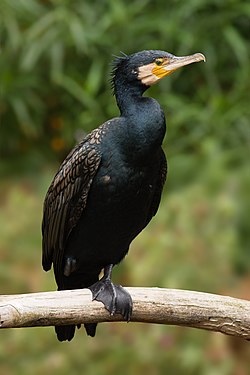

Phalacrocorax is a genus of fish-eating birds in the cormorant family Phalacrocoracidae. Members of this genus are also known as the Old World cormorants.[2]
Taxonomy
[edit]The genus Phalacrocorax was introduced by the French zoologist Mathurin Jacques Brisson in 1760 with the great cormorant (Phalacrocorax carbo) as the type species.[3][4] Phalacrocorax is the Latin word for a cormorant.[5]
Formerly, many other species of cormorant were classified in Phalacrocorax, but most of these have been split out into different genera. A 2014 study found Phalacrocrax to be the sister genus to Urile, which are thought to have split from each other between 8.9–10.3 million years ago.[1]
Current taxonomy
[edit]A molecular phylogenetic study published in 2014 found that the genus Phalacrocorax contains 12 species.[1] This taxonomy was adopted by the IUCN Red List and BirdLife International, and later by the IOC.[6]
| Common name | Scientific name and subspecies | Range | Size and ecology | IUCN status and estimated population |
|---|---|---|---|---|
| Bank cormorant or Wahlberg's cormorant | Phalacrocorax neglectus (Wahlberg, 1855) |
Namibia and the western seaboard of South Africa 👁 Map of range |
Size: Habitat: Diet: |
EN
|
| Socotra cormorant | Phalacrocorax nigrogularis Ogilvie-Grant & Forbes, HO, 1899 |
Arabian Peninsula. 👁 Map of range |
Size: Habitat: Diet: |
VU
|
| Pitt shag or Featherstone's shag | Phalacrocorax featherstoni Buller, 1873 |
Pitt Island. 👁 Map of range |
Size: Habitat: Diet: |
EN
|
| Spotted shag | Phalacrocorax punctatus (Sparrman, 1786) |
New Zealand. | Size: Habitat: Diet: |
LC
|
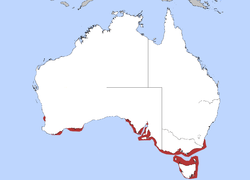
| Black-faced cormorant | Phalacrocorax fuscescens (Vieillot, 1817) |
Western Australia, South Australia, Victoria and Tasmania 👁 Map of range |
Size: Habitat: Diet: |
LC
|
| Australian pied cormorant or yellow-faced cormorant | Phalacrocorax varius (Gmelin, 1789) |
Australasia, New Zealand 👁 Map of range |
Size: Habitat: Diet: |
LC
|
| Little black cormorant | Phalacrocorax sulcirostris (Brandt, 1837) |
Australia and northern New Zealand | Size: Habitat: Diet: |
LC
|
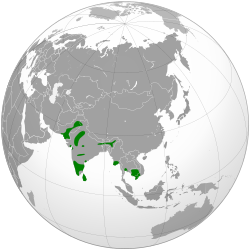
| Indian cormorant | Phalacrocorax fuscicollis (Stephens, 1826) |
Indian Subcontinent west to Sind and east to Thailand and Cambodia. 👁 Map of range |
Size: Habitat: Diet: |
LC
|
| Cape cormorant | Phalacrocorax capensis (Sparrman, 1788) |
the Congo, and up the east coast of South Africa as far as Mozambique. 👁 Map of range |
Size: Habitat: Diet: |
EN
|
| Japanese cormorant or Temminck's cormorant | Phalacrocorax capillatus (Temminck & Schlegel, 1850) |
Taiwan, north through Korea and Japan, to the Russian Far East. 👁 Map of range |
Size: Habitat: Diet: |
LC
|
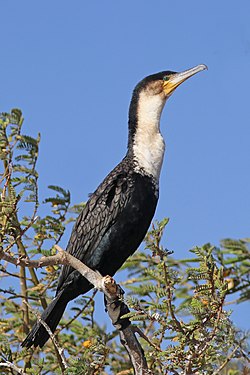
| White-breasted cormorant | Phalacrocorax lucidus (Lichtenstein, MHC, 1823) |
the Cape Verde Islands to Guinea-Bissau and from Angola to the Cape of Good Hope and northwards on the east coast to Mozambique. 👁 Map of range |
Size: Habitat: Diet: |
LC
|
| Great cormorant or black shag | Phalacrocorax carbo (Linnaeus, 1758) |
the Old World, Australia, New Zealand and the Atlantic coast of North America. 👁 Map of range |
Size: Habitat: Diet: |
LC
|


_(11415901286).jpg)


.jpg)




.jpg)


Alternative taxonomies
[edit]Formerly, the genus Phalacrocorax often included all members of the family Phalacrocoracidae. More recently, some authorities, such as the Clements checklist, recognized Microcarbo as distinct (due to its morphological distinctiveness and the old age of its split from the remaining cormorants), while retaining all other cormorants in a still-broad Phalacrocorax. The IOC checklist went a step further in recognizing Leucocarbo as well as Microcarbo as distinct (while retaining the rest in Phalacrocorax), but this treatment rendered Phalacrocorax paraphyletic (with some members much more closely related to Leucocarbo than others). Nowadays, due to the age of the splits between different cormorant clades, most authorities, including the aforementioned two checklists, now recognize seven cormorant genera: Microcarbo, Poikilocarbo, Phalacrocorax, Urile, Gulosus, Nannopterum, and Leucocarbo.[1]
References
[edit]- ^ a b c d Kennedy, M.; Spencer, H.G. (2014). "Classification of the cormorants of the world". Molecular Phylogenetics and Evolution. 79: 249–257. Bibcode:2014MolPE..79..249K. doi:10.1016/j.ympev.2014.06.020. PMID 24994028.
- ^ "Old World Cormorants (Genus Phalacrocorax)". iNaturalist NZ. Archived from the original on 2023-06-20. Retrieved 2023-06-20.
- ^ Brisson, Mathurin Jacques (1760). Ornithologie, ou, Méthode Contenant la Division des Oiseaux en Ordres, Sections, Genres, Especes & leurs Variétés (in French and Latin). Paris: Jean-Baptiste Bauche. Vol. 1, p. 60, Vol. 6, p. 511.
- ^ Mayr, Ernst; Cottrell, G. William, eds. (1979). Check-list of Birds of the World. Vol. 1 (2nd ed.). Cambridge, Massachusetts: Museum of Comparative Zoology. p. 163.
- ^ Jobling, James A. (2010). The Helm Dictionary of Scientific Bird Names. London: Christopher Helm. p. 301. ISBN 978-1-4081-2501-4.
- ^ Gill, Frank; Donsker, David; Rasmussen, Pamela, eds. (August 2022). "Storks, frigatebirds, boobies, darters, cormorants". IOC World Bird List Version 12.2. International Ornithologists' Union. Archived from the original on 20 August 2019. Retrieved 21 November 2022.


