
| Pond heron | |
|---|---|
| 👁 Image | |
| Indian pond heron (Ardeola grayii) | |
| Scientific classification 👁 Edit this classification | |
| Kingdom: | Animalia |
| Phylum: | Chordata |
| Class: | Aves |
| Order: | Pelecaniformes |
| Family: | Ardeidae |
| Subfamily: | Ardeinae |
| Genus: | F. Boie, 1822 |
| Type species | |
| Ardea ralloides | |
| Species | |
|
See text | |


Pond herons (Ardeola) are herons, typically 40–50 cm (16–20 in) long with an 80–100 cm (30–40 in) wingspan. Most breed in the tropical Old World, but the migratory squacco heron occurs in southern Europe and the Middle East and winters in Africa. The scientific name comes from Latin ardeola, a small heron (ardea).[1]
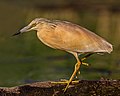
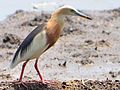
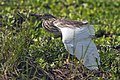
These pond herons are stocky species with a short neck, short thick bill, typically buff or brownish back, and coloured or streaked fore neck and breast. In summer, adults may have long neck feathers. Ardeola herons are transformed in flight, looking very white due to the brilliant white wings.
Their breeding habitat is marshy wetlands. They nest in small colonies, often with other wading birds, usually on platforms of sticks in trees or shrubs. Two to five eggs are laid.
These herons feed on insects, fish and amphibians. They are often found on small ponds giving rise to the English name shared by most of the species.
| Image | Name | Common name | Distribution |
|---|---|---|---|
| 👁 Image |
Ardeola grayii | Indian pond heron | southern Iran and east to Pakistan, India, Burma, Bangladesh and Sri Lanka |
| 👁 Image |
Ardeola ralloides | Squacco heron | southern Europe, Greater Middle East and Africa |
| 👁 Image |
Ardeola bacchus | Chinese pond heron | Breeds in eastern China, Japan and adjacent areas; spends non-breeding season in far southern China and southeast Asia |
| 👁 Image |
Ardeola speciosa | Javan pond heron | Mainland Southeast Asia, the Sunda Islands and southern Philippines |
| 👁 Image |
Ardeola idae | Malagasy pond heron | Breeds in Madagascar, Réunion and Seychelles; spends non-breeding season in eastern mainland Africa |
| 👁 Image |
Ardeola rufiventris | Rufous-bellied heron | Africa: Angola, Botswana, Burundi, Democratic Republic of the Congo, Kenya, Lesotho, Malawi, Mali, Mozambique, Namibia, Rwanda, South Africa, Swaziland, Tanzania, Uganda, Zambia and Zimbabwe |


.jpg)


_(15224926489).jpg)
.jpg)

Diet
[edit]Pond herons are carnivorous.[2] Though pond herons often live near freshwater bodies and consume aquatic prey, they often hunt terrestrially as well. Though the majority of their diet mainly consists of insects, fish, and amphibians supplemented sometimes by molluscs and invertebrates, they are known to opportunistically prey on birds and mammals. Pond herons are typically generalists. Pond herons exhibit a wide variety of predation strategies. They are known to employ the ‘stand and wait’ technique, which involves standing on both legs in either an upright or crouched position and waiting for prey to appear. They also employ the ‘walk slowly’ strategy, in which the heron will walk slowly to stalk and ambush prey. Some pond herons perform unique strategies such as ‘hovering’, which has been observed in the Indian pond heron, Chinese pond heron, and Javan pond heron.[3] 'Hovering' requires that a bird maintain flight over an area for a few seconds before diving to catch prey. Pond heron species’ hunt at a wide variety of times of day.[3]


The Indian pond heron prefers to eat insects.[4] It supplements its diet with fish, amphibians, annelids, and molluscs.[4] The Indian pond heron practices a variety of predation techniques including using surprise attacks, walk fast and strike, fish baiting, scavenging, 'stand and wait', probing, and floating.[4][5] The Indian pond heron hunts during the morning and late afternoon.[6]
_hunting_..._(46772065901).jpg)

Squacco herons mainly prey on fish.[7][8][9] They supplement their diets with amphibians such as frogs. They eat smaller birds opportunistically.[10] Squacco herons can be aggressive against other herons when hunting for prey.[9] They can perform niche partitioning when competing with other heron species and will often consume smaller varieties of prey.[9] Squacco herons have been known to use bait such as insects to lure minnows to surface waters.[11] They perform predation techniques such as ‘stand and wait’ and ‘walk slowly’.[12] They prefer to hunt at dusk and dawn.[12]
The Chinese pond heron opportunistically preys on birds such as the swallow.[13] It employs ‘stand and wait’ and ‘walk slowly’ hunting techniques.[14] It feeds at dusk and dawn.[14]
The Javan pond heron eats insects such as grasshoppers, beetles, ants, and termites.[15] It also feeds on fish and frogs.[15] It typically uses the ‘stand and wait’ and ‘walk slowly’ hunting techniques. It prefers to hunt during the morning and evening.[15]
The Malagasy pond heron mainly eats insects. Their diet is supplemented by other invertebrates, fish, amphibians, and reptiles.[16] It uses the 'stand and wait' and 'walk slowly' hunting techniques.[17]
The Rufous-bellied heron consumes a diet consisting of annelids, insects, crustaceans, frogs, and fish. They hunt by ‘walking slowly’.[18] They mainly hunt during the day but sometimes hunt at night.[18]
References
[edit]- ^ Jobling, James A (2010). The Helm Dictionary of Scientific Bird Names. London: Christopher Helm. p. 54. ISBN 978-1-4081-2501-4.
- ^ "Handbook of the birds of Europe, the Middle East, and North Africa: The birds of the Western Palearctic, v.7". Choice Reviews Online. 31 (3): 31–1515–31-1515. 1993-11-01. doi:10.5860/choice.31-1515 (inactive 7 December 2025). ISSN 0009-4978.
{{cite journal}}: CS1 maint: DOI inactive as of December 2025 (link) - ^ a b Ewbank, D.A. (2015). "Javan Pond Heron (Ardeola speciosa) feeds by hovering". Journal of Heron Biology and Conservation. 2 – via HeronConservation.
- ^ a b c Dwivedi, Akanksha (2020-06-13). "Seasonal variation in feeding behaviour and foraging success of Indian pond heron (Ardeola grayii) in different habitats". Indian Journal of Science and Technology. 13 (22): 2203–2213. doi:10.17485/ijst/v13i22.473. ISSN 0974-6846.
- ^ Selvaraj, Prasath; Victor, Reginald (2022-03-25). "Notes on Indian Pond Heron Ardeola grayii feeding on the dragonfly, Wandering Glider, Pantala flavescens from Coimbatore, Tamil Nadu, India". International Journal of Environmental Studies. 80 (4): 853–855. doi:10.1080/00207233.2022.2057702. ISSN 0020-7233.
- ^ Andrews, M.I.; Matthew, T.K. (1997). "Some observations on the feeding behaviour of the Cattle Egret Bubulcus ibis coromandus (Boddaert) and the Pond Heron Ardeola grayii grayii (Sykes)". Pavo. 35: 67–73 – via HeronConservation.
- ^ Fasola, Mauro; Rosa, Paola; Canova, Luca (1993). "The diets of Squacco herons, Little egrets, Night, Purple and Grey herons in their italian breeding ranges". Revue d'Écologie (La Terre et la Vie). 48 (1): 35–47. doi:10.3406/revec.1993.2078. ISSN 0249-7395.
- ^ Ashoori, Abbas; Moradi, Hossien Varasteh; Rezaiee, Hamid Reza; Mahiny, Abdolrassoul Salman (December 2017). "Dietary Segregation of Four Ardeid Species Breeding in Anzali International Wetland, Northern Iran". Waterbirds. 40 (4): 377–389. doi:10.1675/063.040.0409. ISSN 1524-4695.
- ^ a b c Kasprzykowski, Zbigniew; Golawski, Artur (2024-03-30). "Comparative foraging behavior of 3 heron species in small standing-water ecosystems in the arid zone of Oman". Current Zoology. 70 (6): 780–785. doi:10.1093/cz/zoae011. ISSN 1674-5507. PMC 11634682. PMID 39678822.
- ^ Gordon, P.R. (1986). "Squacco Herons eating Passerines". British Birds. 79 (11): 590 – via Web of Science.
- ^ Crous, R (1994). "An incidence of bait-fishing in the squacco heron Ardeola ralloides". Babbler (26–27): 32 – via Web of Science.
- ^ a b "Squacco Heron". Heron Conservation. 2025. Retrieved 2025-12-06.
- ^ Melville, D.S. (1994). "Chinese Pond Heron eating a Swallow". Hong Kong Bird Report: 216 – via Web of Science.
- ^ a b "HeronConservation". Retrieved 2025-12-06.
- ^ a b c "HeronConservation". Retrieved 2025-12-06.
- ^ Y.Z.M., Pruvot; Rene de Roland, L.A. (2021). JHBC/vol06/art01/ "Food habits of the Malagasy Pond Heron (Ardeolaidae) during the breeding season in northern Madagascar". Journal of Heron Biology and Conservation – via HeronConservation.
{{cite journal}}: Check|url=value (help) - ^ "HeronConservation". Retrieved 2025-12-06.
- ^ a b "HeronConservation". Retrieved 2025-12-06.


