


| Categories & Main topics |
|
Tasks and Projects |


Aviation includes the activities surrounding mechanical flight and the aircraft industry. Aircraft include fixed-wing and rotary-wing types, morphable wings, wing-less lifting bodies, as well as lighter-than-air aircraft such as hot air balloons and airships.
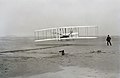
Aviation began in the 18th century with the development of the hot air balloon, an apparatus capable of atmospheric displacement through buoyancy. Clément Ader built the "Ader Éole" in France and made an uncontrolled, powered hop in 1890. This was the first powered aircraft, although it did not achieve controlled flight. Some of the most significant advancements in aviation technology came with the controlled gliding flying of Otto Lilienthal in 1896. A major leap followed with the construction of the Wright Flyer, the first powered airplane by the Wright brothers in the early 1900s.
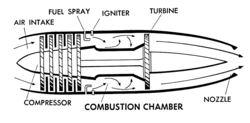
Since that time, aviation has been technologically revolutionized by the introduction of the jet engine which enabled aviation to become a major form of transport throughout the world. In 2024, there were 9.5 billion passengers worldwide according to the ICAO. As of 2018, estimates suggest that 11% of the world's population traveled by air, with up to 4% taking international flights. (Full article...)
Selected article


The plane crashed in a field just outside Shanksville, Pennsylvania, about 150 miles (240 km) northwest of Washington, D.C., killing all 44 people aboard, including the hijackers. Many witnessed the impact from the ground and news agencies began reporting on the event within an hour. The plane fragmented upon impact, leaving a crater, and some debris was blown miles from the crash site. The remains of everyone on board the aircraft were later identified. Subsequent analysis of the flight recorders revealed how the actions taken by the passengers prevented the aircraft from reaching either the White House or United States Capitol. A permanent memorial is planned for construction on the crash site. The chosen design has been the source of criticism and is scheduled to be dedicated in 2011. (Full article...)
Selected image
.png)
Did you know
...that in the late 1940s the USAF Northrop YB-49 set both an unofficial endurance record and a transcontinental speed record?


...that Royal Brunei Catering, a wholly-owned subsidiary of Royal Brunei Airlines, was named as Best Regional Caterer 1995/1996 by Singapore Airlines?
General images - load new batch
-
👁 Image 1An Airbus A321 of Vietravel Airlines parking next to a Vietnam Airlines Airbus A350-900 and a Cargolux Boeing 747-400 widebodies, highlighting their size differences. (from Wide-body aircraft)An Airbus A321 of Vietravel Airlines parking next to a Vietnam Airlines Airbus A350-900 and a Cargolux Boeing 747-400 widebodies, highlighting their size differences. (from Wide-body aircraft)
-
👁 Image 2Experimental helicopter by Enrico Forlanini (1877), exposed at the Museo nazionale della scienza e della tecnologia Leonardo da Vinci of Milan, Italy (from History of aviation)Experimental helicopter by Enrico Forlanini (1877), exposed at the Museo nazionale della scienza e della tecnologia Leonardo da Vinci of Milan, Italy (from History of aviation)
-
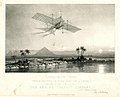
👁 Image 31843 artist's impression of John Stringfellow's plane Ariel flying over the Nile (from History of aviation)1843 artist's impression of John Stringfellow's plane Ariel flying over the Nile (from History of aviation)
-
Me 262, world first operational jet fighter (from History of aviation)
-
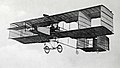
Early Voisin biplane (from History of aviation)
-
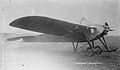
👁 Image 7Nieuport IV, operated by most of the world's air forces before WW1 for reconnaissance and bombing, including during the Italian-Turkish war (from History of aviation)Nieuport IV, operated by most of the world's air forces before WW1 for reconnaissance and bombing, including during the Italian-Turkish war (from History of aviation)
-
👁 Image 81928 issue of Popular Aviation (now Flying magazine), which became the largest aviation magazine with a circulation of 100,000. (from History of aviation)1928 issue of Popular Aviation (now Flying magazine), which became the largest aviation magazine with a circulation of 100,000. (from History of aviation)
-
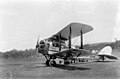
Qantas De Havilland biplane, c. 1930 (from History of aviation)
-
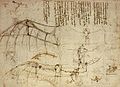
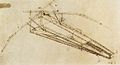
One of Leonardo's sketches (from History of aviation)
-
The 14-bis, or Oiseau de proie (from History of aviation)
-
Planophore model aeroplane by Alphonse Pénaud, 1871 (from History of aviation)
-
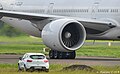
👁 Image 13An Airbus A380 of Qantas. The A380 is the world's largest passenger airliner. (from Wide-body aircraft)An Airbus A380 of Qantas. The A380 is the world's largest passenger airliner. (from Wide-body aircraft)
-
👁 Image 15First failure of Langley's manned Aerodrome on the Potomac River, 7 October 1903 (from History of aviation)First failure of Langley's manned Aerodrome on the Potomac River, 7 October 1903 (from History of aviation)
-
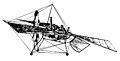
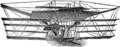
Maxim's flying machine (from History of aviation)
-
👁 Image 17Woodcut print of a kite from John Bate's 1635 book The Mysteryes of Nature and Art (from History of aviation)Woodcut print of a kite from John Bate's 1635 book The Mysteryes of Nature and Art (from History of aviation)
-
Clément Ader Avion III (1897 photograph) (from History of aviation)
-
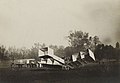
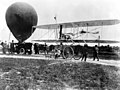
The Wright Military Flyer aboard a wagon in 1908 (from History of aviation)
-
👁 Image 22Often published as a photo of Santos-Dumont during the prize-winning flight, this is actually an earlier attempt using his "Number 5" (from History of aviation)Often published as a photo of Santos-Dumont during the prize-winning flight, this is actually an earlier attempt using his "Number 5" (from History of aviation)
-
👁 Image 23Concorde, G-BOAB, in storage at London Heathrow Airport following the end of all Concorde flying. This aircraft flew for 22,296 hours between its first flight in 1976 and final flight in 2000 (from History of aviation)Concorde, G-BOAB, in storage at London Heathrow Airport following the end of all Concorde flying. This aircraft flew for 22,296 hours between its first flight in 1976 and final flight in 2000 (from History of aviation)
-
Map of record breaking flights of the 1920s (from History of aviation)
-
"Governable parachute" design of 1852 (from History of aviation)
-
👁 Image 26"Map of Air Routes and Landing Places in Great Britain, as temporarily arranged by the Air Ministry for civilian flying", published in 1919, showing Hounslow, near London, as the hub (from History of aviation)"Map of Air Routes and Landing Places in Great Britain, as temporarily arranged by the Air Ministry for civilian flying", published in 1919, showing Hounslow, near London, as the hub (from History of aviation)
-
👁 Image 29The Biot-Massia glider, restored and on display in the Musee de l'Air (from History of aviation)The Biot-Massia glider, restored and on display in the Musee de l'Air (from History of aviation)
-
The Aeroplane of Victor Tatin, 1879. (from History of aviation)
-
👁 Image 32The Wright Flyer: the first sustained flight with a powered, controlled aircraft (from History of aviation)The Wright Flyer: the first sustained flight with a powered, controlled aircraft (from History of aviation)
-
👁 Image 33A Boeing 777X. It is being tested and will be the largest twinjet and eventually the airliner with the widest fuselage to enter production. (from Wide-body aircraft)A Boeing 777X. It is being tested and will be the largest twinjet and eventually the airliner with the widest fuselage to enter production. (from Wide-body aircraft)
-
Jean-Marie Le Bris and his flying machine, Albatros II, 1868 (from History of aviation)
-
👁 Image 38French reconnaissance balloon L'Intrépide of 1796, the oldest existing flying device, in the Heeresgeschichtliches Museum, Vienna (from History of aviation)French reconnaissance balloon L'Intrépide of 1796, the oldest existing flying device, in the Heeresgeschichtliches Museum, Vienna (from History of aviation)
-
Apollo 11 lifts off on its mission to land a man on the Moon (from History of aviation)
-
👁 Image 40D.H. Comet, the world's first jet airliner. As in this picture, it also saw RAF service (from History of aviation)D.H. Comet, the world's first jet airliner. As in this picture, it also saw RAF service (from History of aviation)
-
Alberto Santos-Dumont flying the Demoiselle over Paris (from History of aviation)
-
Otto Lilienthal, 29 May 1895 (from History of aviation)
-
Flagg biplane from 1933 (from History of aviation)
-
La France flying in 1885 (from History of aviation)


.jpg)










.jpg)




.png)

.jpg)






.jpg)


.jpg)



.jpg)

.jpg)


.jpg)


.jpg)


In the news

- May 29: Austrian Airlines cancels Moscow-bound flight after Russia refuses a reroute outside Belarusian airspace
- August 8: Passenger flight crashes upon landing at Calicut airport in India
- June 4: Power firm helicopter strikes cables, crashes near Fairfield, California
- January 29: Former basketball player Kobe Bryant dies in helicopter crash, aged 41
- January 13: Iran admits downing Ukrainian jet, cites 'human error'
- January 10: Fire erupts in parking structure at Sola Airport, Norway
- October 27: US announces restrictions on flying to Cuba
- October 3: World War II era plane crashes in Connecticut, US, killing at least seven
- September 10: Nevada prop plane crash near Las Vegas leaves two dead, three injured
- August 6: French inventor Franky Zapata successfully crosses English Channel on jet-powered hoverboard
Related portals


Associated Wikimedia
The following Wikimedia Foundation sister projects provide more on this subject:
-
Commons
Free media repository -
Wikibooks
Free textbooks and manuals -
Wikidata
Free knowledge base -
Wikinews
Free-content news -
Wikiquote
Collection of quotations -
Wikisource
Free-content library -
Wikiversity
Free learning tools -
Wikivoyage
Free travel guide -
Wiktionary
Dictionary and thesaurus


Selected biography


Ballooning was a risky business for the pioneers. Blanchard lost consciousness on a few occasions, endured freezing temperatures and almost drowned when her balloon crashed in a marsh. In 1819, she became the first woman to be killed in an aviation accident when, during an exhibition in the Tivoli Gardens in Paris, she launched fireworks that ignited the gas in her balloon. Her craft crashed on the roof of a house and she fell to her death. She is commonly referred to as Madame Blanchard and is also known by many combinations of her maiden and married names, including Madeleine-Sophie Blanchard, Marie Madeleine-Sophie Blanchard, Marie Sophie Armant and Madeleine-Sophie Armant Blanchard.
Selected Aircraft

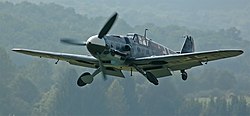
The Messerschmitt Bf 109 was a German World War II fighter aircraft designed by Willy Messerschmitt in the early 1930s. It was one of the first true modern fighters of the era, including such features as an all-metal monocoque construction, a closed canopy, and retractable landing gear. The Bf 109 was produced in greater quantities than any other fighter aircraft in history, with a total of 33,984 units produced up to April 1945. Fighter production totalled 47% of all German aircraft production, and the Bf 109 accounted for 57% of all German fighter types produced.
The Bf 109 was the backbone of the Luftwaffe fighter force in World War II, although it began to be partially replaced by the Focke-Wulf Fw 190 from 1941. The Bf 109 was the most successful fighter of World War II, shooting down more aircraft than any of its contemporaries. Originally conceived as an interceptor, it was later developed to fulfill multiple tasks, serving as bomber escort, fighter bomber, day-, night- all-weather fighter, bomber destroyer, ground-attack aircraft, and as reconnaissance aircraft.
The Bf 109 was flown by the three top-scoring fighter aces of World War II: Erich Hartmann, the top scoring fighter pilot of all time with 352 victories, Gerhard Barkhorn with 301 victories, and Günther Rall with 275 victories. All of them flew with Jagdgeschwader 52, a unit which exclusively flew the Bf 109 and was credited with over 10,000 victories, chiefly on the Eastern Front. Hartmann chose to fly the Bf 109 in combat throughout the war, despite being offered the use of the Me 262. Hans-Joachim Marseille, the highest scoring German ace in the North African Campaign, also scored all of his 158 victories flying the Bf 109, against Western Allied pilots.
- Span: 9.925 m (32 ft 6 in)
- Length: 8.95 m (29 ft 7 in)
- Height: 2.60 m (8 ft 2 in)
- Engine: 1× Daimler-Benz DB 605A-1 liquid-cooled inverted V12, 1,475 PS (1,455 hp, 1,085 kW)
- Cruising Speed: 590 km/h (365 mph) at 6,000 m (19,680 ft)
- First Flight: 28 May 1935
| More selected aircraft | Read more... |
Today in Aviation
- 2009 – Quebec Service Aérien Canadair CL-415 C-GQBG makes a belly landing at Québec City Jean Lesage International Airport, Canada and suffers substantial damage.
- 2008 – In the 2008 Suriname plane crash, an Antonov An-28 operated by Blue Wing Airlines crashes near Benzdorp in Suriname. All nineteen on board are killed.
- 2008 – ATA Airlines ceased all operations due to unrecovering bankruptcy.
- 2006 – USAF Lockheed C-5B Galaxy, 84-0059, of 436th Airlift Wing/512th Airlift Wing AF Reserve, crashes in a field one mile (1.6 km) short of the runway during landing approach to Dover AFB, Delaware. All 17 on board survive, although three are seriously injured. The cause was found to be aircrew error as the pilots and flight engineers did not properly configure, maneuver and power the aircraft during approach and landing.
- 1996 – 1996 Croatia USAF CT-43 crash: A USAF Boeing CT-43, 73-1149 (c/n 20696), call sign IFO 21, of the 76th Airlift Squadron, 86th Airlift Wing, Ramstein Air Base, Germany, on an official trade mission, crashed on approach to Dubrovnik Airport, Croatia, killing United States Secretary of Commerce Ron Brown and 34 other people. The crash board findings, announced 7 June 1996, blamed the crash on a failure of command, aircrew error and an improperly designed instrument approach procedure.
- 1985 – First Kamov V-80-01, prototype of Kamov Ka-50 "Hokum", '010', crashes, killing the pilot.
- 1982 – First flight of the Airbus A310
- 1981 – Pan Am founder Juan Trippe dies in Los Angeles.
- 1980 – The prototype of the Bombardier Challenger 600 crashes in the Mojave Desert in California, killing its pilot.
- 1970 – A USAF Boeing B-52D-60-BO Stratofortress, 55-089, c/n 464-17205, of the 28th Bomb Wing caught fire and crashed during landing at Ellsworth AFB, South Dakota, skidding into a brick storage building containing 25,000 gallons of jet fuel. Heroic efforts by crash crew save all nine on board, although one suffered broken limbs, and three firefighters were injured. One of the eight jet engines ran for forty minutes following crash.
- 1968 – The RCAF’s Lockheed P2V Neptune flew its last operational mission. A few would later be activated when the Canadair Argus was grounded after cracks were discovered in some.
- 1968 – President Lyndon B. Johnson's administration restricts American bombing of North Vietnam to targets south of the 19th Parallel.
- 1965 – United States Air Force and U. S. Navy aircraft begin covert Operation Steel Tiger armed reconnaissance flights over southeastern Laos.
- 1965 – The first jet-to-jet combat of the Vietnam War occurs. Although all American aircraft involved return safely, the North Vietnamese Air Force claims to have shot down a U. S. Navy Vought F-8 Crusader fighter and in future years celebrates April 3 as "North Vietnamese Air Force Day. "
- 1965 – The U. S. Air Force mounts the first and largest U. S. air strike against the Thanh Hoa Railroad and Highway Bridge in North Vietnam, which the bridge survives. Despite 873 sorties against it over the next seven years, the bridge will not be destroyed until April 1972.
- 1953 – BOAC introduces a weekly service to Tokyo by de Havilland Comet jet airliner.
- 1952 – A United States Air Force Boeing B-29A-65-BN Superfortress, 44-62164, crashes at night. Suspected reason – Fuel line issues. The crew bailed out over a farmer's field 8 miles (13 km) N/5.5 miles W of Onaga, Kansas, United States. The captain died in the crash and one airman perished when his parachute failed to open. In addition, several cattle were killed. The surviving crew was fired at by the farmer, who believed them to be invading "ruskies".
- 1951 – Sole prototype Hawker P.1081, converted from second prototype Hawker P.1052, VX279, with 5,000 lb (2,300 kg). s.t. Rolls-Royce Nene turbojet, first flown 19 June 1950, crashes this date at high speed on the South Downs, killing pilot Squadron Leader T. S. "Wimpy" Wade, DFC, AFC, Hawker's chief test pilot. He attempts ejection but his non-Martin-Baker seat fails. Cause was never fully established, but aircraft may have gone out of control during dive and exceeded limitations, witnesses reported hearing sonic boom as it came down. Australian interest in building type under license disappears, both they and the Royal Air Force acquiring Canadair Sabres to fill requirement for a high-speed fighter. Program abandoned.
- 1944 – American aircraft raid Wotje.
- 1944 – The U. S. Army Forces’ Fifth Air Force resumes attacks on Japanese airfields around Hollandia on New Guinea with the heaviest raid yet, including nearly a hundred Douglas A-20 Havoc bombers. They encounter only sporadic Japanese resistance.
- 1944 – In Operation Tungsten, a raid launched from the British aircraft carriers HMS Victorious, HMS Furious, HMS Emperor, HMS Fencer, HMS Pursuer, and HMS Searcher, 42 Fleet Air Arm Fairey Barracuda aircraft escorted by 40 fighters scores 14 hits with 1,600-lb (726-kg) bombs on the German battleship Tirpitz in Altenfjord, Norway, badly damaging her and killing 122 of her crew. Two Barracudas are lost.
- 1942 – The US 303rd Bomb Group, activated at Pendleton Field, Oregon, on 3 February 1942, suffers its first fatal aircraft accident when three flying officers and five enlisted crew are killed in the crash of a Boeing B-17E Flying Fortress, 41-9053, six miles (10 km) N of Strevell, Idaho during a training mission.
- 1941 – The British aircraft carrier HMS Argus flies off 12 Royal Air Force Hawker Hurricanes to Malta from a point south of Sardinia.
- 1939 – First flight of the Gloster F.9/37 (or Gloster G.39), a British twin-engined design for a cannon-armed fighter.
- 1933 – United States Navy airship USS Akron, encounters severe weather and crashes into the Atlantic off the coast of New Jersey. 73 passengers and crew, including Rear Admiral William A. Moffett, were killed. It did not have the Curtiss F9C Sparrowhawks deployed aboard when it was lost. The new Naval Airship Station at Sunnyvale, California is named Moffett Field in honour of the lost admiral.
- 1933 – The Royal Air Force reinstates the squadron of nine to 12 planes as the basic organizational unit for its aircraft assigned to Royal Navy aircraft carriers, retaining the six-plane flight as the basic organizational unit only for aircraft assigned to operate from battleship and cruiser catapults.
- 1933 – Two British aircraft, the Westland PV-3 and Westland PV-6 make the first flight over Mount Everest
- 1926 – Gus Grissom, American astronaut, was born (d. 1967). Virgil Ivan Grissom, more widely known as Gus Grissom, was one of the original NASA Project Mercury astronauts and a United States Air Force pilot. He was the second American to fly in space. Grissom was killed along with fellow astronauts Ed White and Roger Chaffee during a training exercise and pre-launch test for the Apollo 1 mission at the Kennedy Space Center. He was a recipient of the Distinguished Flying Cross and, posthumously, the Congressional Space Medal of Honor.
- 1904 – Gabriel Voisin successfully flies a modified Archdeacon glider at Berck sur Mer, Picardy. Voisin added a canard to the design. His longest flight on this day was 25 seconds.
References
- Shortcuts to this page: Portal:Airplanes • P:AVIA
- Portals with untriaged subpages from June 2018
- All portals with untriaged subpages
- Portals with no named maintainer
- Random portal component with 26–30 available subpages
- Random portal component with over 50 available image subpages
- Random portal component with 21–25 available subpages
- Unredirected portals with existing subpages