


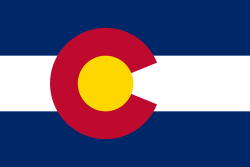


WikiProject Colorado
👁 An index finger pointing right


WikiProject Colorado 👁 An index finger pointing left


You need not be either an expert or a resident.
You only need an active interest in the Centennial State.
Request an article about a Colorado topic here or volunteer here.
Colorado Events
- Wikimedia US Mountain West Spring 2026 online meeting, Tuesday, May 12, 2026, 8:00-9:00 PM MDT
- Wikimedia US Mountain West Summer 2026 online meeting, Tuesday, August 11, 2026, 8:00-9:00 PM MDT
- Wikimedia US Mountain West Autumn 2026 online meeting, Tuesday, November 10, 2026, 8:00-9:00 PM MST
Previous events:
|
|---|
Colorado events
|
Colorado Facts
- Date admitted to Union: August 1, 1876 (38th State)
- Demonym: Coloradan
- Capital: Denver
- Elected state officers:
- Governor: Jared Polis (D) (2019–)
- Lieutenant Governor: Dianne Primavera (D) (2019–)
- Secretary of State: Jena Griswold (D) (2019–)
- Treasurer: Dave Young (D) (2019–)
- Attorney General: Phil Weiser (D) (2019–)
- Colorado General Assembly:
- Colorado Senate:
- D-23 R-12 (2025–2027)
- Colorado House of Representatives:
- D-43 R-22 (2025-2027)
- Colorado Senate:
- Colorado Supreme Court:
- Monica Márquez, Chief Justice (2024–)
- Brian Boatright (2011-)
- William Hood, III (2014–)
- Richard Gabriel (2015–)
- Melissa Hart (2017–)
- Carlos Samour, Jr (2018–)
- Maria Berkenkotter (2021–)
- U.S. Senators:
- Class 2. John Hickenlooper (D) (2021–)
- Class 3. Michael Bennet (D) (2009–)
- 1. Diana DeGette (D) (1997–)
- 2. Joe Neguse (D) (2019–)
- 3. Jeff Hurd (R) (2025-)
- 4. Lauren Boebert (R) (2025-)
- 5. Jeff Crank (R) (2025-)
- 6. Jason Crow (D) (2019–)
- 7. Brittany Pettersen (D) (2023-)
- 8. Gabe Evans (R) (2025–)
- Total area: 104,094 square miles (269,602 km2) (eighth most extensive state)
- Highest elevation: Mount Elbert 14,440 feet (4,401.2 m) (third highest state)
- Mean elevation: 6,800 feet (2,070 m) (highest state)
- Lowest elevation: Arikaree River 3,317 feet (1,011 m) (highest state)
- Population (2020 census): 5,773,714 (21st most populous state)
- Population density: 55.47 per square mile (21.40 km−2) (39th most densely populated state)
- Number of counties: 64 counties (including two consolidated city and county governments)
- Number of municipalities: 273 municipalities, comprising 2 consolidated city and county governments, 73 cities, and 198 towns
- Time zone: MST=UTC−07, MDT=UTC−06
- USPS code: CO
- ISO 3166 code: US-CO
- Adjacent U.S. states: Wyoming, Nebraska, Kansas, Oklahoma, New Mexico, Arizona, Utah (tied for third most)
- State government website: Colorado.gov
- State tourism website: Colorado.com
State Symbols


Subcategories


Featured article - show another 👁 Image


The Colorado River (Spanish: Río Colorado) is one of the principal rivers (along with the Rio Grande) in the Southwestern United States and in northern Mexico. The 1,450-mile-long (2,330 km) river, the 5th longest in the United States, drains an expansive, arid watershed that encompasses parts of seven U.S. states and two Mexican states. The name Colorado derives from the Spanish language for "colored reddish" due to its heavy silt load. Starting in the Rocky Mountains of Colorado, it flows generally southwest across the Colorado Plateau and through the Grand Canyon before reaching Lake Mead on the Arizona–Nevada border, where it turns south toward the international border. After entering Mexico, the Colorado approaches the mostly dry Colorado River Delta at the tip of the Gulf of California between Baja California and Sonora.
Known for its dramatic canyons, whitewater rapids, and eleven U.S. National Parks, the Colorado River and its tributaries are a vital source of water for 40 million people. An extensive system of dams, reservoirs, and aqueducts divert almost its entire flow for agricultural irrigation and urban water supply. Its large flow and steep gradient are used to generate hydroelectricity, meeting peaking power demands in much of the Intermountain West. Intensive water consumption has dried up the lower 100 miles (160 km) of the river, which has rarely reached the sea since the 1960s. (Full article...)
Selected mountain - show another


The highest summit of Mosquito Range and the entire Missouri River drainage basin.
Selected biography - show another


Selected article - show another


Lake Alamosa is a former lake in Colorado. It existed from the Pliocene to the middle Pleistocene in the San Luis Valley, fed by glacial meltwater from surrounding mountain ranges. Water levels waxed and waned with the glacial stages until at highstand the lake (high water level in the lake) reached an elevation of 2,335 meters (7,661 ft) and probably a surface of over 4,000 square kilometers (1,500 sq mi), but only sparse remains of the former waterbody are visible today. The existence of the lake was postulated in the early 19th century and eventually proven in the early 20th century.
The lake eventually overflowed into the Rio Grande river system during the middle Pleistocene. The overflow cut down a valley that eventually drained the lake, leaving only the San Luis Closed Basin as a remnant. The Alamosa Formation is a rock formation left by the lake. Groundwater resources are contained trapped between sediments left by the former lake. (Full article...)
Selected image - show another


National Parks in Colorado


The 23 national parks in Colorado:
- Amache National Historic Site
- Arapaho National Recreation Area
- Bent's Old Fort National Historic Site
- Black Canyon of the Gunnison National Park
- Browns Canyon National Monument
- Camp Hale-Continental Divide National Monument
- Canyons of the Ancients National Monument
- Chimney Rock National Monument
- Colorado National Monument
- Continental Divide National Scenic Trail
- Curecanti National Recreation Area
- Dinosaur National Monument
- Florissant Fossil Beds National Monument
- Great Sand Dunes National Park and Preserve
- Hovenweep National Monument
- Mesa Verde National Park and World Heritage Site
- Old Spanish National Historic Trail
- Pony Express National Historic Trail
- Rocky Mountain National Park
- Sand Creek Massacre National Historic Site
- Santa Fe National Historic Trail
- Yucca House National Monument
Interesting facts- View different entries

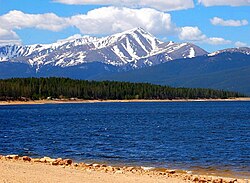
- The highest point in Colorado and all the Rocky Mountains is the summit of Mount Elbert at 14,439.6 feet (4,401.2 m) elevation.
- Although the Rocky Mountains extend from New Mexico to British Columbia, the Rockies' 30 highest major summits all rise in Colorado.
- The western portal of the Eisenhower Tunnel on Interstate Highway I-70 is the highest point on the U.S. Interstate Highway System.
- U.S. Highway 34 on Trail Ridge Road in Rocky Mountain National Park is the highest U.S. Highway.
- The Pikes Peak Highway is the highest toll road in the world.
- Colorado State Highway 105 on the Mount Blue Sky Scenic Byway is the highest paved highway in North America.
- The Manitou and Pike's Peak Railway is the highest railroad in North America.
- A freedman miner lived for many years in a cabin he built at about 14,000 feet (4,270 m) elevation on Mount Lincoln. The cabin is believed to have been the highest permanent residence in North America.
- The summit elevation of Pikes Peak is 14,115.19 feet (4,302.31 m) above sea level.
- Colorado State Highway 5, the Mount Blue Sky Scenic Byway, ascends to 14,160 feet (4,316 m) elevation near the summit of Mount Blue Sky.
- The summit of Grays Peak at 14,278 feet (4,352 m) elevation is the highest point on the Continental Divide of North America.
Did you know (auto-generated) - load new batch


- ... that Ivan Ivan played for the Eagles and the Eagles?
- ... that abortion-rights groups in Colorado opposed a 2016 ballot measure to create a statewide universal healthcare scheme?
- ... that environmental journalist Gloria Dickie wrote her thesis on how cities in Colorado changed garbage laws to prevent bear incursions?
- ... that Donald Trump would "much prefer not having a picture than having this one"?
- ... that Kelley Dolphus Stroud hitchhiked from Colorado Springs to Boston in twelve days to compete in the 1928 United States Olympic trials?
- ... that Satank Bridge to Satank, Colorado, was constructed in 1900 for $2,325, while its 2011 restoration was estimated to cost at least $750,000?
- ... that Ruben A. Valdez, a high-school dropout, became the speaker of the Colorado House of Representatives?
Related WikiProjects


Related portals


Resources
Associated Wikimedia
The following Wikimedia Foundation sister projects provide more on this subject:
-
Commons
Free media repository -
Wikibooks
Free textbooks and manuals -
Wikidata
Free knowledge base -
Wikinews
Free-content news -
Wikiquote
Collection of quotations -
Wikisource
Free-content library -
Wikiversity
Free learning tools -
Wikivoyage
Free travel guide -
Wiktionary
Dictionary and thesaurus


Collaboration


Topics


Sources
- Automatically maintained portals with listed maintainers
- Portals with triaged subpages from March 2025
- All portals with triaged subpages
- Portals with named maintainer
- Random portal component with 2–5 available subpages
- Random portal component with 21–25 available subpages
- Random portal component with more available subpages than specified max
- Random portal component with 16–20 available subpages
- Random portal component with 21–25 available image subpages
- Random portal component with 11–15 available subpages