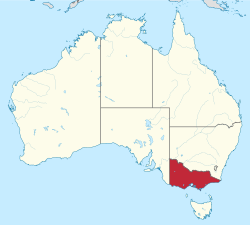
Victoria, commonly abbreviated as Vic, is a state in southeastern Australia. It is the second-smallest state (after Tasmania), with a land area of 227,444 square kilometres (87,817 sq mi); the second-most-populous state (after New South Wales), with a population of over 7 million; and the most densely populated state in Australia (31.1 per km2). Victoria's economy is the second-largest among Australian states and is highly diversified, with service sectors predominating.
Named in honour of Queen Victoria, Victoria was separated from New South Wales and established as a separate Crown colony in 1851, achieving responsible government in 1855. The Victorian gold rush in the 1850s and 1860s significantly increased Victoria's population and wealth. By the time of Australian Federation in 1901, Melbourne had become the largest city in Australasia, and was the seat of Federal government until Canberra became the national capital in 1927. The state continued to grow strongly through various periods of the 20th and 21st centuries due to high levels of international and interstate migration. Melbourne hosts a number of museums, art galleries, and theatres; in 2016 a sports marketing company named it the world's sporting capital. (Full article...)
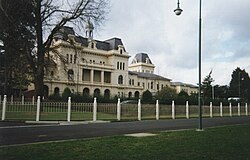
Kew Lunatic Asylum is a decommissioned heritage-listed psychiatric hospital located between Princess Street and Yarra Boulevard in Kew, a suburb of Melbourne, Australia. Operational from 1871 to 1988, Kew Asylum was one of the largest asylums ever built in Australia. Later known as Willsmere, the complex of buildings were constructed between 1864 and 1872 to the design of architects G.W. Vivian and Frederick Kawerau of the Victorian Public Works Office to house the growing number of "lunatics", "inebriates", and "idiots" in the Colony of Victoria.
The first purpose-built asylum in the Colony of Victoria, Kew was also larger and more expensive than its sister asylums at Ararat and Beechworth. The asylum's buildings are typical examples of the Italianate architecture style which was popular in Victorian Melbourne. Designed to be elegant, beautiful, yet substantial, and to be viewed as "a magnificent asylum for the insane" with the aim of portraying Melbourne as a civilised and benevolent city whilst avoiding the jail-like appearance of other asylums. These aims were furthered by the use of low ha-ha walls and extensively landscaped grounds. Long considered of cultural and historic significance to Melbourne, Kew Asylum and its complex of buildings were registered on the Register of the National Estate in March 1978. (Full article...)
In preparation for the club's entry into the league, Geelong were provided with a range of recruitment concessions, including early access to existing clubs' players prior to the league's signing period, and additional selections in the 2018 AFL Women's draft. Nina Morrison was selected by the Cats with the first overall selection in the draft. (Full article...)
Sir Wilfrid Selwyn "Bill" Kent Hughes (12 June 1895 – 31 July 1970) was an Australian army officer and politician who had a long career in both state and federal politics, most notably as a minister in the Menzies government. He also had a longstanding involvement with the Olympic movement, as both an athlete and organiser.
Ellie Victoria Cole, AM (born 12 December 1991) is an Australian retired Paralympic swimmer and wheelchair basketball player. After having her leg amputated due to cancer, she trained in swimming as part of her rehabilitation program and progressed more rapidly than instructors had predicted. She began competitive swimming in 2003 and first competed internationally at the 2006 IPC Swimming World Championships, where she won a silver medal. Since then, she has won medals in the Pan Pacific Swimming Championships, the Commonwealth Games, the Paralympic Games, the IPC Swimming World Championships, and various national championships.
Following the 2012 London Paralympics, where she won four gold and two bronze medals, Cole underwent two shoulder reconstructions and made a successful return to swimming at the 2015 IPC Swimming World Championships, winning five medals, including three golds. She subsequently represented Australia at the 2016 Rio de Janeiro Paralympics, the 2018 Commonwealth Games, and the 2020 Tokyo Paralympics. In claiming her seventeenth Paralympic medal in Tokyo, Cole became Australia's most decorated female Paralympian with six gold, five silver and six bronze medals from four Paralympic Games. (Full article...)
👁 Image Persoonia linearis, commonly known as the narrow-leaved geebung, is a shrub native to New South Wales and Victoria in eastern Australia. It reaches 3 m (9.8 ft), or occasionally 5 m (16 ft), in height and has thick, dark grey papery bark. The leaves are, as the species name suggests, more or less linear in shape, and are up to 9 cm (3.5 in) long, and 0.1 to 0.7 cm (0.039 to 0.276 in) wide. The small yellow flowers appear in summer, autumn and early winter (December to July), followed by small green fleshy fruit known as drupes. Within the genus Persoonia, it is a member of the Lanceolata group of 58 closely related species. P. linearis interbreeds with several other species where they grow together.
Found in dry sclerophyll forest on sandstone-based nutrient-deficient soils, P. linearis is adapted to a fire-prone environment; the plants resprout epicormic buds from beneath their thick bark after bushfires. The fruit are consumed by vertebrates such as kangaroo, possums and currawongs. As with other members of the genus, P. linearis is rare in cultivation as it is very hard to propagate by seed or by cuttings, but once propagated, it adapts readily, preferring acidic soils with good drainage and at least a partly sunny aspect. (Full article...)
She is legally blind, and represents Australia internationally in three sports: skiing, athletics and cycling. Besides her skiing achievements, she has represented Australia in athletics at the 2012 Summer Paralympics in London, and won a silver and a bronze medal at the 2011 Christchurch IPC Athletics World Championships in long jump and javelin, respectively. She has also represented the state of Victoria as a junior in netball and basketball. Gallagher was selected in the Australian cycling team with her pilot Madison Janssen for the 2016 Rio Paralympics. Her "long term goal is to be the first Australian to medal at a summer and winter Paralympics or Olympics". This was achieved when she won a bronze medal in the women's B/VI 1000m time trial in Rio. (Full article...)
The airport comprises four terminals: one international terminal, two domestic terminals and one budget domestic terminal, presently covering 1,070 hectares (2,600 acres) of airport property. It is 18 kilometres (11 miles) northwest of the city centre, adjacent to the suburb of Tullamarine. The airport has its own suburb with its own postcode — Melbourne Airport, 3045 respectively. (Full article...)
The Australian Academy of Cinema and Television Arts (AACTA) is a professional organisation of film and television practitioners in Australia. The academy's aim is "to identify, award, promote, and celebrate Australia's greatest achievements in film and television".
It was established in August 2011 with the backing of the Australian Film Institute (AFI) to act as its industry engagement arm and to administer the AACTA Awards (formerly the Australian Film Institute Awards, also known as the AFI Awards) which rewards achievements in Australian feature film, television, documentary and short films. (Full article...)
Map of the far southeast of Australia, with Monaro Highway highlighted in red
Monaro Highway is a 285-kilometre-long (177 mi) highway in Victoria, New South Wales, and the Australian Capital Territory, in Australia, linking Cann River in Victoria to Canberra in the Australian Capital Territory (ACT) via the Monaro region. From its southern terminus, it follows the nearby Cann River upstream towards the New South Wales border through heavily forested terrain. Within New South Wales (NSW), it makes its way through further forest before reaching the pastures typical of the Monaro. There are multiple towns and villages along the highway, including Bombala, Nimmitabel and Cooma. The terrain within the Monaro is largely hilly, and there are numerous crossings. The road also parallels the former Bombala railway line in several locations. Within the ACT, the road becomes a high volume roadway and serves the southern suburbs of Canberra. The highway has more recently had a grade-separated dual carriageway extension constructed within Canberra, as part of the Eastern Parkway construction project. It is designated part of route M23, and route A23 within Canberra, and route B23 within Victoria and New South Wales, with a concurrency where it also carries route B72 between the two sections of Snowy Mountains Highway. (Full article...)
The first series of Australian crime television drama series Underbelly originally aired from 13 February 2008 to 7 May 2008 on the Nine Network and is loosely based on the real events of the 1995–2004 gangland war in Melbourne. It depicts the key players in Melbourne's criminal underworld, including the Carlton Crew and their rival, Carl Williams. The series is based on the book Leadbelly: Inside Australia's Underworld, by journalists John Silvester and Andrew Rule, and borrows its name from the successful Underbelly true crime anthology book series also authored by Silvester and Rule. An alternative and significantly updated tie-in novel, Underbelly: The Gangland War, was released as their 13th book in the series. The series is produced by the Australian Film Finance Corporation, in association with Film Victoria. The executive producers are Des Monaghan and Jo Horsburgh.
The lead-up to Underbelly involved a heavy marketing campaign which covered radio, print, billboards and an increased online presence, including the use of social networking tools. At a reported cost of $500,000, both this marketing investment and potentially millions of dollars in advertising revenue were claimed to be put at risk by the Victorian Supreme Court's injunction, as the series was expected to attract 800,000 to 1 million viewers in Victoria alone. The injunction was put in place to ensure that upcoming criminal trials were not unfair to the accused, because the series contained fictionalised re-enactments of several disputed events. Underbelly began screening on 13 February 2008 on the Nine Network in all states and territories except Victoria and some regional parts of New South Wales, Queensland, South Australia, Tasmania and the Northern Territory. An edited version of the series premiered in Victoria on 14 September 2008 after the injunction was partially lifted, although only the first five episodes were shown. In 2011, the injunction was partially lifted and the series was screened as "Underbelly: Uncut". This rebroadcast included scenes from the original DVD release, as well as several significant changes that were made to keep the show current, including a newly recorded final voiceover and the crediting of several characters that were previously uncredited (allowable due to the ending of related trials). Some previously named characters in the final episode however are now unable to be named, resulting in a continued banning of the sale of the video release in Victoria. (Full article...)
The area command continued to operate following the end of the war, becoming the hub of Air Force training services. In October 1953, the RAAF began reorganising its command-and-control system from one based on geography to one based on function; Southern Area was re-formed as Training Command, which in 2006 became Air Force Training Group, a component of RAAF Air Command. (Full article...)
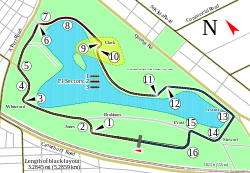
Mercedes driver Nico Rosberg was the defending race winner. His team-mate, Lewis Hamilton started the race from pole, his fourth at the circuit and a record for the venue. Hamilton led home Rosberg in a Mercedes 1–2 finish, with Ferrari's Sebastian Vettel completing the podium in his first start with the team. This race also featured the debuts of future four-time world champion Max Verstappen, and future race winner Carlos Sainz, both driving for Toro Rosso. In the process, Verstappen set the record for the youngest-ever debut in Formula One at 17 years and 166 days old. (Full article...)
Michael Schumacher won the 33rd pole position of his career by recording the fastest lap in qualifying. He maintained the lead until a major accident on lap five involving Williams' Ralf Schumacher and British American Racing (BAR) driver Jacques Villeneuve resulted in the death of spectator marshal Graham Beveridge, who was struck in the chest by Villeneuve's right-rear wheel. The incident necessitated deploying the safety car. The race restarted eleven laps later with Michael Schumacher in first place until the pit stop phase for fuel and tyres. Coulthard led for three laps until his stop before Michael Schumacher regained the lead which he maintained to win the race. (Full article...)
TISM (/ˈtɪzəm/TIZ-əm; an acronym of This Is Serious Mum) are a seven-piece anonymousalternative rock band, formed in Melbourne, Australia, on 30 December 1982 by vocalist/drummer Humphrey B. Flaubert, bassist/vocalist Jock Cheese and keyboardist/vocalist Eugene de la Hot Croix Bun, with vocalist Ron Hitler-Barassi joining the group the following year. These four members have formed the core of the band since their inception, with the line-up being rounded out by guitarists Leak Van Vlalen (1982–1991), Tokin' Blackman (1991–2004; died 2008) and Vladimir Lenin-McCartney (2022–present), as well as backing vocalists/dancers Les Miserables and Jon St. Peenis.
Noted for their dark humour, sarcastic delivery and melodic songwriting, the seven members of TISM appear in public as a pseudonymous, semi-paramilitary collective masked in a variety of balaclavas (usually as part of a more elaborate costume), and are known for their "chaotic" appearances in Australian media, often frustrating interviewers with absurd non sequiturs and tongue-in-cheek nihilism. Their catalogue is replete with references to popular culture, particularly literature, music and Australian rules football; their (usually derogatory) references to celebrities have sometimes incurred controversy and even censorship. (Full article...)
Robert Neil Harvey (born 8 October 1928) is an Australian former cricketer who was a member of the Australian cricket team between 1948 and 1963, playing in 79 Test matches. He was the vice-captain of the team from 1957 until his retirement. An attacking left-handed batsman, sharp fielder and occasional off-spin bowler, Harvey was the senior batsman in the Australian team for much of the 1950s and was regarded by Wisden as the finest fielder of his era. Upon his retirement, Harvey was the second-most prolific Test run-scorer and century-maker for Australia.
One of six cricketing brothers, four of whom represented Victoria, Harvey followed his elder brother Merv into Test cricket and made his debut in January 1948, aged 19 and three months. In his second match, he became the youngest Australian to score a Test century, a record that still stands. Harvey was the youngest member of the 1948 Invincibles of Don Bradman to tour England, regarded as one of the finest teams in history. After initially struggling in English conditions, he made a century on his Ashes debut. Harvey started his career strongly, with six centuries in his first thirteen Test innings at an average over 100, including four in 1949–50 against South Africa, including a match-winning 151 not out on a sticky wicket. As Bradman's team broke up in the 1950s due to retirements, Harvey became Australia's senior batsman, and was named as one of the Wisden Cricketers of the Year in 1954, in recognition of his feat in scoring more than 2,000 runs during the 1953 tour of England. (Full article...)
Keith Ross MillerAMMBE (28 November 1919 – 11 October 2004) was an Australian Test cricketer and a Royal Australian Air Force pilot during World War II. Miller is widely regarded as Australia's greatest ever all-rounder. His ability, irreverent manner and good looks made him a crowd favourite. Journalist Ian Wooldridge called Miller "the golden boy" of cricket, leading to him being nicknamed "Nugget".
A member of the record-breaking Invincibles, at the time of his retirement from Test cricket in 1956, Miller had the best statistics of any all-rounder in cricket history. He often batted high in the order, sometimes as high as number three. He was a powerful striker of the ball, and one straight six that he hit at the Sydney Cricket Ground was still rising when it hit the upper deck of the grandstand. Miller was famous for varying his bowling to bemuse batsmen: he made sparing use of slower deliveries and would often adjust his run-up, surprisingly bowling his fastest deliveries from a short run. He was also a fine fielder and an especially acrobatic catcher in the slips. (Full article...)
William Maldon WoodfullOBE (22 August 1897 – 11 August 1965) was an Australian cricketer of the 1920s and 1930s. He captained both Victoria and Australia, and was best known for his dignified and moral conduct during the tumultuous bodylineseries in 1932–33. Trained as a schoolteacher, Woodfull was known for his benevolent attitude towards his players, and his patience and defensive technique as an opening batsman. His opening pairing with fellow Victorian Bill Ponsford for both his state and Australia remains one of the most successful in history. While not known for his tactical skills, Woodfull was widely admired by his players and observers for his sportsmanship and ability to mould a successful and loyal team through the strength of his character.
Woodfull started playing cricket from a young age. He made his professional debut in Melbourne's district competition staying until the age of 19. He made his first-class debut for Victoria at the age of 24 late in 1921–22. After scoring a century in his second match, Woodfull was promoted to open the following season, and he opened for the rest of his career. After scoring three centuries, including a 236, in 1925–26, he was selected for the 1926 tour of England. Woodfull made eight centuries during the tour and topped the Australian averages and was named one of the five Wisden Cricketers of the Year. (Full article...)
The Melbourne Storm are an Australian rugby league football club based in Melbourne, Victoria, Australia that participates in the National Rugby League (NRL). The club plays its home games at AAMI Park, and wears a purple and navy blue jersey with gold and white trim.
The first fully professional rugby league team in the state, the club was founded in 1997, playing its first season in the newly reunified NRL competition in 1998. They have won four premierships since their inception, in 1999, 2012, 2017 and 2020, and have contested several more grand finals. They won the 2007 and 2009 grand finals, but were stripped of those premierships following salary cap breaches. (Full article...)
The Shrine of Remembrance (commonly referred to as The Shrine) is a war memorial in Melbourne, Victoria, Australia, located in Kings Domain on St Kilda Road. It was built to honour the men and women of Victoria who served in World War I, but now functions as a memorial to all Australians who have served in any war. It is a site of annual observances for Anzac Day (25 April) and Remembrance Day (11 November), and is one of the largest war memorials in Australia.
Designed by architects Phillip Hudson and James Wardrop, both World War I veterans, the Shrine is in classical style, based on the Tomb of Mausolus at Halicarnassus and the Parthenon in Athens, Greece. The crowning element at the top of the ziggurat roof references the Choragic Monument of Lysicrates. Built from Tynong granite, the Shrine originally consisted only of the central sanctuary surrounded by the ambulatory. The sanctuary contains the marble Stone of Remembrance, upon which is engraved the words "Greater love hath no man" (John 15:13); once per year, on 11 November at 11 a.m. (Remembrance Day), a ray of sunlight shines through an aperture in the roof to light up the word "Love" in the inscription. Beneath the sanctuary lies the crypt, which contains a bronze statue of a soldier father and son, and panels listing every unit of the Australian Imperial Force. (Full article...)
👁 Image George Henry Stevens Trott (5 August 1866 – 9 November 1917) was an Australian cricketer who played 24 Test matches as an all-rounder between 1888 and 1898. Although Trott was a versatile batsman, spin bowler and outstanding fielder, "it is as a captain that he is best remembered, an understanding judge of human nature". After a period of some instability and ill discipline in Australian cricket, he was the first in a succession of assertive Australian captains that included Joe Darling, Monty Noble and Clem Hill, who restored the prestige of the Test team. Respected by teammates and opponents alike for his cricketing judgement, Trott was quick to pick up a weakness in opponents. A right-handed batsman, he was known for his sound defence and vigorous hitting. His slow leg-spin bowling was often able to deceive batsmen through subtle variations of pace and flight, but allowed opposition batsmen to score quickly.
Trott made his Test debut in 1888, on a tour of England, and would tour England another three times (in 1890, 1893 and 1896), scoring more than 1000 runs on each occasion. For the 1896 tour, Trott was elected captain by his teammates. Despite England winning the series two Tests to one and retaining The Ashes, Trott's ability as a captain was highly regarded. In the return series in Australia during the 1897–98 season, Trott's team was more successful, winning the five-Test series 4–1 and regaining The Ashes. At a time when the federation of the Australian colonies was under discussion, the victory saw Trott praised as a "national institution" and his team as having "done more for the federation of Australian hearts than all the big delegates put together". (Full article...)
Banksia serrata, commonly known as the saw banksia, the old man banksia, the saw-tooth banksia or the red honeysuckle and as wiriyagan by the Cadigal people, is a species of woody shrub or tree of the genus Banksia, in the family Proteaceae. Native to the east coast of Australia, it is found from Queensland to Victoria with outlying populations on Tasmania and Flinders Island. Commonly growing as a gnarled tree up to 16 m (50 ft) in height, it can be much smaller in more exposed areas. This Banksia species has wrinkled grey bark, shiny dark green serrated leaves and large yellow or greyish-yellow flower spikes appearing over summer. The flower spikes, or inflorescences, turn grey as they age and pollinated flowers develop into large, grey, woody seed pods called follicles.
B. serrata is one of the four original Banksia species collected by Sir Joseph Banks in 1770, and one of four species published in 1782 as part of Carolus Linnaeus the Younger's original description of the genus. There are no recognised varieties, although it is closely related to Banksia aemula. Throughout its range, it grows exclusively in sandy soil, and is usually the dominant plant in scrubland or low woodland. B. serrata is pollinated by and provides food for a wide array of vertebrate and invertebrate animals in the autumn and winter months, and is an important source of food for honeyeaters. It is a common plant of parks and gardens. (Full article...)
Ian William Geddes Johnson, CBE (8 December 1917 – 9 October 1998) was an Australian cricketer who played 45 Test matches as a slow off-breakbowler between 1946 and 1956. Johnson captured 109 Test wickets at an average of 29.19 runs per wicket and as a capable lower order batsman made 1,000 runs at an average of 18.51 runs per dismissal. He captained the Australian team in 17 Tests, winning seven and losing five, with a further five drawn. Despite this record, he is better known as the captain who lost consecutive Ashes series against England. Urbane, well-spoken and popular with his opponents and the public, he was seen by his teammates as a disciplinarian and his natural optimism was often seen as naive.
Aged 17, Johnson made his first-class cricket debut for Victoria in the 1935–36 season but did not establish a permanent place in the team until 1939–40. His career was interrupted by the Second World War; he served with the Royal Australian Air Force as a pilot and later as a flight instructor. He returned to cricket after his discharge and was selected to tour New Zealand with the Australian team, making his Test debut. Johnson was part of Don Bradman's Invincibles team; undefeated on tour in England in 1948. He was a regular member of the national team until poor form saw him left out of the Australian squad for the 1953 tour of England. (Full article...)
The station is owned, operated and maintained by Civic Nexus, a subsidiary of IFM Investors and operating as Southern Cross Station Pty Ltd, under a 30-year lease to 2036 from the Victorian State Government, as part of a public-private partnership.
The station is the terminus of the state's regional railway network operated by V/Line, The Overland rail service to Adelaide, and NSW TrainLink XPT services to Sydney. It is also served by suburban rail services operated by Metro Trains, being one of five stations on the City Loop, a mostly underground railway that encircles the Central Business District. It is the second busiest railway station in Melbourne's metropolitan network, with 19.551 million metropolitan passenger movements recorded in 2018/9. In 2018/9 the station also recorded an additional 6.306 million regional passengers through the V/Line network.
Wodonga (/wəˈdɒŋɡə/wə-DONG-gə; Pallanganmiddang: Wordonga) is a city on the Victorian side of the border with New South Wales, 324 kilometres (201 mi) north-east of Melbourne, Australia. It is part of the twin city of Albury–Wodonga and is located all within the boundaries of the City of WodongaLGA and is separated from its twin city in New South Wales, Albury, by the Murray River. As of the 2021 Census, Wodonga and its suburbs have a population of 37,839 and combined with Albury, the two cities form the urban area Albury–Wodonga with a population of 97,793. There are multiple suburbs of Wodonga including Bandiana, Baranduda, Barnawartha, Bonegilla, Ebden, Huon Creek, Killara, Leneva and Staghorn.
Wodonga produces a gross domestic product of $2.57 billion per year on average. (Full article...)
Lake Elizabeth, formed from a landslide in 1952, it broke its banks allowing the West Barwon River to flow.
The Great Otway National Park is a national park located in the Barwon South West region of Victoria, Australia. The 103,185-hectare (254,980-acre) national park is situated approximately 162 kilometres (101 mi) southwest of Melbourne, in the Otway Ranges, a low coastal mountain range; its highest peak is Mount Cowley, 670 metres (2,198 feet), and is within the park. The park contains a diverse range of landscapes and vegetation types. (Full article...)
Traditionally a working class area noted for its large Italian and Greek communities, Brunswick is currently known for its bohemian culture and strong arts and live music scenes. It is also home to a large student population owing to its proximity to the University of Melbourne and RMIT University, the latter of which has a campus in the suburb. Brunswick's major thoroughfare is Sydney Road, one of Melbourne's major commercial and nightlife strips. It also encompasses the northern section of Lygon Street, synonymous with the Italian community of Melbourne, which forms its border with Brunswick East. (Full article...)
Geelong (/dʒɪˈlɒŋ/jih-LONG; Wathawurrung: Djilang/Djalang) is a port city in Victoria, Australia, located at the eastern end of Corio Bay (the smaller western portion of Port Phillip Bay) and the left bank of Barwon River, about 75 km (47 mi) southwest of Melbourne. With an estimated population of 282,809 in 2023, Geelong is the second-largest city in the state of Victoria. It is the administrative centre for the City of Greater Geelong municipality, which is Port Phillip's only regional metropolitan area, and covers all the urban, rural and coastal reserves around the city including the entire Bellarine Peninsula and from the plains of Lara in the north to the rolling hills of Waurn Ponds to the south, with Corio Bay to the east and the Barrabool Hills to the west.
The traditional owners of the land on which Geelong sits are the Wadawurrung (also known as Wathaurong) Aboriginal people of the Kulin nation. The modern name of Geelong, first recorded in 1827, was derived from the local Wadawurrung name for the region, Djilang, thought to mean "land", "cliffs" or "tongue of land or peninsula". The area was first surveyed by the European settlers in 1838, three weeks after Melbourne. During the 1850s Victorian gold rush, Geelong experienced a brief boom as the main port to the goldfields of central Victoria. The town then diversified into manufacturing, and during the 1860s became one of the largest manufacturing centres in Australia with its wool mills, ropeworks, and paper mills. During the city's early years, inhabitants of Geelong were often called Geelongites or Pivotonians, derived from the city's nickname of "The Pivot", referring to the city's role as a shipping and rail hub for Ballarat and the Western District. (Full article...)
The Melbourne Storm are an Australian rugby league football club based in Melbourne, Victoria, Australia that participates in the National Rugby League (NRL). The club plays its home games at AAMI Park, and wears a purple and navy blue jersey with gold and white trim.
The first fully professional rugby league team in the state, the club was founded in 1997, playing its first season in the newly reunified NRL competition in 1998. They have won four premierships since their inception, in 1999, 2012, 2017 and 2020, and have contested several more grand finals. They won the 2007 and 2009 grand finals, but were stripped of those premierships following salary cap breaches. (Full article...)
Its southernmost area is considered part of the central business district of the city. Southbank is bordered to the north by the Yarra River, and to the east by St Kilda Road. Southbank's southern and western borders are bounded by Dorcas Street, Kings Way, Market Street, Ferrars Street, and a triangle bordered by Gladstone Street, Montague Street and the West Gate Freeway. (Full article...)
Melbourne Gardens was founded in 1846 when land was reserved on the south side of the Yarra River for a new botanic garden. It extends across 38 hectares (94 acres) that slope to the river with trees, garden beds, lakes and lawns. It displays almost 50,000 individual plants representing 8,500 different species. These are displayed in 30 living plant collections. (Full article...)
St Kilda is an inner seaside suburb in Melbourne, Victoria, Australia, six kilometres (3+1⁄2 miles) southeast of the Melbourne central business district, located within the City of Port Philliplocal government area. St Kilda recorded a population of 19,490 at the 2021 census. The beachfront and hill portion of the locality (between Fitzroy Street, the beach and St Kilda Road), is well known for its cafes, bars, palm trees and old flats and mansions, particularly along the main streets such as Fitzroy Street, Grey Street and Acland Street. The locality also includes the lower density areas between Barkly Street and Hotham Street, and the area south of Carlisle Street down to Dickens Street, as well as a part of Albert Park.
St Kilda was named by Charles La Trobe, then superintendent of the Port Phillip District, after a schooner, Lady of St Kilda, which moored at the main beach in early 1842. From the 1850s to the 1880s in the Victorian era, St Kilda became a favoured suburb of Melbourne's elite, and many palatial mansions and grand terraces were constructed along its hills, wide streets and waterfront. After the turn of the century, the St Kilda foreshore became Melbourne's favoured playground, with electric tram lines linking the suburbs to the seaside amusement rides, ballrooms, cinemas and cafes, and crowds flocked to St Kilda Beach. Many of the mansions and grand terraces became guest houses, and some demolished or their gardens were filled in with apartment buildings, making St Kilda the most densely populated suburb in Melbourne by the 1930s. (Full article...)
Ballarat (/ˌbæləˈræt/BAL-ə-RAT) (Wathawurrung: balla arat) is a city in the Central Highlands of Victoria, Australia. At the 2021 census, Ballarat had a population of 111,973, making it the third-largest urban inland city in Australia and the third-largest city in Victoria.
Within months of Victoria separating from the colony of New South Wales in 1851, gold was discovered near Ballarat, sparking the Victorian gold rush. Ballarat subsequently became a thriving boomtown that for a time rivalled Melbourne, the capital of Victoria, in terms of wealth and cultural influence. In 1854, following a period of civil disobedience in Ballarat over gold licenses, local miners launched an armed uprising against government forces. Known as the Eureka Rebellion, it led to the introduction of white male suffrage in Australia, and as such is interpreted as the origin of Australian democracy. The rebellion's symbol, the Eureka Flag, has become a national symbol. (Full article...)
Here are some WikiProject Melbourne articles which attract a high number of "page hits" but are only rated as Stub Class, or otherwise need additional citations or attention:


.svg)






.jpg)


.jpg)


.jpg)

,_St_Kilda_Beach_--_2019_--_1590.jpg)


