
Qiu Zhe | |
|---|---|
| Chinese: 丘哲 | |
| 👁 Image | |
| Personal details | |
| Born | September 1885 (1885-09) Zhangzhou, Fujian, Qing dynasty |
| Died | January 5, 1959(1959-01-05) (aged 73) Guangzhou, Guangdong, People's Republic of China |
| Alma mater | Meizhou Middle School; Waseda University |
| Occupation | Politician, revolutionary, political activist |
| Known for | Founder and leader of the Chinese Peasants' and Workers' Democratic Party and the China Democratic League |

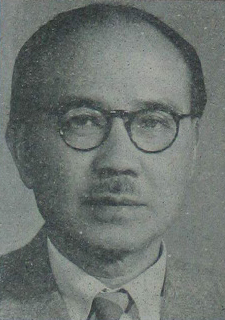
Qiu Zhe (Chinese: 丘哲; September 1885 – January 5, 1959), courtesy name Yingfu, originally named Qiu Jingrong, was a Chinese revolutionary, democratic political activist, and one of the founders and leading figures of the precursor of the Chinese Peasants' and Workers' Democratic Party as well as an important member of the China Democratic League. Born in Zhangzhou in Fujian and originally from Meixian, Guangdong, he participated in several revolutionary movements during the late Qing dynasty and the Republic of China period. After the establishment of the People's Republic of China in 1949, he served in a number of governmental and political positions in Guangdong and was elected as a deputy to the 1st National People's Congress. He died in Guangzhou on January 5, 1959.[1]
Biography
[edit]Qiu Zhe was born in September 1885 in Zhangzhou, Fujian. His ancestral home was Songkou Town in Meixian, Guangdong. During his childhood he studied with his father and returned to Meixian in 1896. By the age of twelve he was already able to read classical Chinese works such as the Records of the Grand Historian and the Zuo Zhuan. In 1902 he was admitted to Meizhou Wuben Middle School (today Meizhou Middle School). A year later he transferred to the Songkou Normal Training Institute and later worked as a teacher at Songkou Public School.[2]
While studying, Qiu was strongly influenced by revolutionary and democratic ideas. In 1906 he joined the Tongmenghui through the introduction of Xie Yiqiao and Wen Jinghou, becoming actively involved in revolutionary activities aimed at overthrowing the Qing dynasty. In 1907 he participated in the Huanggang Uprising in Raoping planned by Sun Yat-sen. After the failure of the uprising he returned to Songkou and helped establish the Songkou Physical Education School, which served as a center for revolutionary propaganda and training. During this period he also opened a rice shop in Songkou that secretly functioned as a communication base for Tongmenghui members.[3]
In 1909 Qiu went to Hong Kong to assist in organizing underground revolutionary networks together with Liang Mingjiu and Xie Liangmu, transporting weapons and coordinating plans for armed uprisings between Guangzhou and Hong Kong. In 1910 he joined the Guangdong New Army uprising led by Huang Xing. The following year he took part in the Huanghuagang Uprising in Guangzhou. Although the uprising failed, he continued to raise funds for revolutionary activities and helped organize Tongmenghui groups in Southeast Asia before returning to China to participate in the military campaign to recapture Chaozhou during the Xinhai Revolution.[4]
After the establishment of the Republic of China, Qiu was sent to Japan on government sponsorship in 1912 and later studied political economy at Waseda University. During the period when Yuan Shikai attempted to proclaim himself emperor, Qiu organized Chinese students in Japan to oppose Yuan's plans. He founded the magazine Minfeng and wrote articles criticizing Yuan Shikai, which led to his arrest by the Japanese police before he was eventually released through the efforts of overseas Chinese students and community leaders.[5]
In 1917 Qiu returned to China and briefly served as police commissioner in Zhangzhou, Fujian. He later joined forces associated with Sun Yat-sen and participated in the campaigns of the Guangdong–Fujian army. After Guangdong was recovered, he served as director of the Guangdong Provincial Treasury and later as governor of the Bank of Guangdong.[6] Following the rebellion of Chen Jiongming, Qiu refused to cooperate with Chen and moved to Shanghai, where he founded the Qizhi Publishing House and Printing Company and published the magazine Ziwei (Chinese: 自卫).[7][8]
In the late 1920s Qiu worked closely with Deng Yanda and Huang Qixiang. In 1927 he traveled to Europe with Huang Qixiang at Deng Yanda's invitation to study the conditions of workers and peasants and examine agrarian issues. After returning to China, he helped Deng Yanda establish the Chinese Kuomintang Provisional Action Committee, the predecessor of the Chinese Peasants' and Workers' Democratic Party. After Deng Yanda was executed in 1931 by the government of Chiang Kai-shek, Qiu continued to advocate Deng's political ideas and maintained opposition to Chiang's rule.[9]
During the Second Sino-Japanese War, Qiu was active in democratic and anti-Japanese movements. He cooperated with leaders such as Zhou Enlai and Ye Jianying and worked with intellectuals including Huang Yanpei to promote democratic unity and resistance against Japan. He also helped establish political organizations and newspapers advocating national unity and resistance, including the Qianjin Daily. In the early 1940s he became involved in the formation of the China Democratic League, serving as a central committee member and helping organize its southern branch in Hong Kong.[10]
In 1949, Qiu participated in the preparatory meetings for the Chinese People's Political Consultative Conference and attended the first plenary session in Beijing, contributing to the establishment of the People's Republic of China.[11][12]
After 1949 he served as a member of the Guangdong Provincial People's Government, director of the Guangdong Department of Agriculture and Forestry, vice chairman of the southern branch of the China Democratic League, and chairman of the Guangdong committee of the Chinese Peasants' and Workers' Democratic Party. He also served as a member of the South Central Military and Administrative Committee, vice mayor of Guangzhou, vice chairman of the Guangzhou Municipal Committee of the Chinese People's Political Consultative Conference, and later as vice governor of Guangdong Province. He was elected as a deputy to the 1st National People's Congress.[13]
During the Anti-Rightist Campaign in 1957, Qiu was mistakenly labeled a "Rightist" and removed from all his posts. He died in Guangzhou on January 5, 1959. In 1979, after the reforms following the Third Plenum of the 11th Central Committee of the Chinese Communist Party, the verdict against him was officially overturned and his political reputation was rehabilitated.[14]
References
[edit]- ^ 梅县志 (in Chinese). 广东人民出版社. 1994. p. 1139. ISBN 978-7-218-01404-3. Retrieved 2026-03-09.
- ^ 秦国生; 胡治安 (1990). 中国民主党派历史, 政纲, 人物 (in Chinese). 山东人民出版社. p. 656. ISBN 978-7-209-00722-1. Retrieved 2026-03-09.
- ^ 梅縣統戰志 (in Chinese). 該組. 1995. p. 148. Retrieved 2026-03-09.
- ^ 大塘街志 (in Chinese). 出版者不详. 2002. p. 211. Retrieved 2026-03-09.
- ^ 梅州市志 (in Chinese). 广东人民出版社. 1999. p. 1939. ISBN 978-7-218-03132-3. Retrieved 2026-03-09.
- ^ 广东省志: 人物志 (in Chinese). 广东人民出版社. 2002. p. 617. ISBN 978-7-218-04186-5. Retrieved 2026-03-09.
- ^ 梅县志 (in Chinese). 广东人民出版社. 1994. p. 1139. ISBN 978-7-218-01404-3. Retrieved 2026-03-09.
- ^ 广州市志 (in Chinese). 广州出版社出版发行. 1995. p. 78. ISBN 978-7-80592-469-4. Retrieved 2026-03-09.
- ^ 广州市志 (in Chinese). 广州出版社出版发行. 1995. p. 77. ISBN 978-7-80592-469-4. Retrieved 2026-03-09.
- ^ 中囯民主党派上海市地方組织志 (in Chinese). 上海社会科學院出版社. 1998. p. 482. ISBN 978-7-80618-505-6. Retrieved 2026-03-09.
- ^ 窦爱芝 (1992). 中国民主党派史 (in Chinese). 南开大学出版社. p. 309. ISBN 978-7-310-00432-4. Retrieved 2026-03-09.
- ^ 何锦洲 (1997). 中国共产党与各民主党派合作革命史 (in Chinese). 中山大学出版社. p. 176. ISBN 978-7-306-01299-9. Retrieved 2026-03-09.
- ^ 中国民主党派史丛书: 中囯农工民主党卷 (in Chinese). 河北人民出版社. 2001. p. 72. Retrieved 2026-03-09.
- ^ 广东历史人物辞典 (in Chinese). 广东高等教育出版社. 2001. p. 88. ISBN 978-7-5361-2564-3. Retrieved 2026-03-09.
- 1885 births
- 1959 deaths
- People from Zhangzhou
- People from Meizhou
- Chinese revolutionaries
- Chinese democracy activists
- Members of the China Democratic League
- Chinese Peasants' and Workers' Democratic Party politicians
- Waseda University alumni
- Delegates to the 1st National People's Congress
- Vice-governors of Guangdong
- Vice-mayors of Guangzhou