VOOZH about

URL: https://en.wikipedia.org/wiki/Soyuz-TM

⇱ Soyuz-TM - Wikipedia


Jump to content
From Wikipedia, the free encyclopedia
Fourth-generation of the Soyuz spacecraft
Soyuz-TM
πŸ‘ Image
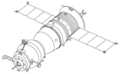
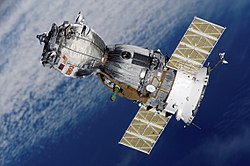
Soyuz-TM spacecraft.
ManufacturerKorolev
Country of originSoviet Union and Russia
OperatorSoviet space program/Russian Federal Space Agency
ApplicationsCarry three cosmonauts to Mir and ISS and back
Specifications
RegimeLow Earth orbit
Design lifeUp to six months docked to station
Production
StatusOut of service
Launched34
Maiden launchSoyuz TM-1, 1986
Last launchSoyuz TM-34, 2002
Related spacecraft
Derived fromSoyuz-T
DerivativesSoyuz-TMA

The Soyuz TM (Russian: транспортный ΠΌΠΎΠ΄ΠΈΡ„ΠΈΡ†ΠΈΡ€ΠΎΠ²Π°Π½Π½Ρ‹ΠΉ, romanizedTransportnyi Modifitsirovannyi, lit. 'Transport Modified') were fourth generation (1986–2002) Soyuz spacecraft used for ferry flights to the Mir and ISS space stations. The Soyuz spacecraft consisted of three parts, the Orbital Module, the Descent Module and the Service Module.[1]

The first launch of the spacecraft was the uncrewed Soyuz TM-1 on May 21, 1986, where it docked with the Mir space station.[2] The final flight was Soyuz TM-34, which docked with the International Space Station and landed November 10, 2002.[3]

Background

[edit]

After the Apollo-Soyuz Test project in 1976, the Soyuz for crewed flights had the singular mission of supporting crewed space stations.[4] The original Soyuz had a limited endurance when docked with a station, only about 60 to 90 days.[4] There were two avenues for extending the duration of missions past this. The first avenue was to make upgrades to increase the Soyuz spacecraft's endurance. The Soyuz-T could last 120 days and the Soyuz-TM could last 180 days.[4] The other was to use a Visiting Expedition to fly a new Soyuz up to the station and depart with the spacecraft nearing the end of its rated endurance.[4]

The preliminary design was released in April 1981 and the main set of working documentation was released in early 1982.[5]

Upgrades from Soyuz-T

[edit]

Orbital Module

[edit]

With the growth of orbital complexes, the Soyuz-T used the Igla system that required continuous orientation with the station and had high fuel costs. The Soyuz-TM was upgraded with the Kurs system that did not require the same orientation from the station and allowed measurements from a range of 200 km instead of the 30 km of the Igla.[6]

Descent Module

[edit]

It also increased the payload to 51.6Β° orbit by 200–250 kg and was able to return 70–90 kg more back to earth. Energia accomplished this by increasing the capabilities of the launch vehicle and decreasing the mass of the ship.[6] The parachute system mass was decreased by 120 kg (40%) by using synthetic material for the slings and lightweight material for the parachute domes.[6]

Propulsion/Service Module

[edit]

It also featured a new KTDU-80 propulsion module that permitted the Soyuz-TM to maneuver independently of the station, without the station making "mirror image" maneuvers to match unwanted translations introduced by earlier models' aft-mounted attitude control. It also used the baffles inside the tanks became structural, allowing further reduction in mass.

Typical Flight for Soyuz-TM

[edit]

Training

[edit]
πŸ‘ Image
Soyuz TM control panel simulator

Classroom training is completed on Soyuz systems and required crew operations. Cosmonauts must pass an oral test on the material for certification. Training was also completed on Soyuz mockups and simulators. Two weeks before launch, after passing all the tests, the crew is flown to Baikonur to participate in a test at the launch site to go through all the steps associated with the launch.[7]

For Flight Readiness

[edit]

The final decision to launch is made by the assembly company (General Designer).[8] There is a Space Committee formed of approximately 20 people headed by a 3-star General for Air and Space with the following representation:

When different companies/countries are involved, they are represented as well at on the Space Committee. For Soyuz launches, the Ministry of Defense representative states that everything has been checked because all preparations at Baikonur are performed by the military. Independent assessment is made by the Central Institute of Machine Building for every flight.[8] Cosmonauts had to get clearance from the Russian Medical Commission, the Institute of Biomedical Problems and the GCTC at the flight readiness Review.[8]

Launch

[edit]

Space Station

[edit]

Landing

[edit]

Table of Flights

[edit]
Mission Launch Launch Crew Landed Landed Crew Duration Summary
Soyuz TM-1 21 May 1986 30 May 1986 9 days Uncrewed test flight
Soyuz TM-2 5 February 1987 Mir EO-2:
πŸ‘ Soviet Union
 Yuri Romanenko
πŸ‘ Soviet Union
 Aleksandr Laveykin
30 July 1987 Mir EP-1:
πŸ‘ Soviet Union
 Aleksandr Viktorenko
πŸ‘ Ba'athist Syria
 Muhammed Faris
Mir EO-2:
πŸ‘ Soviet Union
 Aleksandr Laveykin
174 days
Soyuz TM-3 22 July 1987 Mir EP-1:
πŸ‘ Soviet Union
 Aleksandr Viktorenko
πŸ‘ Ba'athist Syria
 Muhammed Faris
Mir EO-2:
πŸ‘ Soviet Union
 Aleksandr Pavlovich Aleksandrov
29 December 1987 Mir EO-2:
πŸ‘ Soviet Union
 Yuri Romanenko
πŸ‘ Soviet Union
 Aleksandr Pavlovich Aleksandrov
Mir LII-1:
πŸ‘ Soviet Union
 Anatoli Levchenko
160 days
Soyuz TM-4 21 December 1987 Mir EO-3:
πŸ‘ Soviet Union
 Vladimir Titov
πŸ‘ Soviet Union
 Musa Manarov
Mir LII-1:
πŸ‘ Soviet Union
 Anatoli Levchenko
17 June 1988 Mir EP-2:
πŸ‘ Soviet Union
 Anatoly Solovyev
πŸ‘ Soviet Union
 Viktor Savinykh
πŸ‘ Bulgaria
 Aleksandr Aleksandrov
178 days
Soyuz TM-5 7 June 1988 Mir EP-2:
πŸ‘ Soviet Union
 Anatoly Solovyev
πŸ‘ Soviet Union
 Viktor Savinykh
πŸ‘ Bulgaria
 Aleksandr Aleksandrov
7 September 1988 Mir EP-3:
πŸ‘ Soviet Union
 Vladimir Lyakhov
πŸ‘ Afghanistan
 Abdul Ahad Mohmand
91 days
Soyuz TM-6 29 August 1988 Mir EP-3:
πŸ‘ Soviet Union
 Vladimir Lyakhov
πŸ‘ Afghanistan
 Abdul Mohmand
πŸ‘ Soviet Union
 Valeri Polyakov
21 December 1988 Mir EO-3:
πŸ‘ Soviet Union
 Vladimir Titov
πŸ‘ Soviet Union
 Musa Manarov
Mir Aragatz:
πŸ‘ France
 Jean-Loup ChrΓ©tien
114 days
Soyuz TM-7 26 November 1988 Mir EO-4:
πŸ‘ Soviet Union
 Alexander Volkov
πŸ‘ Soviet Union
 Sergei Krikalev
Mir Aragatz:
πŸ‘ France
 Jean-Loup ChrΓ©tien
27 April 1989 Mir EO-4:
πŸ‘ Soviet Union
 Alexander Volkov
πŸ‘ Soviet Union
 Sergei Krikalev
πŸ‘ Soviet Union
 Valeri Polyakov
151 days
Soyuz TM-8 5 September 1989 Mir EO-5:
πŸ‘ Soviet Union
 Aleksandr Viktorenko
πŸ‘ Soviet Union
 Aleksandr Serebrov
19 February 1990 Mir EO-5:
πŸ‘ Soviet Union
 Aleksandr Viktorenko
πŸ‘ Soviet Union
 Aleksandr Serebrov
166 days
Soyuz TM-9 11 February 1990 Mir EO-6:
πŸ‘ Soviet Union
 Anatoly Solovyev
πŸ‘ Soviet Union
 Aleksandr Balandin
9 August 1990 Mir EO-6:
πŸ‘ Soviet Union
 Anatoly Solovyev
πŸ‘ Soviet Union
 Aleksandr Balandin
179 days
Soyuz TM-10 1 August 1990 Mir EO-7:
πŸ‘ Soviet Union
 Gennady Manakov
πŸ‘ Soviet Union
 Gennady Strekalov
10 December 1990 Mir EO-7:
πŸ‘ Soviet Union
 Gennady Manakov
πŸ‘ Soviet Union
 Gennady Strekalov
Reporter:
πŸ‘ Japan
 Toyohiro Akiyama
130 days
Soyuz TM-11 2 December 1990 Mir EO-8:
πŸ‘ Soviet Union
 Viktor Afanasyev
πŸ‘ Soviet Union
 Musa Manarov
Reporter:
πŸ‘ Japan
 Toyohiro Akiyama
26 May 1991 Mir EO-8:
πŸ‘ Soviet Union
 Viktor Afanasyev
πŸ‘ Soviet Union
 Musa Manarov
Project Juno:
πŸ‘ United Kingdom
 Helen Sharman
175 days
Soyuz TM-12 18 May 1991 Mir EO-9:
πŸ‘ Soviet Union
 Anatoly Artsebarsky
πŸ‘ Soviet Union
 Sergei Krikalev
Project Juno:
πŸ‘ United Kingdom
 Helen Sharman
10 October 1991 Mir EO-9:
πŸ‘ Soviet Union
 Anatoly Artsebarsky
Others:
πŸ‘ Kazakh Soviet Socialist Republic
 Toktar Aubakirov
πŸ‘ Austria
 Franz ViehbΓΆck
144 days
Soyuz TM-13 2 October 1991 Mir EO-10:
πŸ‘ Soviet Union
 Alexander Volkov
Others:
πŸ‘ Kazakh Soviet Socialist Republic
 Toktar Aubakirov
πŸ‘ Austria
 Franz ViehbΓΆck
25 March 1992 Mir EO-10:
πŸ‘ Russia
 Alexander Volkov
πŸ‘ Russia
 Sergei Krikalev
Other:
πŸ‘ Germany
 Klaus-Dietrich Flade
175 days In orbit during the Dissolution of the Soviet Union
Soyuz TM-14 17 March 1992 Mir EO-11:
πŸ‘ Russia
 Aleksandr Viktorenko
πŸ‘ Russia
 Aleksandr Kaleri
Other:
πŸ‘ Germany
 Klaus-Dietrich Flade
10 August 1992 Mir EO-11:
πŸ‘ Russia
 Aleksandr Viktorenko
πŸ‘ Russia
 Aleksandr Kaleri
Other:
πŸ‘ France
 Michel Tognini
145 days
Soyuz TM-15 27 July 1992 Mir EO-12:
πŸ‘ Russia
 Anatoly Solovyev
πŸ‘ Russia
 Sergei Avdeyev
Other:
πŸ‘ France
 Michel Tognini
1 February 1993 Mir EO-12:
πŸ‘ Russia
 Anatoly Solovyev
πŸ‘ Russia
 Sergei Avdeyev
188 days
Soyuz TM-16 24 January 1993 Mir EO-13:
πŸ‘ Russia
 Gennadi Manakov
πŸ‘ Russia
 Alexander Poleshchuk
22 July 1993 Mir EO-13:
πŸ‘ Russia
 Gennadi Manakov
πŸ‘ Russia
 Alexander Poleshchuk
Other:
πŸ‘ France
 Jean-Pierre HaignerΓ©
179 days
Soyuz TM-17 1 July 1993 Mir EO-14:
πŸ‘ Russia
 Vasili Tsibliyev
πŸ‘ Russia
 Aleksandr Serebrov
Other:
πŸ‘ France
 Jean-Pierre HaignerΓ©
14 January 1994 Mir EO-14:
πŸ‘ Russia
 Vasili Tsibliyev
πŸ‘ Russia
 Aleksandr Serebrov
196 days
Soyuz TM-18 8 January 1994 Mir EO-15:
πŸ‘ Russia
 Viktor Afanasyev
πŸ‘ Russia
 Yury Usachov
πŸ‘ Russia
 Valeri Polyakov
9 July 1994 Mir EO-15:
πŸ‘ Russia
 Viktor Afanasyev
πŸ‘ Russia
 Yury Usachov
182 days
Soyuz TM-19 1 July 1994 Mir EO-16:
πŸ‘ Russia
 Yuri Malenchenko
πŸ‘ Kazakhstan
 Talgat Musabayev
4 November 1994 Mir EO-16:
πŸ‘ Russia
 Yuri Malenchenko
πŸ‘ Kazakhstan
 Talgat Musabayev
Euromir 94:
πŸ‘ Germany
 Ulf Merbold
125 days
Soyuz TM-20 3 October 1994 Mir EO-17:
πŸ‘ Russia
 Aleksandr Viktorenko
πŸ‘ Russia
 Yelena Kondakova
Euromir 94:
πŸ‘ Germany
 Ulf Merbold
22 March 1995 Mir EO-17:
πŸ‘ Russia
 Aleksandr Viktorenko
πŸ‘ Russia
 Yelena Kondakova
πŸ‘ Russia
 Valeri Polyakov
169 days
Soyuz TM-21 14 March 1995 Mir EO-18:
πŸ‘ Russia
 Vladimir Dezhurov
πŸ‘ Russia
 Gennady Strekalov
πŸ‘ United States
 Norman Thagard
11 September 1995 Mir EO-19:
πŸ‘ Russia
 Anatoly Solovyev
πŸ‘ Russia
 Nikolai Budarin
181 days
Soyuz TM-22 3 September 1995 Mir EO-20:
πŸ‘ Russia
 Yuri Gidzenko
πŸ‘ Russia
 Sergei Avdeyev
Euromir 95:
πŸ‘ Germany
 Thomas Reiter
29 February 1996 Mir EO-20:
πŸ‘ Russia
 Yuri Gidzenko
πŸ‘ Russia
 Sergei Avdeyev
Euromir 95:
πŸ‘ Germany
 Thomas Reiter
179 days
Soyuz TM-23 21 February 1996 Mir EO-21:
πŸ‘ Russia
 Yuri Onufrienko
πŸ‘ Russia
 Yury Usachov
2 September 1996 Mir EO-21:
πŸ‘ Russia
 Yuri Onufrienko
πŸ‘ Russia
 Yury Usachov
Other:
πŸ‘ France
 Claudie AndrΓ©-Deshays
193 days
Soyuz TM-24 17 August 1996 Mir EO-22:
πŸ‘ Russia
 Valery Korzun
πŸ‘ Russia
 Aleksandr Kaleri
Other:
πŸ‘ France
 Claudie AndrΓ©-Deshays
2 March 1997 Mir EO-22:
πŸ‘ Russia
 Valery Korzun
πŸ‘ Russia
 Aleksandr Kaleri
Other:
πŸ‘ Germany
 Reinhold Ewald
196 days
Soyuz TM-25 10 February 1997 Mir EO-23:
πŸ‘ Russia
 Vasili Tsibliyev
πŸ‘ Russia
 Aleksandr Lazutkin
Other:
πŸ‘ Germany
 Reinhold Ewald
14 August 1997 Mir EO-23:
πŸ‘ Russia
 Vasili Tsibliyev
πŸ‘ Russia
 Aleksandr Lazutkin
184 days
Soyuz TM-26 5 August 1997 Mir EO-24:
πŸ‘ Russia
 Anatoly Solovyev
πŸ‘ Russia
 Pavel Vinogradov
19 February 1998 Mir EO-24:
πŸ‘ Russia
 Anatoly Solovyev
πŸ‘ Russia
 Pavel Vinogradov
Other:
πŸ‘ France
 LΓ©opold Eyharts
197 days
Soyuz TM-27 29 January 1998 Mir EO-25:
πŸ‘ Russia
 Talgat Musabayev
πŸ‘ Russia
 Nikolai Budarin
Other:
πŸ‘ France
 LΓ©opold Eyharts
25 August 1998 Mir EO-25:
πŸ‘ Russia
 Talgat Musabayev
πŸ‘ Russia
 Nikolai Budarin
Other:
πŸ‘ Russia
 Yuri Baturin
207 days
Soyuz TM-28 13 August 1998 Mir EO-26:
πŸ‘ Russia
 Gennady I. Padalka
πŸ‘ Russia
 Sergei Avdeyev
Other:
πŸ‘ Russia
 Yuri Baturin
28 February 1999 Mir EO-26:
πŸ‘ Russia
 Gennady I. Padalka
Other:
πŸ‘ Slovakia
 Ivan Bella
198 days
Soyuz TM-29 20 February 1999 Mir EO-27:
πŸ‘ Russia
 Viktor Afanasyev
πŸ‘ France
 Jean-Pierre HaignerΓ©
Other:
πŸ‘ Slovakia
 Ivan Bella
28 August 1999 Mir EO-27:
πŸ‘ Russia
 Viktor Afanasyev
πŸ‘ France
 Jean-Pierre HaignerΓ©
Other:
πŸ‘ Russia
 Sergei Avdeyev
188 days
Soyuz TM-30 4 April 2000 Mir EO-28:
πŸ‘ Russia
 Sergei Zalyotin
πŸ‘ Russia
 Aleksandr Kaleri
16 June 2000 Mir EO-28:
πŸ‘ Russia
 Sergei Zalyotin
πŸ‘ Russia
 Aleksandr Kaleri
72 days Last mission to Mir
Soyuz TM-31 31 October 2000 Expedition 1:
πŸ‘ Russia
 Yuri Gidzenko
πŸ‘ Russia
 Sergei Krikalev
πŸ‘ United States
 William Shepherd
6 May 2001 ISS EP-1:
πŸ‘ Russia
 Talgat Musabayev
πŸ‘ Russia
 Yuri Baturin
πŸ‘ United States
 Dennis Tito
186 days First Soyuz to the International Space Station
Soyuz TM-32 28 April 2001 ISS EP-1:
πŸ‘ Russia
 Talgat Musabayev
πŸ‘ Russia
 Yuri Baturin
πŸ‘ United States
 Dennis Tito
31 October 2001 ISS EP-2:
πŸ‘ Russia
 Viktor M. Afanasyev
πŸ‘ France
 Claudie HaignerΓ©
πŸ‘ Russia
 Konstantin Kozeyev
185 days
Soyuz TM-33 21 October 2001 ISS EP-2:
πŸ‘ Russia
 Viktor M. Afanasyev
πŸ‘ France
 Claudie HaignerΓ©
πŸ‘ Russia
 Konstantin Kozeyev
5 May 2002 πŸ‘ Russia
 Yuri Gidzenko
πŸ‘ Italy
 Roberto Vittori
πŸ‘ South Africa
 Mark Shuttleworth
195 days
Soyuz TM-34 25 April 2002 πŸ‘ Russia
 Yuri Gidzenko
πŸ‘ Italy
 Roberto Vittori
πŸ‘ South Africa
 Mark Shuttleworth
10 November 2002 πŸ‘ Russia
 Sergei Zalyotin
πŸ‘ Belgium
 Frank De Winne
πŸ‘ Russia
 Yury Lonchakov
198 days

Gallery

[edit]

External links

[edit]
Wikimedia Commons has media related to Soyuz spacecraft.

References

[edit]
  1. ^ Miller, Denise (30 July 2013). "What is the Soyzu Spacecraft". nasa.gov.
  2. ^ Portree, David S. (1995). Mir Hardware Heritage (PDF). NASA. pp. 53–59. Archived from the original (PDF) on 2003-07-09.
  3. ^ "Soyuz ISS Missions" (PDF). NASA. Archived from the original (PDF) on 2011-12-02.
  4. ^ a b c d Portree, David S. (1995). Mir Hardware Heritage. NASA. pp. 6–7.
  5. ^ "Soyuz TM (7K-STM) spacecraft". gctc.ru.
  6. ^ a b c "Soyuz TM manned transport spacecraft". energia.ru.
  7. ^ OSMA Assessments Team. "NASA Astronauts on Soyuz: Experience and Lessons for the Future" (PDF). sma.nasa.gov.
  8. ^ a b c OSMA Assessments Team (2010). NASA Astronauts on Soyuz: Experience and Lessons for the Future (PDF). NASA. pp. 12–13.