


.svg)


The Nigeria national football team[i] represents Nigeria in international men's football. Governed by the Nigeria Football Federation (NFF), they are three-time Africa Cup of Nations (AFCON) winners, with their most recent title in 2013.[3] In February 2024, the Nigerian national football team was ranked 28th in the FIFA rankings. The team has qualified for six of the last nine FIFA World Cups, missing only the 2006, 2022 and 2026 tournaments. They have reached the round of 16 on three occasions. Their first World Cup appearance was in the 1994 edition. The team is a member of FIFA and Confederation of African Football (CAF).[citation needed]
History
[edit]

Early history
[edit]Nigeria first played other colonies in unofficial games, initially in 1938 when they played the Gold Coast with a team of Lagos-based players.[4] Nigeria formed a representative national team to send abroad for a tour of England, arriving in Liverpool on 29 August 1949, and playing matches against amateur sides including Marine A.F.C. (which drew 6,000 spectators, a record their Rossett Park ground[5]), Bishop Auckland, Leytonstone, Dulwich Hamlet and Bromley.[6] Nigeria then played its first official game in October 1949, while still a British colony, as they beat Sierra Leone 2–0 in Freetown.[7]
1963–1980
[edit]Nigeria first appeared in the Africa Cup of Nations in 1963, when they were drawn in a group with Sudan, and the then United Arab Republic. They did not advance to the next stage.[8]
The team's first major success was a gold medal in the 2nd All-Africa games in 1973 led by captain, Victor Oduah. The team went on to achieve 3rd-place finishes in the 1976 and 1978 African Cup of Nations to follow. In 1980, with players such as Segun Odegbami and Best Ogedegbe, the team, led by Christian Chukwu, won the African Cup for the first time in Lagos.[9]
Nigeria Olympic Men's football team won the football event at the 1996 Olympics in Atlanta, beating Mexico, Brazil and Argentina in the process. They were runners-up in the same event at the 2008 Olympics in Beijing, losing to Argentina in a rematch of the 1996 Final of the event.[10][11]
In 1984, 1988 and 2000,[12] Nigeria reached the Cup of Nations final, losing to Cameroon. Three of the five African titles won by Cameroon have been won by defeating Nigeria. Missing out to Cameroon on many occasions has created an intense rivalry between both nations. Three notable occasions; narrowly losing out in the 1988 African Cup of Nations, qualifiers for the 1990 World Cup, and the controversial final of the 2000 African Cup of Nations where a kick taken by Victor Ikpeba during the penalty shoot-out was adjudged not to have crossed the goal-line by the referee.[13][9]
The team withdrew from two African Cup of Nations between 1963 and 1974, due to political instability and in 1996. In 1976, they came back to the Cup of Nations with third-place finishes in both the 1976 and 1978 African Cup of Nations.
1980–1990
[edit]Nigeria hosted the 1980 Africa Cup of Nations and also won their first Cup of Nations title that year in Lagos. Nigeria came out as runners-up three times and had one group stage elimination, between 1982 and 1990. They also failed to qualify for the 1986 Africa Cup of Nations hosted by Egypt.
1992–2006
[edit]Nigeria appeared again in the African Cup of Nations in 1992 and 1994, they finished third in 1992 and won the 1994 Africa Cup of Nations, which was the second time they won the tournament.


Nigeria finally reached the World Cup for the first time in 1994 after years of struggling to get there. They were managed by Clemens Westerhof. Nigeria topped their group which included Argentina, Bulgaria, and Greece. Nigeria defeated Bulgaria 3–0, lost to Argentina 1–2, and reached the second round after a 2–0 victory over Greece. In the second round, Nigeria played Italy and took the lead with a goal from Emmanuel Amunike in the 25th minute. Nigeria was within two minutes of qualifying for the quarter-finals, when Roberto Baggio scored to take the game to extra time. He also scored the eventual winning goal. The game ended 2–1 in favour of the Italians. In 1996 the team withdrew from that year's African Cup of Nations under pressure from the country's military dictator Sani Abacha due to the criticism received from the tournament hosts South Africa and especially its president Nelson Mandela, for the execution of Ogoni activist Ken Saro-Wiwa. Nigeria was subsequently banned from entering the 1998 African Cup of Nations.
In 1998, Nigeria returned to the World Cup alongside Cameroon, Morocco, Tunisia, and South Africa. Optimism was high due to its manager Bora Milutinović and the return of most 1994 squad members. In the final tournament Nigeria were drawn into group D with Spain, Bulgaria, Paraguay. Nigeria scored a major upset by defeating Spain 3–2 after coming back twice from being 1–0 and 2–1 down. The Eagles qualified for the second round with a win against Bulgaria and a loss to Paraguay. The team's hopes of surpassing its 1994 performance were shattered after a 1–4 loss to Denmark. This is currently the only World Cup that Nigeria qualified for without playing Argentina in the tournament finals.
In 2000 they returned to the Cup of Nations and were the runner-up and subsequently finished in third place at the 2002, 2004 and 2006 Africa Cup of Nations.
2002 and 2006 World Cups
[edit]The 2002 World Cup in South Korea and Japan saw Nigeria again qualify with optimism. With a new squad and distinctive pastel green kits, the Super Eagles were expected to build on its strong performances in the 2000 and 2002 African Cup of Nations. Nigeria was drawn into group F with powerhouses Sweden, Argentina, and England. The first game against Argentina started with a strong defense that kept the first half scoreless. In the 61st minute, Gabriel Batistuta breached the Nigerian defense to put Argentina in the lead 1–0, and Argentina would go on to win the game. Nigeria's second game against Sweden saw them take the lead but later lose 2–1. Nigeria then drew 0–0 with England and bowed out in the first round.
Nigeria failed to qualify for the 2006 World Cup after finishing level on points in the qualification group with Angola, but having an inferior record in the matches between the sides.[14]
2008–2013
[edit]

In the 2008 Africa Cup of Nations, Nigeria ended their campaign in the quarter finals after losing to Ghana. They qualified for 2010 Africa Cup of Nations, hosted by Angola, but were eliminated by Ghana in the semi-finals.
On 14 November 2009, Nigeria qualified for the 2010 World Cup after defeating Kenya by 3–2 in Nairobi.[15]


Nigeria lost its opening match against Argentina 1–0 at Ellis Park Stadium following a controversial Gabriel Heinze header in the 6th minute.[16][17] In its second game Nigeria led early on by a goal from Kalu Uche. A red card against Sani Kaita gave Greece the advantage. Greece scored the equaliser late in the first half and Nigeria conceded the second goal in the second half and lost the game 2–1. In their last group stage match against South Korea, Nigeria took an early lead in the 12th minute off of a great finish by Kalu Uche after a low cross from Chidi Odiah. However, goals from Lee Jung-Soo and Park Chu-Young gave South Korea a 2–1 lead, which looked to be enough for South Korea to advance into the round of 16. However, Nigeria got a chance in the 66th minute, on the end of a pass from Ayila Yussuf that was fed through the South Korean defense was none other than Yakubu, once the pass found Yakubu's foot about four yards away from the empty goal, Yakubu pushed the ball wide of the left post to leave South Korea still ahead 2–1. Three minutes later, Yakubu was able to calmly finish a penalty to knot the score at two apiece, but Nigeria was unable to score again and the match ended in a 2–2 draw. With this result, Nigeria was eliminated from the 2010 World Cup with just one point, while South Korea advanced into the round of 16 with four points. On 30 June 2010, following the team's early exit and poor showing, the then President of Nigeria, Goodluck Jonathan suspended the national football team from international competition for two years.[18] This suspension put the team at risk of being banned from international football by FIFA for reasons of political interference.[19]
On 5 July 2010, the Nigerian government rescinded its ban of the national football team from FIFA/CAF football competitions,[20] but the sanction of suspension was applied by FIFA some three months after.[21] On 4 October 2010, Nigeria was indefinitely banned from international football due to government interference following the 2010 World Cup.[21] Four days later, however, the ban was "provisionally lifted" until 26 October, the day after the officially unrecognised players' union – National Association of Nigerian Footballers (NANF) dropped its court case against the NFF.[22]
Nigeria failed to qualify for the 2012 Africa Cup of Nations after ending the qualifiers with a 2–2 draw against Guinea with goals from Ikechukwu Uche and Victor Obinna,[23] but were successful in their 2013 Africa Cup of Nations qualification campaign, qualifying for the final tournament in South Africa after an 8–3 aggregate win over Liberia;[24] after playing through the tournament with an unbeaten run, they defeated Burkina Faso 1–0 in the final to lift the Cup for the third time.[25] However, they did not qualify for either of the next two tournaments.[26]
2014–present
[edit]2014 World Cup
[edit]
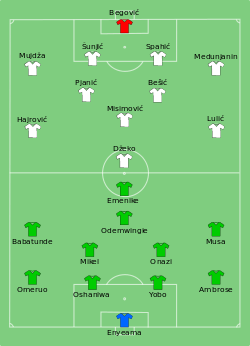
Nigeria's campaign in the 2014 FIFA World Cup opened with a disappointing 0–0 draw against Iran. Four days later the team played their second game against Bosnia and Herzegovina. A controversial 29th-minute Peter Odemwingie goal gave Nigeria their first World Cup match win since 1998. They faced Argentina another four days later: a 3rd minute Lionel Messi goal for the opposition was followed almost instantly with an equalizer by Ahmed Musa. Messi gave Argentina the lead back just before half-time. In the second half, Musa leveled the game out again, Lionel Messi was substituted and handed over his captaincy to Marcos Rojo only for Rojo to put Argentina 3–2 ahead minutes later.
Nigeria lost the match, but still qualified for the round of 16. In the Round of 16, Nigeria faced France, an 18th-minute stabbed shot from Emmanuel Emenike saw the ball in the net, past the French goal-keeper but the goal was ruled off-side by the linesman. Nigeria held them off until the 79th minute when a cross and a Paul Pogba header gifted France the lead. An accidental own goal by Super Eagles Captain Joseph Yobo in injury time put the result beyond any doubt: Nigeria was out. This is the third time Nigeria is eliminated in the round of 16 and they were not still able to enter the Quarter-finals in the FIFA World Cup.
2018 World Cup
[edit]


On 24 June 2016, The Confederation of African Football released the draw for the 3rd round of the World Cup qualifiers which saw Nigeria grouped in what was described as a "group of death"; alongside Zambia, Algeria, and Cameroon. Nigeria started their group stage matches with a 2–1 win over Zambia in Ndola[27] and defeated Algeria 3–1 in their second match at the Godswill Akpabio International Stadium.[28] They went on to beat Cameroon 5–1 home and away in a back to back contest.[29]
The Super Eagles of Nigeria became the first African team to qualify for the 2018 FIFA World Cup after beating Zambia 1–0 in Uyo.[30][31][32] On 3 June 2018, coach Gernot Rohr unveiled a 23-man squad for the 2018 FIFA World Cup.[33] Nigeria lost their first match of the tournament 0–2 to Croatia in Kaliningrad,[34] before they won 2–0 in the second match against a brave Iceland,[35] with Ahmed Musa scoring both goals.[36] Nigeria had a huge chance to qualify to the next round as Argentina was demolished 3–0 by Croatia. Despite this advantage, they lost 2–1 in their last group stage match against Argentina,[37] with one goal by Victor Moses.[38] For this defeat, and followed with Iceland's defeat to Croatia, Nigeria missed the opportunity to advance to the round of 16 and got eliminated from the tournament.[39]
2019 Africa Cup of Nations
[edit]The Super Eagles started their campaign at the 2019 AFCON by defeating Burundi 1–0 in group B opening match. They went on to defeat Guinea and lost 2–0 to Madagascar in their final group stage match. The round of 16 saw the national football team of Nigeria defeating Cameroon 3–2 with goals coming from Jude Ighalo and Iwobi, they later went on to confront South Africa in the quarter-finals of the tournament. An 89th-minute header from Troost-Ekong gave Nigeria the lead over South Africa and the match ended 2–1 in favour of Nigeria. Nigeria faced Algeria in the semi-finals and were knocked out of the tournament after a 95th-minute free kick from Riyad Mahrez gave Algeria the lead. The Super Eagles later faced Tunisia in a third place match which they won 1–0 with the only goal coming from Ighalo which made him the top scorer of the tournament.
.jpg)

2021 Africa Cup of Nations
[edit]On 18 July 2019, the Confederation of African Football (CAF) released the draw for the 2021 Africa Cup of Nations qualification. The Super Eagles were grouped in group L alongside Lesotho, Benin, and Sierra Leone. Nigeria started out by defeating Benin 2–1 at Uyo in their first group match and later went on to beat Lesotho 4–2 in an away match. In March 2020, as a result of the COVID-19 pandemic, the CAF postponed all AFCON qualifiers indefinitely.[40] Subsequently, on 30 June 2020, CAF rescheduled the 2021 African Cup of Nations to 2022, to take place from 9 January to 6 February 2022.[41] The qualifiers resumed on 9 November 2020.[42][43]
The 2021 AFCON started on 9 January 2022, and Nigeria was the only team in the tournament to win all three group stage matches after defeating Egypt 1–0, Sudan 3–1, and Guinea-Bissau 2–0.[44] However, Nigeria lost 1–0 in the round of 16 to Tunisia on 23 January.[45]
2022 World Cup
[edit]Nigeria failed to qualify for the FIFA World Cup for the first time in 16 years, losing to Ghana on the away goals rule after drawing 0–0 in Ghana and 1–1 in Nigeria.[46][47]
2023 Africa Cup of Nations
[edit]The Super Eagles started their campaign at the 2023 AFCON by drawing 1–1 to Equatorial Guinea in their opening group A match. They went on to defeat hosts Ivory Coast 1–0 and defeated Guinea Bissau in the same scoreline. The round of 16 saw the national football team of Nigeria defeating Cameroon 2–0 with a brace from Ademola Lookman, they later went on to defeat Angola in the quarter-finals of the tournament thanks to a first half strike from Lookman. Nigeria faced South Africa in the semi-finals. Substitute Kelechi Iheanacho scored to give Nigeria a 4–2 penalty shootout victory over South Africa. The match finished 1–1 after extra time. In the final, the Super Eagles finished as runners-up, losing 2–1 to hosts Ivory Coast.[48]
Team image
[edit].jpg)

Kits and crest
[edit]

The Nigeria national team has traditionally used a mostly-solid green on green primary set with white numbering, lettering, and highlights; coupled with all-white reversed secondary kits, all emblematic of the colours of the Nigerian flag. The shade of green has varied over the years. An olive drab-tinged, forest green was frequently favoured during the 1980s to the early 1990s, and jade has appeared in each of those decades as well; even harlequin has been used. Over the last decade, the team has appeared to settle on the more standard office green which most closely resembles the shade used on the flag. Nigeria's first national teams used a solid scarlet top over white shorts and socks until the country adopted its current colours after its independence.[49]
On 23 April 2015, Nike was announced to be the supplier of Nigeria's kits after Adidas ended their kit contract with the NFF.[50][51] Before that, Nike supplied Nigeria's kit between 1994 and 2003.[52] The kit Nike designed for Nigeria to wear at the 2018 World Cup went on to become one of the most popular international kits for collectors.[53]
Kit suppliers
[edit]| 👁 Image |

| Kit supplier | Period | Notes |
|---|---|---|
| 👁 West Germany Erima |
1980–1984[54] | Used during early golden era including 1980 AFCON win. |
| 👁 United Kingdom Admiral |
1984–1987[54] | Featured during Nigeria's rebuilding phase. |
| 👁 Germany Adidas |
1988–1994[54] | Worn during 1994 AFCON win and USA 1994 World Cup. |
| 👁 United States Nike |
1994–2003[52] | Worn during Nigeria's debut Olympic gold (1996) and three World Cups (1994, 1998, 2002). |
| 👁 Germany Adidas |
2004–2014[55] | Kit supplier for 2006, 2010, and 2014 World Cup squads. |
| 👁 United States Nike |
2015–present[56] | Iconic 2018 World Cup kit went viral globally. Also used for 2019, 2021, and 2023 AFCONs. |


Kit deals
[edit]| 👁 Image |
| Kit supplier | Period | Announced | Duration | Value | Notes |
|---|---|---|---|---|---|
| 👁 United States Nike |
2015–present | 23 April 2015 | 1 May 2015 – 30 October 2018 (3.5 years)[57] | US$3.75 million (₦743 million)[58] | |
| 20 November 2018 | 1 November 2018 – 31 December 2026 (8 years 2 months) | Undisclosed[59] | The new deal is reported to be worth significantly more than the previous US$3.75 million contract. |
Nigeria's national team image has evolved throughout its history. Before independence, they were nicknamed the "Red Devils" due to their red-topped kits.[60] After independence, the name was changed to the "Green Eagles", referencing the national flag and the eagle from the coat of arms. Though still known as the Green Eagles at the 1988 Africa Cup of Nations, the name "Super Eagles" was officially adopted at a post-tournament reception.[61][62]
Today, only the senior men's national team uses the "Super Eagles" nickname. The women's team is known as the "Super Falcons", while the male youth teams are the "Flying Eagles" (U-20) and the "Golden Eaglets" (U-17).
Media coverage
[edit]The Nigerian football federation currently has an active deal with the parent company of AIT and Ray Power Radio.[63] Internationally, Nigeria's qualifiers and African Cup matches are regularly broadcast abroad by the multi-platform international sports network, beIN Sports and South African broadcaster SuperSport.[64] Nigeria's international friendlies are regularly scheduled in the UK through independent organisers are marketed to the country's large population of Nigerian expatriates.
Supporters
[edit]

Though the club is most notable at Nigeria's home matches wearing green-themed embroidered outfits specific to the club along with wigs, hats and large sunglasses while dancing, singing, playing drums and trumpets, as well as carrying pom poms, culturally significant objects, inflatable beachballs, and waving flags; they have also shown a presence travelling abroad to support Nigeria in away matches.[65][66] However, the club's efforts at improving the atmosphere at Nigeria's home and away matches are beset by funding issues, corruption and infighting.[67] The club's current head, Rafiu Ladipo, has drawn criticism from its membership and is under pressure to defer the leadership to one of his deputies.[68]
A regular sight at Nigerian home matches is also their brass and percussion band, whose rendition of well-known Highlife songs provides Nigerian home matches with a unique feel. In Nigeria, these performers are occasionally conspicuous with their military uniforms or they may be members of the Football Supporters Club.[69] A popular chant among supporters from all over the country, after a goal scored, is "Oshe Baba!", which means "Thank you father!" in Yoruba.
Rivalries
[edit]Ghana
[edit]Many important matches have been played against various nations who have been occasional rivals. Of these nations, Ghana is widely considered Nigeria's primary rival as the two sides have met one another more than any other opponent, as well as being two of the most successful national teams in Africa. Nigeria has enjoyed periods of success. The most notable of these periods are the early contests during the 1950s, and matches that took place in the early 2000s.
_versus_Super_Eagles_(Nigeria_national_football_team).jpg)

FIFA lists the first official match between the two as a World Cup qualifier match in 1960. However both national teams had already engaged in competitive matches dating back to 1950.[70] The national teams of these two West African countries were formed during the time in which both remained protectorates of the British Empire. At that time the modern-day nation of Ghana was known as the Gold Coast. Nigeria, prior to adopting the national colours of green and white, wore scarlet tops over white shorts and were known as the "Red Devils".[49] The two sides played for several rivalry and tournament cups during this period in which full international competition was barred to them. The encounter between these two teams is commonly known as the Jollof Derby.[71]
Cameroon
[edit]Nigeria's neighbours to the east, Cameroon, have also played Nigeria a number of times over the years. The teams have met three times in the final of the African Cup of Nations with Cameroon winning each time.[72] Both carry histories of continental success and World Cup representation that is nearly unrivaled on the African continent.
Their rivalry began in 1960 and since then, Nigeria has proved to be a more dominating team, but in all three AFCON Final matches in 1984, 1988 and 2000, Cameroon prevailed over Nigeria.
Nigeria has qualified for six FIFA World Cup finals, advancing from the group stage three times (1994, 1998 and 2014), getting knocked out in the round of 16 all three times, while Cameroon has qualified eight times, advancing from the group stage only once (1990) though they made it to the quarter-finals in that edition.
Other African nations
[edit]There is also a number of competitive matches with Algeria dating back to the 1970s. The two sides met twice in the African Cup of Nations finals, with each nation splitting the win totals. It was a 1–1 draw in Algeria on 8 October 1993 that enabled Nigeria to claim its first World Cup berth in the 1994 edition of the tournament. Nigeria since then had an undefeated streak against Algeria, until the semi-finals of the 2019 Africa Cup of Nations when Algeria prevailed over Nigeria.
Nigeria's western neighbour, Benin, has played competitive matches with the team since the period of European colonisation when they were known as Dahomey. But with only two wins and two draws to Benin's credit against Nigeria's fourteen wins, and with the sides having only met six times since 1980, Benin remains a lightly regarded opponent.
Argentina
[edit].jpg)

In five of its six World Cup appearances, Nigeria was drawn in the group stage with three-time champion Argentina and is regarded by many fans as having fairly acquitted themselves against the footballing giant.[73] The fixture is the most common in the competition's history involving an African nation.[74] All five matches have been won by Argentina, but all were by a one-goal margin (2–1 in 1994, 1–0 in 2002, 1–0 in 2010, 3–2 in 2014 and 2–1 in 2018) and have been tightly contested. To date, Nigeria has recorded two wins against Argentina's six, with the victories occurring during friendly matches. Nigeria came close to defeating Argentina in their first meeting, during which they held a lead for some minutes of the match. This was followed by a Confederations Cup match in 1995 which saw Nigeria hold the South Americans to a 0–0 draw. Below full international level, their Olympic teams also faced off in the gold medal match in 1996 (3–2 to Nigeria), and 2008 (1–0 to Argentina). The final of the 2005 FIFA World Youth Championship was also played between them; both Argentina goals in their 2–1 win were scored by Lionel Messi, who would go on to find the net for the senior team in the 2014[75] and 2018[76] World Cup fixtures.
The match-up holds some importance to many Nigerian football fans who regard the challenge as an important measuring stick for the development of Nigerian football. Argentine fans for their part, typically do not regard Nigeria as a rival. Although it means less to Argentine fans, matches against Nigeria are always seen as needing to be played with caution.[77][78][79][80]
South Africa
[edit]In the 17 games that the Super Eagles have played against the Bafana Bafana, Nigeria have won seven games, drawn seven and lost two. This record forms the statistical backbone of one of Africa’s most recognizable football rivalries, a matchup shaped by competitive history, political symbolism, and repeated high‑stakes encounters. The rivalry intensified in the late 1990s and early 2000s, when Nigeria eliminated South Africa in the 2000 Africa Cup of Nations. Then, the two sides got drawn into the same group in the 2010 FIFA World Cup qualification – CAF second round, with the Nigerians winning each game that round in qualifying. In 2019 Africa Cup of Nations qualification Group E, Visitors South Africa stunned Nigeria in the opening game of the qualifiers in Uyo. In the return leg, the Eagles would only manage a draw, but both teams ended up reaching the final tournament in Egypt convincingly over Seychelles national football team and Libya national football team. In the final matchday of 2015 Africa Cup of Nations qualification Group A, the Super Eagles needed a win vs. South Africa at home in Uyo to qualify. South Africa went 2-0 up, but Nigeria came back to get a draw via a Sone Aluko brace. Consequently, the defending champions would miss out on the 2015 Africa Cup of Nations. In 2026 FIFA World Cup qualification – CAF Group C, both sides played 1-1 draws in Godswill Akpabio International Stadium and Free State Stadium. South Africa qualified for their first World Cup in 16 years, topping the group with 18 points. Nigeria finished second with 17 points. The Super Eagles ended up making the 2026 FIFA World Cup qualification – CAF second round, where they trashed the Gabon national football team 4-1 but lost to the DR Congo national football team on penalties to miss back-to-back World Cups for the first time ever since their debut.
Home stadium
[edit]

The Moshood Abiola National Stadium (formerly known as National Stadium, Abuja) serves as the official home stadium of the Super Eagles. Several international matches are played in other stadiums across the country. However, since the construction of Godswill Akpabio International Stadium in Uyo, Akwa Ibom State, most of the Super Eagles' important home matches have been played there.
Super Eagles match venues
[edit]| Stadium | Capacity | Commissioned | City | State/Territory | Ref |
|---|---|---|---|---|---|
| Godswill Akpabio International Stadium | 30,000 | 2012 | Uyo | Akwa Ibom | [81][82] |
| Stephen Keshi Stadium | 22,000 | 2018 | Asaba | Delta | |
| Adokiye Amiesimaka Stadium | 38,000 | 2015 | Port Harcourt | Rivers | [83] |
| Moshood Abiola National Stadium | 60,491 | 2000 | Abuja | FCT | |
| Lagos National Stadium | 45,000 | 1972 | Surulere | Lagos | |
| U. J. Esuene Stadium | 16,000 | 1977 | Calabar | Cross River | |
| Teslim Balogun Stadium | 24,325 | 1984 | Surulere | Lagos | |
| Obafemi Awolowo Stadium | 25,000 | 1960 | Ibadan | Oyo | |
| Sani Abacha Stadium | 16,000 | 1998 | Kano | Kano | |
| Ahmadu Bello Stadium | 16,000 | 1965 | Kaduna | Kaduna | |
| Nnamdi Azikiwe Stadium | 22,000 | 1986 | Enugu | Enugu | |
| Liberation Stadium | 16,000 | Port Harcourt | Rivers |
Results and fixtures
[edit]The following is a list of football match results in the last 12 months, as well as any future matches that have been scheduled.
Win Draw Loss Fixture
2025
[edit]
| 28 May 2025 Unity Cup | 👁 Image | 2–1 | 👁 Image Ghana | London, England |
|
Report |
|
Stadium: Gtech Community Stadium Referee: Stuart Attwell (England) |


| 31 May 2025 Unity Cup | 👁 Image | 2–2 (5–4 p) | 👁 Image Jamaica | London, England |
| Report | Stadium: Gtech Community Stadium Attendance: 17250 Referee: Stuart Attwell (England) | |||
| Penalties | ||||


| 6 June Friendly match | Russia 👁 Image | 1–1 | 👁 Image | Moscow, Russia |
| 20:00 UTC+3 |
|
Report | Stadium: Luzhniki Stadium Attendance: 45638 Referee: Aliyar Aghayev (Azerbaijan) |

| 6 September 2026 FIFA World Cup qualification | 👁 Image | 1–0 | 👁 Image Rwanda | Uyo, Nigeria |
| 17:00 UTC+1 | Report | Stadium: Godswill Akpabio International Stadium Referee: Alhadi Allaou Mahamat (Chad) |

| 9 September 2026 FIFA World Cup qualification | South Africa 👁 Image | 1–1 | 👁 Image | Blomfontein, South Africa |
| 18:00 UTC+2 | Report | Stadium: Free State Stadium Referee: Pierre Atcho (Gabon) |

| 10 October 2026 FIFA World Cup qualification | Lesotho 👁 Image | 1–2 | 👁 Image | Polokwane, South Africa |
| Report |
|
Stadium: Peter Mokaba Stadium Referee: Alhadi Allaou Mahamat (Chad) |

| 14 October 2026 FIFA World Cup qualification | 👁 Image | 4–0 | 👁 Image Benin | Uyo, Nigeria |
| 17:00 UTC+1 | Report | Stadium: Godswill Akpabio International Stadium Referee: Amin Omar (Egypt) |

| 13 November 2026 FIFA World Cup qualification | 👁 Image | 4–1 (a.e.t.) | 👁 Image Gabon | Rabat, Morocco |
| Report | Lemina 👁 Image 89' |
Stadium: Moulay Hassan Stadium Referee: Abongile Tom (South Africa) |

| 16 November 2026 FIFA World Cup qualification | 👁 Image | 1–1 (3–4 p) | 👁 Image DR Congo | Rabat, Morocco |
| 20:00 UTC+1 | Report | Stadium: Moulay Hassan Stadium Referee: Jalal Jayed (Morocco) | ||
| Penalties | ||||

| 16 December Friendly | Egypt 👁 Image | 2–1 | 👁 Image | Cairo, Egypt |
| 20:00 UTC+2 |
|
Report | Stadium: Cairo International Stadium Referee: Mahmoud Nagy (Egypt) |

| 23 December 2025 AFCON GS | 👁 Image | 2–1 | 👁 Image Tanzania | Fez, Morocco |
| 18:30 UTC+1 | Report | M'Mombwa 👁 Image 50' |
Stadium: Fez Stadium Attendance: 11,444 Referee: Dahane Beida (Mauritania) |

| 27 December 2025 AFCON GS | 👁 Image | 3–2 | 👁 Image Tunisia | Fez, Morocco |
| 21:00 UTC+1 | Report | Stadium: Fez Stadium Attendance: 25,544 Referee: Boubou Traore (Mali) |

| 30 December 2025 AFCON GS | Uganda 👁 Image | 1–3 | 👁 Image | Fez, Morocco |
| 17:00 UTC+1 |
|
Report | Stadium: Fez Stadium Attendance: 11,545 Referee: Djindo Louis Houngnandande (Benin) |

2026
[edit]
| 5 January 2025 AFCON R16 | 👁 Image | 4–0 | 👁 Image Mozambique | Fez, Morocco |
| 20:00 UTC+1 | Report | Stadium: Fez Stadium Attendance: 14,593 Referee: Abdou Abdel Mefire (Cameroon) |

| 10 January 2025 AFCON QF | Algeria 👁 Image | 0–2 | 👁 Image | Marrakesh, Morocco |
| 17:00 UTC+1 | Report | Stadium: Marrakesh Stadium Attendance: 32,452 Referee: Issa Sy (Senegal) |

| 14 January 2025 AFCON SF | 👁 Image | 0–0 (2–4 p) | 👁 Image Morocco | Rabat, Morocco |
| 21:00 UTC+1 | Report | Stadium: Prince Moulay Abdellah Stadium Attendance: 65,458 Referee: Daniel Nii Laryea (Ghana) | ||
| Penalties | ||||
| 17 January 2025 AFCON Third-place match | Egypt 👁 Image | 0–0 (2–4 p) | 👁 Image | Casablanca, Morocco |
| 17:00 UTC+1 | Report | Stadium: Mohammed V Stadium Attendance: 38,113 Referee: Jalal Jayed (Morocco) | ||
| Penalties | ||||

| 27 March 2026 Jordan International Tournament | Iran 👁 Image | 1–2 | 👁 Image | Antalya, Turkey[a] |
| 16:00 UTC+3 | Report | Stadium: Corendon Airlines Park Attendance: 0 Referee: Cihan Aydın (Turkey) |

| 31 March 2026 Jordan International Tournament | Jordan 👁 Image | 2–2 | 👁 Image | Antalya, Turkey[a] |
| 20:30 UTC+3 |
|
Report | Stadium: Mardan Sports Complex Attendance: 0 Referee: Atilla Karaoğlan (Turkey) |

| 26 May 2026 Unity Cup | 👁 Image | 2–0 | 👁 Image Zimbabwe | London, England |
| 19:30 UTC+1 | Report | Stadium: The Valley Referee: John Brooks (England) |
| 30 May 2026 Unity Cup | 👁 Image | 3–0 | 👁 Image Jamaica | London, England |
| Stadium: The Valley |

| 3 June Friendly | Poland 👁 Image | 2–2 | 👁 Image | Warsaw, Poland |
| 20:45 CEST (UTC+2) |
|
Report | Stadium: Stadion Narodowy Attendance: 54,408 Referee: Marian Barbu (Romanian Football Federation) |

| 10 June Friendly | Portugal 👁 Image | 2−1 | 👁 Image | Leiria, Portugal |
| 20:45 EEST (UTC+01:00) | Report | Stadium: Estádio Dr. Magalhães Pessoa Referee: Mateo Busquets Ferrer (Spain) |

| TBD 2027 AFCON qualification | 👁 Image | v | 👁 Image Madagascar | TBD, Nigeria |
| TBD | Stadium: TBD |
| TBD 2027 AFCON qualification | Madagascar 👁 Image | v | 👁 Image | TBD, Madagascar |
| TBD | Stadium: TBD |
| TBD 2027 AFCON qualification | 👁 Image | v | 👁 Image Tanzania | TBD, Nigeria |
| TBD | Stadium: TBD |
| TBD 2027 AFCON qualification | Tanzania 👁 Image | v | 👁 Image | TBD, Tanzania |
| TBD | Stadium: TBD |

| TBD 2027 AFCON qualification | 👁 Image | v | 👁 Image Guinea-Bissau | TBD, Nigeria |
| TBD | Stadium: TBD |
| TBD 2027 AFCON qualification | Guinea-Bissau 👁 Image | v | 👁 Image | TBD, Guinea-Bissau |
| TBD | Stadium: TBD |
Coaching staff
[edit]The current Nigerian (Super Eagles) managerial staff is made up of a technical adviser who serves as the coach in charge of full international matches and a chief coach who serves as the first assistant coach. The second assistant coach is in charge of the home-based team as well as the CHAN tournament and other home based competitions. Other positions also include the technical assistant and the goalkeeper trainer.
| Position | Name |
|---|---|
| Technical director | 👁 Nigeria Augustine Eguavoen |
| Head coach | 👁 Mali Éric Chelle |
| Assistant coach | 👁 France Hedi Taboubi |
| Assistant coach | 👁 Nigeria Fidelis Ilechuku |
| Assistant coach | 👁 Nigeria Daniel Ogunmodede |
| Goalkeeping coach | 👁 France Jean-Daniel Padovani |
| Fitness coach | 👁 Slovenia Tomaž Zorec |
| Video analyst | 👁 Nigeria Afolabi Adebayo |
| Match analyst | 👁 Nigeria Eboboritse Uwejamomere |


Coaching history
[edit]- Caretaker managers are listed in italics.
- 👁 England
Jack Finch (1949) - 👁 Nigeria
Adewale Adegoke (1950–1952) - 👁 Nigeria
Daniel Anyiam (1954–1956, 1964–1965) - 👁 England
Les Courtier (1956–1960) - 👁 Israel
Jerry Beit haLevi (1960–1961) - 👁 Hungary
George Vardar (1961–1963) - 👁 Brazil
Jorge Penna (1963–1964, 1972–1973) - 👁 Hungary
József Ember (1965–1968) - 👁 Spain
Sabino Barinaga (1968–1969) - 👁 Nigeria
Peter Amaechina (1969–1970) - 👁 West Germany
Karl-Heinz Marotzke (1970–1972, 1973–1974) - 👁 Socialist Federal Republic of Yugoslavia
Tiko Jelisavčić (1974–1978) - 👁 Brazil
Otto Glória (1978–1981) - 👁 Germany
Gottlieb Göller (1981) - 👁 Nigeria
Adegboyega Onigbinde (1981–1984) - 👁 Nigeria
Chris Udemezue (1984–1986) - 👁 West Germany
Manfred Höner (1987–1988) - 👁 Nigeria
Paul Hamilton (1989) - 👁 Netherlands
Clemens Westerhof (1989–1994) - 👁 Nigeria
Shuaibu Amodu (1994–1995, 1996–1997, 2001–2002, 2008–2010, 2014) - 👁 Netherlands
Jo Bonfrère (1995–1996) - 👁 France
Philippe Troussier (1997) - 👁 Federal Republic of Yugoslavia
Bora Milutinović (1997–1998) - 👁 Netherlands
Thijs Libregts (1998–1999) - 👁 Netherlands
Jo Bonfrère (1999–2001) - 👁 Nigeria
Festus Onigbinde (2002) - 👁 Nigeria
Christian Chukwu (2003–2005) - 👁 Nigeria
Augustine Eguavoen (2005–2007, 2010, 2021–2022, 2024, 2024–2025) - 👁 Germany
Berti Vogts (2007–2008) - 👁 Sweden
Lars Lagerbäck (2010) - 👁 Nigeria
Samson Siasia (2010–2011, 2016) - 👁 Nigeria
Stephen Keshi (2011–2014, 2015) - 👁 Nigeria
Shuaibu Amodu (2015) - 👁 Nigeria
Sunday Oliseh (2015–2016) - 👁 Nigeria
Salisu Yusuf (2016) - 👁 Germany
Gernot Rohr (2016–2021) - 👁 Portugal
José Peseiro (2022–2024) - 👁 Nigeria
Finidi George (2024) - 👁 France
👁 Mali
Éric Chelle (2025–present)


Players
[edit]Current squad
[edit]The following players were called up for the friendlies against Poland and Portugal on 3 and 10 June 2026; respectively.[85]
Caps and goals correct as of 10 June 2026, after the match against Portugal.
| No. | Pos. | Player | Date of birth (age) | Caps | Goals | Club |
|---|---|---|---|---|---|---|
| 1 | 1GK | Francis Uzoho | (1998-10-28) 28 October 1998 (age 27) | 37 | 0 | 👁 Cyprus Football Association Omonia |
| 16 | 1GK | Arthur Okonkwo | (2001-09-09) 9 September 2001 (age 24) | 2 | 0 | 👁 Football Association of Wales Wrexham |
| 23 | 1GK | Maduka Okoye | (1999-08-28) 28 August 1999 (age 26) | 21 | 0 | 👁 Italian Football Federation Udinese |
| 3 | 2DF | Zaidu Sanusi | (1997-06-13) 13 June 1997 (age 29) | 32 | 0 | 👁 Portuguese Football Federation Porto |
| 6 | 2DF | Semi Ajayi | (1993-11-09) 9 November 1993 (age 32) | 57 | 2 | 👁 The Football Association Hull City |
| 13 | 2DF | Bruno Onyemaechi | (1999-04-03) 3 April 1999 (age 27) | 30 | 0 | 👁 Hellenic Football Federation Olympiacos |
| 14 | 2DF | Christian Akpan | (2005-01-29) 29 January 2005 (age 21) | 1 | 0 | 👁 Royal Belgian Football Association Genk |
| 18 | 2DF | Emmanuel Fernandez | (2001-11-20) 20 November 2001 (age 24) | 3 | 1 | 👁 Scottish Football Association Rangers |
| 21 | 2DF | Calvin Bassey | (1999-12-31) 31 December 1999 (age 26) | 45 | 1 | 👁 The Football Association Fulham |
| 2 | 3MF | Abdullahi Bewene | (2004-11-29) 29 November 2004 (age 21) | 2 | 0 | 👁 Football Association of the Czech Republic Baník Ostrava |
| 4 | 3MF | Wilfred Ndidi (Captain) | (1996-12-16) 16 December 1996 (age 29) | 79 | 1 | 👁 Turkish Football Federation Beşiktaş |
| 8 | 3MF | Frank Onyeka | (1998-01-01) 1 January 1998 (age 28) | 45 | 3 | 👁 The Football Association Coventry City |
| 10 | 3MF | Fisayo Dele-Bashiru | (2001-02-06) 6 February 2001 (age 25) | 19 | 2 | 👁 Italian Football Federation Lazio |
| 12 | 3MF | Tochukwu Nnadi | (2003-06-30) 30 June 2003 (age 22) | 5 | 0 | 👁 French Football Federation Marseille |
| 17 | 3MF | Alex Iwobi | (1996-05-03) 3 May 1996 (age 30) | 99 | 10 | 👁 The Football Association Fulham |
| 20 | 3MF | Raphael Onyedika | (2001-04-19) 19 April 2001 (age 25) | 26 | 3 | 👁 Royal Belgian Football Association Club Brugge |
| 7 | 4FW | Philip Otele | (1999-04-15) 15 April 1999 (age 27) | 5 | 0 | 👁 German Football Association Hamburger SV |
| 9 | 4FW | Terem Moffi | (1999-05-25) 25 May 1999 (age 27) | 23 | 6 | 👁 Portuguese Football Federation Porto |
| 11 | 4FW | Samuel Chukwueze | (1999-05-22) 22 May 1999 (age 27) | 59 | 7 | 👁 The Football Association Fulham |
| 15 | 4FW | Moses Simon | (1995-07-12) 12 July 1995 (age 30) | 99 | 12 | 👁 French Football Federation Paris |
| 19 | 4FW | Paul Onuachu | (1994-05-28) 28 May 1994 (age 32) | 33 | 5 | 👁 Turkish Football Federation Trabzonspor |
| 22 | 4FW | Akor Adams | (2000-01-29) 29 January 2000 (age 26) | 15 | 6 | 👁 Royal Spanish Football Federation Sevilla |


Recent call-ups
[edit]The following players have also been called up to the Nigeria squad within the last twelve months.
| Pos. | Player | Date of birth (age) | Caps | Goals | Club | Latest call-up |
|---|---|---|---|---|---|---|
| GK | Michael Atata | (2005-10-23) 23 October 2005 (age 20) | 0 | 0 | 👁 Nigeria Ikorodu City |
2026 Unity Cup, 26–30 May 2026 |
| GK | Adebayo Adeleye | (2000-05-17) 17 May 2000 (age 26) | 2 | 0 | 👁 Cyprus Enosis Neon Paralimni |
v. 👁 Image Jordan, 31 March 2026 |
| GK | Stanley Nwabali | (1996-06-10) 10 June 1996 (age 30) | 34 | 0 | Unattached | 2025 Africa Cup of Nations |
| GK | Amas Obasogie | (1999-12-27) 27 December 1999 (age 26) | 1 | 0 | 👁 Tanzania Singida Black Stars |
2025 Africa Cup of Nations |
| GK | Ebenezer Harcourt | (2009-10-21) 21 October 2009 (age 16) | 1 | 0 | 👁 Nigeria Sporting Lagos |
2025 Africa Cup of Nations PRE |
| DF | Igoh Ogbu | (2000-02-08) 8 February 2000 (age 26) | 12 | 0 | 👁 Czech Republic Slavia Prague |
v. 👁 Image Portugal, 10 June 2026 WD |
| DF | Bright Osayi-Samuel | (1997-12-31) 31 December 1997 (age 28) | 35 | 0 | 👁 England Birmingham City |
v. 👁 Image Poland, 3 June 2026 WD |
| DF | Chibuike Nwaiwu | (2003-07-23) 23 July 2003 (age 22) | 3 | 0 | 👁 Turkey Trabzonspor |
2026 Unity Cup, 26–30 May 2026 |
| DF | Kenneth Igboke | (2005-07-27) 27 July 2005 (age 20) | 2 | 0 | 👁 Nigeria Enugu Rangers |
2026 Unity Cup, 26–30 May 2026 |
| DF | Chibueze Oputa | (2005-10-17) 17 October 2005 (age 20) | 2 | 0 | 👁 Nigeria Enugu Rangers |
2026 Unity Cup, 26–30 May 2026 |
| DF | Tijani Al-Ameen | Unknown | 1 | 0 | 👁 Nigeria Shooting Stars |
2026 Unity Cup, 26–30 May 2026 |
| DF | Elias Ochobi | Unknown | 0 | 0 | 👁 Nigeria Rivers United |
2026 Unity Cup, 26–30 May 2026 |
| DF | Chidozie Awaziem | (1997-01-01) 1 January 1997 (age 29) | 40 | 2 | 👁 France Nantes |
2025 Africa Cup of Nations |
| DF | Ryan Alebiosu | (2001-12-17) 17 December 2001 (age 24) | 1 | 0 | 👁 England Blackburn Rovers |
2025 Africa Cup of Nations |
| DF | William Troost-Ekong RET | (1993-09-01) 1 September 1993 (age 32) | 82 | 8 | 👁 Qatar Al-Ahli |
2025 Africa Cup of Nations PRE |
| DF | Ola Aina | (1996-10-08) 8 October 1996 (age 29) | 48 | 0 | 👁 England Nottingham Forest |
2025 Africa Cup of Nations PRE / INJ |
| DF | Olakunle Olusegun | (2002-04-23) 23 April 2002 (age 24) | 2 | 0 | 👁 Russia Pari Nizhny Novgorod |
2025 Africa Cup of Nations PRE |
| DF | Adeleke Adekunle | (2002-07-27) 27 July 2002 (age 23) | 1 | 0 | 👁 Nigeria Abia Warriors |
2025 Africa Cup of Nations PRE |
| DF | Felix Agu | (1999-09-27) 27 September 1999 (age 26) | 1 | 0 | 👁 Germany Werder Bremen |
2025 Africa Cup of Nations PRE |
| DF | Emmanuel Michael | (2006-06-16) 16 June 2006 (age 20) | 0 | 0 | 👁 Austria LASK |
2025 Africa Cup of Nations PRE |
| DF | Benjamin Fredrick | (2005-05-28) 28 May 2005 (age 21) | 7 | 0 | 👁 Belgium Dender |
v. 👁 Image DR Congo, 16 November 2025 |
| MF | Alhassan Yusuf | (2000-07-18) 18 July 2000 (age 25) | 10 | 2 | 👁 United States New England Revolution |
2026 Unity Cup, 26–30 May 2026 |
| MF | Samson Tijani | (2002-05-17) 17 May 2002 (age 24) | 3 | 0 | 👁 Czech Republic Dukla Prague |
2026 Unity Cup, 26–30 May 2026 |
| MF | Aderemi Adeoye | (2007-01-29) 29 January 2007 (age 19) | 2 | 0 | 👁 Nigeria Ikorodu City |
2026 Unity Cup, 26–30 May 2026 |
| MF | Tosin Oyedokun | (2002-07-23) 23 July 2002 (age 23) | 2 | 0 | 👁 Nigeria Ikorodu City |
2026 Unity Cup, 26–30 May 2026 |
| MF | Ebenezer Akinsanmiro | (2004-11-25) 25 November 2004 (age 21) | 1 | 0 | 👁 Italy Pisa |
2026 Unity Cup, 26–30 May 2026 |
| MF | Ayobami Junior | (1998-12-24) 24 December 1998 (age 27) | 1 | 0 | 👁 Nigeria Shooting Stars |
2026 Unity Cup, 26–30 May 2026 |
| MF | Zadok Yohanna | (2007-06-29) 29 June 2007 (age 18) | 0 | 0 | 👁 Sweden AIK |
2026 Unity Cup, 26–30 May 2026 |
| MF | Chidera Ejuke | (1998-01-02) 2 January 1998 (age 28) | 14 | 1 | 👁 Spain Sevilla |
v. 👁 Image Jordan, 31 March 2026 |
| MF | Yira Sor | (2000-07-24) 24 July 2000 (age 25) | 1 | 0 | 👁 Belgium Genk |
v. 👁 Image Jordan, 31 March 2026 |
| MF | Muhammed Usman | (1994-03-02) 2 March 1994 (age 32) | 0 | 0 | 👁 Israel Ironi Tiberias |
2025 Africa Cup of Nations |
| MF | Peter Agba | (2002-12-20) 20 December 2002 (age 23) | 0 | 0 | 👁 Israel Maccabi Haifa |
2025 Africa Cup of Nations PRE |
| MF | Tom Dele-Bashiru | (1999-09-17) 17 September 1999 (age 26) | 0 | 0 | 👁 Turkey Gençlerbirliği |
2025 Africa Cup of Nations PRE |
| FW | Rafiu Durosinmi | (2003-01-01) 1 January 2003 (age 23) | 3 | 0 | 👁 Italy Pisa |
v. 👁 Image Portugal, 10 June 2026 WD |
| FW | Victor Osimhen | (1998-12-29) 29 December 1998 (age 27) | 51 | 35 | 👁 Turkey Galatasaray |
v. 👁 Image Poland, 3 June 2026 WD |
| FW | Ademola Lookman | (1997-10-20) 20 October 1997 (age 28) | 43 | 11 | 👁 Spain Atlético Madrid |
v. 👁 Image Poland, 3 June 2026 WD |
| FW | Femi Azeez | (2001-06-05) 5 June 2001 (age 25) | 2 | 2 | 👁 England Millwall |
2026 Unity Cup, 26–30 May 2026 |
| FW | Owen Oseni | (2003-05-07) 7 May 2003 (age 23) | 1 | 0 | 👁 England Plymouth Argyle |
2026 Unity Cup, 26–30 May 2026 |
| FW | Cyriel Dessers | (1994-12-08) 8 December 1994 (age 31) | 11 | 3 | 👁 Greece Panathinaikos |
2025 Africa Cup of Nations |
| FW | Salim Fago Lawal | (2003-01-15) 15 January 2003 (age 23) | 2 | 0 | 👁 Czech Republic Viktoria Plzeň |
2025 Africa Cup of Nations |
| FW | Kelechi Iheanacho | (1996-10-03) 3 October 1996 (age 29) | 58 | 14 | 👁 Scotland Celtic |
2025 Africa Cup of Nations PRE |
| FW | Umar Sadiq | (1997-02-02) 2 February 1997 (age 29) | 12 | 1 | 👁 Spain Valencia |
2025 Africa Cup of Nations PRE |
| FW | Victor Boniface | (2000-12-23) 23 December 2000 (age 25) | 12 | 0 | 👁 Germany Werder Bremen |
2025 Africa Cup of Nations PRE / INJ |
| FW | Tolu Arokodare | (2000-11-23) 23 November 2000 (age 25) | 10 | 2 | 👁 England Wolverhampton Wanderers |
2025 Africa Cup of Nations PRE |
| FW | Taiwo Awoniyi | (1997-08-12) 12 August 1997 (age 28) | 10 | 2 | 👁 England Nottingham Forest |
2025 Africa Cup of Nations PRE |
| FW | Christantus Uche | (2003-05-19) 19 May 2003 (age 23) | 3 | 0 | 👁 England Crystal Palace |
2025 Africa Cup of Nations PRE |
| FW | Chisom Orji | (2001-04-05) 5 April 2001 (age 25) | 1 | 0 | 👁 Nigeria Warri Wolves |
2025 Africa Cup of Nations PRE |
| FW | Nathan Tella | (1999-07-05) 5 July 1999 (age 26) | 1 | 0 | 👁 Germany Bayer Leverkusen |
2025 Africa Cup of Nations PRE |
| FW | Abdulrasheed Shehu Dabai | (2006-03-21) 21 March 2006 (age 20) | 0 | 0 | 👁 Nigeria Niger Tornadoes |
2025 Africa Cup of Nations PRE |
| FW | Chukwubuikem Ikwuemesi | (2001-08-05) 5 August 2001 (age 24) | 0 | 0 | 👁 Belgium Oud-Heverlee Leuven |
2025 Africa Cup of Nations PRE |
| FW | Ekeson Okorie | (2004-05-28) 28 May 2004 (age 22) | 0 | 0 | 👁 Rwanda Police |
2025 Africa Cup of Nations PRE |
INJ The player is not part of the current squad due to injury | ||||||


Player records
[edit]- As of 10 June 2026[86]
- Statistics include official FIFA-recognised matches only.
- Players in bold are still active with Nigeria.
Most appearances
[edit]
| Rank | Player | Caps | Goals | Career |
|---|---|---|---|---|
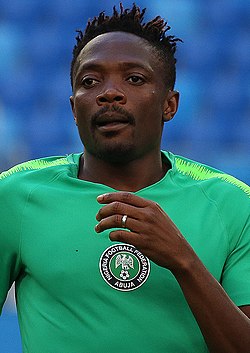
| 1 | Ahmed Musa[b] | 110 | 16 | 2010–2025 |
| 2 | Vincent Enyeama | 101 | 0 | 2002–2015 |
| Joseph Yobo | 101 | 7 | 2001–2014 | |
| 4 | Alex Iwobi[c] | 99 | 10 | 2015–present |
| Moses Simon | 99 | 12 | 2015–present | |
| 6 | Mikel John Obi | 91 | 6 | 2005–2019 |
| 7 | Mudashiru Lawal | 86 | 11 | 1975–1985 |
| Nwankwo Kanu | 86 | 12 | 1994–2011 | |
| 9 | William Troost-Ekong[c] | 82 | 8 | 2015–2025 |
| 10 | Wilfred Ndidi[c] | 79 | 1 | 2015–present |
Top goalscorers
[edit]| Rank | Player | Goals | Caps | Ratio | Career |
|---|---|---|---|---|---|
| 1 | Rashidi Yekini | 37 | 62 | 0.6 | 1983–1998 |
| 2 | Victor Osimhen[c] | 35 | 51 | 0.69 | 2017–present |
| 3 | Segun Odegbami | 22 | 47 | 0.47 | 1976–1981 |
| 4 | Yakubu Aigyegbeni | 21 | 58 | 0.36 | 2000–2012 |
| 5 | Ikechukwu Uche | 19 | 46 | 0.41 | 2007–2014 |
| 6 | Obafemi Martins | 18 | 42 | 0.43 | 2004–2015 |
| 7 | Sunday Oyarekhua | 17 | 28 | 0.61 | 1971–1976 |
| Samson Siasia | 17 | 49 | 0.35 | 1984–1998 | |
| 9 | Odion Ighalo | 16 | 37 | 0.43 | 2015–2022 |
| Ahmed Musa[b] | 16 | 110 | 0.15 | 2010–2025 |
- ^ a b The four nation tournament between Jordan, Iran, Nigeria, and Costa Rica were moved from Amman, Jordan to Antalya, Turkey due to the travel restrictions from the 2026 Iran war.[84]
- ^ a b Musa also appeared in one match against Togo in 2017, scoring two goals, however Nigeria made nine substitutions during this match, and therefore it is not recognised as an official match by FIFA.
- ^ a b c d Also appeared in one match against Togo in 2017, however Nigeria made nine substitutions during this match, and therefore it is not recognised as an official match by FIFA.
Competitive record
[edit]FIFA World Cup
[edit]| FIFA World Cup record | Qualification record | |||||||||||||||||||
|---|---|---|---|---|---|---|---|---|---|---|---|---|---|---|---|---|---|---|---|---|
| Year | Round | Position | Pld | W | D | L | GF | GA | Squad | Pld | W | D | L | GF | GA | Total | ||||
| 👁 Uruguay 1930 |
Part of 👁 Image United Kingdom |
Part of 👁 Image United Kingdom | ||||||||||||||||||
| 1934 to 1958 | Not a FIFA member | Not a FIFA member | ||||||||||||||||||
| 👁 Chile 1962 |
Did not qualify | 2 | 0 | 1 | 1 | 3 | 6 | 1962 | ||||||||||||
| 👁 England 1966 |
Withdrew[n 1][87] | Withdrew | ||||||||||||||||||
| 👁 Mexico 1970 |
Did not qualify | 8 | 3 | 4 | 1 | 15 | 12 | 1970 | ||||||||||||
| 👁 West Germany 1974 |
4 | 1 | 2 | 1 | 3 | 4 | 1974 | |||||||||||||
| 👁 Argentina 1978 |
8 | 3 | 3 | 2 | 17 | 8 | 1978 | |||||||||||||
| 👁 Spain 1982 |
8 | 3 | 2 | 3 | 8 | 8 | 1982 | |||||||||||||
| 👁 Mexico 1986 |
6 | 5 | 0 | 1 | 11 | 3 | 1986 | |||||||||||||
| 👁 Italy 1990 |
6 | 3 | 1 | 2 | 7 | 5 | 1990 | |||||||||||||
| 👁 United States 1994 |
Round of 16 | 9th | 4 | 2 | 0 | 2 | 7 | 4 | Squad | 8 | 5 | 2 | 1 | 17 | 5 | 1994 | ||||
| 👁 France 1998 |
12th | 4 | 2 | 0 | 2 | 6 | 9 | Squad | 6 | 4 | 1 | 1 | 10 | 4 | 1998 | |||||
| 👁 South Korea 👁 Japan 2002 |
Group stage | 27th | 3 | 0 | 1 | 2 | 1 | 3 | Squad | 10 | 6 | 2 | 2 | 19 | 3 | 2002 | ||||
| 👁 Germany 2006 |
Did not qualify | 10 | 6 | 3 | 1 | 21 | 7 | 2006 | ||||||||||||
| 👁 South Africa 2010 |
Group stage | 27th | 3 | 0 | 1 | 2 | 3 | 5 | Squad | 12 | 9 | 3 | 0 | 20 | 5 | 2010 | ||||
| 👁 Brazil 2014 |
Round of 16 | 16th | 4 | 1 | 1 | 2 | 3 | 5 | Squad | 8 | 5 | 3 | 0 | 11 | 4 | 2014 | ||||
| 👁 Russia 2018 |
Group stage | 21st | 3 | 1 | 0 | 2 | 3 | 4 | Squad | 8 | 5 | 2 | 1 | 13 | 6 | 2018 | ||||
| 👁 Qatar 2022 |
Did not qualify | 8 | 4 | 3 | 1 | 10 | 4 | 2022 | ||||||||||||
| 👁 Canada 👁 Mexico 👁 United States 2026 |
12 | 5 | 6 | 1 | 20 | 10 | 2026 | |||||||||||||
| 👁 Morocco 👁 Portugal 👁 Spain 2030 |
To be determined | To be determined | ||||||||||||||||||
| 👁 Saudi Arabia 2034 | ||||||||||||||||||||
| Total | Round of 16 | 6/16 | 21 | 6 | 3 | 12 | 23 | 30 | — | 124 | 67 | 38 | 19 | 205 | 94 | – | ||||


- Notes
- ^ All African nations withdrew due to a lack of qualifying berths.
Africa Cup of Nations
[edit]| Africa Cup of Nations record | Qualification record | |||||||||||||||||
|---|---|---|---|---|---|---|---|---|---|---|---|---|---|---|---|---|---|---|
| Year | Round | Position | Pld | W | D* | L | GF | GA | Squad | Pld | W | D* | L | GF | GA | |||
| 👁 Sudan 1957 |
Not affiliated to CAF | Not affiliated to CAF | ||||||||||||||||
| 👁 United Arab Republic 1959 | ||||||||||||||||||
| 👁 Ethiopia 1962 |
Withdrew | 4 | 1 | 2 | 1 | 4 | 5 | |||||||||||
| 👁 Ghana 1963 |
Group stage | 6th | 2 | 0 | 0 | 2 | 3 | 10 | Squad | 2 | 0 | 1 | 1 | 2 | 3 | |||
| 👁 Tunisia 1965 |
Withdrew | Withdrew | ||||||||||||||||
| 👁 Ethiopia 1968 |
Did not qualify | 4 | 1 | 1 | 2 | 4 | 5 | |||||||||||
| 👁 Sudan 1970 |
Withdrew | Withdrew | ||||||||||||||||
| 👁 Cameroon 1972 |
Did not qualify | 2 | 0 | 1 | 1 | 1 | 2 | |||||||||||
| 👁 Egypt 1974 |
4 | 2 | 1 | 1 | 7 | 9 | ||||||||||||
| 👁 Ethiopia 1976 |
Third place | 3rd | 6 | 3 | 1 | 2 | 11 | 10 | Squad | 2 | 2 | 0 | 0 | 3 | 1 | |||
| 👁 Ghana 1978 |
5 | 2 | 2 | 1 | 8 | 5 | Squad | 4 | 2 | 1 | 1 | 7 | 4 | |||||
| 👁 Nigeria 1980 |
Champions | 1st | 5 | 4 | 1 | 0 | 8 | 1 | Squad | Qualified as hosts | ||||||||
| 👁 Libya 1982 |
Group stage | 6th | 3 | 1 | 0 | 2 | 4 | 5 | Squad | Qualified as holders | ||||||||
| 👁 Ivory Coast 1984 |
Runners-up | 2nd | 5 | 1 | 3 | 1 | 7 | 8 | Squad | 4 | 1 | 2 | 1 | 2 | 1 | |||
| 👁 Egypt 1986 |
Did not qualify | 2 | 0 | 1 | 1 | 0 | 1 | |||||||||||
| 👁 Morocco 1988 |
Runners-up | 2nd | 5 | 1 | 3 | 1 | 5 | 3 | Squad | 4 | 2 | 1 | 1 | 6 | 3 | |||
| 👁 Algeria 1990 |
Runners-up | 5 | 3 | 0 | 2 | 5 | 6 | Squad | 4 | 2 | 2 | 0 | 8 | 2 | ||||
| 👁 Senegal 1992 |
Third place | 3rd | 5 | 4 | 0 | 1 | 8 | 5 | Squad | 8 | 4 | 3 | 1 | 15 | 3 | |||
| 👁 Tunisia 1994 |
Champions | 1st | 5 | 3 | 2 | 0 | 9 | 3 | Squad | 6 | 3 | 2 | 1 | 12 | 1 | |||
| 👁 South Africa 1996 |
Withdrew | Qualified as holders | ||||||||||||||||
| 👁 Burkina Faso 1998 |
Banned | Banned | ||||||||||||||||
| 👁 Ghana 👁 Nigeria 2000 |
Runners-up | 2nd | 6 | 4 | 2 | 0 | 12 | 5 | Squad | Qualified as hosts | ||||||||
| 👁 Mali 2002 |
Third place | 3rd | 6 | 4 | 1 | 1 | 5 | 2 | Squad | 6 | 4 | 2 | 0 | 9 | 1 | |||
| 👁 Tunisia 2004 |
6 | 4 | 1 | 1 | 11 | 5 | Squad | 4 | 2 | 2 | 0 | 7 | 3 | |||||
| 👁 Egypt 2006 |
6 | 4 | 1 | 1 | 7 | 3 | Squad | 10 | 6 | 3 | 1 | 21 | 7 | |||||
| 👁 Ghana 2008 |
Quarter-finals | 7th | 4 | 1 | 1 | 2 | 3 | 3 | Squad | 6 | 5 | 0 | 1 | 10 | 3 | |||
| 👁 Angola 2010 |
Third place | 3rd | 6 | 3 | 1 | 2 | 6 | 4 | Squad | 12 | 9 | 3 | 0 | 20 | 5 | |||
| 👁 Equatorial Guinea 👁 Gabon 2012 |
Did not qualify | 6 | 3 | 2 | 1 | 12 | 5 | |||||||||||
| 👁 South Africa 2013 |
Champions | 1st | 6 | 4 | 2 | 0 | 11 | 4 | Squad | 4 | 2 | 2 | 0 | 10 | 3 | |||
| 👁 Equatorial Guinea 2015 |
Did not qualify | 6 | 2 | 2 | 2 | 9 | 7 | |||||||||||
| 👁 Gabon 2017 |
4 | 1 | 2 | 1 | 2 | 2 | ||||||||||||
| 👁 Egypt 2019 |
Third place | 3rd | 7 | 5 | 0 | 2 | 9 | 7 | Squad | 6 | 4 | 1 | 1 | 14 | 6 | |||
| 👁 Cameroon 2021 |
Round of 16 | 9th | 4 | 3 | 0 | 1 | 6 | 2 | Squad | 6 | 4 | 2 | 0 | 14 | 7 | |||
| 👁 Ivory Coast 2023 |
Runners-up | 2nd | 7 | 4 | 2 | 1 | 8 | 4 | Squad | 6 | 5 | 0 | 1 | 22 | 4 | |||
| 👁 Morocco 2025 |
Third place | 3rd | 7 | 5 | 2 | 0 | 14 | 4 | Squad | 6 | 3 | 2 | 1 | 9 | 3 | |||
| 👁 Kenya 👁 Tanzania 👁 Uganda 2027 |
To be determined | To be determined | ||||||||||||||||
| 👁 Image 2028 | ||||||||||||||||||
| Total | 3 Titles | 21/35 | 110 | 63 | 24 | 23 | 160 | 99 | — | 132 | 70 | 41 | 21 | 230 | 96 | |||


- *Denotes draws including knockout matches decided via a penalty shoot-out.
- **Red border colour indicates tournament was held on home soil.
African Nations Championship
[edit]| African Nations Championship record | Qualification record | |||||||||||||||||
|---|---|---|---|---|---|---|---|---|---|---|---|---|---|---|---|---|---|---|
| Year | Round | Position | Pld | W | D* | L | GF | GA | ||||||||||
| 👁 Ivory Coast 2009 |
Did not qualify | |||||||||||||||||
| 👁 Sudan 2011 | ||||||||||||||||||
| 👁 South Africa 2014 |
3rd place | 3rd | 6 | 4 | 1 | 1 | 12 | 8 | 2 | 1 | 0 | 1 | 4 | 3 | ||||
| 👁 Rwanda 2016 |
Group stage | 10th | 3 | 1 | 1 | 1 | 5 | 3 | ||||||||||
| 👁 Morocco 2018 |
Runners-up | 2nd | 6 | 4 | 1 | 1 | 7 | 6 | ||||||||||
| 👁 Cameroon 2020 |
Did not qualify | |||||||||||||||||
| 👁 Algeria 2022 | ||||||||||||||||||
| 👁 Uganda 2024 |
Group stage | 3rd | 3 | 2 | 1 | 0 | 8 | 4' | ||||||||||
| Total | Runners-up | 3/7 | 15 | 8 | 4 | 3 | 24 | 17 | ||||||||||

WAFU Nations Cup
[edit]| WAFU Nations Cup record | ||||||||
|---|---|---|---|---|---|---|---|---|
| Year | Round | Position | Pld | W | D | L | GF | GA |
| 👁 Nigeria 2010 |
Champions | 1st | 5 | 5 | 0 | 0 | 14 | |
| 👁 Nigeria 2011 |
Runners-up | 2nd | 4 | 1 | 0 | 0 | 9 | |
| 👁 Ghana 2013 |
Did not enter | |||||||
| 👁 Ghana 2017 |
Runners-up | 2nd | 4 | 1 | 0 | 0 | 9 | |
| 👁 Senegal 2019 |
Quarter-finals | |||||||
| Total | 1 Title | 3/4 | 13 | 7 | 0 | 0 | 32 | 9 |
FIFA Confederations Cup
[edit]| FIFA Confederations Cup record | |||||||||
|---|---|---|---|---|---|---|---|---|---|
| Year | Round | Position | Pld | W | D* | L | GF | GA | Squad |
| 👁 Saudi Arabia 1992 |
Did not qualify | ||||||||
| 👁 Saudi Arabia 1995 |
Fourth place | 4th | 3 | 1 | 2 | 0 | 4 | 1 | Squad |
| 👁 Saudi Arabia 1997 |
Did not qualify | ||||||||
| 👁 Mexico 1999 | |||||||||
| 👁 South Korea 👁 Japan 2001 | |||||||||
| 👁 France 2003 | |||||||||
| 👁 Germany 2005 | |||||||||
| 👁 South Africa 2009 | |||||||||
| 👁 Brazil 2013 |
Group stage | 5th | 3 | 1 | 0 | 2 | 7 | 6 | Squad |
| 👁 Russia 2017 |
Did not qualify | ||||||||
| Total | Fourth place | 2/10 | 6 | 2 | 2 | 2 | 11 | 7 | - |
Olympic Games[edit]
|
African Games[edit]
| ||||||||||||||||||||||||||||||||||||||||||||||||||||||||||||||||||||||||||||||||||||||||||||||||||||||||||||||||||||||||||||||||||||||||||||||||||||||||||||||||||||||||||||||||||


Honours
[edit]Intercontinental
[edit]- Afro-Asian Cup of Nations
- 👁 1st place, gold medalist(s)
Champions (1): 1995
- 👁 1st place, gold medalist(s)

Continental
[edit]


Regional
[edit]- WAFU Nations Cup
- 👁 1st place, gold medalist(s)
Champions (1): 2010 - 👁 2nd place, silver medalist(s)
Runners-up (2): 2011, 2017
- 👁 1st place, gold medalist(s)
- West African Nations Cup
- 👁 3rd place, bronze medalist(s)
Third place (1): 1987
- 👁 3rd place, bronze medalist(s)
- CEDEAO Cup
- 👁 1st place, gold medalist(s)
Champions (2): 1977, 1990 - 👁 2nd place, silver medalist(s)
Runners-up (1): 1983
- 👁 1st place, gold medalist(s)


Friendly
[edit]- Unity World Cup
- Champions (1): 2014
- WAFU Unity Cup
- Runners-up (1): 2005[88]
- Ethiopia Tournament[89]
- Runners-up (1): 1992
- Lunar New Year Cup
- Champions (1): 1998
- Catalonia International Trophy
- Champions (1): 2012
- LG Cup
- Champions (1): 2003
- Unity Cup
Awards
[edit]- FIFA Best Mover of the Year (1): 2000
- World Soccer Team of the Year (1): 1996
- African National Team of the Year (3): 1993, 1994, 2013
Summary
[edit]| Competition | 👁 1st place, gold medalist(s) |
👁 2nd place, silver medalist(s) |
👁 3rd place, bronze medalist(s) |
Total |
|---|---|---|---|---|
| CAF African Cup of Nations | 3 | 5 | 9 | 17 |
| CAF African Nations Championship | 0 | 1 | 1 | 2 |
| Afro-Asian Cup of Nations | 1 | 0 | 0 | 1 |
| Total | 4 | 6 | 9 | 19 |
- Notes
- Competition organized by ANOCA, officially not recognized by FIFA.
See also
[edit]


- Nigeria national under-23 football team
- Nigeria national under-20 football team
- Nigeria national under-17 football team
- Nigeria national futsal team
- Nigeria national beach soccer team
- Nigeria women's national football team
- Nigeria women's national under-20 football team
- Nigeria women's national under-17 football team
Notes
[edit]References
[edit]- Specific
- ^ "The FIFA/Coca-Cola Men's World Ranking". 11 June 2026. Retrieved 11 June 2026.
- ^ Elo rankings change compared to one year ago. "World Football Elo Ratings". eloratings.net. 15 June 2026. Retrieved 15 June 2026.
- ^ Ogunwale, Joba (10 February 2021). "On This Day In 2013 The Super Eagles Made History - Soccernet NG". Soccernet. Retrieved 5 July 2024.
- ^ Akpabot 1985, p. 16.
- ^ "1949 FA NEWS BULLETIN CHANGES ATTENDANCE RECORD FOR MARINE". Marine A.F.C. – via www.pitchero.com.
- ^ Akpabot 1985, p. 11–13.
- ^ "Behold! Nigeria Football's October 8 Magic - Sports Village Square". 8 October 2024.
- ^ "Today in History: Black Stars dominate Africa with 1963 AFCON win - MyJoyOnline".
- ^ a b Coffey, Jonny (3 January 2024). "AFCON Archives Nigeria: How the Super Eagles started soaring".
- ^ "GOLD AWAITS NIGERIA OR ARGENTINA IN MEN'S OLYMPIC FOOTBALL". 19 August 2008. Archived from the original on 27 November 2021. Retrieved 27 November 2021.
- ^ Mather, Victor (22 August 2008). "FINAL Argentina 1 – Nigeria 0, Gold Medal Men's Soccer". Archived from the original on 27 November 2021. Retrieved 27 November 2021.
- ^ "Nigeria v Cameroon: Picture gallery". BBC News. Archived from the original on 14 June 2021. Retrieved 14 June 2021.
- ^ "Cameroon are Kings of Africa". bbc.co.uk. Archived from the original on 4 August 2020. Retrieved 4 July 2017.
- ^ "Nigeria". gamji.com. Archived from the original on 4 March 2016. Retrieved 14 November 2016.
- ^ "Kenya 2–3 Nigeria". ESPN. 14 November 2009. Archived from the original on 16 November 2009. Retrieved 14 November 2009.
- ^ "Argentina 1–0 Nigeria". BBC. Archived from the original on 22 August 2019. Retrieved 14 June 2010.
- ^ "Argentina vs. Nigeria: Argentina wins, now faces a strong South Korea". The Christian Science Monitor. 12 June 2010. ISSN 0882-7729. Archived from the original on 19 October 2017. Retrieved 18 October 2017.
- ^ "Nigeria president suspends team". BBC Sport. 30 June 2010. Archived from the original on 30 June 2010. Retrieved 30 June 2010.
- ^ Adigun, Bashir; Gambrell, Jon (30 June 2010). "Nigeria's president suspends soccer team". USA Today. Archived from the original on 3 July 2010. Retrieved 30 June 2010.
- ^ "Nigerian government rescinds ban". ESPN Soccernet. 5 July 2010. Archived from the original on 8 July 2010. Retrieved 7 July 2010.
- ^ a b "Fifa issues world ban to Nigeria". BBC News. 4 October 2010. Archived from the original on 15 August 2017. Retrieved 5 October 2010.
- ^ "Fifa lifts Nigeria's suspension". BBC Sport. 8 October 2010. Retrieved 8 October 2010.
- ^ "Big names miss out on 2012 Africa Cup of Nations qualification". CNN. 8 October 2011. Retrieved 12 March 2025.
- ^ Ajom, Jacob (13 October 2012). "AFCON 2013: How Eagles rout Liberia 6-1 to qualify". Vanguard. Lagos, Nigeria. Retrieved 12 March 2025.
- ^ "Africa Cup of Nations 2013 final: Nigeria 1-0 Burkina Faso". BBC Sport. 9 February 2013. Retrieved 12 March 2025.
- ^ "Afcon 2017: Nigeria fail to qualify after defeat by Egypt". BBC Sport. 29 March 2016. Archived from the original on 30 March 2016. Retrieved 30 March 2016.
- ^ Roche, C.; Dunne, Robbie (8 October 2017). "Nigeria vs Zambia World Cup: Nigeria book their place in the World Cup". Diario AS. Archived from the original on 17 June 2018. Retrieved 17 June 2018.
- ^ "FULL-TIME: Nigeria vs Algeria 3 -1". Vanguard. Lagos, Nigeria. 12 November 2016. Archived from the original on 17 June 2018. Retrieved 17 June 2018.
- ^ Eludini, Tunde (4 September 2017). "Cameroon Vs. Nigeria Live Updates: Super Eagles, Lions Fight In Yaoundé". Premium Times. Archived from the original on 17 June 2018. Retrieved 17 June 2018.
- ^ "How Nigeria vs Algeria sparked MMM trend". Vanguard. Lagos, Nigeria. 13 November 2016. Archived from the original on 14 November 2016. Retrieved 14 November 2016.
- ^ "2018 FIFA World Cup Russia – Matches – Nigeria-Algeria". FIFA. 12 November 2016. Archived from the original on 15 November 2016. Retrieved 14 November 2016.
- ^ Babarinsa, Olusola (12 November 2016). "Moses, Mikel lead Nigeria past Algeria". The Punch. Archived from the original on 14 November 2016. Retrieved 14 November 2016.
- ^ Udoh, Colin (3 June 2018). "Super Eagles drop Aina, Agu from World Cup squad". ESPN. Archived from the original on 12 June 2018. Retrieved 3 June 2018.
- ^ Abayomi, Tosin (16 June 2018). "Jerseys don't win matches, Twitter trolls Super Eagles after Croatia defeat". Pulse Nigeria. Archived from the original on 17 June 2018. Retrieved 17 June 2018.
- ^ Udoh, Colin (22 June 2018). "3 Takeaways from Nigeria's win over Iceland". ESPN. Archived from the original on 23 June 2018. Retrieved 23 June 2018.
- ^ Pylas, Pan (22 June 2018). "World Cup 2018: Ahmed Musa scores twice to give Nigeria 2–0 win over Iceland". Stuff (company). Staff Limited. Archived from the original on 23 June 2018. Retrieved 23 June 2018.
- ^ "Nigeria lost to experienced Argentine side – Rohr". Vanguard. Lagos, Nigeria. 27 June 2018. Archived from the original on 27 June 2018. Retrieved 27 June 2018.
- ^ Potts, Michael (26 June 2018). "Victor Moses: Chelsea fans compare Nigeria star to Eden Hazard after penalty vs Argentina". Daily Express. Express Newspapers. Archived from the original on 27 June 2018. Retrieved 27 June 2018.
- ^ "World Cup 2018: Nigeria eliminated by late Argentina strike". Africa News. 26 June 2018. Archived from the original on 28 June 2018. Retrieved 28 June 2018.
- ^ "Coronavirus, CAF Postpones AFCON Qualifiers". goal.com. Archived from the original on 14 March 2020. Retrieved 30 April 2020.
- ^ "Africa Cup of Nations postponed from January next year to 2022". France 24. 30 June 2020. Archived from the original on 23 January 2022. Retrieved 23 January 2022.
- ^ "Cameroon 2021 qualifiers resume November, Qatar 2022 set for May 2021". CAF. Archived from the original on 13 September 2020. Retrieved 23 January 2022.
- ^ "Qualified teams to Total Africa Cup of Nations, Cameroon 2021". CAF. Archived from the original on 23 January 2022. Retrieved 23 January 2022.
- ^ "Africa Cup of Nations – AFCON daily: Nigeria secure perfect group stage record, Egypt qualify for last 16". France 24. 19 January 2022. Archived from the original on 23 January 2022. Retrieved 23 January 2022.
- ^ "German Gernot Rohr sacked as Nigeria coach". GhanaWeb. 15 December 2021. Archived from the original on 24 January 2022. Retrieved 24 January 2022.
- ^ "Nigeria vs. Ghana". ESPN.com. Archived from the original on 30 March 2022. Retrieved 29 March 2022.
- ^ "Portugal vs Nigeria". footballcoal.com. Archived from the original on 17 November 2022. Retrieved 17 November 2022.
- ^ Stevens, Rob (11 February 2024). "Nigeria 1–2 Ivory Coast". BBC Sport.
- ^ a b "Nigeria, Ghana and the genesis of a rivalry". 22 November 2012. Retrieved 11 November 2016.
- ^ "NIKE PARTNERS WITH THE NIGERIA FOOTBALL FEDERATION". Nike. 23 April 2015. Archived from the original on 9 March 2016. Retrieved 23 July 2015.
- ^ "Nigeria Ends Kit Renewal Deal with Adidas". This Day. 13 March 2015. Archived from the original on 24 July 2015. Retrieved 23 July 2015.
- ^ a b Odunsi, Wale (6 December 2014). "AFCON fallout: Nigeria loses Adidas kit sponsor". Daily Post. Lagos, Nigeria. Archived from the original on 31 March 2022. Retrieved 30 March 2022.
- ^ Tansley, Eduardo (17 June 2025). "How Nigeria's 2018 shirt became the holy grail of modern football kit releases". The New York Times. Retrieved 17 June 2025.
- ^ a b c "Full Nigeria Kit History 1949–2020". Archived from the original on 21 May 2021. Retrieved 21 May 2021.
- ^ Ahmadu, Israel (23 April 2015). "Nigeria Ends Ties With Adidas, Agrees Kit Sponsorship Deal With Nike". Savid News. Archived from the original on 30 August 2019. Retrieved 4 February 2019.
- ^ "NFF to unveil Eagles new jerseys October". The Punch. 2 September 2020. Archived from the original on 31 March 2022. Retrieved 30 March 2022.
- ^ Dede, Steve (23 April 2015). "NFF sign deal with Nike". Pulse Nigeria. Archived from the original on 4 February 2019. Retrieved 4 February 2019.
- ^ "NFF's new Nike deal worth $3.75m (743m Naira)". Goal. Archived from the original on 4 February 2019. Retrieved 4 February 2019.
- ^ Abayomi, Tosin (25 August 2022). "NFF extends contract with Nike until 2026". Pulse Nigeria. Archived from the original on 30 September 2022. Retrieved 27 September 2022.
- ^ "Super Eagles". naij.com. Archived from the original on 17 November 2016. Retrieved 16 November 2016.
- ^ "I don't Relax with 'Odeku' Or 'Nkwobi' - Nwosu". Independent. Lagos, Nigeria. Archived from the original on 15 June 2018. Retrieved 4 July 2017.
- ^ "How Green Eagles changed to Super Eagles – Aloy Agu". Vanguard. Lagos, Nigeria. 17 May 2013. Archived from the original on 27 January 2018. Retrieved 4 July 2017.
- ^ "Nigeria: N250m Broadcast Right, Historic – Odili". All Africa. 21 May 2008. Archived from the original on 26 July 2008. Retrieved 16 November 2016.
- ^ "OVERVIEW OF PROPERTIES". beIN Sports. Archived from the original on 19 October 2016. Retrieved 16 November 2016.
- ^ "Supporters club set to storm Rio". Vanguard. Lagos, Nigeria. 9 August 2016. Archived from the original on 17 November 2016. Retrieved 16 November 2016.
- ^ "Nigeria Football Supporters Club: Supporters club contributed to Nigeria's bronze medal victory in Rio – Ladipo". thenewsnigeria.com. 2 September 2016. Archived from the original on 17 November 2016. Retrieved 16 November 2016.
- ^ "Crisis rocks Nigeria Football Supporters Club". Vanguard (Nigeria). 18 July 2016. Archived from the original on 17 November 2016. Retrieved 16 November 2016.
- ^ "Nigerian Football Supporters Club asks Rafiu Ladipo to go". The NEWS. thenewsnigeria.com. 17 July 2016. Archived from the original on 17 November 2016. Retrieved 16 November 2016.
- ^ "Band helps boost enthusiasm for Nigeria's soccer team at Women's World Cup". winnipeg.ctvnews.ca. 12 June 2015. Archived from the original on 17 November 2016. Retrieved 16 November 2016.
- ^ "Nigeria vs Ghana: Head to Head". Vanguard. Lagos, Nigeria. 29 January 2014. Archived from the original on 11 November 2016. Retrieved 11 November 2016.
- ^ "VAR, Fun and Disappointment: Ghana and Nigeria 'jollof derby' leaves fans asking for more". Goal. Archived from the original on 31 March 2022. Retrieved 30 March 2022.
- ^ "Nigeria – Record against Cameroon". worldfootball.net. Archived from the original on 1 June 2022. Retrieved 1 June 2022.
- ^ "Nigeria always loses to Argentina and I'm sick of it". SB Nation. 26 June 2018. Archived from the original on 28 June 2018. Retrieved 28 June 2018.
- ^ "Photos of the 24-year soccer rivalry between Nigeria and Argentina". Quartz. 26 June 2018. Archived from the original on 28 June 2018. Retrieved 28 June 2018.
- ^ Klein, Jeff (25 June 2014). "World Cup 2014: Argentina Defeats Nigeria, 3–2". The New York Times. Archived from the original on 12 October 2017. Retrieved 28 June 2018.
- ^ "Nigeria 1–2 Argentina". BBC Sport. 26 June 2018. Archived from the original on 8 November 2018. Retrieved 28 June 2018.
- ^ "2010 FIFA World Cup: Is Argentina vs. Nigeria an Emerging World Rivalry?". Bleacher Report. 3 June 2010. Archived from the original on 10 September 2017. Retrieved 9 September 2017.
- ^ "Nigeria-Argentina: A rivalry that keeps on running". FIFA. 25 June 2014. Archived from the original on 27 June 2014. Retrieved 9 September 2017.
- ^ "Nigeria-Argentina: The Eternal Rivalry". The Red Card District. 7 June 2014. Archived from the original on 10 September 2017. Retrieved 9 September 2017.
- ^ "Argentina prepare to renew burgeoning World Cup rivalry with Nigeria". Metro UK. 25 June 2014. Archived from the original on 10 September 2017. Retrieved 9 September 2017.
- ^ "2 feared dead, 20 injured in stampede at Akwa Ibom new stadium". Premium Times. 7 November 2014. Archived from the original on 8 November 2014. Retrieved 8 November 2014.
- ^ "Akwa Ibom Stadium will host world class matches – Pinnick". The Nation. Lagos, Nigeria. 7 November 2014. Archived from the original on 8 November 2014. Retrieved 8 November 2014.
- ^ "PHOTONEWS: Abuja National Stadium From Green Grass To Forest And Now Desert". Sahara Reporters. New York City, United States. March 2013. Archived from the original on 9 November 2014. Retrieved 9 November 2014.
- ^ "أنطاليا تحتضن الدورة الدولية الرباعية بمشاركة النشامى". Jordan Football Association (in Arabic). 14 March 2026.
- ^ @NGSuperEagles (20 May 2026). "Your #SuperEagles squads for the #2026UnityCup and June Friendlies" (Tweet). Retrieved 20 May 2026 – via X (formerly Twitter).
- ^ Mamrud, Roberto. "Nigeria – Record International Players". RSSSF. Archived from the original on 15 March 2023. Retrieved 3 February 2023.
- ^ "VIII WORLD CUP (ENGLAND 1966) QUALIFYING STAGE". Lingua Sport. Archived from the original on 10 April 2020. Retrieved 2 January 2012.
- ^ WAFU Unity Cup (2005) Archived 13 May 2014 at the Wayback Machine Rec.Sport.Soccer Statistics Foundation. Retrieved 21 December 2013.
- ^ Ethiopia International Tournament (1992) Archived 16 March 2013 at the Wayback Machine Rec.Sport.Soccer Statistics Foundation. Retrieved 21 December 2013.
- Bibliography
- Akpabot, Samuel Ekpe (1985). Football in Nigeria. London: Macmillan Publishers. ISBN 978-0-333-37931-8.
External links
[edit]- Nigeria Football Federation – official site
- Nigeria at CAF
- Nigeria at FIFA
- GreenEagles.org – Unofficial Database of The Super Eagles of Nigeria (archived 10 January 2012)
- RSSSF archive of results 1955–2008


- Articles containing Hausa-language text
- Articles containing Igbo-language text
- Articles containing Yoruba-language text
- CS1: unfit URL
- CS1 Arabic-language sources (ar)
- Webarchive template wayback links
- Articles with short description
- Short description is different from Wikidata
- Use Nigerian English from January 2024
- All Wikipedia articles written in Nigerian English
- Use dmy dates from June 2023
- All articles with unsourced statements
- Articles with unsourced statements from November 2025
- Commons link is locally defined
- Incomplete lists from June 2018
- Incomplete lists from February 2014
- Commons category link from Wikidata
- Pages using national squad without sport or team link