
Svislach
Свіслач | |
|---|---|
| 👁 Image | |
|
👁 Coat of arms of Svislach Coat of arms | |
| Coordinates: 53°02′N 24°06′E / 53.033°N 24.100°E / 53.033; 24.100 | |
| Country | Belarus |
| Region | Grodno Region |
| District | Svislach District |
| First mentioned | 1256 |
| Area | |
• Total | 4.28 km2 (1.65 sq mi) |
| Population (2025)[1] | |
• Total | 5,851 |
| Time zone | UTC+3 (MSK) |
| Postal code | 231960-231969 |
| Area code | +375 1513 |
| License plate | 4 |
.jpg)


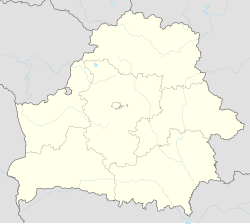

Svislach (Belarusian: Свiслач, romanized: Svislač; Russian: Свислочь; Polish: Świsłocz; Yiddish: סיסלעוויטש) is a town in Grodno Region, Belarus.[1] It serves as the administrative center of Svislach District.[1] It is connected with the town Vawkavysk by a railroad branch and with Grodno city by a highway. As of 2025, it has a population of 5,851.[1]
History
[edit]This section needs additional citations for verification. Please help improve this article by adding citations to reliable sources in this section. Unsourced material may be challenged and removed. (May 2025) (Learn how and when to remove this message) |


Within the Grand Duchy of Lithuania, Svislach was part of Nowogródek Voivodeship. In 1795, Svislach was acquired by the Russian Empire in the course of the Third Partition of Poland.
In 1927, Rabbi Chaim Yaakov Mishkinsky, whose wife Chaya was the granddaughter of Rabbi Naftali Hertz Halperin of Bialystok, was appointed the rabbi of Svislach.[citation needed] He led the community until the Nazis entered in November 1942 murdering the entire Jewish community. Prior to the war, Rabbi Mishkinsky sent his sons Yitzchak [he] and Moshe [he] to Israel (Palestine). Rabbi Mishkinsky's great-grandson, Yochanan Chaim Ivry, serves as rabbi of Toras Emes, Staten Island, NY and his great-granddaughter, Batya Yocheved Friedman serves as one of the rebbetzins in Park East Synagogue, NYC
Svislach was part of the Second Polish Republic from 1921 until 1939. In September 1939, Svislach was occupied by the Red Army and, on 14 November 1939, incorporated into the Byelorussian SSR. In 1939, there were around 3,000 Jews living in Svislach, along with refugees from western Poland who had settled there after the invasion of Poland. From June 1941 until 17 July 1944, Svislach was occupied by Nazi Germany and administered as a part of Bezirk Bialystok. In July 1941, a ghetto was established in the old Jewish neighbourhood, in the northwest of Svislach. In that area, Jews were also gathered from the village of Golobudy. It was an open ghetto, and the western border of the ghetto's territory ran near the Svislach River. On November 2, 1942, the ghetto was liquidated when the Jews were sent by train to the Vawkavysk transit camp where many massacres occurred. The remaining Jews, mostly elderly and sick, were killed in the Visnik Forest, just outside Svislach.[2]
Notable people
[edit]- Aharon Kotler (1892–1962), rabbi
- Samuel Belkin (1911–1976), rabbi
- David Lewis (Losz) (1909–1981), Canadian lawyer and federal New Democratic Party leader[3]
Notes
[edit]References
[edit]- ^ a b c d "Численность населения на 1 января 2025 г. и среднегодовая численность населения за 2024 год по Республике Беларусь в разрезе областей, районов, городов, поселков городского типа". belsat.gov.by. Archived from the original on 29 March 2025. Retrieved 8 May 2025.
- ^ "YAHAD - IN UNUM".
- ^ Smith, Cameron (1989). Unfinished Journey: The Lewis Family. Toronto: Summerhill Press. pp. 9–19, 93. ISBN 0-929091-04-3.
External links
[edit]


- Pages using gadget WikiMiniAtlas
- Articles with short description
- Short description is different from Wikidata
- Articles containing Belarusian-language text
- Articles containing Russian-language text
- Articles containing Polish-language text
- Articles containing Yiddish-language text
- Articles needing additional references from May 2025
- All articles needing additional references
- All articles with unsourced statements
- Articles with unsourced statements from July 2016
- Commons category link is on Wikidata
- All stub articles
- Coordinates on Wikidata